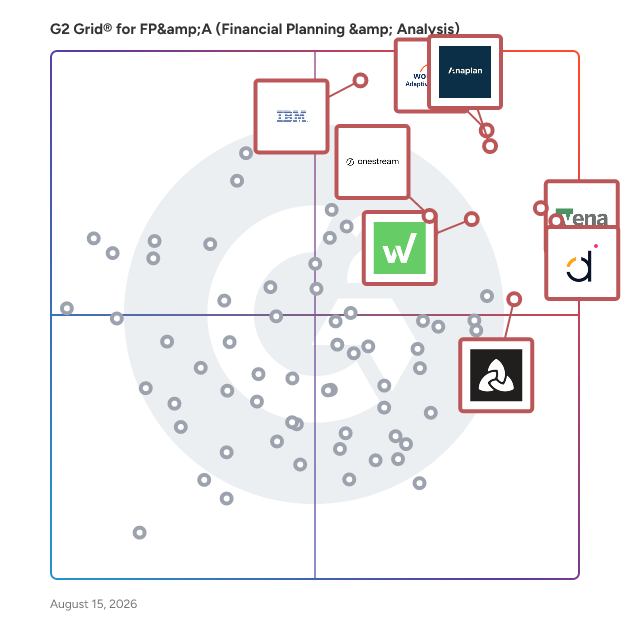
FP&A (financial planning and analysis) software enables financial analysts, managers, and CFOs to align financial management with broader business strategy through accurate planning, forecasting, and budgeting, automating workflows, linking data from disparate systems, and delivering real-time reporting to support decision-making across the organization.
Core Capabilities of FP&A Software
To qualify for inclusion in the FP&A category, a product must:
- Provide budgeting and forecasting tools
- Integrate with ERP, CRM, accounting, or other business tools
- Provide financial statements, reports, and dashboards
- Track key performance indicators (KPIs) relative to corporate business objectives
Common Use Cases for FP&A Software
Finance teams and business leaders use FP&A software to drive strategic planning and monitor financial performance. Common use cases include:
- Building and managing annual budgets and rolling forecasts
- Modeling financial scenarios to evaluate the impact of strategic decisions
- Providing executives and department heads with real-time financial visibility
How FP&A Software Differs from Other Tools
FP&A software is often used interchangeably with corporate performance management (CPM) software, as both support strategic financial decisions and monitor business performance. It typically integrates with accounting software, ERP systems, and CRM software to consolidate financial, operational, and sales data into a unified planning environment.
Insights from G2 on FP&A Software
Based on category trends on G2, real-time dashboards and scenario modeling stand out as the most valued capabilities. Time savings from automated forecasting and improved cross-functional alignment stand out as primary reasons for adoption.