# Best Experience Management Software - Page 9

  *By [Jeffrey Lin](https://research.g2.com/insights/author/jeffrey-lin)*

   Experience management software consolidates feedback from a specific, target audience and delivers actionable insights and follow-up steps to close the loop. Experience management solutions build on the features provided by [survey software](https://www.g2.com/categories/survey) and [enterprise feedback management software](https://www.g2.com/categories/enterprise-feedback-management) by adding functionality that enables businesses to plan and take informed actions based on received feedback. Specifically, these tools deploy analytics dashboards for feedback data that is viewable by stakeholders across an organization. Some products will also provide gamification features or agent-based scoring metrics to incentivize employees to leverage insights offered by the platform.

Experience management solutions can be leveraged for different use cases across a business, including customer experience (CX), B2B account experience, product experience, and market research. Though most offerings specialize in only one use case, some products will target multiple groups of respondents and allow businesses to segment their audiences. Products that specialize in CX collect customer feedback and deploy insights to frontline employees who can execute closed-loop actions based on that feedback. Products designed for B2B account experience collect client feedback and deliver insights to sales or customer success teams. Product experience solutions help product management teams collect and analyze feedback about their customers’ experiences with a product. Finally, market research solutions provide special features like research panels to enable businesses to survey their target audience.

Experience management software offers the survey development and implementation features provided by survey products and the business-focused analytics features provided by enterprise feedback management solutions. Experience management tools differ from survey and enterprise feedback management tools because they offer additional features that allow for closed-loop actions to follow up on feedback.

Based on the stacking nature of these groups of products, the Experience Management, Enterprise Feedback Management, and Survey categories are mutually exclusive to provide clarity to the exact feature sets provided by each type of software solution.

To qualify for inclusion in the Experience Management category, a product must:

- Provide all the features of an enterprise feedback management solution
- Connect with other repositories of data
- Analyze and segment experience data across all points in the customer journey
- Deliver relevant, real-time insights from feedback to relevant stakeholders
- Provide multidirectional communication channels to allow stakeholders to respond to feedback or share it with leadership
- Facilitate closed-loop action items based on respondent sentiment


## How Many Experience Management Software Products Does G2 Track?
**Total Products under this Category:** 122

### Category Stats (May 2026)
- **Average Rating**: 4.5/5 (↓0.01 vs Apr 2026)
- **New Reviews This Quarter**: 178
- **Buyer Segments**: Mid-Market 42% │ Small-Business 38% │ Enterprise 20%
- **Top Trending Product**: SupportLogic (+0.014)
*Last updated: May 18, 2026*

  
## How Does G2 Rank Experience Management Software Products?

**Why You Can Trust G2's Software Rankings:**

- 30 Analysts and Data Experts
- 25,200+ Authentic Reviews
- 122+ Products
- Unbiased Rankings

G2's software rankings are built on verified user reviews, rigorous moderation, and a consistent research methodology maintained by a team of analysts and data experts. Each product is measured using the same transparent criteria, with no paid placement or vendor influence. While reviews reflect real user experiences, which can be subjective, they offer valuable insight into how software performs in the hands of professionals. Together, these inputs power the G2 Score, a standardized way to compare tools within every category.

  
## Which Experience Management Software Is Best for Your Use Case?

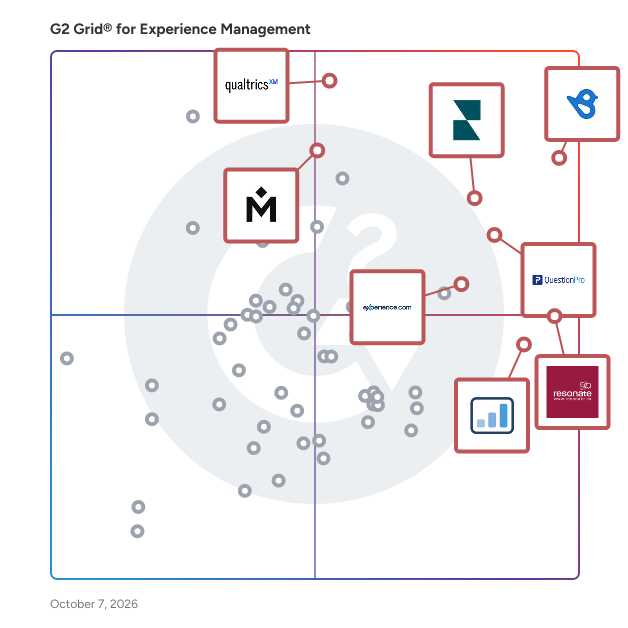
- **Leader:** [Birdeye](https://www.g2.com/products/birdeye/reviews)
- **Highest Performer:** [ReputationStacker](https://www.g2.com/products/reputationstacker/reviews)
- **Easiest to Use:** [Experience.com](https://www.g2.com/products/experience-com/reviews)
- **Top Trending:** [Resonate CX](https://www.g2.com/products/resonate-cx/reviews)
- **Best Free Software:** [Qualtrics Strategy &amp; Research](https://www.g2.com/products/qualtrics-strategy-research/reviews)

  
---

**Sponsored**

### Surveybox

Surveybox.ai is an all-in-one software solution designed to help users create surveys, gather feedback, and manage customer experiences efficiently. This platform integrates various functionalities, allowing businesses to streamline their feedback processes and gain valuable insights into customer sentiment and preferences. By harnessing the power of artificial intelligence, Surveybox.ai enables organizations to not only collect data but also analyze it effectively, making it a comprehensive tool for enhancing customer engagement. Targeted at businesses of all sizes, Surveybox.ai caters to marketing teams, customer service departments, and product managers who seek to understand their customers better. The platform is particularly useful for organizations looking to enhance their customer experience by gathering actionable feedback. Whether it’s for product development, service improvement, or customer satisfaction analysis, Surveybox.ai provides the necessary tools to facilitate these processes. Its user-friendly interface allows users to create surveys in minutes, ensuring that gathering feedback does not become a cumbersome task. One of the standout features of Surveybox.ai is its ability to automate follow-up actions based on survey responses. This means that businesses can engage with customers promptly, addressing any concerns or acknowledging positive feedback without manual intervention. The automation capabilities not only save time but also enhance the overall customer experience by ensuring timely communication. Additionally, the platform offers robust analytics tools that help users interpret the data collected, providing insights into customer sentiment and the Voice of the Customer (VoC). Surveybox.ai distinguishes itself from other survey tools through its seamless integration of various functionalities into a single platform. Users can manage their surveys, responses, and insights all in one place, which simplifies the workflow and reduces the need for multiple tools. The AI-powered features further enhance the platform&#39;s capabilities, allowing for advanced data analysis and trend identification that can inform strategic decisions. By providing a holistic view of customer feedback and experience, Surveybox.ai empowers businesses to make data-driven decisions that can lead to improved customer satisfaction and loyalty. Overall, Surveybox.ai serves as a comprehensive solution for organizations aiming to elevate their customer experience initiatives. With its combination of survey creation, feedback collection, automation, and insightful analytics, it positions itself as a valuable resource for any business looking to understand and respond to their customers effectively.


[Visit website](https://www.g2.com/external_clickthroughs/record?secure%5Bad_program%5D=ppc&amp;secure%5Bad_slot%5D=category_product_list&amp;secure%5Bcategory_id%5D=2378&amp;secure%5Bdisplayable_resource_id%5D=28&amp;secure%5Bdisplayable_resource_type%5D=Category&amp;secure%5Bmedium%5D=sponsored&amp;secure%5Bplacement_reason%5D=neighbor_category&amp;secure%5Bplacement_resource_ids%5D%5B%5D=28&amp;secure%5Bprioritized%5D=false&amp;secure%5Bproduct_id%5D=1560488&amp;secure%5Bresource_id%5D=2378&amp;secure%5Bresource_type%5D=Category&amp;secure%5Bsource_type%5D=category_page&amp;secure%5Bsource_url%5D=https%3A%2F%2Fwww.g2.com%2Fcategories%2Fexperience-management%3Fpage%3D9&amp;secure%5Btoken%5D=ecc60b2146f0ab14e53006846d5552efda56d0c39ec18bd886dffe08b4e4fe8f&amp;secure%5Burl%5D=https%3A%2F%2Fsurveybox.ai%2F&amp;secure%5Burl_type%5D=custom_url)

---

  
    ## What Is Experience Management Software?
  [Customer Service Software](https://www.g2.com/categories/customer-service)
  ## What Software Categories Are Similar to Experience Management Software?
    - [Survey Software](https://www.g2.com/categories/survey)
    - [User Research Tools](https://www.g2.com/categories/user-research)
    - [Feedback Analytics Software](https://www.g2.com/categories/feedback-analytics)

  
---

## How Do You Choose the Right Experience Management Software?

### What You Should Know About Experience Management Software

### What is Experience Management Software?

Experience management (XM) software, also known as customer experience (CX) or customer experience management (CEM or CXM) software, refers to technology that helps manage an organization’s interactions with its customers across all channels and touchpoints in the customer journey. CXM software enables businesses to collect, consolidate, and analyze customer feedback, providing actionable insights throughout the customer journey and lifecycle. With real-time, advanced analytics, experience management tools help companies understand how feedback relates to their business metrics. With these products, the most successful businesses are able to use predictive analytics to act on potential issues before they arise. Experience management software also provides tools for closed-loop actions, meaning employees are empowered to take action on optimization of customer experiences by responding to customers or prioritizing product roadmaps based on feedback.

#### What Types of Experience Management Software Exist?

All experience management solutions offer the same basic functionality. The most common use case is CX; however, some products are able to target other types of audiences for feedback concerning product experience, brand experience, and even market research. Some experience management platforms also offer features for gauging employee experiences.

1. [**Customer experience (CX)**](https://www.g2.com/categories/experience-management/f/customer-experience) **:** Most experience management solutions are designed for targeting customers for feedback at various points in the customer journey. These platforms analyze feedback and deliver insights to customer-facing employees and other relevant stakeholders so immediate actions can be taken if necessary.
2. [**B2B account experience**](https://www.g2.com/categories/experience-management/f/b2b-account-experience) **:** This enables the collection of feedback from B2B clients and accounts on their experience with a business and its products or services. It helps deliver actionable insights to relevant stakeholders, such as sales and customer success teams.
3. **Brand experience:** Experience management products with features for brand experience collect feedback concerning brand perception and brand loyalty. These insights are delivered to relevant stakeholders like marketing professionals who use the data to improve brand positioning and develop new marketing strategies.
4. [**Product experience**](https://www.g2.com/categories/experience-management/f/product-experience) **:** Product experience solutions collect customer feedback concerning their experience with a product. Insights concerning product experiences are routed to product management teams who use customer feedback to fix bugs or prioritize their roadmaps.
5. [**Market research**](https://www.g2.com/categories/experience-management/f/market-research) **:** Businesses may use experience management solutions to perform market research. These tools collect feedback from a company’s audience or target market and provide market research-specific features like panels.

### What are the Common Features of Experience Management Software?

1. **Survey management:** A core feature of experience management software is the creation and distribution of surveys to customers. These tools allow businesses to solicit customer feedback through a variety of channels, including through their website, email, SMS, or in-app messages. While some customers may prefer to receive communications via email, others may be more inclined to respond to surveys sent through SMS, so it’s important for businesses to understand their customers’ preferences when requesting feedback.
2. **Text analytics:** In customer surveys, businesses may elect to include open-ended questions. This permits users to elaborate on “yes&quot; or “no&quot; responses, identify specific issues with a product, or describe personal experiences, contributing to a wider variety and depth of data. Experience management tools use machine learning and natural language processing (NLP) to analyze these open-ended text responses. Text analytics features help organizations understand customer sentiment, uncover trends, and identify opportunities, turning their customers’ feedback into actionable insights.
3. **Net promoter score (NPS):** Experience management software allows organizations to send NPS surveys to their customers. NPS is one of the primary metrics for CX and an indicator of business growth. These surveys ask how likely the customer is to recommend the product or service to a friend or colleague on a scale of 1 to 10. NPS surveys are typically followed by an open-ended question asking customers to elaborate on their ratings. Measuring NPS on a regular basis provides businesses with key insights into brand loyalty and customer engagement.
4. **Customer satisfaction (CSAT) scores:** CSAT is another common key performance indicator (KPI) used in measuring CX. This score is calculated by asking a customer how satisfied they were with a recent transaction on a rating scale. While NPS is a high-level KPI for customer loyalty, CSAT is typically focused on a specific point in the customer journey. Customers might receive a CSAT survey after making a purchase or speaking to a customer service representative.
5. **Customer effort score (CES):** Experience management software helps businesses measure a third CX metric, the CES. This is another customer service KPI that asks customers how much effort was required for them to get an issue resolved or a request handled. Tracking CES helps an organization identify opportunities to improve customer service processes to make customer experiences more effortless and intuitive.
6. **Closed-loop actions:** In contrast to enterprise feedback management, experience management solutions offer enhanced capabilities for closing the loop on customer feedback. For example, customer service teams may be notified of a negative response to a survey; experience management software would allow an agent to respond to that customer directly through the platform. Conversely, if a response is positive, the agent may ask the customer to leave a review or send a referral. Features for closing the loop empower businesses to take immediate action on customer feedback.

### What are the Benefits of Experience Management Software?

Experience management platforms help businesses bridge the gap between the experiences they believe they are delivering to customers and the experiences customers are actually receiving. Below are a few benefits of the software:&amp;nbsp;

- **Collect feedback:** Like enterprise feedback management software, experience management tools enable organizations to collect feedback from their customers with surveys that measure NPS, CSAT, and CES. While many of these tools focus on customer service, they can be leveraged across many different areas of a business, including product development, marketing, and even human resources.&amp;nbsp;
- **Provide analysis** : By combining and analyzing customer feedback from multiple channels, experience management software offers companies a holistic view of their customers’ experiences and how those experiences are impacting the business.
- **Voice of customer (VoC)**: Organizations invest in experience management tools to support their VoC programs. VoC, which is relatively new in the field of CX, is a market research technique focused on capturing customer feedback. Experience management software is used to gather and collaborate on data related to the VoC, empowering businesses to make data-driven decisions to meet their customers’ needs and expectations.

### Who Uses Experience Management Software?

Any business with a vested interest in promoting positive customer experiences benefits from experience management software. These platforms are leveraged by organizations across many different industries, including retail, healthcare, technology, financial services, hospitality, and nonprofit.

**Customer service:** Customer support and customer success teams are some of the heaviest users of experience management software. These departments work closely with business customers and play a major role in managing customer experiences. Customer service teams use experience management software to track CX metrics with surveys that measure NPS, CSAT, and CES. These metrics help businesses understand where they are falling short and how they can improve to meet the expectations of their customers. Experience management solutions flag negative customer feedback and provide teams with tools to follow up with those customers, turning negative experiences into positive interactions. Feedback collected through experience management tools is routed directly to a company’s contact center, where agents follow up with dissatisfied customers.

**Marketing:** Most consumers rely on reviews from their peers when they make purchasing decisions. As a result, positive customer experiences are a powerful tool for promoting a company’s products and services. Experience management software allows marketing teams to capture positive reviews and feedback that are shared on social media, added to marketing materials, or used as case studies.

**Product development:** Experience management software helps inform decision making around product updates and new product development. Text analytics and advanced reporting features allow product teams to identify pain points in the user experience. With these insights, product teams are able to add functionality or introduce new features that will improve customers’ experiences with the product.

### What’s the best experience management software for small businesses?

For small businesses aiming to enhance customer satisfaction and gather actionable feedback, [top small business experience management platforms](https://www.g2.com/categories/experience-management/small-business) include:

- [Birdeye](https://www.g2.com/products/birdeye/reviews) offers an all-in-one platform for reviews, surveys, and customer feedback, helping small businesses manage their online reputation and improve customer experience.
- [SurveySparrow](https://www.g2.com/products/surveysparrow/reviews) features conversational surveys and automation capabilities, allowing small businesses to engage customers effectively and analyze feedback for continuous improvement.

### What are the top experience management platforms for SaaS companies?

For SaaS companies seeking to optimize user experience and gather product feedback, leading experience management platforms on G2 include:

- [Qualtrics CoreXM](https://www.g2.com/products/qualtrics-strategy-research-formerly-corexm/reviews) provides advanced survey tools and analytics, enabling SaaS companies to collect and act on customer insights to enhance product offerings.
- [UserTesting](https://www.g2.com/products/usertesting/reviews) offers real-time user feedback through video recordings, helping SaaS companies understand user behavior and improve usability.

### What’s the most recommended experience management software for large enterprises?

For large enterprises aiming to manage complex customer journeys and gather comprehensive feedback, leading [enterprise-level experience management platforms](https://www.g2.com/categories/experience-management/enterprise) include:

- [Medallia Experience Cloud](https://www.g2.com/products/medallia-customer-experience/reviews) provides real-time feedback and AI-driven insights, enabling enterprises to understand customer sentiments and drive improvements across touchpoints.
- [Verint](https://www.g2.com/products/verint-verint-voice-of-the-customer/reviews) delivers tools for capturing and analyzing customer feedback across channels, helping enterprises enhance customer satisfaction and loyalty.

#### Software Related to Experience Management Software

[Enterprise feedback management software](https://www.g2.com/categories/enterprise-feedback-management)[:](https://www.g2.com/categories/enterprise-feedback-management) Enterprise feedback management solutions offer similar functionality to that of experience management software. These tools enable businesses to collect, analyze, and distribute customer feedback. Businesses may use these products instead of experience management solutions if closing the loop on feedback is unnecessary or if they use another platform to follow up with customers.

[Survey software](https://www.g2.com/categories/survey)[:](https://www.g2.com/categories/survey) Survey features serve as the foundation of experience management software. Businesses, as well as non-business entities, use survey software to create and share online surveys, quizzes, polls, and web forms.

[User research software](https://www.g2.com/categories/user-research)[:](https://www.g2.com/categories/user-research) User experience (UX) and product development teams may prefer user research software over experience management tools. User research platforms enable businesses to target customers or outside audiences for in-the-moment feedback on a product or brand. User research may be conducted through surveys, interviews, and focus groups.

[Employee engagement software](https://www.g2.com/categories/employee-engagement)[:](https://www.g2.com/categories/employee-engagement) Organizations dedicated to improving the health of their business understand that it’s important to gauge employee satisfaction as well as customer satisfaction. While experience management software helps businesses collect external customer feedback, employee engagement software may be used to conduct pulse surveys and track employee feedback.

### Challenges with Experience Management Software

**Lack of adoption:** Experience management software is designed to support robust customer service programs and cross-department collaboration. If a business does not already have plans and processes in place for experience management, it may be difficult for teams within the organization to adopt such a platform. Before implementing an experience management solution, executives should examine their current processes and consider whether employee training is needed to ensure the product is adopted across the company.

### How to Buy Experience Management Software?

The complexity of an experience management solution depends on the size of the business and what a business wants to accomplish. The software can be simplified with basic features for communicating with customers or have comprehensive features that would integrate with existing platforms or software products. However, the overall reason for a business to invest in customer experience management software is to achieve better customer experience and brand loyalty. Factors that businesses should consider include:&amp;nbsp;

**Business size capability:** Small and mid-sized companies can opt for CEM software that focuses on customer interactions and highlights the internal problems that might impact customer experience, such as monitoring live chat. However, larger enterprises can opt for a robust comprehensive software that helps in managing the complexities of various departments like marketing, sales, etc.

**Communication integration:** CEM needs to integrate well with various communication methods, such as social media, emails, etc.&amp;nbsp;

**Data integration:** CEM also needs to integrate with existing platforms like customer databases, customer relationship management (CRM) software, etc.&amp;nbsp;