Best Container Engine Software

How Many Container Engine Software Products Does G2 Track?

Total Products under this Category: 23

Category Stats (Sep 2026)

  • Average Rating: 4.38/5 The average rating of products in this category, based on all submitted ratings
  • Top Trending Product: Docker (+0.04%) - Among all products in this category, Docker recorded the largest rating increase compared to last month

Last updated: September 12, 2026

How Does G2 Rank Container Engine Software Products?

Why You Can Trust G2's Software Rankings:

  • 30 Analysts and Data Experts
  • 4,100+ Authentic Reviews
  • 23+ Products
  • Unbiased Rankings

G2's software rankings are built on verified user reviews, rigorous moderation, and a consistent research methodology maintained by a team of analysts and data experts. Each product is measured using the same transparent criteria, with no paid placement or vendor influence. While reviews reflect real user experiences, which can be subjective, they offer valuable insight into how software performs in the hands of professionals. Together, these inputs power the G2 Score, a standardized way to compare tools within every category.

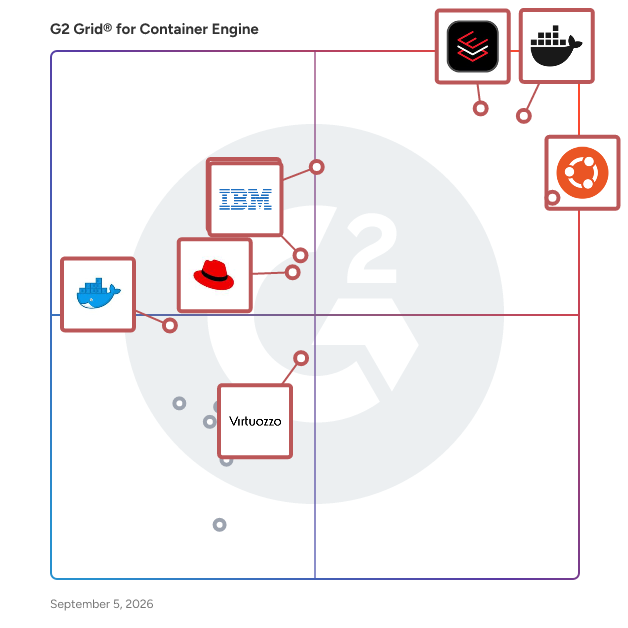
G2 Grid® for Container Engine Software

G2 Grid® for Container Engine Software plotting products by satisfaction and market presence

Highlighted products: Docker, Red Hat Enterprise Linux, Ubuntu, Oracle Cloud Infrastructure Compute, IBM WebSphere, Red Hat OpenShift Kubernetes Engine, Virtuozzo, and runc.

Underlying data: [Grid® JSON](https://www.g2.com/categories/container-engine/grids.json?focus%5B%5D=docker-inc-docker&focus%5B%5D=red-hat-enterprise-linux&focus%5B%5D=ubuntu&focus%5B%5D=oracle-cloud-infrastructure-compute&focus%5B%5D=ibm-websphere&focus%5B%5D=red-hat-openshift-kubernetes-engine&focus%5B%5D=virtuozzo&focus%5B%5D=runc)

Docker

Docker Hub is the world’s largest repository of container images with an array of content sources including container community developers, open source projects and independent software vendors (ISV) building and distributing their code in containers. Users get access to free public repositories for storing and sharing images or can choose subscription plan for private repos.

Average Rating: 4.6/5.0

Total Reviews: 295

How Do G2 Users Rate Docker?

  • Quality of Support: 8.4/10 (Category avg: 8.3/10)
  • Has the product been a good partner in doing business?: 9.2/10 (Category avg: 8.6/10)
  • Ease of Use: 8.8/10 (Category avg: 8.6/10)
  • Ease of Admin: 9.0/10 (Category avg: 8.6/10)

Who Is the Company Behind Docker?

  • Seller: Docker
  • Company Website:
  • Year Founded: 2013
  • HQ Location: San Francisco, CA
  • Twitter: @docker
    550,337 Twitter followers
  • LinkedIn® Page: www.linkedin.com
    1,071 employees on LinkedIn®

Who Uses This Product?

  • Who Uses This: Software Engineer, Senior Software Engineer
  • Top Industries: Information Technology and Services, Computer Software
  • Company Size: 40% Small, 31% Medium

What Are Recent G2 Reviews of Docker?

What Are G2 Users Discussing About Docker?

Red Hat Enterprise Linux

Red Hat Enterprise Linux (RHEL) is a enterprise operating system designed to provide a secure, stable, and high-performance environment for modern IT infrastructures. It supports a wide range of applications across physical, virtual, and cloud environments, making it a versatile choice for businesses of all sizes. Key Features and Functionality: - Security: RHEL offers live kernel patching, security profiles, and adheres to security standards certifications, ensuring a robust defense against vulnerabilities. - Consistent Lifecycle: The operating system follows a predictable lifecycle with three phases: full support, maintenance support, and an extended life phase, providing long-term stability and planning capabilities. - Cloud Integration: RHEL is optimized for cloud environments and collaborates with major cloud providers like AWS, Microsoft Azure, and Google Cloud, facilitating seamless workload migration and management. - Developer Access: Red Hat provides developers with free access to RHEL through the "Red Hat Enterprise Linux for Business Developers" platform, allowing up to 25 instances for development purposes. Primary Value and Solutions: RHEL addresses the need for a reliable and secure operating system that can handle diverse workloads across various environments. Its comprehensive security features mitigate risks, while the consistent lifecycle ensures long-term support and stability. The integration with leading cloud providers simplifies cloud adoption and management, and the provision of free developer access fosters innovation and accelerates application development. Overall, RHEL empowers organizations to build, deploy, and manage applications efficiently, aligning with business demands for production-readiness and operational excellence.

Average Rating: 4.6/5.0

Total Reviews: 933

How Do G2 Users Rate Red Hat Enterprise Linux?

  • Quality of Support: 8.8/10 (Category avg: 8.3/10)
  • Has the product been a good partner in doing business?: 8.8/10 (Category avg: 8.6/10)
  • Ease of Use: 8.4/10 (Category avg: 8.6/10)
  • Ease of Admin: 8.5/10 (Category avg: 8.6/10)

Who Is the Company Behind Red Hat Enterprise Linux?

  • Seller: Red Hat
  • Year Founded: 1993
  • HQ Location: Raleigh, NC
  • Twitter: @RedHat
    300,769 Twitter followers
  • LinkedIn® Page: www.linkedin.com
    19,487 employees on LinkedIn®

Who Uses This Product?

  • Who Uses This: Software Engineer, DevOps Engineer
  • Top Industries: Information Technology and Services, Computer Software
  • Company Size: 49% Large, 29% Medium

What Do G2 Reviewers Say About Red Hat Enterprise Linux?

AI-generated summary from verified user reviews

Pros
  • Users value the high level of security offered by Red Hat Enterprise Linux, ensuring reliable protection against threats.
  • Users value the enterprise-grade stability of Red Hat Enterprise Linux, facilitating the management of numerous VM servers.
  • Users appreciate the reliability of Red Hat Enterprise Linux, ensuring stability for automation and long-running workloads.
  • Users praise the excellent customer support of Red Hat Enterprise Linux, highlighting its availability and timely assistance.
  • Users value the RHEL compatibility that facilitates seamless integration with various services and strong community support.
Cons
  • Users find the high cost of Red Hat Enterprise Linux burdensome, especially for smaller teams and budget constraints.
  • Users find Red Hat Enterprise Linux too expensive compared to other free alternatives, impacting accessibility for smaller teams.
  • Users find usage difficult due to a steep learning curve and reliance on command line configurations.
  • Users find the outdated software can complicate tasks and frustrate those seeking a modern experience.
  • Users find the complexity of the subscription system for Red Hat Enterprise Linux to be challenging and costly.

What Are Recent G2 Reviews of Red Hat Enterprise Linux?

What Are G2 Users Discussing About Red Hat Enterprise Linux?

Ubuntu

Ubuntu is the Linux OS that’s made for everyone. Harness the freedom and creativity of open source, from laptops and workstations to servers and IoT devices Published by Canonical, Ubuntu brings you the best of open source, backed by enterprise-grade assurance. Ubuntu delivers a unified and stable experience. Ubuntu serves as an interoperable platform, from the desktop to the edge. Wherever you innovate, you can expect high-performance and the same rich tooling ecosystem. Through community and partnership, we ensure that Ubuntu is always at the cutting-edge. Open source contributors work to ensure that the latest applications, tools and libraries have a home in the Ubuntu ecosystem. Our hardware partners, such as Dell, Lenovo, HP, IBM and NVIDIA, work with us to certify Ubuntu out-of-the-box on the latest boards, devices and chipsets, through a series of over 500 OS compatibility tests per device. When the time comes to scale up, Ubuntu provides integrations to make device governance manageable. Enforce strict identity management protocols with support for Microsoft Active Directory, Entra ID and Google Cloud platform, through Ubuntu’s AuthD broker. Ubuntu’s regular release cadence empowers you to plan ahead with confidence. Across your stack, Ubuntu LTS (long-term support) releases receive 5 years of patching and maintenance as standard. Additional enterprise-grade support is delivered through Ubuntu Pro - Canonical’s comprehensive subscription for open source security. Ubuntu Pro expands security patching and maintenance for up to 12 years and includes tooling for hardening and compliance, enabling you to stay ahead of CVEs, minimize downtime and meet your regulatory requirements. This includes support for frameworks such as FIPS, DISA STIG, NIST and the Cyber Resilience Act.

Average Rating: 4.5/5.0

Total Reviews: 2,351

How Do G2 Users Rate Ubuntu?

  • Quality of Support: 8.3/10 (Category avg: 8.3/10)
  • Has the product been a good partner in doing business?: 8.7/10 (Category avg: 8.6/10)
  • Ease of Use: 8.7/10 (Category avg: 8.6/10)
  • Ease of Admin: 8.7/10 (Category avg: 8.6/10)

Who Is the Company Behind Ubuntu?

  • Seller: Canonical Ltd.
  • Year Founded: 2004
  • HQ Location: London
  • Twitter: @Canonical
    110,908 Twitter followers
  • LinkedIn® Page: www.linkedin.com
    2,067 employees on LinkedIn®

Who Uses This Product?

  • Who Uses This: Software Engineer, Senior Software Engineer
  • Top Industries: Information Technology and Services, Computer Software
  • Company Size: 48% Small, 33% Medium

What Do G2 Reviewers Say About Ubuntu?

AI-generated summary from verified user reviews

Pros
  • Users find Ubuntu's user-friendly interface enhances their experience, making it accessible even to Linux newcomers.
  • Users love Ubuntu for its lightweight efficiency and extensive compatibility, making it ideal for coding and development tasks.
  • Users love Ubuntu for its open-source nature, allowing customization and free use while ensuring robust security and stability.
  • Users appreciate the user-friendly interface of Ubuntu, finding it accessible and efficient for both new and experienced users.
  • Users praise Ubuntu for its user-friendly interface, making it accessible for both new users and experienced developers.
Cons
  • Users often face compatibility issues with software, particularly proprietary apps and graphical games, impacting their overall experience.
  • Users often face limited software availability on Ubuntu, impacting productivity and the ability to use essential applications.
  • Users often face driver issues with Ubuntu, affecting gaming, AMD chipsets, and WiFi connectivity.
  • Users often face usage difficulties without prior UNIX/Linux experience, particularly with command lines and snap management.
  • Users report performance issues with gaming, Snap packages, and overall usability, affecting their experience on Ubuntu.

What Are Recent G2 Reviews of Ubuntu?

What Are G2 Users Discussing About Ubuntu?

Oracle Cloud Infrastructure Compute

Compute options range from VMs to GPUs to bare metal servers, and includes options for dense I/O workloads, high performance computing (HPC), and AMD EPYC processors.

Average Rating: 4.1/5.0

Total Reviews: 60

How Do G2 Users Rate Oracle Cloud Infrastructure Compute?

  • Quality of Support: 8.1/10 (Category avg: 8.3/10)
  • Has the product been a good partner in doing business?: 8.1/10 (Category avg: 8.6/10)
  • Ease of Use: 8.7/10 (Category avg: 8.6/10)
  • Ease of Admin: 8.2/10 (Category avg: 8.6/10)

Who Is the Company Behind Oracle Cloud Infrastructure Compute?

  • Seller: Oracle
  • Year Founded: 1977
  • HQ Location: Austin, TX
  • Twitter: @Oracle
    827,997 Twitter followers
  • LinkedIn® Page: www.linkedin.com
    207,576 employees on LinkedIn®
  • Ownership: NYSE:ORCL

Who Uses This Product?

  • Who Uses This: Software Engineer
  • Top Industries: Information Technology and Services, Computer Software
  • Company Size: 47% Large, 29% Medium

What Are Recent G2 Reviews of Oracle Cloud Infrastructure Compute?

What Are G2 Users Discussing About Oracle Cloud Infrastructure Compute?

IBM WebSphere

IBM WebSphere Liberty and Application Server (WAS) are part of JSphere Suite for Java, a portfolio of products including application runtimes, modernization tooling, and developer productivity IDE extensions that enable you to rapidly modernize enterprise Java applications and create new cloud-native applications, with support for on-premise and major public cloud deployments; in virtual machines, containers and Kubernetes. IBM WebSphere Liberty is a next-generation, enterprise-grade application runtime that accelerates the delivery of cloud-native applications, allowing your team to rapidly deliver differentiating innovation. Whether you're running microservices in a serverless environment or a traditional always on application, Liberty requires less infrastructure, memory, and compute resources, providing the flexibility your organization needs to deploy on any cloud in a trusted, secure and open environment. Liberty empowers your development and platform engineering teams to continuously deliver code that meets and exceeds your customers' expectations. Adopt Liberty today and experience up to a 99% reduction in time to deploy code. Traditional WebSphere runtimes, include IBM WebSphere Application Server, IBM WebSphere Application Server Liberty Core, IBM WebSphere Network Deployment (WAS-ND), Reviews for any of these components can be done here.

Average Rating: 4.1/5.0

Total Reviews: 141

How Do G2 Users Rate IBM WebSphere?

  • Quality of Support: 8.4/10 (Category avg: 8.3/10)
  • Has the product been a good partner in doing business?: 8.6/10 (Category avg: 8.6/10)
  • Ease of Use: 7.9/10 (Category avg: 8.6/10)
  • Ease of Admin: 8.0/10 (Category avg: 8.6/10)

Who Is the Company Behind IBM WebSphere?

  • Seller: IBM
  • Year Founded: 1911
  • HQ Location: Armonk, New York, United States
  • Twitter: @IBMSecurity
    74,660 Twitter followers
  • LinkedIn® Page: www.linkedin.com
    344,328 employees on LinkedIn®
  • Ownership: SWX:IBM

Who Uses This Product?

  • Top Industries: Banking, Information Technology and Services
  • Company Size: 65% Large, 27% Medium

What Are Recent G2 Reviews of IBM WebSphere?

What Are G2 Users Discussing About IBM WebSphere?

Red Hat OpenShift Kubernetes Engine

Red Hat OpenShift Kubernetes Engine is an enterprise-ready Kubernetes platform that provides a foundational environment for deploying and managing containerized applications across hybrid cloud infrastructures. Built on Red Hat Enterprise Linux CoreOS, it offers automated installation, upgrades, and management functions, ensuring a consistent and secure operational experience. This solution is designed for organizations seeking a robust, security-focused Kubernetes environment to support their container orchestration needs. Key Features and Functionality: - Enterprise-Grade Kubernetes: Delivers a stable and secure Kubernetes environment with automated installers and over-the-air updates, facilitating seamless deployment and maintenance. - Automated Installation and Upgrades: Features a fully automated installer that supports deployment across various infrastructures, including popular public cloud providers and specific hardware configurations. - Integrated Core Components: Includes essential services such as monitoring, registry, networking, routing, and virtualization, all deployed using a fully automated installer. - Operator Lifecycle Management: Manages the installation, update, and lifecycle of Kubernetes Operators and their associated services across clusters, enhancing operational efficiency. - OpenShift Virtualization: Enables the running and management of virtual machine workloads alongside container workloads within the same platform, providing flexibility in workload management. - Command-Line Interfaces: Supports both `kubectl` and `oc` command-line tools, allowing administrators to interact with Kubernetes clusters effectively. - Administrator Web Console: Offers a web-based interface for administrators to visualize, browse, and manage project contents, streamlining cluster management tasks. Primary Value and Problem Solved: Red Hat OpenShift Kubernetes Engine addresses the complexities associated with deploying and managing containerized applications in hybrid cloud environments. By providing a secure, automated, and enterprise-grade Kubernetes platform, it simplifies operations, enhances security, and ensures consistency across various deployment infrastructures. This solution empowers organizations to focus on application development and innovation without the overhead of managing the underlying container orchestration platform.

Average Rating: 4.5/5.0

Total Reviews: 15

How Do G2 Users Rate Red Hat OpenShift Kubernetes Engine?

  • Quality of Support: 8.8/10 (Category avg: 8.3/10)
  • Has the product been a good partner in doing business?: 8.6/10 (Category avg: 8.6/10)
  • Ease of Use: 8.5/10 (Category avg: 8.6/10)
  • Ease of Admin: 8.3/10 (Category avg: 8.6/10)

Who Is the Company Behind Red Hat OpenShift Kubernetes Engine?

  • Seller: Red Hat
  • Year Founded: 1993
  • HQ Location: Raleigh, NC
  • Twitter: @RedHat
    300,769 Twitter followers
  • LinkedIn® Page: www.linkedin.com
    19,487 employees on LinkedIn®

Who Uses This Product?

  • Company Size: 40% Medium, 40% Large

What Are Recent G2 Reviews of Red Hat OpenShift Kubernetes Engine?

Virtuozzo

Virtuozzo, a leading hyperconverged cloud platform for service providers, ISVs, and enterprises, enables production-ready OpenStack Infrastructure-as-a-Service, multi-cloud Platform-as-a-Service, Kubernetes hosting, S3-compatible storage, cloud database management, and other cloud services. Virtuozzo liberates businesses from the complexities of IT infrastructure configuration and management, allowing them to refocus on their own growth. The cloud platform is designed for both cloud-native and traditional applications, ensuring optimized performance, rapid time-to-market, cost efficiency, and personalized support. Virtuozzo is available as public, private, hybrid, and multi-cloud software across more than 680 cloud service providers, managed service providers, and hosting providers in 84 countries.  Virtuozzo offers a suite of products & services providing best in class public, private, hybrid and multi-cloud solutions: [PRODUCTS] - High margin cloud for the channel- * Virtuozzo Hybrid Cloud - Infrastructure as a Service- * Virtuozzo Hybrid Infrastructure * Virtuozzo Cloud Storage - Platform as a Service​- * Virtuozzo Application Platform - Hosting Transformation​- * Virtuozzo Hybrid Server [MULTI-CLOUD ENABLEMENT] * Applications as a Service * Database as a Service * WordPress as a Service * Kubernetes as a Service

Average Rating: 4.4/5.0

Total Reviews: 52

How Do G2 Users Rate Virtuozzo?

  • Quality of Support: 8.3/10 (Category avg: 8.3/10)
  • Has the product been a good partner in doing business?: 8.8/10 (Category avg: 8.6/10)
  • Ease of Use: 8.7/10 (Category avg: 8.6/10)
  • Ease of Admin: 8.8/10 (Category avg: 8.6/10)

Who Is the Company Behind Virtuozzo?

  • Seller: Virtuozzo
  • Year Founded: 2015
  • HQ Location: Schaffhausen
  • Twitter: @virtuozzoinc
    3,439 Twitter followers
  • LinkedIn® Page: www.linkedin.com
    279 employees on LinkedIn®

Who Uses This Product?

  • Who Uses This: DevOps Engineer
  • Top Industries: Information Technology and Services, Computer & Network Security
  • Company Size: 62% Small, 27% Medium

What Do G2 Reviewers Say About Virtuozzo?

AI-generated summary from verified user reviews

Pros
  • Users value the affordable pricing of Virtuozzo, making advanced virtualization accessible and budget-friendly.
  • Users value the cost-effective solution of Virtuozzo, appreciating its affordability and high-quality virtualization capabilities.
  • Users find Virtuozzo's easy workload migration from other platforms to be a significant advantage for their operations.
  • Users appreciate the easy deployment of Virtuozzo, making it a convenient solution for virtualization and integration.
  • Users value the ease of use of Virtuozzo, praising its simple deployment and migration features.
Cons
  • Users find the minimum server requirement of three for cluster setup to be a limitation in flexibility.

What Are Recent G2 Reviews of Virtuozzo?

What Are G2 Users Discussing About Virtuozzo?

runc

runc is a CLI tool for spawning and running containers according to the OCI specification.

Average Rating: 4.2/5.0

Total Reviews: 11

How Do G2 Users Rate runc?

  • Quality of Support: 7.3/10 (Category avg: 8.3/10)
  • Has the product been a good partner in doing business?: 6.7/10 (Category avg: 8.6/10)
  • Ease of Use: 8.7/10 (Category avg: 8.6/10)
  • Ease of Admin: 9.2/10 (Category avg: 8.6/10)

Who Is the Company Behind runc?

  • Seller: Object Computing
  • Year Founded: 1993
  • HQ Location: Saint Louis, Missouri
  • Twitter: @ObjectComputing
    3,575 Twitter followers
  • LinkedIn® Page: www.linkedin.com
    403 employees on LinkedIn®

Who Uses This Product?

  • Company Size: 64% Small, 18% Large

What Are Recent G2 Reviews of runc?

Sandboxie

Sandboxie uses isolation technology to separate programs from your underlying operating system preventing unwanted changes from happening to your personal data, programs and applications that rest safely on your hard drive.

Average Rating: 4.6/5.0

Total Reviews: 14

How Do G2 Users Rate Sandboxie?

  • Quality of Support: 8.6/10 (Category avg: 8.3/10)
  • Has the product been a good partner in doing business?: 8.3/10 (Category avg: 8.6/10)
  • Ease of Use: 9.4/10 (Category avg: 8.6/10)
  • Ease of Admin: 8.9/10 (Category avg: 8.6/10)

Who Is the Company Behind Sandboxie?

Who Uses This Product?

  • Company Size: 43% Medium, 43% Small

What Are Recent G2 Reviews of Sandboxie?

What Are G2 Users Discussing About Sandboxie?

KubeSphere Container Platform

KubeSphere is a distributed operating system for cloud-native application management, using Kubernetes as its kernel. It provides a plug-and-play architecture, allowing third-party applications to be seamlessly integrated into its ecosystem. KubeSphere is also a multi-tenant enterprise-grade open-source Kubernetes container platform with full-stack automated IT operations and streamlined DevOps workflows. It provides developer-friendly wizard web UI, helping enterprises to build out a more robust and feature-rich Kubernetes platform, which includes the most common functionalities needed for enterprise Kubernetes strategies.

Average Rating: 4.3/5.0

Total Reviews: 12

How Do G2 Users Rate KubeSphere Container Platform?

  • Quality of Support: 8.1/10 (Category avg: 8.3/10)
  • Has the product been a good partner in doing business?: 8.3/10 (Category avg: 8.6/10)
  • Ease of Use: 9.1/10 (Category avg: 8.6/10)
  • Ease of Admin: 10.0/10 (Category avg: 8.6/10)

Who Is the Company Behind KubeSphere Container Platform?

  • Seller: KubeSphere
  • HQ Location: Hong Kong, CN
  • Twitter: @KubeSphere
    2,022 Twitter followers
  • LinkedIn® Page: www.linkedin.com
    6 employees on LinkedIn®

Who Uses This Product?

  • Company Size: 33% Large, 33% Medium

What Are Recent G2 Reviews of KubeSphere Container Platform?

What Are G2 Users Discussing About KubeSphere Container Platform?

Canonical MicroK8s

MicroK8s is pure upstream Kubernetes, not a subset. We keep it small with sensible choices that just work. That makes a quick install, with easy upgrades and great security — and leaves your options open later.

Average Rating: 4.4/5.0

Total Reviews: 17

How Do G2 Users Rate Canonical MicroK8s?

  • Quality of Support: 8.3/10 (Category avg: 8.3/10)
  • Has the product been a good partner in doing business?: 7.8/10 (Category avg: 8.6/10)
  • Ease of Use: 9.5/10 (Category avg: 8.6/10)
  • Ease of Admin: 7.9/10 (Category avg: 8.6/10)

Who Is the Company Behind Canonical MicroK8s?

  • Seller: Canonical Ltd.
  • Year Founded: 2004
  • HQ Location: London
  • Twitter: @Canonical
    110,908 Twitter followers
  • LinkedIn® Page: www.linkedin.com
    2,067 employees on LinkedIn®

Who Uses This Product?

  • Top Industries: Computer Software
  • Company Size: 59% Small, 24% Medium

What Are Recent G2 Reviews of Canonical MicroK8s?

What Are G2 Users Discussing About Canonical MicroK8s?

Apache Mesos

Apache Mesos is a cluster manager that distributes resources across applications and databases.

Average Rating: 4.2/5.0

Total Reviews: 16

How Do G2 Users Rate Apache Mesos?

  • Quality of Support: 7.8/10 (Category avg: 8.3/10)
  • Has the product been a good partner in doing business?: 7.8/10 (Category avg: 8.6/10)
  • Ease of Use: 7.4/10 (Category avg: 8.6/10)
  • Ease of Admin: 6.7/10 (Category avg: 8.6/10)

Who Is the Company Behind Apache Mesos?

Who Uses This Product?

  • Top Industries: Internet
  • Company Size: 38% Large, 38% Medium

What Are Recent G2 Reviews of Apache Mesos?

What Are G2 Users Discussing About Apache Mesos?

resinOS

resinOS is an operating system tailored for containers and designed for the unique realities of the embedded world. resinOS supports almost 20 distinct device types, has a robust networking and provisioning story, emphasizes reliability over long periods of operation, and enables a productive developer workflow. We’ve been running resinOS as part of the resin.io platform for years and are now releasing it as an independent operating system, so that others can benefit and contribute to running containers on connected devices.

Average Rating: 4.4/5.0

Total Reviews: 10

How Do G2 Users Rate resinOS?

  • Quality of Support: 8.8/10 (Category avg: 8.3/10)
  • Has the product been a good partner in doing business?: 9.4/10 (Category avg: 8.6/10)
  • Ease of Use: 8.3/10 (Category avg: 8.6/10)
  • Ease of Admin: 8.3/10 (Category avg: 8.6/10)

Who Is the Company Behind resinOS?

  • Seller: balena
  • Year Founded: 2013
  • HQ Location: London, GB
  • Twitter: @balena_io
    5,988 Twitter followers
  • LinkedIn® Page: www.linkedin.com
    73 employees on LinkedIn®

Who Uses This Product?

  • Company Size: 60% Small, 40% Medium

What Are Recent G2 Reviews of resinOS?

What Are G2 Users Discussing About resinOS?

OCI

The Open Container Initiative (OCI) is comprised of a diverse set of members that are committed to creating an open industry standard around a container image format and runtime backed by a certification program.

Average Rating: 4.3/5.0

Total Reviews: 20

How Do G2 Users Rate OCI?

  • Quality of Support: 8.2/10 (Category avg: 8.3/10)
  • Has the product been a good partner in doing business?: 8.5/10 (Category avg: 8.6/10)
  • Ease of Use: 8.0/10 (Category avg: 8.6/10)
  • Ease of Admin: 8.7/10 (Category avg: 8.6/10)

Who Is the Company Behind OCI?

  • Seller: OCI
  • Year Founded: 2018
  • HQ Location: San Francisco, US
  • Twitter: @OCI_ORG
    5,407 Twitter followers
  • LinkedIn® Page: www.linkedin.com
    2 employees on LinkedIn®

Who Uses This Product?

  • Top Industries: Computer Software, Information Technology and Services
  • Company Size: 52% Large, 30% Medium

What Are Recent G2 Reviews of OCI?

What Are G2 Users Discussing About OCI?

Flockport

Flockport is a lightweight container management and orchestration engine that lets you manage and deploy containers on single hosts and across servers. Flockport supports provisioning, overlay networks, distributed storage, service discovery, HA, a container build system and an app store.

Average Rating: 3.6/5.0

Total Reviews: 12

How Do G2 Users Rate Flockport?

  • Quality of Support: 8.5/10 (Category avg: 8.3/10)
  • Has the product been a good partner in doing business?: 8.3/10 (Category avg: 8.6/10)
  • Ease of Use: 8.9/10 (Category avg: 8.6/10)
  • Ease of Admin: 9.4/10 (Category avg: 8.6/10)

Who Is the Company Behind Flockport?

  • Seller: Flockport
  • Year Founded: 2017
  • HQ Location: Mumbai, India
  • Twitter: @flockport
    79 Twitter followers
  • LinkedIn® Page: www.linkedin.com
    2 employees on LinkedIn®

Who Uses This Product?

  • Top Industries: Computer Software
  • Company Size: 46% Small, 38% Medium

What Are Recent G2 Reviews of Flockport?

What Are G2 Users Discussing About Flockport?

Adam Crivello
AC
Researched and written by Adam Crivello
Updated October 3, 2024

Learn More About Container Engine Software

What is Container Engine Software?

Container engine software provides the infrastructure to run, manage, and execute container instances. Containers are executable software units that run on the cloud, desktop, or traditional IT systems. The container engine supports running multiple, isolated, container instances on the same OS kernel.

The container engine is responsible for many tasks in containers. This includes container creation by taking container images. Container images are built-in units that house applications, metadata, and dependencies required for a container runtime.  Most container engines use the open container initiatives (OCI) container image formats.

The software prepares the isolated environment for containers – known as provisioning – and allocates requirements for the container execution. To ensure smooth execution in isolated environments, it monitors container runtimes and enhances security, allowing set security policies and configurations as required.  

Many open-source providers offer container engine software. A command line interface (CLI) can also manage container engines, whereby instructions are given to container runtimes in the command line.

What are the Common Features of Container Engine Software?

Container engine software comes with a lot of functionalities. While every vendor might not provide all the features, here are the most common features in container engine software.

Isolation and resource management: The container engine creates new containers and isolates old ones from the operating systems. It then allocates necessary resources such as memory, CPU, and network so the container runs efficiently. 

Container creation: It creates a new container by setting up resources and pulling in a container image, a built-in unit that stores all dependencies and libraries required for the execution of containers.

Container execution: The container engine software produces the necessary container runtime environment to execute containers. It also monitors the container during execution and manages its lifecycle.

Security: Container engine solutions ensure the safety of the container by restricting access privileges and isolating containers from each other.

Integration: The container can integrate and verify compatibility with other container software.

What are the Benefits of Container Engine Software?

Container engines are an essential part of the ecosystem of container tools. They are crucial to the smooth and efficient functioning of containers. Here we list the most important benefits:

Easy deployment: Containerization engine software facilitates well-ordered-enables deployment of containers and guarantees automation across different environments.

Efficient resource utilization and automation: Container engines ensure optimal resource usage, as it makes it possible for multiple containers to run in a single operating system through isolation for execution.

Security: The container engine isolates containers for execution into namespaces and assigns restrictions on container access to provide holistic protection.

Who Uses Container Engine Software?

Companies involved in software development and deployment use the containerization engine system. 

Developers: Developers use this software to bundle cloud-native applications and execute them in the desired environment.

DevOps teams: DevOps teams utilize container engines in the continuous development/continuous deployment automation practices.

System administrators: Container engines manage the lifecycle of containers, in turn helping system administrators handle their production environments.

What are the Alternatives to Container Engine Software?

Container engine software can be replaced by this type of software, either partially or completely:

Virtual machines (VM): They provide isolations between cloud-native applications. Each VM runs its own operating system instance.

Operating system virtualization: This provides a way to isolate apps, but might be limited to some OSs. 

Software Related to Container Engine Software

Container engine software is used along with other container technology software, including:

Container orchestration tools: Container orchestration tools assist in the deployment and management of container lifecycles. They also boost security by keeping containers separate from each other.

Container management software: Container management software provides support for virtualization, resource allocation, and management of container workloads. These platforms scale containerization processes by organizing container workloads and related resources, and troubleshooting when allocation issues arise.

Container security tools: Container security software is used to protect containerized applications, related resources, container networks, nodes, and the infrastructure.

Challenges with Container Engine Software

Software solutions can come with their own set of challenges. The container engine has to work with the entire container ecosystem; if not,  security and performance issues may develop.

Security: If not correctly configured, security risks occur because containerized applications share the same kernel. Safety problems in one container's workload can affect the others. Regular updates and the right configuration are important for mitigating these risks.

Monitoring: Because they have to function properly in different environments, at the right performance levels, keeping an eye on metrics for all the running containers is arduous.

Storage: The container engine needs to connect with persistent storage and data centers to stow docs and information that are accessible without latency when containerized applications are running.

Which Companies Should Buy Container Engine Software?

Companies that are in development that use container technology should invest in container engine software.

Software development companies: Companies that use DevOps principles should buy container engine software. It lends a hand to their continuous integration/continuous deployment practices.

Cloud platform providers: By including the capabilities to run containerized apps, cloud platform providers can cater to clients who use containers in their IT landscape.

How to Buy Container Engine Software

Requirements Gathering (RFI/RFP) for Container Engine Software

The software’s ability to integrate with development lifecycle workflows, cloud infrastructure, other container software, and APIs must be considered.

Companies should take advantage if a container engine software vendor offers a free trial to evaluate the product before investing. Depending on the scope of the deployment, it might be helpful to produce an RFI, a one-page list with a few bullet points describing what a business needs from the software. 

Compare Container Engine Software Products

Create a long list

Buyers need to identify features and use cases that they need from their container engine tools, which will start them off with a large pool of software providers. Next comes evaluating the pros and cons of each product. Plenty of open-source projects provide free setups. CRI-O is an example of a community-driven container engine.

Create a short list

Short lists cross-reference the results of initial vendor evaluations with other buyer reviews on third-party review sites such as G2.com, which guide the buyer on their path to purchase. From a list of three to five products, buyers compare pricing and features to determine the best fit.

Conduct demos

Companies should try out all of the products on their shortlist. During vendor demonstrations, buyers should ask specific questions about the functionalities and use cases they care about the most. For example, they might ask the vendor to show how the container engine software tool enforces access control.

Selection of Container Engine Software

Choose a selection team

Involving the most relevant personnel is crucial during the software selection process. The team should include relevant company stakeholders who can scrutinize the software to check whether it will meet the organization’s requirements. The individuals responsible for the day-to-day use of container registry software must be a part of the selection team. 

Negotiation

The cost of the software varies based on the features offered, the number of instances, and the number of users. Buyers looking to trim costs should negotiate the specific functions that matter to them to get the best price. More often than not, the price and specifications on the vendor’s pricing page are flexible. It’s crucial to negotiate about the fees for implementation and support, as well. 

Final decision

Before deciding to purchase the software, testing it for a short period is advisable. Everyday users are the best people to perform this assessment. They can use and analyze the software product's capabilities and offer valuable feedback. In most cases, software service providers offer tutorials and a short-term product trial. If the selection team is satisfied with what the software does, the buyers can proceed with the purchase or contracting process.