Best Object Storage Solutions

How Many Object Storage Solutions Products Does G2 Track?

Total Products under this Category: 80

Category Stats (Aug 2026)

  • Average Rating: 4.4/5 The average rating of products in this category, based on all submitted ratings
  • Top Trending Product: Contabo (+5.21%) - Among all products in this category, Contabo recorded the largest rating increase compared to last month

Last updated: August 11, 2026

How Does G2 Rank Object Storage Solutions Products?

Why You Can Trust G2's Software Rankings:

  • 30 Analysts and Data Experts
  • 5,100+ Authentic Reviews
  • 80+ Products
  • Unbiased Rankings

G2's software rankings are built on verified user reviews, rigorous moderation, and a consistent research methodology maintained by a team of analysts and data experts. Each product is measured using the same transparent criteria, with no paid placement or vendor influence. While reviews reflect real user experiences, which can be subjective, they offer valuable insight into how software performs in the hands of professionals. Together, these inputs power the G2 Score, a standardized way to compare tools within every category.

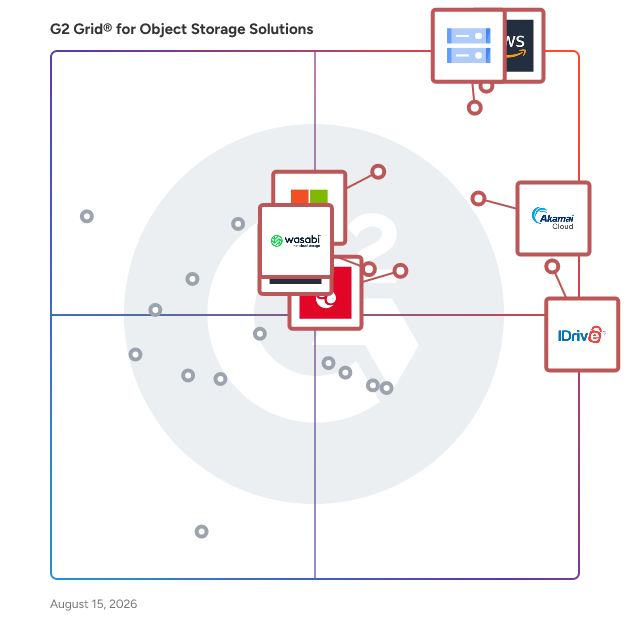
G2 Grid® for Object Storage Solutions

G2 Grid® for Object Storage Solutions plotting products by satisfaction and market presence

Highlighted products: Amazon Simple Storage Service (S3), Google Cloud Storage, IDrive Online and SaaS Backup, Object Storage e2, Akamai Cloud Computing, Azure Blob Storage, Amazon S3 Glacier, Backblaze B2 Cloud Storage, and Wasabi Object Storage.

Underlying data: [Grid® JSON](https://www.g2.com/categories/object-storage-solutions/grids.json?focus%5B%5D=amazon-simple-storage-service-s3&focus%5B%5D=google-cloud-storage&focus%5B%5D=idrive-online-and-saas-backup-object-storage-e2&focus%5B%5D=akamai-cloud-computing&focus%5B%5D=azure-blob-storage&focus%5B%5D=amazon-s3-glacier&focus%5B%5D=backblaze-b2-cloud-storage&focus%5B%5D=wasabi-object-storage)

Sponsored

Vertice

Vertice is the intelligent procurement platform built for the modern enterprise. By uniting agentic workflows, AI-powered insights, and expert buying talent, we enable finance and procurement teams in 30+ countries to operate with greater precision, speed, and impact. Customers including ARM, Blackberry, Factorial, Le Figaro and Santander use Vertice's platform to review, analyze and negotiate purchases with greater confidence. Vertice processes over $75bn in spend, with a proven track record of delivering 20%+ savings and accelerating procurement cycles by 2x. Headquartered in London and recognised in 2025 by the Financial Times as the UK’s fastest growing scale-up, Vertice also operates in New York, Sydney, Brno, Linz and Johannesburg. Learn more at www.vertice.one.

Visit website

Amazon Simple Storage Service (S3)

Amazon S3 is storage for the Internet. It is designed to make web-scale computing easier for developers. Amazon S3 provides a simple web services interface that can be used to store and retrieve any amount of data, at any time, from anywhere on the web. It gives any developer access to the same highly scalable, reliable, secure, fast, inexpensive infrastructure that Amazon uses to run its own global network of web sites. The service aims to maximize benefits of scale and to pass those benefits on to developers.

Average Rating: 4.6/5.0

Total Reviews: 841

How Do G2 Users Rate Amazon Simple Storage Service (S3)?

  • Has the product been a good partner in doing business?: 9.0/10 (Category avg: 8.6/10)
  • Interoperability: 9.1/10 (Category avg: 8.9/10)
  • Auditing: 8.6/10 (Category avg: 8.7/10)
  • Availability: 9.7/10 (Category avg: 9.4/10)

Who Is the Company Behind Amazon Simple Storage Service (S3)?

  • Seller: Amazon Web Services (AWS)
  • Year Founded: 2006
  • HQ Location: Seattle, WA
  • Twitter: @awscloud
    2,232,483 Twitter followers
  • LinkedIn® Page: www.linkedin.com
    147,094 employees on LinkedIn®
  • Ownership: NASDAQ: AMZN

Who Uses This Product?

  • Who Uses This: Software Engineer, Senior Software Engineer
  • Top Industries: Information Technology and Services, Computer Software
  • Company Size: 41% Large, 34% Medium

What Do G2 Reviewers Say About Amazon Simple Storage Service (S3)?

AI-generated summary from verified user reviews

Pros
  • Users appreciate the scalability of Amazon S3, enabling seamless data storage and access from anywhere effortlessly.
  • Users value the seamless integration of S3 with AWS services, enhancing functionality and flexibility across data management tasks.
  • Users appreciate the robust security features of Amazon S3, enhancing data protection and compliance effortlessly.
  • Users value the reliable and secure cloud storage of Amazon S3, facilitating safe and effective data management.
  • Users appreciate the ease of use of Amazon S3, making deployment and integration straightforward and efficient.
Cons
  • Users find pricing issues with S3, especially concerning high data retrieval costs and the complexity of management.
  • Users find the complex features of S3 challenging, especially regarding pricing and managing security configurations.
  • Users find the complexity of the interface challenging, requiring strong cloud knowledge for effective use.
  • Users find the pricing of S3 to be expensive, making it challenging for those with high data needs.
  • Users find the learning difficulty of AWS S3's complex setup burdensome, requiring extensive knowledge for effective use.

What Are Recent G2 Reviews of Amazon Simple Storage Service (S3)?

What Are G2 Users Discussing About Amazon Simple Storage Service (S3)?

Google Cloud Storage

Cloud Storage is a managed service for storing unstructured data, like videos and documents. It is most commonly used for data lakes for analytics, storing AI data, or web hosting. With Cloud Storage you can store any amount of data, and retrieve it as often as you like. New customers can use $300 in free credits to try Cloud Storage. All customers get 5 GiB of US regional storage free per month, not charged against your credits. If you’re a consumer or business looking for file sharing, check out Workspace products like Google Drive (https://workspace.google.com/products/drive/). If you’re looking for photo storage, use Google Photos (www.google.com/photos)

Average Rating: 4.6/5.0

Total Reviews: 564

How Do G2 Users Rate Google Cloud Storage?

  • Has the product been a good partner in doing business?: 8.9/10 (Category avg: 8.6/10)
  • Interoperability: 8.6/10 (Category avg: 8.9/10)
  • Auditing: 8.8/10 (Category avg: 8.7/10)
  • Availability: 9.4/10 (Category avg: 9.4/10)

Who Is the Company Behind Google Cloud Storage?

  • Seller: Google
  • Year Founded: 1998
  • HQ Location: Mountain View, CA
  • Twitter: @google
    31,899,995 Twitter followers
  • LinkedIn® Page: www.linkedin.com
    341,888 employees on LinkedIn®
  • Ownership: NASDAQ:GOOG

Who Uses This Product?

  • Who Uses This: Software Engineer, CTO
  • Top Industries: Information Technology and Services, Computer Software
  • Company Size: 46% Small, 29% Large

What Do G2 Reviewers Say About Google Cloud Storage?

AI-generated summary from verified user reviews

Pros
  • Users appreciate the affordability and ease of use of Google Cloud Storage, making it ideal for data management.
  • Users value the ease of use of Google Cloud Storage, effortlessly managing diverse data and launching websites.
  • Users value the strong security features of Google Cloud Storage, ensuring their files are well-protected and secure.
  • Users appreciate the excellent scalability of Google Cloud Storage, enabling easy resource adjustments for changing business demands.
  • Users value the wide-ranging features of Google Cloud Storage, which simplify data management across various applications.
Cons
  • Users find Google Cloud Storage expensive, with complicated pricing and high costs for uploads compared to alternatives.
  • Users find the storage limitations frustrating, as upgrading storage incurs additional monthly fees for more space.
  • Users find the complexity of Google Cloud Storage challenging, particularly in pricing and management for newcomers.
  • Users find the cost issues significant, noting that expenses increase with more storage in Google Cloud Storage.
  • Users find the learning difficulties with Google Cloud Storage's terminology and structure challenging, especially for newcomers.

What Are Recent G2 Reviews of Google Cloud Storage?

What Are G2 Users Discussing About Google Cloud Storage?

IDrive Online and SaaS Backup, Object Storage e2

IDrive protects all your PCs, Macs, mobile devices, Servers, your Cloud Applications Data (SAAS) including Office 365, Google Workspace and more, and provides the best in class S3 compatible Object Storage service with IDrive e2. IDrive offers many different plans for cloud backup for your devices: -IDrive Personal -IDrive Team -IDrive Small Business -IDrive Enterprise - IDrive360 EndPoint IDrive provides Cloud Applications data (SAAS) Backup: - Microsoft Office 365 Backup - Google Workspace Backup - Dropbox and Box Backup - Salesforce Backup The company's services help over 4 million customers back up over 1 Exabyte of data

Average Rating: 4.4/5.0

Total Reviews: 1,979

How Do G2 Users Rate IDrive Online and SaaS Backup, Object Storage e2?

  • Has the product been a good partner in doing business?: 9.0/10 (Category avg: 8.6/10)
  • Interoperability: 9.0/10 (Category avg: 8.9/10)
  • Auditing: 9.1/10 (Category avg: 8.7/10)
  • Availability: 9.3/10 (Category avg: 9.4/10)

Who Is the Company Behind IDrive Online and SaaS Backup, Object Storage e2?

  • Seller: IDrive
  • Year Founded: 2007
  • HQ Location: Calabasas, CA
  • Twitter: @IDriveBackup
    17,846 Twitter followers
  • LinkedIn® Page: www.linkedin.com
    134 employees on LinkedIn®

Who Uses This Product?

  • Who Uses This: Owner, President
  • Top Industries: Photography, Information Technology and Services
  • Company Size: 88% Small, 4% Medium

What Do G2 Reviewers Say About IDrive Online and SaaS Backup, Object Storage e2?

AI-generated summary from verified user reviews

Pros
  • Users appreciate the ease of use of iDrive, enjoying its straightforward setup and reliable background backups.
  • Users praise the affordable pricing of iDrive, making long-term data backup convenient and stress-free.
  • Users emphasize the affordable pricing and excellent storage capacity of iDrive, making long-term use stress-free.
  • Users find the setup process incredibly easy, allowing for quick installation and straightforward backup customization.
  • Users appreciate the daily backup frequency of iDrive, enjoying hassle-free data protection and peace of mind.
Cons
  • Users experience backup issues due to slow upload speeds and cumbersome file selection, especially during initial backups.
  • Users criticize the poor interface design of IDrive, noting it feels outdated and cumbersome for file management.
  • Users face challenges with backup failures, particularly in identifying undetected or stuck files during the backup process.
  • Users experience storage issues due to slow upload speeds and cumbersome file selection for backups and restorations.
  • Users experience slow backup times, especially for large data volumes, affecting their overall satisfaction with IDrive.

What Are Recent G2 Reviews of IDrive Online and SaaS Backup, Object Storage e2?

What Are G2 Users Discussing About IDrive Online and SaaS Backup, Object Storage e2?

Akamai Cloud Computing

Akamai Cloud Computing is a platform and broad set of distributed cloud and edge computing services to help businesses build, deploy, and manage applications and workloads on the world’s most distributed network. Akamai’s distributed cloud computing platform is designed for developers and built by developers. The platform empowers developers to build apps and APIs using open standards designed to maximize portability and avoid lock-in. With core, distributed, and edge services, developers can choose where to deploy and scale compute, data, and security services, based on business needs.

Average Rating: 4.6/5.0

Total Reviews: 387

How Do G2 Users Rate Akamai Cloud Computing?

  • Has the product been a good partner in doing business?: 9.2/10 (Category avg: 8.6/10)
  • Interoperability: 9.4/10 (Category avg: 8.9/10)
  • Auditing: 8.7/10 (Category avg: 8.7/10)
  • Availability: 9.6/10 (Category avg: 9.4/10)

Who Is the Company Behind Akamai Cloud Computing?

  • Seller: Akamai Technologies
  • Company Website:
  • Year Founded: 1998
  • HQ Location: Cambridge, MA
  • Twitter: @Akamai
    115,251 Twitter followers
  • LinkedIn® Page: www.linkedin.com
    10,552 employees on LinkedIn®

Who Uses This Product?

  • Who Uses This: Software Engineer, Founder
  • Top Industries: Information Technology and Services, Computer Software
  • Company Size: 67% Small, 15% Medium

What Do G2 Reviewers Say About Akamai Cloud Computing?

AI-generated summary from verified user reviews

Pros
  • Users appreciate the ease of use of Akamai Cloud Computing, highlighting its intuitive dashboard and user-friendly tools.
  • Users appreciate the affordable pricing of Akamai Cloud Computing, enjoying cost-effective solutions without compromising on performance.
  • Users love the user-friendly setup and intuitive interface of Akamai Cloud Computing, making deployment seamless and efficient.
  • Users find the setup ease of Akamai Cloud Computing exceptional, enabling quick implementation and customization for their projects.
  • Users praise the easy setup of Akamai Cloud Computing, enabling quick start and efficient use of resources.
Cons
  • Users find Akamai Cloud Computing expensive, desiring more affordable options for dedicated and storage-oriented servers.
  • Users are frustrated by the limited features of Akamai Cloud Computing, wishing for more options on the platform.
  • Users find the complex setup of Akamai Cloud Computing challenging, leading to extended installation times and frustrations.
  • Users report a difficult setup process for Akamai Cloud Computing, leading to delays and confusion during initial configuration.
  • Users find the missing features in Akamai Cloud Computing limiting, wishing for more variety and options.

What Are Recent G2 Reviews of Akamai Cloud Computing?

What Are G2 Users Discussing About Akamai Cloud Computing?

Azure Blob Storage

Azure Blob Storage is Microsoft's cloud-based object storage solution designed to handle vast amounts of unstructured data, such as text and binary files. It is optimized for scenarios like serving images or documents directly to browsers, streaming video and audio, storing backups, and archiving data. Key Features and Functionality: - Scalability and Durability: Azure Blob Storage offers high scalability and durability, ensuring data is stored reliably and can be accessed as needed. - Security: It provides robust security measures, including authentication with Microsoft Entra ID (formerly Azure Active Directory), role-based access control (RBAC), encryption at rest, and advanced threat protection. - Data Management: The service includes end-to-end lifecycle management, policy-based access control, and immutable storage options, facilitating comprehensive data governance. - Integration with Data Lakes: Azure Blob Storage supports Azure Data Lake Storage Gen2, enabling the creation of data lakes for analytics and big data processing. - Multiple Storage Tiers: It offers various storage tiers—Premium, Hot, Cool, and Archive—allowing cost optimization based on data access patterns. Primary Value and Solutions Provided: Azure Blob Storage addresses the need for a scalable, secure, and cost-effective solution for storing unstructured data in the cloud. It enables organizations to build powerful cloud-native and mobile applications, create data lakes for analytics, and implement efficient backup and disaster recovery strategies. By offering multiple storage tiers and robust security features, Azure Blob Storage helps businesses optimize costs while ensuring data availability and protection.

Average Rating: 4.6/5.0

Total Reviews: 103

How Do G2 Users Rate Azure Blob Storage?

  • Has the product been a good partner in doing business?: 9.3/10 (Category avg: 8.6/10)
  • Interoperability: 8.6/10 (Category avg: 8.9/10)
  • Auditing: 8.5/10 (Category avg: 8.7/10)
  • Availability: 9.2/10 (Category avg: 9.4/10)

Who Is the Company Behind Azure Blob Storage?

  • Seller: Microsoft
  • Year Founded: 1975
  • HQ Location: Redmond, Washington
  • Twitter: @microsoft
    13,091,739 Twitter followers
  • LinkedIn® Page: www.linkedin.com
    231,632 employees on LinkedIn®
  • Ownership: MSFT

Who Uses This Product?

  • Top Industries: Information Technology and Services, Computer Software
  • Company Size: 44% Large, 34% Medium

What Do G2 Reviewers Say About Azure Blob Storage?

AI-generated summary from verified user reviews

Pros
  • Users commend the great availability of storage services and fast performance of Azure Blob Storage.
  • Users highlight the exceptional scalability of Azure Blob Storage, effortlessly accommodating large workloads and ensuring consistent data access.
  • Users find Azure Blob Storage to be extremely easy to implement and manage, enhancing their overall experience effortlessly.
  • Users appreciate the wide range of integrated features in Azure Blob Storage, enhancing project management and scalability.
  • Users appreciate the simplicity and ease of use of Azure Services, making it accessible even for beginners.
Cons
  • Users find Azure Blob Storage expensive, especially for the hot tier, affecting its economic viability and performance.
  • Users find the complexity of Azure Blob Storage challenging, requiring extensive training and support to navigate effectively.
  • Users find the complex setup of Azure Blob Storage challenging, particularly regarding access control and pricing tiers.
  • Users find cost issues with Azure Blob Storage, citing high expenses and poor performance for the services offered.
  • Users find Azure Blob Storage has a steep learning curve, necessitating extensive training and resources before use.

What Are Recent G2 Reviews of Azure Blob Storage?

What Are G2 Users Discussing About Azure Blob Storage?

Amazon S3 Glacier

Amazon Glacier is a secure, durable, and extremely low-cost cloud storage service for data archiving and long-term backup. It is designed to deliver 99.999999999% durability, and provides comprehensive security and compliance capabilities that can help meet even the most stringent regulatory requirements. Amazon Glacier provides query-in-place functionality, allowing you to run powerful analytics directly on your archive data at rest. Customers can store data for as little as $0.004 per gigabyte per month, a significant savings compared to on-premises solutions. To keep costs low yet suitable for varying retrieval needs, Amazon Glacier provides three options for access to archives, from a few minutes to several hours.

Average Rating: 4.5/5.0

Total Reviews: 127

How Do G2 Users Rate Amazon S3 Glacier?

  • Has the product been a good partner in doing business?: 8.6/10 (Category avg: 8.6/10)
  • Interoperability: 8.9/10 (Category avg: 8.9/10)
  • Auditing: 9.1/10 (Category avg: 8.7/10)
  • Availability: 9.5/10 (Category avg: 9.4/10)

Who Is the Company Behind Amazon S3 Glacier?

  • Seller: Amazon Web Services (AWS)
  • Year Founded: 2006
  • HQ Location: Seattle, WA
  • Twitter: @awscloud
    2,232,483 Twitter followers
  • LinkedIn® Page: www.linkedin.com
    147,094 employees on LinkedIn®
  • Ownership: NASDAQ: AMZN

Who Uses This Product?

  • Who Uses This: Software Engineer, DevOps Engineer
  • Top Industries: Information Technology and Services, Computer Software
  • Company Size: 38% Small, 33% Large

What Do G2 Reviewers Say About Amazon S3 Glacier?

AI-generated summary from verified user reviews

Pros
  • Users appreciate the affordability of Amazon S3 Glacier, enjoying significant cost savings for secure long-term data storage.
  • Users value the data security of Amazon S3 Glacier, ensuring durability and compliance for long-term archival needs.
  • Users appreciate the easy integrations of Amazon S3 Glacier with other AWS services for seamless data management.
  • Users appreciate the cost-effective and durable storage of Amazon S3 Glacier, ensuring secure long-term data archiving.
  • Users value the high reliability of Amazon S3 Glacier, ensuring data durability and security for long-term archiving.
Cons
  • Users find high retrieval costs and confusing pricing structures in S3 Glacier, complicating their budgeting and retrieval management.
  • Users find slow data retrieval from Amazon S3 Glacier frustrating, often leading to confusion over options and costs.
  • Users find the pricing transparency issues with Amazon S3 Glacier confusing, leading to unexpected costs and concerns.
  • Users find the slow retrieval speed of Amazon S3 Glacier frustrating compared to standard S3 buckets.
  • Users find the unclear instructions regarding retrieval options and pricing of S3 Glacier frustrating and confusing.

What Are Recent G2 Reviews of Amazon S3 Glacier?

What Are G2 Users Discussing About Amazon S3 Glacier?

Backblaze B2 Cloud Storage

Backblaze B2 is S3 compatible cloud object storage built purposefully to unlock budgets, unburden administrators, and unleash innovators. Delivering performance at 1/5 the cost including free egress up to 3x monthly storage, it’s the easy choice for more than 85,000 organizations including Patagonia, UCLA, Fortune, and Streamlabs for backup, active archive, and application storage needs. Together with technology partners, Backblaze B2 helps customers break free from restrictive, overpriced legacy providers that hold them back, and blaze forward with the full power of the open cloud in their hands.

Average Rating: 4.6/5.0

Total Reviews: 114

How Do G2 Users Rate Backblaze B2 Cloud Storage?

  • Has the product been a good partner in doing business?: 8.9/10 (Category avg: 8.6/10)
  • Interoperability: 6.7/10 (Category avg: 8.9/10)
  • Auditing: 9.2/10 (Category avg: 8.7/10)
  • Availability: 9.3/10 (Category avg: 9.4/10)

Who Is the Company Behind Backblaze B2 Cloud Storage?

  • Seller: Backblaze
  • Company Website:
  • Year Founded: 2007
  • HQ Location: San Mateo, California
  • Twitter: @backblaze
    17,828 Twitter followers
  • LinkedIn® Page: www.linkedin.com
    377 employees on LinkedIn®

Who Uses This Product?

  • Who Uses This: Owner
  • Top Industries: Information Technology and Services, Computer Software
  • Company Size: 71% Small, 18% Medium

What Do G2 Reviewers Say About Backblaze B2 Cloud Storage?

AI-generated summary from verified user reviews

Pros
  • Users appreciate the affordable pricing of Backblaze B2 Cloud Storage, finding it excellent value for their backup needs.
  • Users value the reliable performance of Backblaze B2 Cloud Storage, ensuring peace of mind with their data safety.
  • Users appreciate the ease of use of Backblaze B2, enjoying seamless integration and intuitive setup for backups.
  • Users appreciate the easy setup of Backblaze B2, finding it seamless for backups and integration with existing tools.
  • Users appreciate the affordable and reliable storage capacity of Backblaze B2, ensuring easy access and security for their data.
Cons
  • Users find the poor interface design challenging, particularly for those unfamiliar with cloud storage concepts.
  • Users find navigation poor on Backblaze B2, as browsing and accessing advanced features can be cumbersome.
  • Users face storage issues with Backblaze B2, such as limited data center locations and challenging file retrieval.
  • Users find storage limitations with Backblaze B2, especially for occasional users lacking offline options or better compatibility.
  • Users face backup issues, finding it difficult to erase buckets and retrieve files efficiently from Backblaze B2.

What Are Recent G2 Reviews of Backblaze B2 Cloud Storage?

What Are G2 Users Discussing About Backblaze B2 Cloud Storage?

Wasabi Object Storage

Wasabi Hot Cloud Storage is simple, fast, and affordable cloud object storage. There are no archival or warm storage tiers to deal with–it’s just one tier of highly secure, low-latency storage that’s as fast or faster than the hyperscalers’ most expensive frequent-access tiers, yet priced closer to what you’d expect to pay for slower archive storage. This makes Wasabi the ideal storage target for a wide variety of use cases, from active archives to offsite backups, to hybrid cloud storage. Best of all, there are no additional fees for egress of API calls, so you get straightforward pricing that eliminates the guesswork associated with using AWS S3 and other hyperscale storage services and free cloud storage providers.

Average Rating: 4.4/5.0

Total Reviews: 64

How Do G2 Users Rate Wasabi Object Storage?

  • Has the product been a good partner in doing business?: 8.9/10 (Category avg: 8.6/10)
  • Interoperability: 9.3/10 (Category avg: 8.9/10)
  • Auditing: 8.8/10 (Category avg: 8.7/10)
  • Availability: 9.3/10 (Category avg: 9.4/10)

Who Is the Company Behind Wasabi Object Storage?

  • Seller: Wasabi
  • Year Founded: 2017
  • HQ Location: Boston, Massachusetts, United States
  • Twitter: @wasabi_cloud
    6,535 Twitter followers
  • LinkedIn® Page: www.linkedin.com
    577 employees on LinkedIn®

Who Uses This Product?

  • Top Industries: Information Technology and Services, Computer & Network Security
  • Company Size: 49% Medium, 38% Small

What Do G2 Reviewers Say About Wasabi Object Storage?

AI-generated summary from verified user reviews

Pros
  • Users appreciate the affordable pricing of Wasabi Object Storage, which enhances cost-effectiveness for various storage needs.
  • Users love the affordable pricing of Wasabi, appreciating its simplicity and predictability for storage solutions.
  • Users value the affordable and predictable pricing of Wasabi Object Storage, enhancing their storage experience significantly.
  • Users value the affordability of Wasabi Object Storage, appreciating its low costs and predictable pricing structure.
  • Users value the automatic backup feature of Wasabi Object Storage, ensuring reliable and hassle-free data protection.
Cons
  • Users report backup issues with Wasabi, noting data loss during outages and inadequate support for critical needs.
  • Users report data deletion issues with Wasabi, causing concern over data reliability and prompting migration to other services.
  • Users find Wasabi has limited functionality for managing frequently changing files, affecting their overall storage experience.
  • Users find the limited storage capacity restrictive, affecting flexibility for managing frequently changing files.
  • Users experience poor customer support with Wasabi, often facing slow response times that hinder troubleshooting efforts.

What Are Recent G2 Reviews of Wasabi Object Storage?

What Are G2 Users Discussing About Wasabi Object Storage?

DigitalOcean Spaces

Spaces Object Storage complements local storage to help your business scale. Make data storage and delivery easy, reliable and affordable with our S3-compatible object storage, including a built-in Content Delivery Network (CDN).

Average Rating: 4.4/5.0

Total Reviews: 42

How Do G2 Users Rate DigitalOcean Spaces?

  • Has the product been a good partner in doing business?: 9.3/10 (Category avg: 8.6/10)
  • Auditing: 6.7/10 (Category avg: 8.7/10)
  • Availability: 10.0/10 (Category avg: 9.4/10)

Who Is the Company Behind DigitalOcean Spaces?

  • Seller: DigitalOcean
  • Year Founded: 2012
  • HQ Location: New York
  • Twitter: @digitalocean
    221,611 Twitter followers
  • LinkedIn® Page: www.linkedin.com
    2,438 employees on LinkedIn®
  • Ownership: NYSE: DOCN

Who Uses This Product?

  • Who Uses This: Software Engineer
  • Top Industries: Computer Software, Information Technology and Services
  • Company Size: 69% Small, 20% Medium

What Do G2 Reviewers Say About DigitalOcean Spaces?

AI-generated summary from verified user reviews

Pros
  • Users highlight the affordability of DigitalOcean Spaces, finding it a cost-effective alternative to AWS S3.
  • Users value the affordability of DigitalOcean Spaces, finding it cost-effective and convenient compared to alternatives like AWS S3.
  • Users value the affordable pricing of DigitalOcean Spaces, finding it cost-effective and convenient compared to alternatives like AWS S3.
  • Users highlight the ease of use of DigitalOcean Spaces, making file management simple for everyone.
  • Users find the management ease of DigitalOcean Spaces beneficial, simplifying file handling and privacy settings for all.

What Are Recent G2 Reviews of DigitalOcean Spaces?

What Are G2 Users Discussing About DigitalOcean Spaces?

Azure Kubernetes Services

Azure Kubernetes Service (AKS) is a fully managed container orchestration service provided by Microsoft Azure, designed to simplify the deployment, management, and scaling of containerized applications using Kubernetes. By automating complex tasks such as cluster provisioning, upgrades, and monitoring, AKS enables developers to focus on building and maintaining applications without the operational overhead of managing Kubernetes infrastructure. Key Features and Functionality: - Managed Kubernetes Control Plane: AKS handles the Kubernetes control plane, including health monitoring and maintenance, allowing users to manage only the agent nodes. - Scalability: Easily scale applications and resources to meet changing demands with support for horizontal pod autoscaling, cluster autoscaling, and manual scaling. - Integrated Azure Services: Seamless integration with Azure services such as Azure Active Directory, Azure Monitor, Azure Policy, and Azure DevOps provides a comprehensive cloud-based solution for container management. - Security and Compliance: Built-in security features include role-based access control (RBAC), private clusters, and Azure Private Link for secure communication, ensuring compliance with various industry standards. - DevOps and CI/CD Integration: Supports integration with popular DevOps and CI/CD tools like Jenkins, GitLab, and Azure Pipelines, simplifying the deployment and management of containerized applications. Primary Value and Problem Solved: AKS addresses the challenges of deploying and managing containerized applications by providing a fully managed Kubernetes environment. It reduces the complexity and operational burden associated with Kubernetes cluster management, enabling organizations to accelerate application development and deployment. By integrating with Azure's ecosystem, AKS offers a secure, scalable, and efficient platform for running modern applications, allowing businesses to focus on innovation rather than infrastructure management.

Average Rating: 4.5/5.0

Total Reviews: 20

How Do G2 Users Rate Azure Kubernetes Services?

  • Has the product been a good partner in doing business?: 8.3/10 (Category avg: 8.6/10)
  • Interoperability: 8.0/10 (Category avg: 8.9/10)
  • Auditing: 8.6/10 (Category avg: 8.7/10)
  • Availability: 9.0/10 (Category avg: 9.4/10)

Who Is the Company Behind Azure Kubernetes Services?

  • Seller: Microsoft
  • Year Founded: 1975
  • HQ Location: Redmond, Washington
  • Twitter: @microsoft
    13,091,739 Twitter followers
  • LinkedIn® Page: www.linkedin.com
    231,632 employees on LinkedIn®
  • Ownership: MSFT

Who Uses This Product?

  • Top Industries: Computer Software
  • Company Size: 50% Small, 30% Medium

What Do G2 Reviewers Say About Azure Kubernetes Services?

AI-generated summary from verified user reviews

Pros
  • Users appreciate the ease of setup with Azure Kubernetes Services, allowing quick deployment and effortless load balancer activation.
  • Users appreciate the easy setup of Azure Kubernetes Services, allowing for quick deployment with minimal effort.
Cons
  • Users find Azure Kubernetes Services to be expensive, as costs are a significant factor in their experience.
  • Users find that pricing issues with Azure Kubernetes Services can make it a costly option for cloud solutions.

What Are Recent G2 Reviews of Azure Kubernetes Services?

zStorage

Zadara is a leading provider of AI edge clouds, delivering a groundbreaking distributed cloud platform purpose-built for sovereign AI applications. Zadara platform powers advanced AI capabilities with the simplicity, agility, and flexibility of cloud computing while ensuring seamless multi-tenancy through fully automated, end-to-end provisioning of compute, storage, and networking resources. With over 500 edge cloud locations worldwide and the ability to deploy a full-scale cloud infrastructure anywhere, Zadara is uniquely equipped to meet the specialized requirements of sovereign AI workloads. Its solution ensures complete data privacy and security, adhering to stringent compliance standards while enabling both AI model training and AI real-time inference directly at the edge—ideal for service providers and modern enterprises. Zadara’s fully-managed clouds are designed to accommodate any workload, anywhere – whether on-premises, hybrid, multi-cloud or at the edge. Zadara’s cloud platform features a consumption-based pricing model with zero data egress fees, offering cost-effective scalability without hidden charges. Since 2011, Zadara has operated worldwide with a highly skilled team that provides 24/7 follow-the-sun support and services. Zadara is headquartered in Irvine, California.

Average Rating: 4.3/5.0

Total Reviews: 26

How Do G2 Users Rate zStorage?

  • Has the product been a good partner in doing business?: 9.0/10 (Category avg: 8.6/10)
  • Interoperability: 9.7/10 (Category avg: 8.9/10)
  • Auditing: 9.0/10 (Category avg: 8.7/10)
  • Availability: 9.4/10 (Category avg: 9.4/10)

Who Is the Company Behind zStorage?

  • Seller: ZADARA
  • Year Founded: 2011
  • HQ Location: Irvine, California
  • Twitter: @Zadara
    2,487 Twitter followers
  • LinkedIn® Page: www.linkedin.com
    210 employees on LinkedIn®

Who Uses This Product?

  • Top Industries: Information Technology and Services
  • Company Size: 54% Small, 35% Medium

What Do G2 Reviewers Say About zStorage?

AI-generated summary from verified user reviews

Pros
  • Users commend the excellent customer support of zStorage, valuing quick responses and helpful staff.
  • Users appreciate the ease of use of zStorage, enjoying straightforward management and excellent support throughout.
  • Users appreciate the affordability of zStorage, enjoying a cost-effective pay-as-you-go model for flexible storage solutions.
  • Users appreciate the centralized management of zStorage, allowing for effortless maintenance and scalability in varied environments.
  • Users appreciate the remarkable performance of zStorage, offering outstanding speed and flexibility for diverse storage needs.
Cons
  • Users note the limited customization options in zStorage, which can hinder advanced configurations and flexibility.
  • Users note the limited features of zStorage, especially with its management GUI and necessary command line operations.
  • Users find zStorage has limited functionality due to restricted management features and fewer integrations compared to competitors.
  • Users experience slow performance with zStorage, leading to potential downtime and lack of timely alerts.
  • Users face data deletion issues with zStorage, as manual deletion is limited and often requires command line use.

What Are Recent G2 Reviews of zStorage?

What Are G2 Users Discussing About zStorage?

E2E Cloud

E2E Cloud, Meity Empanelled and NSE-Listed AI-First Hyperscaler [NSE:E2E] is a cloud service provider that helps users deploy, manage, and scale high-performance computing resources, particularly for AI/ML applications and data-intensive workloads. It is designed to serve startups, developers, data scientists, enterprises, and public sector organisations with cost-effective and scalable cloud solutions.

Average Rating: 4.8/5.0

Total Reviews: 130

How Do G2 Users Rate E2E Cloud?

  • Has the product been a good partner in doing business?: 9.5/10 (Category avg: 8.6/10)
  • Interoperability: 9.2/10 (Category avg: 8.9/10)
  • Auditing: 8.9/10 (Category avg: 8.7/10)
  • Availability: 9.6/10 (Category avg: 9.4/10)

Who Is the Company Behind E2E Cloud?

  • Seller: E2E Networks
  • Year Founded: 2009
  • HQ Location: New Delhi, IN
  • Twitter: @e2enetworks
    3,448 Twitter followers
  • LinkedIn® Page: www.linkedin.com
    255 employees on LinkedIn®
  • Ownership: E2E (NSE)

Who Uses This Product?

  • Who Uses This: Founder, Director
  • Top Industries: Computer Software, Information Technology and Services
  • Company Size: 73% Small, 26% Medium

What Do G2 Reviewers Say About E2E Cloud?

AI-generated summary from verified user reviews

Pros
  • Users value the cost-effective GPU instances from E2E Cloud, combining affordability with high-quality performance and support.
  • Users commend the excellent customer support from E2E Cloud, appreciating quick and effective assistance for their needs.
  • Users value the affordable pricing of E2E Cloud, which enables cost-effective yet powerful GPU computing solutions.
  • Users highlight the user-friendly interface of E2E Cloud, making management and deployment seamless and efficient.
  • Users praise excellent support and performance from E2E Cloud, highlighting competitive pricing and efficient GPU machines.
Cons
  • Users find the poor customer support frustrating, often leading to delays and complicating their experience with E2E Cloud.
  • Users find the interface issues of E2E Cloud frustrating, noting the outdated and classic dashboard design needing improvement.
  • Users face resource limitations with E2E Cloud, including non-availability of services and confusing billing systems.
  • Users find the poor interface design of E2E Cloud outdated, suggesting significant room for improvement.
  • Users find the poor UI of E2E Cloud outdated and in need of significant improvement for better usability.

What Are Recent G2 Reviews of E2E Cloud?

Impossible Cloud

Impossible Cloud, headquartered in Hamburg (Germany), is one of Europe’s leading providers of S3-compatible object storage. Enterprises from all over the world already rely on the GDPR-compliant solution to securely store, archive, and manage their data in certified data centers that meet the highest security standards. Whether for backup, disaster recovery, tape-to-cloud, or ransomware protection, Impossible Cloud empowers digital sovereignty with full data control, seamless integration, intuitive handling, and future-proof technology.

Average Rating: 4.6/5.0

Total Reviews: 10

How Do G2 Users Rate Impossible Cloud?

  • Has the product been a good partner in doing business?: 9.2/10 (Category avg: 8.6/10)
  • Availability: 10.0/10 (Category avg: 9.4/10)

Who Is the Company Behind Impossible Cloud?

Who Uses This Product?

  • Company Size: 70% Small, 30% Medium

What Are Recent G2 Reviews of Impossible Cloud?

Cloudian HyperStore

Cloudian is revolutionizing software defined object storage storage for enterprises with its exabyte-scalable data platform, designed to meet the demands of today’s data-intensive AI and analytics workloads. By bringing cloud-native S3 storage technology to on-premises and hybrid environments, we’re enabling organizations to build agile, efficient, secure, cost-effective, future-proof data infrastructures.

Average Rating: 4.7/5.0

Total Reviews: 12

How Do G2 Users Rate Cloudian HyperStore?

  • Has the product been a good partner in doing business?: 10.0/10 (Category avg: 8.6/10)
  • Interoperability: 10.0/10 (Category avg: 8.9/10)
  • Auditing: 10.0/10 (Category avg: 8.7/10)
  • Availability: 10.0/10 (Category avg: 9.4/10)

Who Is the Company Behind Cloudian HyperStore?

  • Seller: Cloudian
  • Year Founded: 2011
  • HQ Location: San Mateo, CA
  • Twitter: @CloudianStorage
    3,462 Twitter followers
  • LinkedIn® Page: www.linkedin.com
    185 employees on LinkedIn®

Who Uses This Product?

  • Company Size: 38% Large, 38% Medium

What Do G2 Reviewers Say About Cloudian HyperStore?

AI-generated summary from verified user reviews

Pros
  • Users appreciate the automation capabilities of Cloudian HyperStore, seamlessly integrating with existing cloud-native applications and enhancing efficiency.
  • Users value the seamless cloud integration of Cloudian HyperStore, enhancing compatibility with existing cloud-native applications effortlessly.
  • Users value the easy integrations of Cloudian HyperStore, enhancing efficiency in existing backup workflows and scaling effortlessly.
  • Users value the deployment flexibility of Cloudian HyperStore, seamlessly integrating with various cloud environments and applications.
  • Users value the easy scalability of Cloudian HyperStore, enabling seamless data capacity expansion as needs grow.
Cons
  • Users find the outdated interface of Cloudian HyperStore frustrating, needing improvements and better documentation for advanced configurations.
  • Users find the poor documentation challenging, particularly for advanced configurations that need better support and guidance.
  • Users find the navigation poor, as the interface for monitoring requires extra steps to access important details.

What Are Recent G2 Reviews of Cloudian HyperStore?

Hitachi Content Platform

Hitachi Content Platform (HCP) is an object storage software solution that connects data producers, users, applications and devices into a central cloud storage

Average Rating: 4.7/5.0

Total Reviews: 11

How Do G2 Users Rate Hitachi Content Platform?

  • Has the product been a good partner in doing business?: 9.2/10 (Category avg: 8.6/10)
  • Interoperability: 10.0/10 (Category avg: 8.9/10)
  • Auditing: 9.7/10 (Category avg: 8.7/10)
  • Availability: 9.7/10 (Category avg: 9.4/10)

Who Is the Company Behind Hitachi Content Platform?

  • Seller: Hitachi Vantara
  • HQ Location: Santa Clara, CA
  • Twitter: @HitachiVantara
    28,391 Twitter followers
  • LinkedIn® Page: www.linkedin.com
    10,547 employees on LinkedIn®

Who Uses This Product?

  • Company Size: 55% Large, 27% Small

What Are Recent G2 Reviews of Hitachi Content Platform?

What Are G2 Users Discussing About Hitachi Content Platform?

Rachana Hasyagar
RH
Researched and written by Rachana Hasyagar
Updated November 6, 2024

Learn More About Object Storage Solutions

Object storage is a software architecture used to handle large amounts of unstructured data. Under object storage, data is stored as discrete units or objects within a data-connected environment. Each discrete storage unit contains the data being stored since it is the data repository, the metadata (information describing the object), and a globally unique identifier or ID number, allowing applications to access the unit when required. Each object is then aggregated under storage pools with several other objects, allowing for an unlimited scale of storage.

An application programming interface (API) is used to access each object. These APIs are used to create a query for the object’s metadata. The metadata is used to locate the desired object via the internet from any device and from any location. The native API used is an HTTP-based RESTful API. Some of the HTTP commands that are used to control the data include “POST” or “PUT” to upload data within the object, “DELETE” to remove the data, ”GET” to retrieve data from the object, and several other commands.

Traditional file (network attached storage (NAS)) and block (storage area networks (SAN)) software storage methods cannot be used when scalability is a requirement. This is where object storage steps in. Object storage solutions allow companies to store their data by providing scalability up to a terabyte (TB), petabyte (PB), or even higher.

Some common examples of object storage solutions used in daily life include storing playlists on Spotify, photos on Facebook, and documents using Google Drive, Dropbox, Sharepoint, and several other tools.

What is object storage?

Object storage is a computer data storage architecture that stores and manages large volumes of unstructured data using distinct data units or objects. Each object has a metadata and a unique identifier that users can use to retrieve and access data. Users can also customize the metadata to add contextual information for easy retrieval later. Object storage systems don’t organize files using a hierarchical path, making storing data in a flat environment easy. 

Object storage solutions store data in a global storage pool, meaning users can query and find the exact data they need using RESTful APIs, HTTP, and HTTPS. The flat environment enables users to easily locate the data they need, no matter where it's stored—be it across various devices or in different geographical locations.

What are the common features of object storage providers?

The following are some core features within object storage solutions that can help users in several ways:

Scale-out architecture: Object storage software is supported by a distributed scale-out architecture. Within the architecture, several clusters of nodes exist, and these nodes contribute to the total amount of space available for storage. Users can also add nodes independently by parallelly adding them to increase capacity. Adding these nodal points provides massive scaling, even up to petabytes of data.

Metadata: The metadata feature is used in combination with several policy-based management capabilities to manage several data services, such as data protection, placement, compression, retention, deduplication, and deletion.

Multi-tenant nature: Object storage solutions separate infrastructure and users' needs using multi-tenancy. Data cannot be accessed by other tenants sharing the same infrastructure. This is especially useful for businesses that want to provide each department with storage space, with accessibility given to the specific department only.

Global namespace: A namespace is a set of signs that identify and refer to different objects. It ensures that objects are given unique names so that they can be identified easily. A namespace is a global feature, meaning that although data is stored in different locations, it will provide a common view to the user. This feature of object storage ensures nondisruptive performance, load balancing, and increased performance efficiency.

Automation: If a service crashes or a site suddenly becomes unavailable due to faults, the object storage system automatically activates the redundant components and services (duplicates) to prevent operations from being affected. Object storage solutions are, therefore, considered self-healing or auto-healing in nature. This important feature helps companies drastically minimize downtime. 

What are the benefits of object storage solutions?

Scalability: Discrete units of data are stored within an object, such as servers or storage boxes, within the data center's infrastructure. In case additional processing is required, the data center infrastructure provider needs to add server boxes parallel to the storage cluster. 

Storing large amounts of unstructured data: Big data growth is explosive with the advent of internet communications and is still growing every second. The large amounts of unstructured data being generated require a strong storage architecture to ensure scalability, and object storage software is one of the best options for supporting unstructured data or big data.

Increased efficiency: Accessing data in a file system is a complex task since there are numerous folders and hierarchies to navigate. In the object storage system, information is immediately retrieved via metadata. This results in increased performance since the time to retrieve data is shortened significantly. 

Disaster recovery support: Object-based storage solutions allow the user to configure the system to duplicate content. Due to any unforeseen activity or a disaster, the disk within a particular cluster may fail. However, since the data has been replicated, the system will continue to operate without any interruptions. The data can be replicated within nodes and several data centers located at different geographical locations.

Cost-effective: One of the main cost savings comes in the form of no upfront cost since an object storage software provider would manage the hardware or servers. A user does not need to purchase several servers and storage systems and set up an IT infrastructure, thereby saving initial costs. In addition, object storage providers offer the service as a pay-as-you-go subscription fee; therefore, no upfront investment is required. 

Compatibility with cloud computing: Object storage is known for its compatibility with cloud computing. Object storage primarily uses cloud services or hosting services to provide storage services. Since the data is stored in the cloud (public cloud or private cloud), the company faces no major upfront cost. In addition, a company can share storage repositories among different departments within the organization, each with a dedicated resource or space.

Simplified manageability: As the amount of data continues to grow, a new approach is required to manage the data, and this is where object storage comes into play. Since object software manages a “name” and not the rack of storage, the difference is huge. The namespace could be located in different locations or local sites, in a single storage box, or within multiple racks. It could be configured in multiple ways, but with all these complexities, it is still manageable via a single pane of glass. 

Who uses object storage solutions?

  • Storage engineering team: The storage engineering team designs and deploys data storage solutions for enterprises, covering roles like storage engineers, storage object administrators, and product engineers. Storage object administrators have full control over objects, handling tasks such as listing, creating, viewing, and deleting them. The team uses object storage software to back up, store, and replicate company data, and ensure no downtime occurs if a node fails.
  • Cloud engineers: A cloud engineer manages a company's private or public cloud services for development, testing, resource allocation, and maintenance, ensuring optimal and economical use of cloud environments. They align the company’s cloud objectives with cloud storage deployment, using an object storage system for data replication, disaster recovery, and modernizing storage infrastructure as part of the cloud journey.
  • Content and data management teams: Since content is an integral part of unstructured data, the teams need to be able to view, stream, and analyze the content right from storage. They also need to ensure they have access to the data at an exabyte scale or as required.
  • Executive teams: Since object storage helps firms save on high infrastructure costs, executive teams, and decision-makers can monitor object-based storage to ensure that they are obtaining a significant return on investment (ROI). With recommendations from the storage engineering and IT teams, the executive team can decide on a plan offered by the object storage software vendor. 

What are the alternatives to object storage solutions?

In object storage solutions, the key functionality is storing the data in a single repository instead of files within folders or blocks on servers. Each self-contained repository owns the data. 

  • File storage software: With file storage software, data is stored as a single piece of information within a folder. The folder system helps keep information organized in a hierarchical structure since it imitates how paper files are stored. In order to find the data from storage, the computer needs to follow a specified file path. The arrangement of files in the hierarchical structure follows a specified logic. File storage is the oldest and most widely used data storage type. Files stored on a personal computer are a good example of file storage since the data is stored, and to access the file, the user will need to follow a specified file path.
  • Block storage software: Information from files is chopped into separate blocks, and the singular block is stored as a separate piece of data. Each block has an identifier, and smaller pieces of the data can be kept at convenient locations. For example, a customer could save some data on a Windows or Linux environment as required. Block storage use cases include static web content, archived information, databases, and several others.

Challenges with object storage software solutions

Object storage software solutions can come with their own set of challenges. 

  • Performance issues: Object storage platforms could possibly be one of the least well-performing storage types compared to file and block storage, primarily because of heavier metadata overhead (although this has started to change with the entry of high-performance object storage solutions). In addition, the duplicate data present in another node could be situated in a completely different geographical location, creating latency issues and causing a performance drop.
  • Scaling on-premises: For a firm that wants to start small and then scale as it grows, cloud object storage is a good solution since it allows nodes to be added to contain the firm's storage as the company expands. However, if a firm wants to start small by using object storage on-premises, it is difficult to scale since these only come in large sizes. So, it will be a challenge if a firm wants to start small and scale later on by using on-premises object storage.
  • Traditional application compatibility: Many traditional applications, such as traditional office applications, large databases, and several other apps, are not really optimized for object storage. Although new-generation apps are supportive of the object storage nature, older applications are still supported via file or block storage, making it difficult to move into an object storage environment. Adding a file storage gateway into the infrastructure could help address compatibility issues, but this would add to the complexity of the infrastructure.
  • Data protection: Data security issues and breaches are important challenges for object storage systems. Since the data is replicated and located across different locations, it could be hacked at any location, violating a company's data security. Object storage will require a type of protection strategy to ensure that a company’s data is safe.

How to choose the best object storage solution

Once a customer has decided that object storage software is best suited for the company’s storage needs and can assist its journey towards cloud storage, some considerations need to be made.

Requirements Gathering (RFI/RFP) for Object Storage Solutions

When selecting from various object storage vendors, there are a few key aspects that need to be taken into consideration:

  • True scalability: Although all object storage platforms are built to scale as and when required, the actual scaling process is much more complex. Architecture constraints could limit scalability. 
  • Monitoring cost per GB ($/GB): Cost per GB is a fundamental parameter that needs to be assessed when selecting an object storage vendor. Firms need to ensure that the cost of storing more data while scaling is at a fraction of the initial costs, especially when this storage system is expected to be used for many years.
  • Dynamic load balancing: Data objects can be replicated and stored at different locations. For large-capacity workloads, this could make the software less responsive without the presence of a dynamic load-balancing system that would read data from the nearest location.
  • Performance consistency: Performance consistency ensures clusters remain efficient across hardware generations. As current hardware becomes unavailable or obsolete, considerations include whether new hardware will be more affordable or expensive and if it will offer a superior cost per GB. Addressing these questions is crucial before selecting an object storage software solution.

Compare Object Storage Solutions

  • Create a long list: The key aspects listed above must be carefully adhered to when making a long list of vendors. The customer can begin listing some of the top key vendors in the space and talk to different sources to identify several vendors. Ensuring that each vendor's offerings are easily categorized is a good practice, which will help create a short list for the next step.
  • Create a short list: When choosing object-based storage solutions, aligning them with the firm's goals and objectives is important. Companies with sufficient budgets can go for complex and feature-rich systems, opting for expensive, scalable, top-tier plans offered by providers. In contrast, smaller firms that want to start with object storage and move only a few workloads can choose pay-as-you-go subscriptions, paying a small fee. Additionally, firms can review other customers' experiences to gauge integration ease, benefits, and challenges. Platforms like G2.com offer unbiased reviews and varied perspectives on object storage solutions.
  • Conduct demos: Before integrating software into infrastructure, it's advisable to request demos from shortlisted vendors. Without this, the chosen object storage may prove unsuitable after integration, leading to serious repercussions, including financial losses and downtime. 

When evaluating vendors for object storage software, ask about compatibility with other software, data security features, authentication methods (like single sign-on and multi-factor authentication), automation capabilities, user roles, and storage tiers. Also, discuss pricing, which may vary based on location, data resilience, storage class, and archival needs. After demos, assess vendor plans to select the storage solution that best meets the company's needs and budget.