Best Machine Translation Software - Page 2

Researched and written by Neeraja Prakash

Machine translation software automates the process of translating text from one language to another. The most basic machine translation software relies strictly on word-for-word substitution. Some technologies include rule-based or statistically-modeled translation for more accurate translations. Machine translation tools translate text without human editing. Machine translation software is best suited when companies need quick, one-off translations and accuracy is not of importance. These products are used by translation service providers and are often included in translation management software.

To qualify for inclusion in the Machine Translation category, a product must:

  • Translate text word for word, or incorporate rule or statistic-based functions
  • Automate translation into multiple languages
  • Instantly produce copy that can be edited by translators
  • Provide tools for editing translated text
  • Organize or allow for the management of translated text

How Many Machine Translation Software Products Does G2 Track?

Total Products under this Category: 110

Category Stats (Jun 2026)

  • Average Rating: 4.38/5 (↑0.04 vs May 2026) The average rating of products in this category, based on all submitted ratings
  • New Reviews This Quarter: 96
  • Buyer Segments: Small-Business 69% │ Mid-Market 25% │ Enterprise 6% Represents the distribution of reviewers across all products in this category.
  • Top Trending Product: Blu Translate (+11.12%) - Among all products in this category, Blu Translate recorded the largest rating increase compared to last month

Last updated: June 09, 2026

How Does G2 Rank Machine Translation Software Products?

Why You Can Trust G2's Software Rankings:

  • 30 Analysts and Data Experts
  • 8,800+ Authentic Reviews
  • 110+ Products
  • Unbiased Rankings

G2's software rankings are built on verified user reviews, rigorous moderation, and a consistent research methodology maintained by a team of analysts and data experts. Each product is measured using the same transparent criteria, with no paid placement or vendor influence. While reviews reflect real user experiences, which can be subjective, they offer valuable insight into how software performs in the hands of professionals. Together, these inputs power the G2 Score, a standardized way to compare tools within every category.

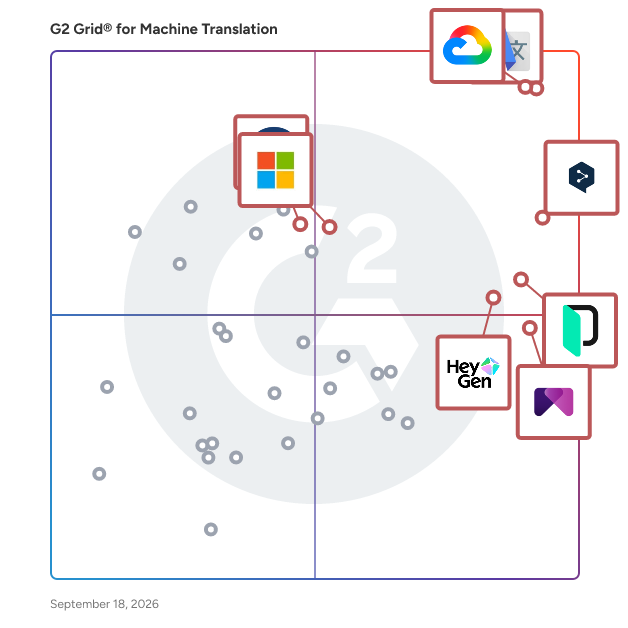
Featured Machine Translation Software At A Glance

G2 Advertising
Sponsored
G2 Advertising
Get 2x conversion than Google Ads with G2 Advertising!
G2 Advertising places your product in premium positions on high-traffic pages and on targeted competitor pages to reach buyers at key comparison moments.

How Do You Choose the Right Machine Translation Software?

What You Should Know About Machine Translation Software

What is Machine Translation Software?

Machine translation (MT) is the process of translating one text to another with the help of artificial intelligence and without any human involvement. 

A large amount of source and target languages are involved in machine translation. Machine translation software compares and matches source and target languages. Some common examples of machine translation software are mobile apps that help in translating content. 

Machine translation software comes with embedded artificial intelligence that helps in real-time translation management. Machine translation solutions help in accurate translations. Translation services providers use machine translation software for better translation management of their projects. This software also helps in translating web pages.

What Types of Machine Translation Software Exist?

Machine translation software has developed over time. There are three major types of machine translation solutions:

Rule-based machine translation

This is the earliest form of machine translation. It is very rarely used today. It requires the manual addition of languages and human post-editing. It depends on a predefined set of rules that help transfer the meaning of text between different languages or any given language pairs.

Statistical machine translation

This type of machine translation tool builds a statistical model of the relationship between words and phrases in a text. This model is then applied to a second language to convert those elements into a new language. Nowadays, this MT software is replaced by neural machine translation.

Neural machine translation (NMT)

NMT uses AI to learn languages constantly to upgrade knowledge like neural networks in the brain. This MT software encodes and decodes the source text. Deep neural machine translation is an advanced version of neural machine translation. It has deep learning as its base technology.

Cloud-based translation

Many translation services vendors provide cloud-based translation systems where there is a pre-trained machine learning model to do the text translation.

What are the Common Features of Machine Translation Software?

The following are some core features within the machine translation platform that can help users in various ways:

Translation memory: A translation memory is a database of sentences that can be used to translate similar content.

Quality assurance: This tool goes over the translated content to detect any errors, resulting in high-quality translations.

Import or export: This functionality supports multiple file formats and helps in smooth translation management. 

Glossaries: Glossary is a dictionary of terms used by a company and is translated consistently. 

Automated translation workflows: This helps teams collaborate and effectively review the translations.

What are the Benefits of Machine Translation Software?

Machine translation tools have greatly improved over the years with AI translation and neural networks, which learn and improve by themselves. The post-edit translations by translators can help enhance the quality of translated content.

Speed and saves time: The machine translation process does not require human intervention or support to translate the text. Thus, machine translation software can translate the content quickly and in some cases, the text translation can be done almost instantly. Machine translation tools can translate text in seconds and hence save time. 

Cost-effective: With an implemented post-edit translation step or a translation memory, machine translation is cost-effective since it involves no human contribution. Machine learning makes it even more efficient. It thus helps agencies complete translation projects faster. 

Who Uses Machine Translation Software?

Machine translation tools have various use cases in different departments and industries alike.

Customer support executives: Machine translation tools help in solving customers’ queries by providing multilingual support. Machine translation software can translate the content or queries of customers into their language for faster and better communication. Thus it is possible to obtain high-quality translations.

Language service providers (LSPs): Language service providers use machine translation tools to increase productivity and achieve high-quality translation. Thus, the machine translation platform improves productivity. An API translation software also helps the developers and translators translate text into different languages.

Challenges with Machine Translation Software

Although machine translation is beneficial for various projects and translates the content to different languages, the technology has its own set of challenges as follows:

Relevance: While the machine translation platform can convert content into various languages, the challenge is to translate relevant content. It is not only about localization of the content or a simple language translation but getting relevant translated content that can communicate a marketing message to a completely new target audience. If a marketing message for a completely new geographical location has to be translated, the text can get translated as is with local references taken into consideration. 

Lack of sensitivity to the culture: Communication varies according to different cultures. Some words can be used and some words cannot. However, machine translation, while providing high-quality translations, could fail at understanding prohibited words and may even use them while translating.

Overall quality: With common concerns like the usage of relevant words, the context of the translated content, and so on, machine translation can further impact the overall quality of the translated text.

How to Buy Machine Translation Software

Requirements Gathering (RFI/RFP) for Machine Translation Software

Machine translation platforms come with various features that cater to the different translation needs of an organization. It is essential to understand the company’s requirements before searching for the right software. 

If the organization needs MT software to keep learning languages on its own, then it should choose neural machine translation software. However, if the organization operates on a statistical model, it would need statistical MT software. RFP or RFIs can help the buyer understand the pricing plans, agreement guidelines, and product features. 

Compare Machine Translation Software Products

Create a long list

The process begins with making a list of all the potential vendors. The product can be evaluated based on features, pricing, customer support, and also verified reviews on G2

Create a short list

After a thorough analysis of the vendors and their products, a few products are shortlisted depending on which one fits the bill and fits the organizational needs.

Conduct demos

Demos are an essential measure to evaluate the MT engines. Vendors can give demos in order to help organizations make better decisions. For example, a statistical translation tool may also have an artificial intelligence (AI) feature helping in obtaining results in natural language. An NMT feature can also be available within a machine translation tool. A demo can help understand the features better, the pricing of the product, and performance expectations from the product.

Selection of Machine Translation Software

Choose a selection team

A team including technical personnel, a business user, a decision maker, and an IT professional is a good mix to test or evaluate different MT engines.

Negotiation

This step occurs after a certain price is quoted by the vendor. The team from the organization negotiates depending on their budget and up to what extent the product fulfills their criteria.

Final decision

Generally, a chief marketing officer (CMO) can make decisions depending on how effectively the product will help the internal teams.