




2020 was a monumental year for the IT infrastructure sector. The onset of the pandemic changed the way that IT infrastructure was traditionally looked at—from several dusty servers at the back of a room, to companies earning billions of dollars in revenue with the explosive growth of the cloud. According to a report from Datacenter Dynamics, 2020 Q1 spend on cloud infrastructure services reached $29 billion, a year-over-year increase of 37%. In May 2020, AWS announced that the company passed $10 billion in revenue in a single quarter for the first time.
Businesses of all sizes and from different verticals have been coerced to get on the digital transformation bandwagon and invest in improving the IT environment to ensure business continuity.
However, the COVID-19 pandemic was only a catalyst; a bigger step is yet to be considered—how to become resilient against uncertainties. Cyber attacks, security breaches, climate change, data regulations, and government policies have added to the current business climate’s uncertainty, forcing owners to take notice of how they can step up in case of any unknown business disruption factors.
Importance of infrastructure resilience
It's not possible to predict and avoid all hazards, so the key is to manage them. Having a well-defined resilience plan can save companies billions of dollars in losses since it reduces the risk and impact of threats.
Infrastructure resilience is the ability of a firm’s infrastructure to adapt, mitigate, and respond to stresses within the IT environment via the integration of software and applications. The IT system can transform itself to ensure that essential business functions and processes are maintained. IT infrastructure now needs to stand the test of time, and being future proof is key.

Here are a few important things to take note of when building infrastructure resilience:
Achieving an agile and flexible infrastructure through cloud computing
Be it the pandemic, climate change, or political instabilities, being adaptive is the way forward for companies to navigate through unprecedented crises. To achieve resilience, firms need hardware and software to be agile and flexible. The IT infrastructure environment should have the ability to scale up, and the flexibility to support heavy workloads when the time comes. This is where cloud computing plays a huge role.
The emergence of cloud infrastructure allowed firms to move from the traditional IT hardware space and modernize IT infrastructure. Cloud-based IT infrastructure is not just scalable and flexible, but also easier to deploy since it is software focused and software defined. The minimal to zero investment in upfront hardware costs and the support and ease to move different workloads and applications to cloud environments via cloud platforms as a service (PaaS) software, has helped cloud grow to the billion-dollar business it has become today.
With companies being able to opt for the best cloud strategy, be it public, private, or hybrid cloud, companies can reduce risk and CapEx and have the ability to be agile and flexible as required.
To support infrastructure resilience, cloud computing provides firms with a way to ensure that critical workloads are still running, they can scale up or out as workloads increase in complexity, all the while maintaining cost efficiency. Businesses are expected to undergo technology transformations at a rapid pace, and organizations are looking at migrating critical operations, customer-facing programs, and applications to hybrid or multicloud platforms.
Automating workloads to improve operational efficiency
As the complexity of data grows, many organizations are automating tasks to build and support smart workflows and streamline processes. AI/ML-powered tools and AIOps platforms help organizations manage their workforce and resources efficiently without any need for human intervention.
Automating different processes helps firms speed up daily processes, reduce human error, and also redirect investments in human assets back into the firm for other requirements. The renewed focus is on the agility of the IT infrastructure and less time is spent finding and fixing errors.
Making well-informed decisions to support the IT resiliency plan
With all the applications, software, enterprise tools, monitoring tools that companies are investing in, it's quite easy to lose the understanding of the bigger picture. Data analytics is taken into consideration to make well-planned and data-driven strategic decisions. Understanding data is key here because the right decisions will enable organizations to increase revenue generation, enhance customer experience, operational agility, reduce time to market, cross-functional team mobility, and others.
Data-driven decisions are integral to obtaining business intelligence. Business intelligence will therefore combine not just data decision making, but also data resilience, data processing, data access, and all other facets of data management.
Ensuring data protection
Infrastructure is resilient when the data is secure and safe. Data asset owners must continuously monitor and analyze the risks involved that could breach data security and decide on action plans that can protect critical data. Identifying the various imminent possibilities of threats and cyber attacks, and building a well unified and densely integrated cyber network is key to protecting all IT infrastructure assets.
A good assumption to make when deciding on an IT infrastructure resilience plan is that several cyber attacks will happen, and they will be successful. This assumption coerces users to identify and stop risks beforehand, which prevents attacks from breaching the company network and stealing classified or critical data.
Growing role of the internet of things (IoT)
The advent of exciting new technologies such as IoT, AI, 5G, ML, quantum computing, and extended reality have changed the way companies are run, and they are the conduit with which companies are making their IT infrastructure resilient.
The future is connected, be it connected cities, cars, or even connected living, and setting up the infrastructure now to be ready when connected becomes the new norm will help companies establish their presence rather than lag behind. By future proofing and being ready for when the time comes, companies will not face an issue moving into the new normal. Companies that are at a complete loss when the future arrives will face technological challenges and repercussions, which could cause them to fail.
The future is growth
With all the need surrounding infrastructure resilience, every company needs to understand that growth is imminent—be it growth from data, from operations, or from employees. This growth factor plays an important role when discussing resilience.
For example, the Video Conferencing Software category on G2 experienced explosive growth with the onset of the pandemic, with 1234.95% year-over-year growth in category traffic for April 2020. However, only those who were using a video conferencing tool already were able to maintain business continuity while others were left scrambling from some software or the other to keep employees connected.
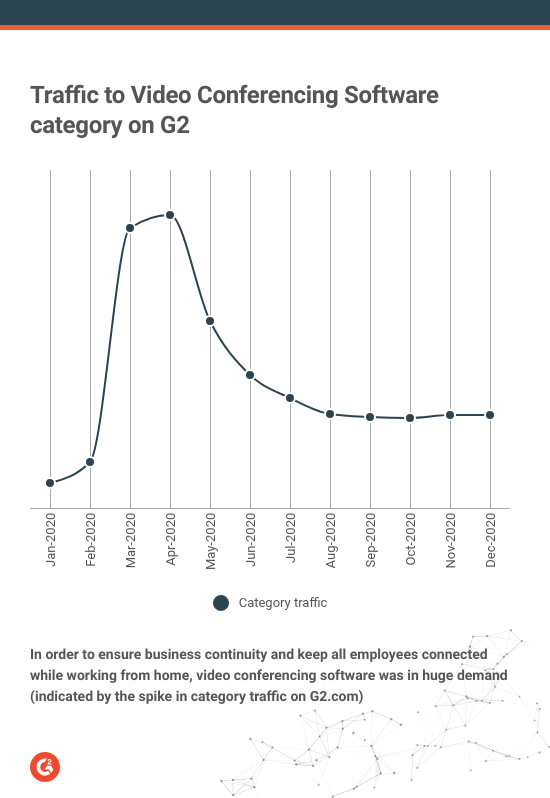
What is key here is that it was not just important to have the software, but because of the increasing data content from video conferencing, the load on a company network surged and a powerful network had to be in place to maintain this surge. A company that had a well-thought-out plan—the right video conferencing tool, a strong network to support increased data loads, the right workloads, and processes to manage the data has been able to survive the pandemic and also has the right foot ahead to manage in a post-pandemic world.
The mentality behind letting go
When a firm has decided to focus on infrastructure resilience and becoming future ready, the first thing to do is to let go of old software and IT infrastructure that does not fit in the new plan. Oftentimes, companies are unwilling to do so because they find it unreasonable to move to a new solution when the old one is working perfectly fine.
Legacy technology can easily hold a business back, which gives competitors a strong edge to overtake and do better in the industry. It is important to not get sentimental, but rather be proactive and choose the best future proof plan.
Looking forward and onward
The need to be future proof and resilient is important now more than ever. Digital transformation has moved on from being just another buzzword to the reality that we all live in. Digital transformation can take countless forms via numerous applications and technologies. It is up to organizations to identify what works best and define methodologies to be followed.
| Read More: The G2 on Tech: Cloud Adoption and Digital Transformation → |
Ultimately, having a resilient infrastructure to support digital transformation initiatives will drive customer centricity, data security, and support firms to be future ready. Infrastructure resilience will aid several firms to combat numerous unknowns unless they own a crystal ball to see into the future.
Want to learn more about IT Resilience Orchestration Automation (ITRO) Software? Explore IT Resilience Orchestration Automation (ITRO) products.

Preethica Furtado
Preethica is a Market Research Manager at G2 focused on the cybersecurity, privacy and ERP space. Prior to joining G2, Preethica spent three years in market research for enterprise systems, cloud forecasting, and workstations. She has written research reports for both the semiconductor and telecommunication industries. Her interest in technology led her to combine that with building a challenging career. She enjoys reading, writing blogs and poems, and traveling in her free time.

