
Darshayita Thakur
Darshayita Thakur is a Senior SEO Content Specialist at G2 who specializes in SEO and AEO-first, data-forward storytelling. She tests and evaluates a broad range of software products, blending search and discovery strategy, content architecture, and practical analytics to translate data into clear, usable narratives. She emphasizes transparency, measurable impact, and helping buyers navigate toward the right software decisions. When she's not writing, Darshayita reads global and translated literature and delights in uncovering weird historical facts.
I evaluated 20 tools to find the 9 best free language learning software. These are AlfaPTE, Babbel for Business, Busuu, ELSA Speak, Memrise, Mondly by Pearson, Speakable, Speexx, and Talkpal for Business.
I wanted to learn Japanese and German, but I wasn’t ready to commit to a paid subscription before knowing whether I could fit regular lessons into my schedule or stay consistent long enough to make it worthwhile. So, like most learners testing a new habit, I started looking for free language learning software that would let me explore both languages without putting money on the line.
Here’s what nobody tells you about free language apps: “free” means something different in almost every one. Some give you a genuinely useful app forever and charge for extras. Others offer one lesson a day before putting the rest behind a paywall. A few give you 14 or 30 days and then lead you toward a paid plan or sales call. I’ve encountered all three, often just as the habit was beginning to stick.
That’s why I went through the leading products on G2’s free language learning software category page to determine exactly what each one offers without payment, how long you can realistically use it for free, and what will eventually push you to upgrade. Here’s what I found about the best free language learning apps in 2026.
What are the best free language learning apps in 2026?
-
AlfaPTE: Best for PTE exam preparation and mock tests
Aimed at candidates with a test date already booked, and the coaching institutes preparing them, where a score matters more than fluency. -
Babbel for Business: Best for workplace-focused language skills
Suits professionals who need to get through a client call or a team meeting. -
Busuu: Best for practising with a community of native speakers
Made for learners who want a real person to correct their writing and speaking without paying for the privilege. -
ELSA Speak: Best for English pronunciation and accent work
Built for non-native English speakers whose grammar is solid but who still get asked to repeat themselves. -
Memrise: Best for vocabulary retention through native-speaker video
A fit for anyone who freezes when a native speaker talks at normal speed rather than textbook pace. -
Mondly by Pearson: Best for gamified daily lessons across 41 languages
Designed around consistency, for people who need a streak and a short daily session to keep the habit alive. -
Speakable: Best for teachers assigning and grading speaking practice
Written for language teachers who spend more of the week marking recorded speaking assignments than teaching. -
Speexx: Best for structured corporate language training with live coaching
Intended for organizations that need certified trainers and CEFR assessment rather than another self-serve app. -
Talkpal for Business: Best for daily AI conversation practice
Ideal for learners who read and write a language comfortably but seize up the moment they have to say something out loud.
*Tools are listed alphabetically. These tools offer free trials, free forever options, or freemium models.
Comparison of the best free language learning apps
Here's a side-by-side look at what each free tier actually gives you before diving into the full reviews.
| Tool | G2 Rating | What the free plan covers | Paid Starts At |
| AlfaPTE | 4.8/5 ⭐ |
|
$10.99 for 10 days |
| Babbel for Business | 4.3/5 ⭐ |
|
$8.77/ user/month |
| Busuu | 4.5/5 ⭐ |
|
$6.08/month for the Premium Plan |
| ELSA Speak | 4.5/5 ⭐ |
|
$89.99/year for ELSA Pro |
| Memrise | 4.6/5 ⭐ |
|
$0.17/day, billed annually |
| Mondly by Pearson | 4.8/5 ⭐ |
|
$12.90/month |
| Speakable | 4.9/5 ⭐ |
|
$300-960/teacher $22 / student |
| Speexx | 4.6/5 ⭐ |
|
Pricing on request |
| Talkpal for Business | 5.0/5 ⭐ |
|
$6.24/ month fora Premium of 24 months |
*All pricing details mentioned in this article are based on publicly available data at the time of publication and are subject to change.
Language skills are wanted in more workplaces than most learners assume. ACTFL's Making Languages Our Business, the most comprehensive survey of US employer language demand to date, found that nine out of ten employers rely on staff with language skills other than English, and 56% expect that demand to grow over the next five years. The counterintuitive part is where the need actually sits: 47% said they need language skills exclusively for the domestic market, not for international expansion, and one in four language-dependent employers already reports a skills gap in its own workforce. None of that helps if you quit in week three, which is why the free tier you'll actually keep opening matters more than the paid one you'll abandon in a month.
How did I find and evaluate these free language learning apps?
I started with G2's free language learning software category page, sorted by G2 Score, and took the top nine products. I then verified every free plan claim against the vendor's own documentation.
I cross-referenced verified G2 user reviews and the G2 Fall 2026 Grid Report to understand what learners consistently praise, what wears thin after a few months, and where the free tier stops being enough. Review recency varies by product. I referenced G2 reviews from 2026 for language learning tools like Speexx, Busuu, AlfaPTE, Talkpal, and Speakable, where recent reviews were available, while for the others, I referred to the latest reviews. Some reviews have been lightly edited for clarity.
The screenshots featured in this article may be a mix of those taken from the vendor's G2 page or from publicly available materials.
What I look for in a free language learning app
Going through nine of these back to back, a few things separated the ones I'd keep from the ones I'd delete:
- What "free" actually means: A free-forever plan and a 14-day trial are completely different products. I checked which one you're really getting, and where the line sits.
- How long the free tier lasts in practice: Not the stated limit, but the real one. A 10-minute daily cap sounds generous until you're mid-conversation and it cuts out.
- Whether speaking is included: Reading and vocabulary are cheap to build and usually free. Speaking practice and pronunciation feedback are expensive, so they're the first thing behind a paywall. The apps that give you some for free stand out.
- Feedback quality: An app that tells you you're wrong is useful. An app that tells you why you're wrong is worth paying for. Some of these give you the second kind free.
- Language coverage on the free tier: Some apps advertise dozens of languages, then restrict the free plan to a handful.
- Whether it survives a busy week: The best app is the one you still open on a day when you have fifteen minutes and no energy.
To be included in this category, a language learning solution must:
- Have features targeted toward language learners
- Include different courses based on competency level
*Review data referenced throughout was pulled from G2 in 2026. Some reviews have been edited for clarity.
Want to learn more about Language Learning Software? Explore Language Learning products.
1. AlfaPTE: Best for PTE exam preparation and mock tests
AlfaPTE is the one product on this list that isn't trying to make you fluent. It's PTE practice and mock test software, and it exists for people with a test date circled on a calendar.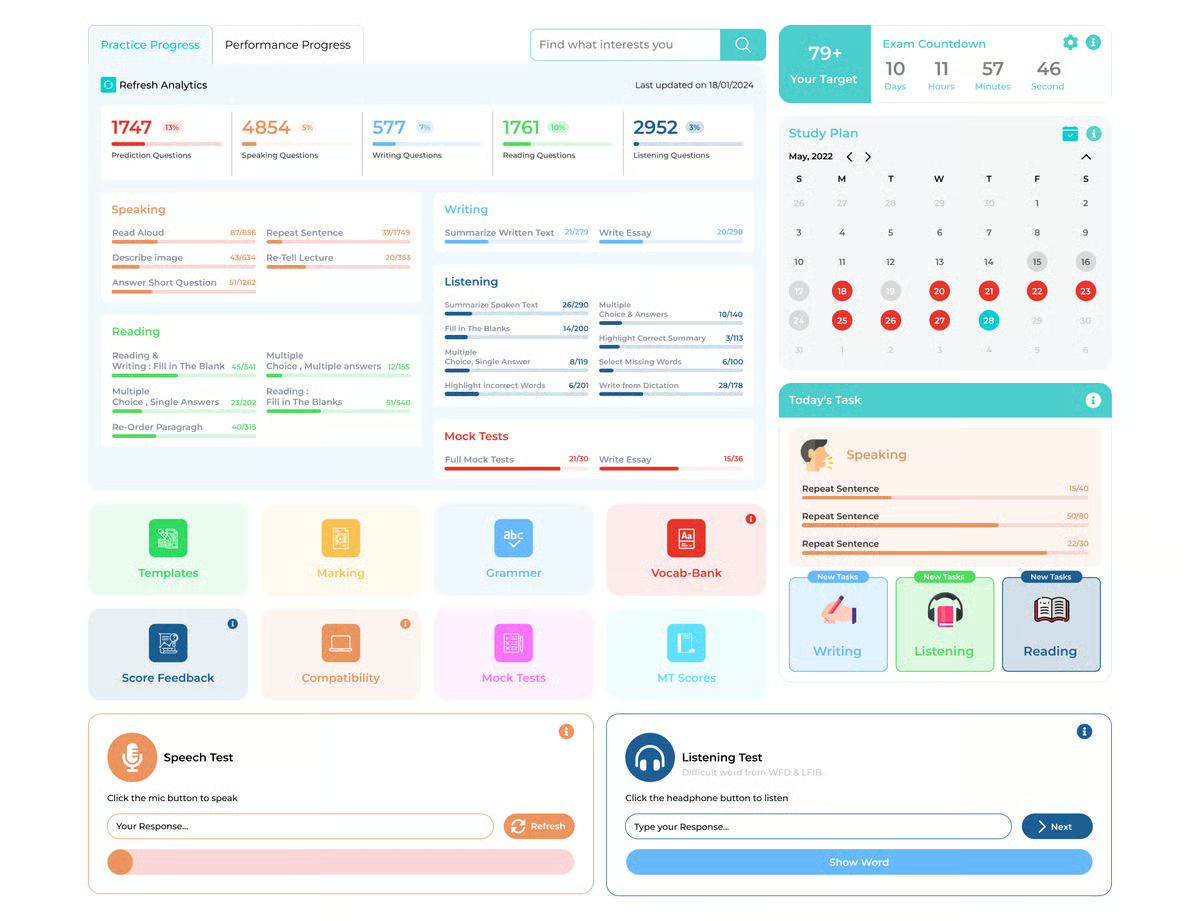
I observed that the narrowness is the point. Where every other app here optimizes for habit and long-term retention, AlfaPTE optimizes for a score. You get full-length and sectional mock tests with AI scoring, a personalized practice portal, and per-student analytics, plus a white-label version that coaching institutes run under their own branding. According to G2 Data, AlfaPTE scores 100% on self-paced lessons.
The exam simulation is close, with G2 reviewers repeatedly saying the interface and scoring resemble the real Pearson test, and one noting the recent redesign replicates it more closely still. The Student Performance Evaluation Report goes further than a score by detailing how long students spend on each question type and which difficult question types they quietly avoid. And the white-labelling genuinely lands; separate student and admin links carrying their own logo make students feel they're using the institute's own portal.
What does AlfaPTE's free plan include?
- Access to 20,000 practice questions
- Five AI score checks per day for speaking, reading, and listening questions, excluding Summarize Spoken Text
- Three one-time AI score checks for writing questions and Summarize Spoken Text
- One full mock test with instant AI scoring
- One sectional mock test with instant AI scoring
- Limited templates
- Strategy videos
When should you upgrade your AlfaPTE free plan?
Upgrade once you exceed the free practice test allowance or need scoring history across repeated full-length mocks. The free tests give you a baseline; the paid tier is what tracks improvement between them.
Where AlfaPTE genuinely stands out:
- Support response is the most repeated theme across the G2 reviews, with users praising their account representatives, mentioning webinar training, and describing feature requests being implemented rather than just acknowledged.
- 20,000 practice questions is the structural advantage over per-test competitors. Students can keep practising until they're confident rather than rationing attempts, which matters when the product is measured against a real exam date.
What G2 users like about AlfaPTE:
"AlfaPTE provides a comprehensive and reliable platform that closely simulates the real PTE exam experience. The AI-powered scoring, extensive question bank, detailed performance analytics, and regular content updates help our students prepare effectively. We also appreciate the responsive support team, who actively listen to feedback and continuously enhance the platform, making it a valuable solution for both training institutes and individual learners."
- AlfaPTE review, Sunny P.
Is AlfaPTE right for you?
Best for: PTE candidates who want realistic mock tests with AI scoring, and education management businesses running PTE coaching who want a branded practice portal with student analytics.
Not ideal for: Anyone learning a language for travel, work, or general fluency. This is an exam preparation software.
What I dislike about AlfaPTE:
- AlfaPTE covers a broad range of PTE practice activities, but G2 reviewers mention several usability rough edges, including occasional login problems, speaking responses that do not return scores, limited information in the student list, and a crowded interface. Shadowing audio is also restricted to the mobile app, making the platform a better fit for learners comfortable switching devices and instructors who prioritize practice depth over streamlined administration.
- The sectional mock tests provide comprehensive exam practice, but some teachers find the combined reading-and-writing format too long and tedious when they want to assess one skill at a time. It is therefore better suited to full-section preparation than short, targeted classroom assignments.
What G2 users dislike about AlfaPTE:
"There is a significant difference between practice score and actual exam score."
- AlfaPTE review, Sangita S.
Related: Prefer learning in short, focused bursts? Explore the best microlearning platforms for delivering bite-sized, engaging training that fits naturally into the workday.
2. Babbel for Business: Best for workplace-focused language skills
Babbel for Business covers 14 languages with lessons split between business contexts and casual conversation, which is the distinction that matters. Most apps teach you to order coffee; Babbel teaches you to get through a meeting. From the G2 reviews I evaluated, it is clear that the blended approach pairs self-study with live classes taught by certified tutors.
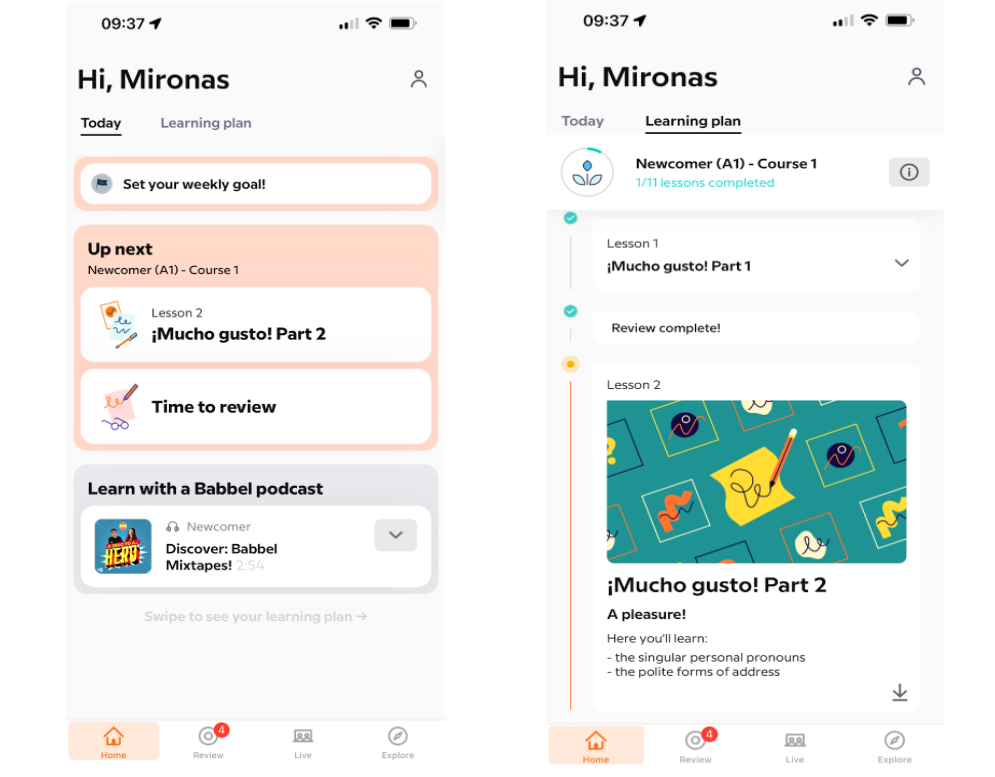
What G2 reviewers return to is scheduling freedom, with users mentioning that Babbel succeeded because it runs from a smartphone at any hour. Corporate reviewers on G2 also mention that their colleagues progress through the same language at different levels and paces without a fixed class time. The language learning platform stands out for its customer success management and its sales and implementation experience.
What does Babbel's free plan include?
- Individual users can register with consumer Babbel and sample the first lesson of every course
- Selected speaking-practice activities and podcasts are also available for free
- Business licences require a paid 12-month or lifetime purchase
When should you upgrade your Babbel free plan?
Upgrade the moment you want lesson two of any course. The free tier caps you at the first lesson of each course plus selected speaking exercises and podcasts, which makes it a sampler across languages rather than a curriculum in one. Organizations have no documented free business tier, so team evaluation runs through sales.
Where Babbel for Business genuinely stands out:
- It works for shift and field workers, which is rarer than it sounds. This is well-suited for organizations whose learners can't attend pre-scheduled classes.
- Users consistently praise responsive customer success managers during implementation and after.
What G2 users like about Babbel for Business:
"Quick and effective interface, very well laid out. But truly, the excellent customer service from the beginning phases of the sales process to the implementation process has been what has sold us on choosing Babbel. Very excited to get this program off the ground with our team!"
- Babbel for Business review, Tamy T.
Is Babbel for Business right for you?
Best for: Companies offering language training as an employee benefit or a workplace safety measure, and individual professionals who want vocabulary for client calls.
Not ideal for: Anyone hoping to learn for free forever. The free tier is a sampler by design. Also not ideal if you need a formal language certification.
What I dislike about Babbel for Business:
- Babbel’s admin dashboard supports basic programme oversight. G2 reviewers mention limited real-time insight into lesson time and say the weekly report can be more informative than the dashboard itself. It is therefore better suited to teams that need straightforward participation tracking than those requiring detailed, live learning analytics.
- Live and Intensive classes expand Babbel beyond self-paced learning, although their credit administration can require additional manual work. The setup is a better fit for organizations running relatively stable class allocations than those that frequently redistribute credits between employees.
What G2 users dislike about Babbel for Business:
"The dashboard does not have real-time analytics of the time learners spent in their lessons. However, that is an updated feature that Babbel is testing and plans to roll out."
- Babbel for Business review, Verified User in Construction
3. Busuu: Best for practising with a community of native speakers
The reason I would pick Busuu over anything else is the community. You write or record something, and actual fluent speakers correct it, rather than an algorithm approximating what a correction should look like. The exchange seems rewarding in both directions: receiving corrections, then correcting other learners in return.
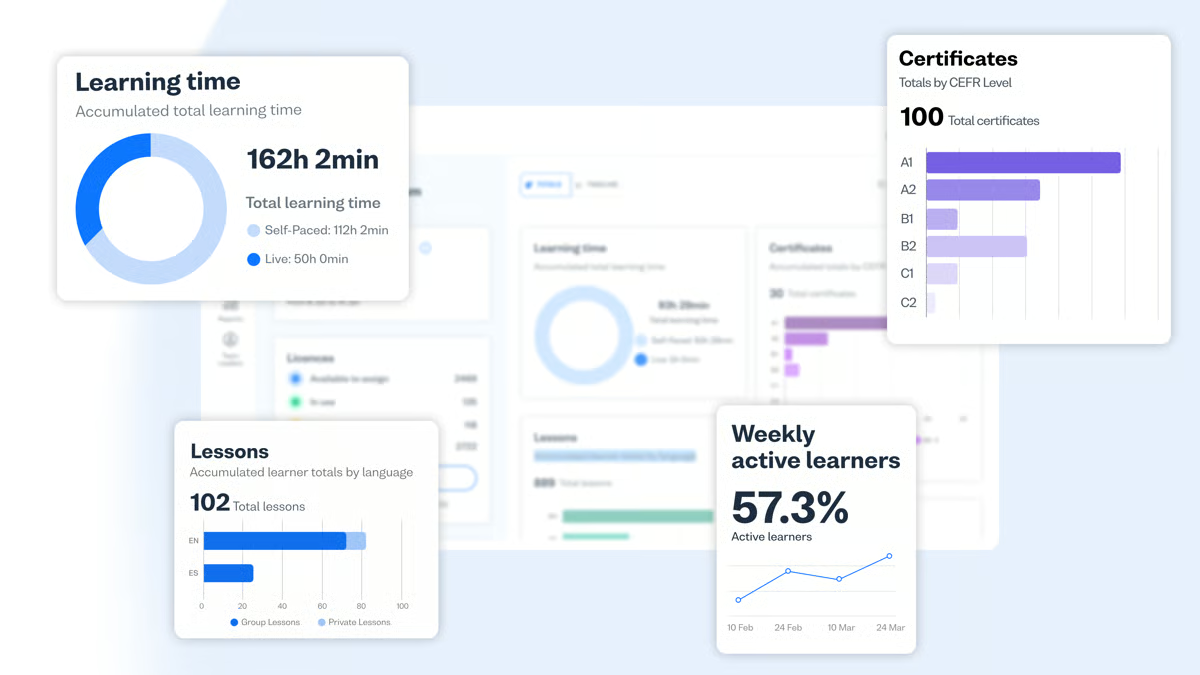
Two other features come up repeatedly in G2 reviews. The placement test is fast, and reviewers trust it. The Common European Framework of Reference for Languages (CEFR) checkpoints give progress a shape. Busuu offers courses in 14 languages and awards Premium learners CEFR-aligned completion certificates at supported levels, ranging from A1 to C1 depending on the language. According to G2 Data, Busuu scores 96% in speech recognition and 97% in both multimedia and certificate features.
What does Busuu's free plan include?
- Access to complete language courses, including all lessons and available levels across 14 languages
- Community exercises and feedback from fluent or native speakers
- Written and spoken answers that can be submitted for community correction
- Basic progress tracking
- Free learning with a short advertisement before each lesson
When should you upgrade your Busuu free plan?
Upgrade when you need the CEFR completion certificate, Live Lessons with certified teachers, offline access, or the AI-powered adaptive tools. The free essential course and community corrections cover everything up to that point. If the certificate is for a job application, there's no free route to it. [VERIFY: paid plan name and price]
Where Busuu genuinely stands out:
- Community feedback on the free plan is the standout feature for Busuu. Every other app here gives you machine feedback for free and reserves human correction for paid tiers, or doesn't offer it at all.
- Busuu structures learning around CEFR checkpoints across 14 languages and awards Premium learners CEFR-aligned completion certificates at supported levels from A1 to C1, depending on the language.
What G2 users like about Busuu:
"I appreciate that Busuu provides the CEFR equivalents and offers live lessons. The live lessons are an obvious way for me to move forward in learning a language that's tailored to me, as having someone live can adapt to my level. Additionally, having the CFR equivalent gives an impression of progress, so I kind of know where I'm at and get the impression that I'm moving forward. It gives me some inkling of where my level is rather than just knowing that I'm terrible at the language. The initial setup of Busuu was very easy, with no problems."
- Busuu review, Camilla K.
Is Busuu right for you?
Best for: Learners who want their work corrected by humans without paying for it, and anyone who needs a CEFR-aligned certificate at the end. Also strong for teams, since the business version offers a management platform with SSO and LMS integrations.
Not ideal for: Learners after a language outside Busuu's 14, or advanced learners.
What I dislike about Busuu:
- The platform combines reading, listening, writing, and speaking, although some G2 reviewers feel the skills do not receive equal attention. Speaking exercises earn praise for their quality, but reviewers want more of them, alongside additional writing practice.
- Live Lessons add valuable instructor-led practice, but the experience can depend on the teacher selected. G2 Reviewers describe formats ranging from structured presentations to 45-minute open discussions and would prefer to see the planned lesson structure before booking. This flexibility can suit conversational learners, while those seeking a consistent syllabus may need to compare instructors more carefully.
What G2 users dislike about Busuu:
"Perhaps the repetitive nature that exercises sometimes take on or the way you learn. The structure is the same, and sometimes that can be a bit tedious, but personally, it doesn't affect me."
- Busuu review, RICARDO G.
4. ELSA Speak: Best for English pronunciation and accent work
ELSA Speak is an AI pronunciation coach for English, giving instant feedback on individual sounds, stress, and intonation. There's a gap between what a learner thinks they said and the sound that actually came out, and nothing closes that gap except hearing it back with a verdict attached. This is where I feel ELSA Speak stands out in this list.
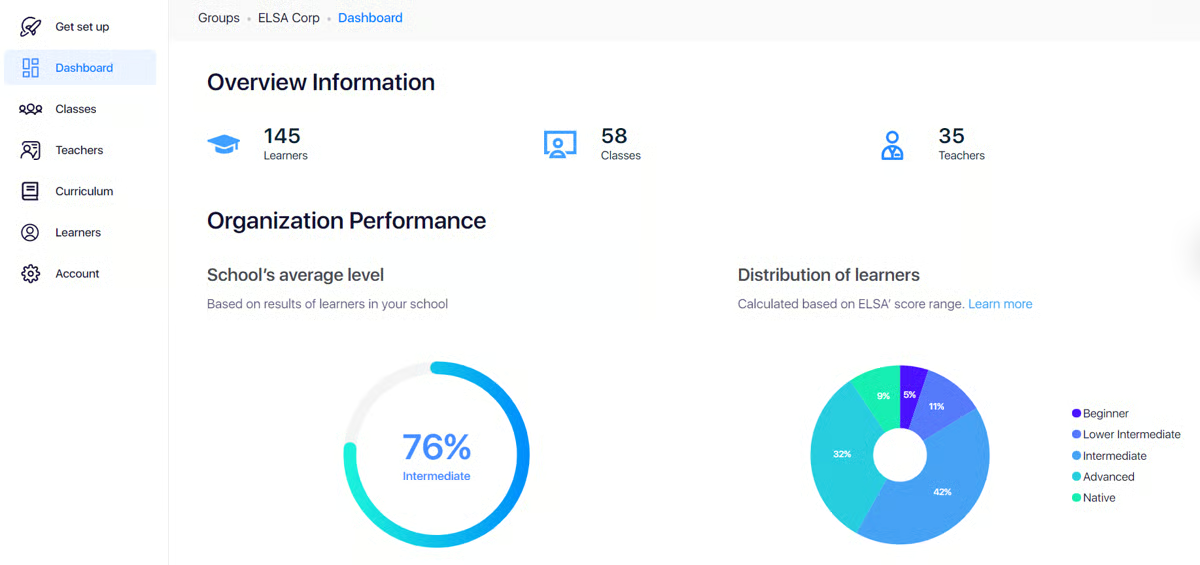
ELSA doesn't just mark you wrong; G2 reviewers describe it telling them whether the problem is a vowel, an inflection, or an intonation issue, down to the specific letter they're struggling with.
That precision is why teachers and coaches show up throughout the G2 reviews. Users describe a second benefit: practising out loud alone, repeatedly, without an audience. This makes the language learning tool ideal for introverts who don't want to expose their mistakes to another person.
The third thing reviewers keep raising is that progress is visible. They track scores across months and cite measurable gains in fluency and accuracy, which is unusual in a category where most apps measure how many days in a row you opened the app rather than whether you got better.
What does ELSA Speak's free plan include?
- Limited AI role-play practice
- Limited access to the advanced AI coach
- Limited real-time feedback and progress tracking
- Limited access to its library of more than 8,000 lessons
- A limited personalized learning path
- Limited bilingual AI-tutor access
- Limited guided practice for interviews, presentations, and exams
- Limited transcripts and vocabulary suggestions
- A free AI speaking assessment with a personalized improvement plan
- Daily learning goals and reminders
When should you upgrade your ELSA Speak free plan?
Upgrade when the free exercises start repeating, or when you need the IELTS practice material and advanced vocabulary modules. The free tier covers core pronunciation correction well enough.
Where ELSA Speak genuinely stands out:
- The diagnostic detail is the differentiator, and G2 reviewers describe being told which vowel, which ending, which intonation pattern is off rather than just receiving a score.
- Progress is visible. Reviewers track their scores over months and cite measurable improvement in fluency and accuracy, which is rarer than it sounds in a category where most apps measure streaks rather than skill.
What G2 users like about ELSA Speak:
"ELSA is a prerequisite for any students taking English lessons with me. What I love the most about it is the possibility of immediate feedback when trying to get the pronunciation of a word right. While trying to learn a foreign language, there is an abyss between what we think we said and what sound actually came out of our mouths. With ELSA, students can get an idea of how off or not they are."
- ELSA Speak review, Lais G.
Is ELSA Speak right for you?
Best for: Non-native English speakers whose reading and writing are already solid but whose speaking lags, and anyone with no English-speaking environment to practise in.
Not ideal for: Anyone learning a language other than English, since ELSA only does English.
What I dislike about ELSA Speak:
- ELSA’s detailed pronunciation scoring is useful for learners targeting American English, but it can be less suitable for those who want to retain another native or regional accent. Learners working toward American pronunciation may value this strictness, while others may prefer a tool that accommodates more English varieties.
- ELSA delivers granular feedback when speech is captured correctly, although recognition can be inconsistent with isolated words, background noise, or an unstable connection. Practising in a quiet environment and using complete phrases may produce more reliable results, but learners focused on single-word pronunciation should expect occasional mismatches.
What G2 users dislike about ELSA Speak:
"I like this software so much, just a little bit expensive."
- ELSA Speak review, Dylan Y.
Wondering how language apps personalize lessons to your level and progress? Learn how adaptive learning uses data and AI to adjust content, difficulty, and feedback for each learner.
5. Memrise: Best for vocabulary retention through native-speaker video
Memrise positions itself as the opposite of textbook learning. I noted that Memrise offers more than 20 official language courses created with input from linguistic experts and native speakers. Its defining feature is authentic video of native speakers using practical words and phrases as they are spoken in real life.
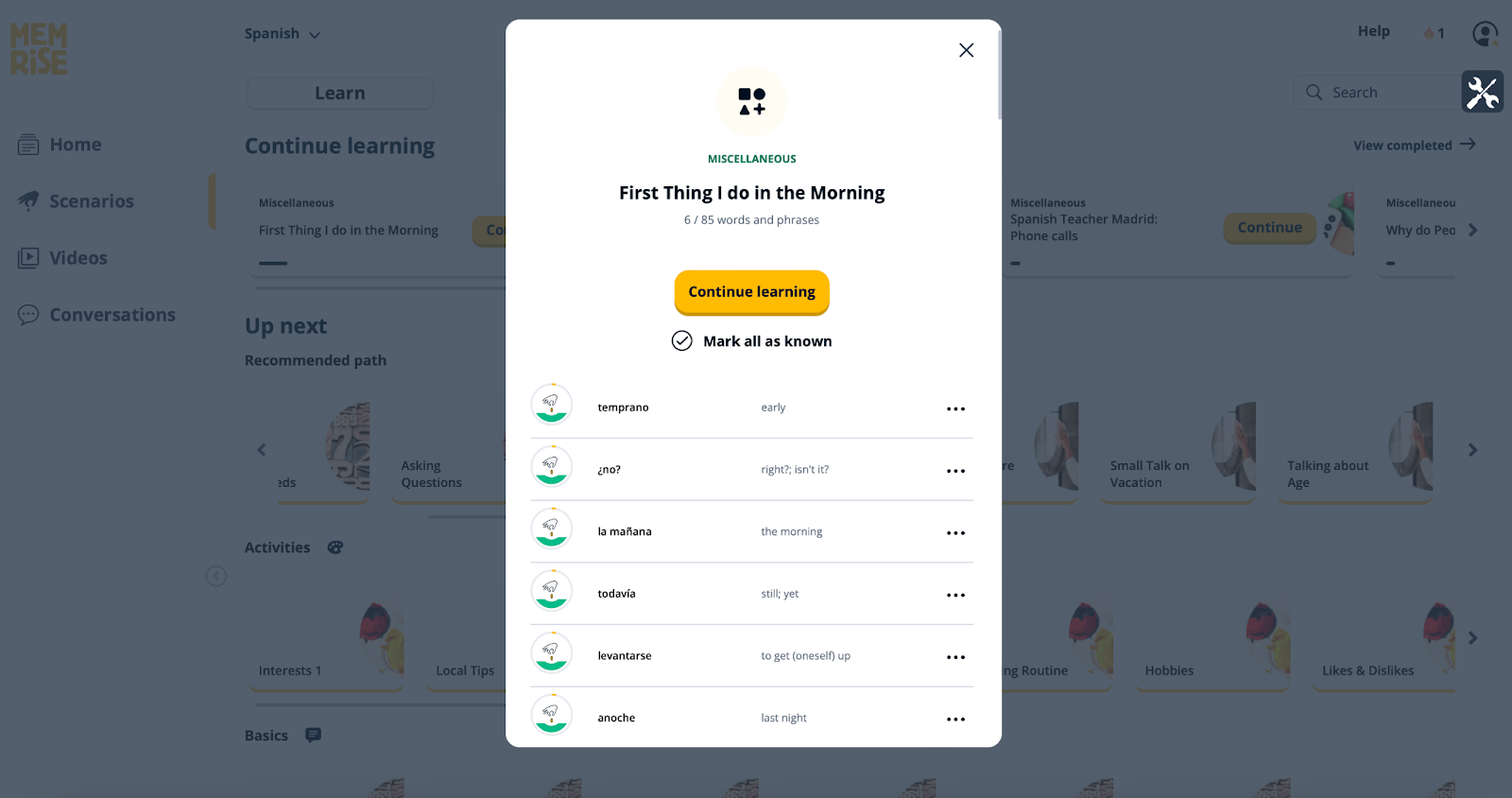
Textbook audio is recorded slowly and clearly by a voice actor. Actual speech is fast, slurred, and full of shortcuts, and from my evaluation, the gap between the two is why people who've studied a language for years still freeze when a native speaker opens their mouth.
I observed G2 reviewers describe that being able to watch the speaker's lips helped their pronunciation more than audio alone, and the short videos helped them pick up a softer accent while learning languages such as German. Memrise offers offline downloads, helping users learn on the go.
What does Memrise's free plan include?
The Memrise free plan offers the following:- A selection of official Memrise language-learning content
- Vocabulary and phrase lessons organized into real-life scenarios
- Spaced-repetition review
- Native-speaker videos featuring authentic accents and natural speech
- Pronunciation, listening, verb conjugation, and sentence-building practice
- Limited practice with MemBot, its AI conversation partner
- Personalized learning recommendations
- Progress tracking through levels, stages, and accumulated points
- Access to community-created courses through the separate Community Courses website
- Learning across web, iOS, and Android
When should you upgrade your Memrise free plan?
Upgrade when ads start breaking your review sessions. Pro removes ads and unlocks premium content; most core learning material is already available free, which makes this the least urgent upgrade on the list.
Where Memrise genuinely stands out:
- The native-speaker video library is the feature that stands out. Watching mouth movements helps fix pronunciation and pick up a natural accent rather than a textbook one.
- The free version carries enough content to be worth using on its own, and users can combine that with offline downloads and multi-device access.
What G2 users like about Memrise:
"Memrise is an amazing app that offers a massive collection of language courses, covering a wide range of languages and other skills, ensuring that every user can find the perfect course for their professional learning needs. They also have quality content from some of the best language experts and native speakers from all over the world that helps small business managers like us to grow."
- Memrise review, Priya S.
Is Memrise right for you?
Best for: Learners who want to understand real spoken language rather than textbook audio, and anyone building vocabulary who wants a free tier they can actually live on long term.
Not ideal for: Learners who want to understand sentence structure and grammatical rules in depth.
What I dislike about Memrise:
- Memrise’s vocabulary-first approach makes it effective for building recall, but grammar receives less attention. Learners who want to understand sentence structure and grammatical rules in depth will likely need to pair it with a dedicated grammar resource.
- The free version provides a useful starting point, although G2 reviewers report that exercises can become repetitive and some courses or activities eventually sit behind a paywall. It is best suited to sampling Memrise’s learning method and establishing a vocabulary habit rather than accessing the entire platform indefinitely.
What G2 users dislike about Memrise:
"The main challenge of using Memrise for the long term is that it mainly focuses only on vocabulary building and not on clearing the basics of grammatical learning. Also, in the free version, the tests start repeating after a certain point in time which limits the growth of the user learning from it."
- Memrise review, Pratush R.
6. Mondly by Pearson: Best for gamified daily lessons across 41 languages
Mondly by Pearson covers 41 languages, and it builds on the consumer Mondly app. Mondly's approach is gamification done with more discipline than most. Interactive dialogues, speech recognition, chatbot conversation practice, and daily and weekly challenges, with video content and live classes on the business tier.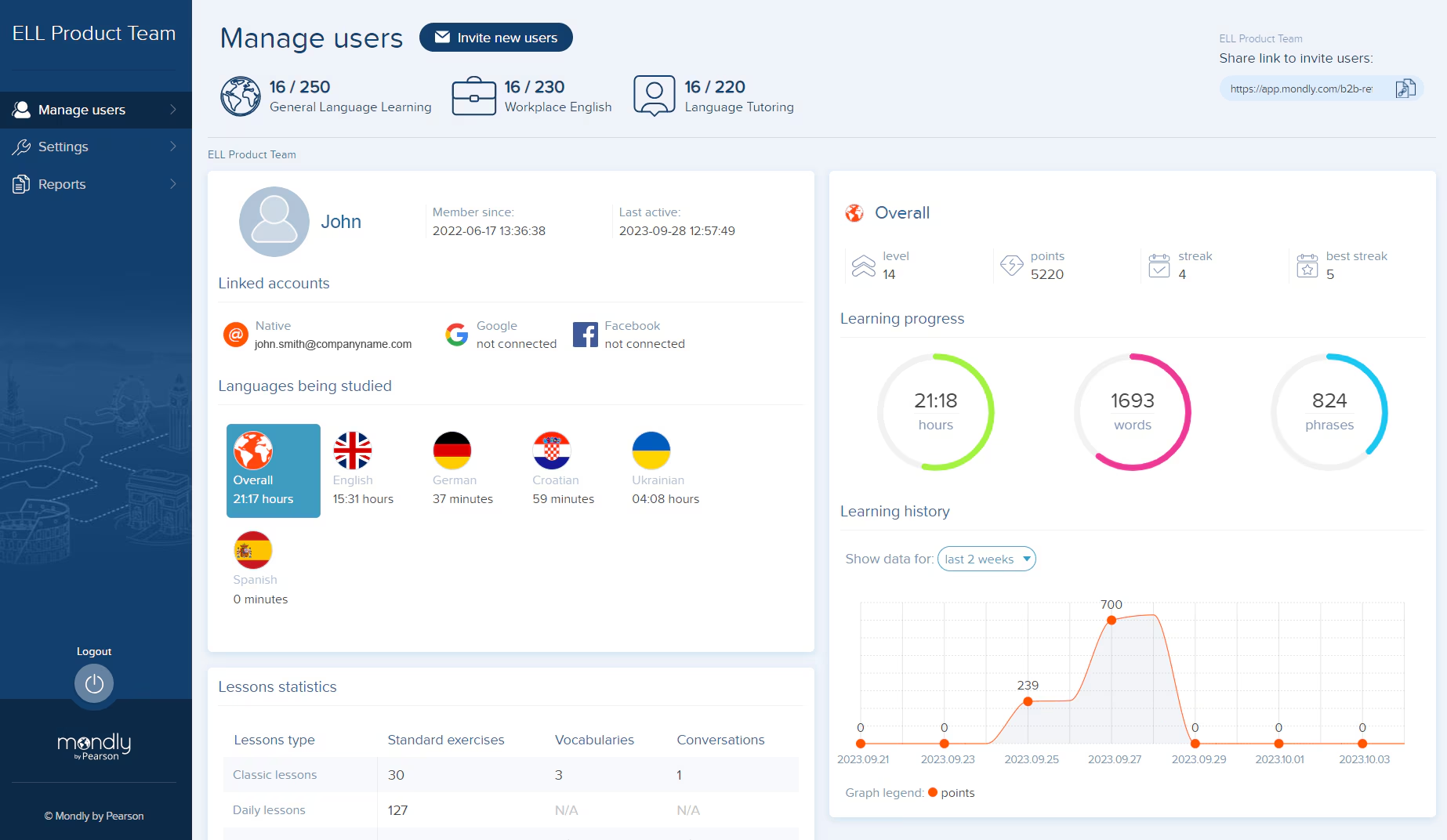
What I observed in G2 reviews is that the motivation mechanics work. Reviewers describe the daily lesson as short enough to fit into a working day, and several say the weekly and monthly tests are what keep them coming back. Despite the small daily time commitment, the vocabulary sticks. Another point reviewers raise repeatedly is topic selection: you pick the context you need, whether travel, meetings, or a specific work field, rather than following a fixed path. Mondly by Pearson scores 100% on ease of use and self-paced lessons, as per G2 Data.
What does Mondly's free plan include?
- Free forever
- One free Daily Lesson, with a new lesson released each day
- Vocabulary, listening, translation, and pronunciation exercises contained within that Daily Lesson
- Access through Mondly’s mobile apps and web app
When should you upgrade your Mondly free plan?
Upgrade when one lesson a day isn't fast enough. That single daily lesson plus the weekly and monthly challenges is the entire free plan; full lesson access requires Premium.
Where Mondly genuinely stands out:
- The language range is the thing that stands out to me. If your target language is outside the usual six or seven, Mondly is one of the few apps here that will have it.
- Topic-based learning paths let you choose the context rather than working through a fixed syllabus.
What G2 users like about Mondly:
"Mondly offers a complete and personalized immersion in language learning, with a wide choice of languages and flexible accessibility. An exceptional experience for language enthusiasts!"
- Mondly by Pearson review, Adriana L.
Is Mondly right for you?
Best for: Learners who need gamification to stay consistent and people wanting a wide language selection.
Not ideal for: Advanced learners and anyone who wants to move faster than one lesson a day without paying.
What I dislike about Mondly:
- Mondly’s short, repeatable exercises make it easy to establish a daily routine, but that consistency can turn monotonous over time. G2 reviewers want faster vocabulary progression and greater task variety. It is better suited to short, regular practice than long-term programs that rely on the app alone to maintain motivation.
- Mondly is most useful for beginners and pre-intermediate learners building practical vocabulary and everyday confidence. More advanced learners may find that it lacks the depth and formal certification needed to function as a standalone learning system, making it a stronger entry point or supplementary practice tool than a complete path to proficiency.
What G2 users dislike about Mondly:
"I would like there to be more topics to talk about. Or better yet, to be able to practice conversation on any topic. Otherwise, I think it meets all expectations."
- Mondly by Pearson review, Javier B.
7. Speakable: Best for teachers assigning and grading speaking practice
Speakable is built for the teacher rather than the learner. I noted that it helps educators create, assign, and assess speaking and writing activities, with the explicit goal of cutting grading time. As per G2 Data, 100% of users believe it is headed in the right direction, and users said they would be likely to recommend Speakable at a rate of 98%.
Speakable supports spoken and written open responses, multiple choice, short answer, and listen-and-repeat exercises, and integrates with Google Classroom, Canvas, and Clever for single sign-on, class rostering, and grade passback.
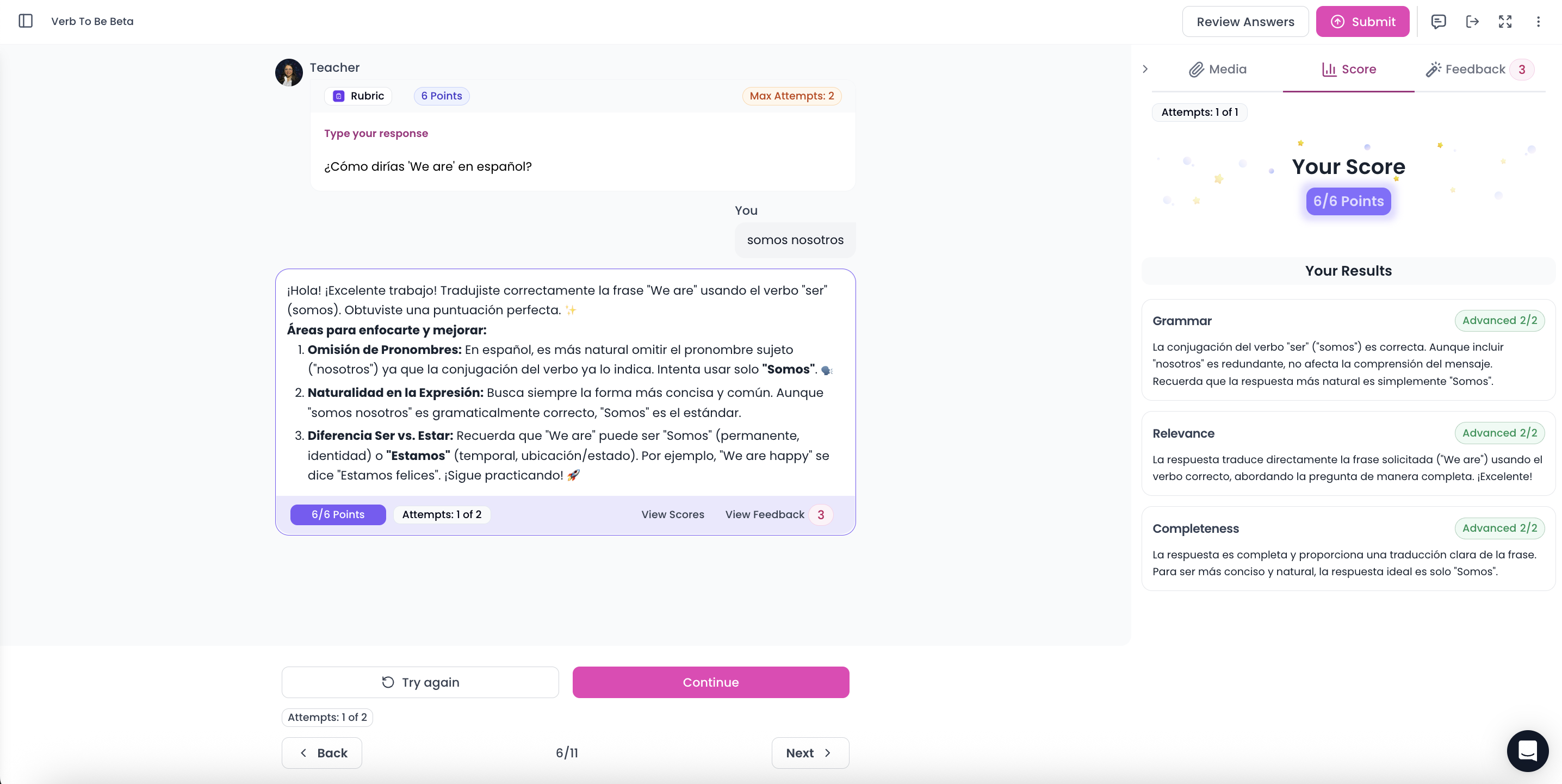
What stood out to me was how Speakable shortens the feedback cycle. Students receive AI feedback as soon as they complete an assignment, so they can act on corrections while the exercise is still fresh. I also found the portfolio view useful for tracking proficiency and giving individual guidance across larger groups.
Transcripts appear alongside each recording, AI rating, and feedback, reducing the effort involved in reviewing speaking assignments without removing the teacher from the process. Reports estimate proficiency against ACTFL or WIDA standards, and educators can upload their own rubrics to align assessments with their criteria.
What does Speakable's free plan include?
- $0 for one individual teacher
- 100 AI credits per month, automatically replenished monthly
- Tools to generate teaching materials with AI
- The ability to create and assign speaking and writing practice
- AI-credit access to:
- Open-response auto-grading
- Grammar insights
- Proficiency-level estimates
- Suggested responses - Unlimited pass/fail auto-grading for open-response activities
When should you upgrade your Speakable free plan?
Upgrade when 100 monthly AI credits no longer cover your assignments, multiple teachers need to collaborate, or you need student portfolios, secure assessments, LMS grade passback, or program-wide proficiency tracking.
Where Speakable genuinely stands out:
- Instant feedback is what reviewers say transforms the classroom, and the mechanism is timing rather than quality
- Reports run at student, class, or organizational level; rubrics are uploadable.
What G2 users like about Speakable:
"Speakable has the capability of rating samples using the ACTFL proficiency scale and providing students with detailed feedback."
- Speakable review, Melanie K.
Is Speakable right for you?
Best for: Language teachers and educational institutions who assign speaking and writing practice and want AI-assisted grading with standards-aligned reporting.
Not ideal for: Individual learners. Speakable is a teaching and assessment tool, and there's no self-directed course to work through on your own.
What I dislike about Speakable:
- G2 reviewers say teachers cannot edit an active assignment or reset a student’s attempts, which makes post-conference retries and mid-assignment corrections harder to manage. Speakable is therefore a better fit when activities and retry rules can be finalized before distribution.
- Its microphone sensitivity can be challenging in shared classrooms, where nearby voices may be captured alongside the intended speaker. Headsets, greater spacing, or quieter individual sessions can improve recording quality, but schools planning simultaneous speaking exercises should test the setup in their actual classroom environment first.
What G2 users dislike about Speakable:
"I dislike that if you would like to alter an assignment after assigning it, you are not able to do so."
- Speakable review, Meg M.
8. Speexx: Best for structured corporate language training with live coaching
Speexx is a people development platform built for corporate L&D, combining AI-driven learning with certified trainers and coaches, CEFR-based assessment, and role-specific content.
What stood out most in my evaluation was Speexx’s combination of instructor-led teaching and flexible, work-friendly learning. Its trainers provide personalized pronunciation guidance, check comprehension during live sessions, and follow conversations with written feedback on areas for improvement. That gives learners a level of individual direction that is difficult to reproduce in a purely self-service app.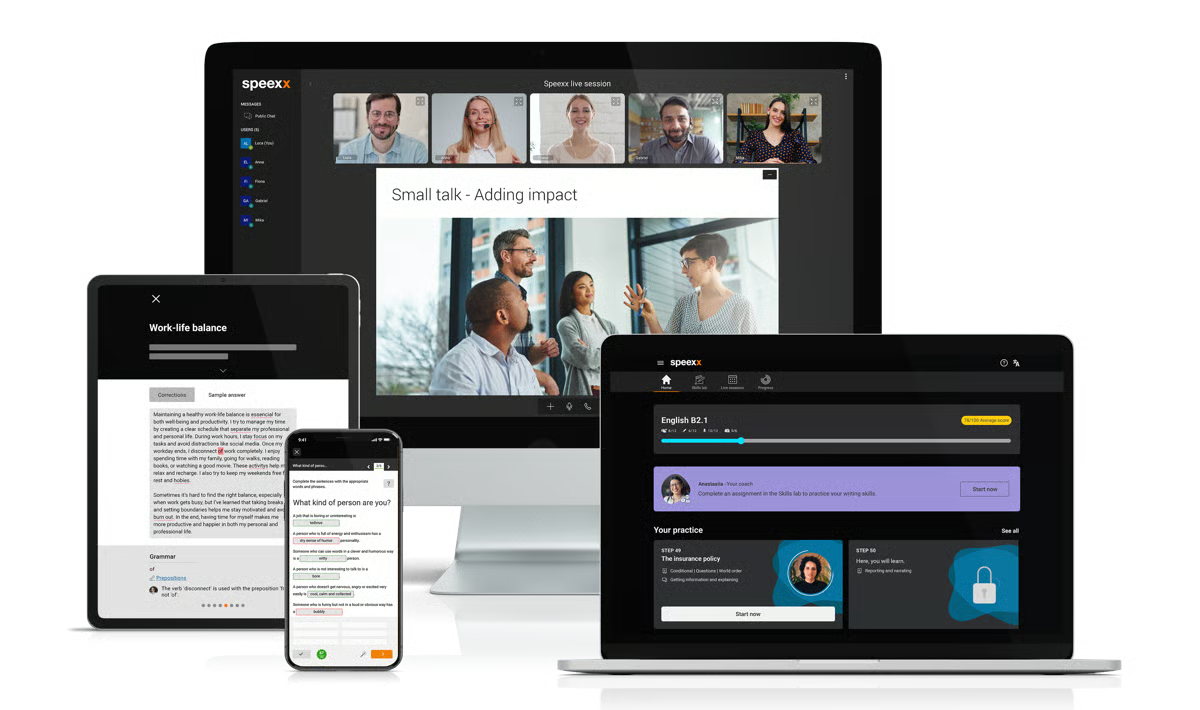
I also found Speexx well suited to employees fitting language study around a working day. Its business-focused content can adapt to learners’ interests and help them build skills for practical situations such as following conversations with international colleagues. As per G2 Data, Speex scores 94% for ease of use and ease of doing business with.
For larger organizations, integrations with SAP SuccessFactors, Workday, and Microsoft Teams make Speexx easier to incorporate into existing learning workflows. Its ISO/IEC 27001:2022, SOC 2 Type II, and TISAX certifications also strengthen its fit for enterprises where security and vendor assurance influence the shortlist.
What does Speexx's free plan include?
- No free-forever plan, 30 days of trial access
- Digital language learning available around the clock
- CEFR-aligned learning and assessment
- Speexx Talk AI-powered conversation practice
- Personalized learning paths
- Business-focused language content
- Intercultural training content
- Exposure to its broader language-training environment, which may include certified trainers and group or one-to-one classes
- Access through desktop and mobile devices
When should you upgrade from Speexx's trial?
Upgrade at the end of the trial or pilot, because there is no free-forever tier. Speexx doesn't publish self-serve pricing, so this is a procurement conversation rather than a checkout page, and the business case is whatever movement your pilot group's CEFR assessment data shows.
Where Speexx genuinely stands out:
- Voice messages demonstrating pronunciation, post-conversation reports identifying what to improve, and trainers who adapt topics to the learner's interests.
- The combination of self-study lessons with scheduled trainer sessions is the reason the habit survives a busy work week.
What G2 users like about Speexx:
"My experience with Speexx has been very enriching; the exercises are easy to execute and understand, which I have loved. I enjoy the quick response and the availability of the teachers to converse, as well as the additional tools like the videos. It is an entertaining service, with practical topics that are easy to internalize. Additionally, the initial setup process was easy."
- Speexx review, Francy Johana P.
Is Speexx right for you?
Best for: Organizations that need CEFR-aligned assessment, certified trainers, live group sessions, and HRIS or LMS integration, and that can run a pilot before committing.
Not ideal for: Individual learners looking for a free app to use on a commute.
What I dislike about Speexx:
- The breadth of the content library is useful for ongoing practice, although some materials need more frequent maintenance. Teams may benefit from curating recommended learning paths instead of giving employees unrestricted access to the entire catalog.
- Learners with little previous exposure could need more everyday examples and contextual guidance before moving into workplace language. Placement testing and trainer support can help establish the right starting point, making the platform better suited to guided beginner programs than an entirely self-directed introduction.
What G2 users dislike about Speexx:
I think one area for improvement could be offering even more interactive speaking activities and personalized content tailored to specific job roles.
- Speexx review, Tania S.
Building a broader employee learning program beyond language training? Compare the best eLearning content software for course libraries, certifications, technical upskilling, compliance, and professional development.
9. Talkpal for Business: Best for daily AI conversation practice
Talkpal for Business is an AI-powered language tutor that lets you chat by writing or speaking across 130+ languages, with a realistic voice on the other end. What makes it interesting is the range of conversation modes rather than the conversation itself. Chat, Roleplays, Characters, Debates, Call Mode, Sentence Mode, and Photo Mode each give you a different reason to open the app.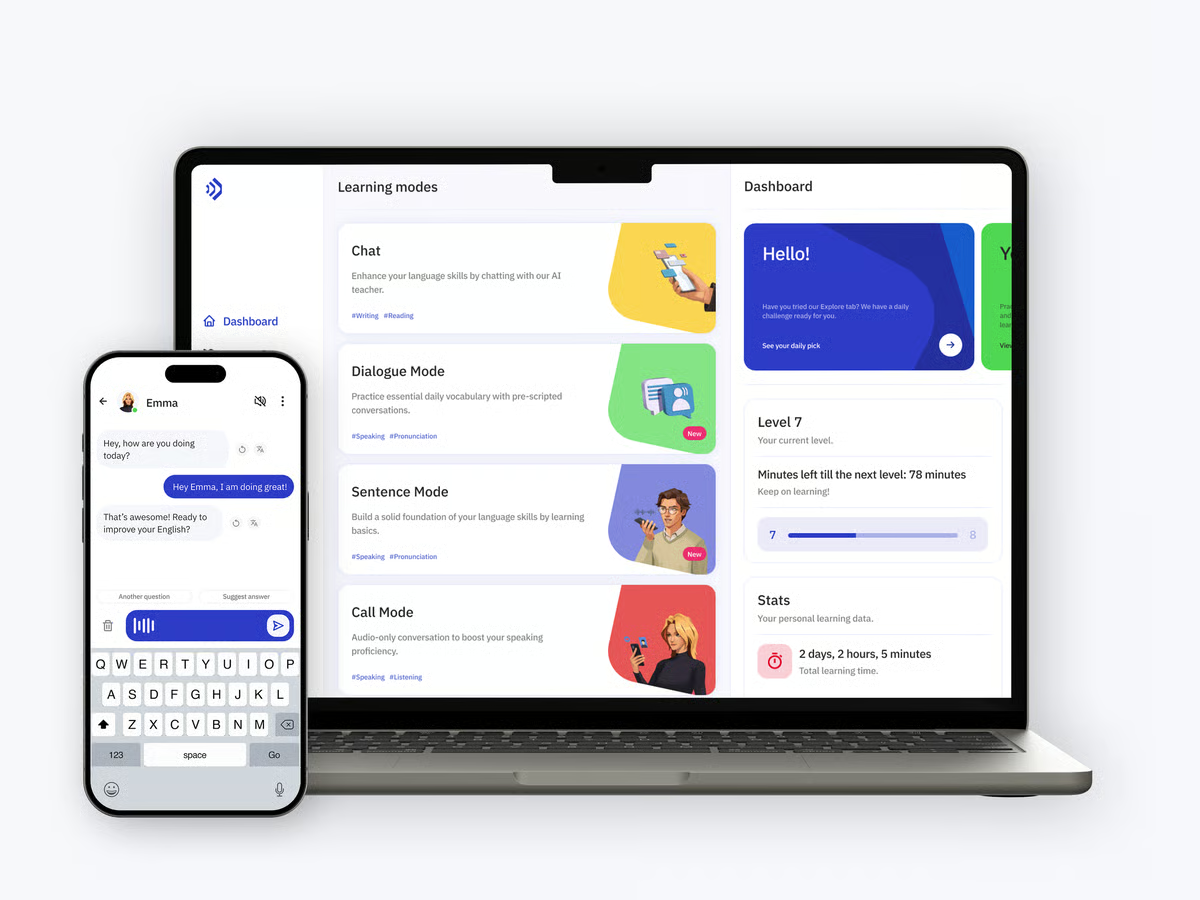
What stood out to me in my evaluation was how Talkpal creates a private, judgment-free space for speaking practice. Learners can rehearse conversations with AI at any time without the self-consciousness that can arise in a group class, helping them build confidence before speaking with a teacher, colleague, or client. This shows up in G2 Data: Talkpal for Business scores 100% for both natural language interaction and AI text-to-speech.
I also found its role-play scenarios more useful than unrestricted AI chat. Educators can assign practical situations, such as job interviews or ordering food, that reinforce an existing curriculum, while businesses can focus practice on conversations employees encounter at work. Combined with pronunciation feedback, this makes Talkpal a useful preparation tool for applying language skills in classrooms and professional settings.
What does Talkpal's free plan include?
- Free Basic plan: approximately 10 minutes of AI practice per day
- 14-day trial of Premium with 130+ currently advertised languages, access to all AI learning modes, advanced grammar explanations, specialized vocabulary exercises, personalized feedback covering speaking, writing, listening, and pronunciation.
When should you upgrade your Talkpal for Business free plan?
Upgrade once 10 minutes of daily practice isn't enough, which is roughly one roleplay scenario, so serious learners clear it in the first session. Premium removes the cap and unlocks all conversation modes.
Where Talkpal genuinely stands out:
- The 130+ language count is the widest here, and unlike apps that advertise a big number then restrict the free tier to a handful, the constraint is time rather than language choice.
- It creates a private, judgment-free space for speaking practice with AI. This prevents learners from being self-conscious in front of a live audience.
What G2 users like about Talkpal for Business:
"It helps students to immerse themselves in various real-life situations, and that it gives them more stimulus to express themselves. It's a great way to boost confidence since you are not talking to a real person and yet to a real-like talking partner."
- Talkpal for Business Review, Mikheil K.
Is Talkpal for Business right for you?
Best for: Intermediate learners whose comprehension has outrun their speaking, and who want low-stakes conversation practice without booking a tutor.
Not ideal for: Complete beginners who need structured grammar foundations first, or anyone expecting meaningful daily practice out of the free tier.
What I dislike about Talkpal for Business:
- Talkpal’s open-ended conversations are most effective for intermediate and advanced learners who already have enough vocabulary to keep an exchange moving. Complete beginners may find the starting point demanding, particularly when activities are pitched above their selected level. Organizations onboarding new learners may need to begin with structured prompts and basic scenarios before moving them into unrestricted conversation practice.
- Talkpal provides flexible AI conversation practice, although G2 reviewers note occasional missed grammar errors and want more ready-made lessons for specific workplace situations.
What G2 users dislike about Talkpal:
"Honestly not much. Sometimes it misses a small grammar mistake, and we'd love a few more ready-made lessons tied to specific work scenarios. Small things, though."
- Talkpal for Business Review, Marina M.
Who should use free language learning apps?
Free plans work best in three situations: you're deciding whether a language is something you'll actually stick with, you're supplementing a class or a tutor rather than replacing one, or you're testing an app before asking your employer to pay for a team licence. The ceiling shows up once you're consistent, which is exactly when daily caps, locked lessons, and paywalled speaking practice start to bite.
When does free stop being enough?
Four triggers recur across the nine tools here.
- The daily cap: Talkpal gives you roughly 10 minutes of conversation a day and Mondly gives you one lesson. Both are sustainable if you're building a habit, and both are exhausted in a single sitting if you're preparing for something.
- Human feedback: Busuu's free community corrections are the exception, not the rule. Everywhere else, getting a person rather than an algorithm to tell you what you got wrong sits behind a paywall.
- Proof: Certificates, CEFR-aligned assessment, and standards-based reporting are paid features almost universally.
- Quiet degradation: ELSA Speak and Memrise reviewers on G2 report free exercises repeating or disappearing after sustained use.
Frequently asked questions (FAQs) about free language learning apps
Have more questions? Find more answers below.
Q1. What are the most trusted free language learning programs by learners based on user reviews?
Speexx, ELSA Speak, and Busuu combine strong ratings with the largest verified review bases in G2's free language learning category. Speexx rates 4.6/5 across 800+ reviews, ELSA Speak 4.5/5 across 100+, and Busuu 4.5/5 across 50+.
Q2. Which are the highest rated free language learning platforms for effective skill development for enterprise teams with demanding schedules?
Busuu is the only platform here offering a free-forever plan alongside a business platform, which serves over 600 organizations with SSO and LMS integrations. Speexx and Babbel for Business rate highly for enterprise use, but neither has a permanent free tier: Speexx runs a trial and enterprise pilot programs for sample groups, and Babbel's free access is limited to the first lesson of every course.
Q3. What long-term engagement and retention support do free language learning plans offer before signing a long-term vendor contract?
Mondly by Pearson, Talkpal for Business, and Busuu give you enough on their free plans to test whether engagement holds before you commit. Mondly's free tier includes a daily lesson plus weekly and monthly challenges, Talkpal's free Basic plan gives roughly 10 minutes of AI conversation a day, and Busuu's free essential course includes corrections from native speakers.
Q4. How do free language learning platforms handle progress tracking and proficiency assessment for skill verification before committing to paid software?
Speakable, Busuu, and AlfaPTE all offer assessment on their free tiers. Speakable's free plan includes 100 monthly AI credits covering proficiency estimates aligned to ACTFL or WIDA standards; Busuu's free plan includes basic progress tracking and a placement test reviewers describe as fast and accurate, and AlfaPTE offers free PTE practice tests with AI scoring. The verification itself usually costs money, though: Busuu's CEFR completion certificates sit on the paid tier, and Speexx's CEFR-based assessment is only available through a trial or pilot. Test scoring accuracy during the free period, since AlfaPTE reviewers disagree about how closely its practice scores match real exam results.
Q5. How do free language learning plans, paid subscription options, and certification programs compare to identify the best fit?
Five of the nine tools here offer genuine free-forever plans: Busuu, ELSA Speak, Memrise, Mondly by Pearson, and Speakable. AlfaPTE and Speexx offer trials rather than permanent free access, and Babbel for Business limits free use to the first lesson of every course. On certification, Busuu issues CEFR-aligned A1 to C1 completion certificates recognised by employers across Europe but only on its paid tier, Speexx includes CEFR-based assessment in its corporate offering, and Babbel does not issue formal certification at all. Speexx does not publish self-serve pricing, so verify current rates against each vendor's own page before budgeting.
Q6. How should you evaluate free language programs for instructor availability, community support, and flexibility?
Busuu is the only tool on this list offering human feedback on its free plan, where native and fluent speakers correct your written and spoken submissions. Everywhere else, instruction from a person sits behind a paywall:
Q7. How do free language learning platforms compare on curriculum quality, lesson format, and speaking practice?
Memrise offers the most usable free curriculum, with most of its learning content and over 20 official courses available without paying, while Busuu's free essential course draws specific praise for its grammar explanations and audio delivered at varying speeds. For free speaking practice, Talkpal for Business gives roughly 10 minutes of AI conversation daily.
Q8. How does free language learning effectiveness depend on engagement features, methodology, and instructor quality for organizations evaluating solutions?
Methodology and engagement features travel well into free tiers, but instructor quality generally does not. Memrise offers the clearest free-tier methodology evidence. Mondly by Pearson delivers engagement through a free daily lesson plus weekly and monthly challenges, and Busuu is the exception on instruction by providing free corrections from real native speakers.
Q9. Which free language programs combine lessons, conversation practice, and cultural immersion for organizations evaluating solutions?
Memrise, Busuu, and Talkpal for Business come closest, and all three offer this on a free plan. Memrise pairs its free courses with video of real native speakers, which reviewers credit with helping them develop a natural accent by hearing how words are actually pronounced. Busuu's free plan connects learners to a community of native speakers who correct their work, and Talkpal's free Basic plan simulates scenarios such as job interviews or ordering food across languages.
Q10. Which free language learning platforms offer structured courses and interactive tools for skill development?
Busuu, Mondly by Pearson, and Memrise all provide structured courses on genuinely free plans. Busuu's free essential course is CEFR-aligned with community correction, Mondly offers one free daily lesson across 41 languages with interactive dialogues and speech recognition, and Memrise makes most of its 20-plus official courses available free with ads.
Choose the free language app that fits your learning style
The best free language learning app isn’t the one with the longest feature list, it’s the one whose free tier survives contact with your actual schedule.
If you want human correction without paying, Busuu is the clearest choice here. If people struggle to understand your English rather than to follow your grammar, ELSA Speak will tell you exactly which sounds are the problem. If you can read a language but freeze when speaking it, Talkpal gives you ten low-stakes minutes a day to fix that. If consistency is your problem rather than ambition, Mondly’s single daily lesson is designed for exactly that. If you’re a teacher drowning in speaking assignments, Speakable’s free credits will buy back your evenings. And if you want the most usable free tier for solo vocabulary work, Memrise gives away more than anyone else on this list.
Pick one and give it a month of real use. You’ll learn more from that than from any comparison table, including this one.
Need a platform for more than language practice? Compare the best online learning platforms for learner engagement, analytics, HR integrations, and multilingual content delivery