AI-Generated Results
Finding matches…
Not seeing what you're looking for?
Dive deeper into "OpenRole" on G2 AI

A complete accounting/ERP system with all of the core financials, fuel, lubricants, home heat/propane, cardlock, c-store, supply chain automation, advanced business analytics, customer relationship management, fixed assets, paperless office and e-Business modules.

Openredis offers dependable Redis hosting with automated backups and memory monitoring.

Netra is a reliability platform purpose-built to observe, evaluate and simulate every decision your AI agents make.
Purpose-built for the non-deterministic reality of AI agent workflows, Netra brings together multiple capabilities in a single platform:
Tracing & Observability: Capture every LLM call, tool execution, cost, and latency across your entire agent workflow — with end-to-end trace visibility and real-time dashboards.
Evaluation: Test every change against production data before it reaches users. Build datasets from live traces, run LLM-as-a-Judge and code evaluators, and catch regressions before they become incidents.
Simulation: Run multi-turn conversational tests with configurable user personas and goals before going live — the only platform with built-in agent simulation.
Monitoring & Insights: Real-time alerts on cost, latency, and error thresholds. Plus Netra Insights — automatic intent discovery, drift detection, and daily AI-generated briefings on what changed in your agents.
OpenTelemetry-native by design, Netra enables faster debugging, safer deployments, and more reliable agent experiences, while remaining agnostic to your model provider, orchestration framework, and cloud. SOC 2 Type II, HIPAA, and GDPR compliant.

SolarFlow is cloud-based solar installation management software developed for solar installation companies in Ireland. It combines CRM, lead and customer management, sales tracking, site surveys, installation scheduling, field operations, job documentation and compliance workflows in one platform. Employee management is available as an optional add-on.
The software helps companies manage customer enquiries, assign work to sales and installation teams, record site survey information, capture installation photos, track job progress, manage faults and rework, and organise relevant SEAI grant and ESB documentation. Customer and installation information recorded in the platform can be used to populate relevant forms and documents.
SolarFlow integrates with OpenSolar and Pylon for solar system design workflows, and with HubSpot for customer relationship management. The optional employee management add-on includes staff records, schedules, leave management, timesheets and document storage.
Office teams can access SolarFlow through a desktop, while field teams can use the mobile apps for iOS and Android. The platform supports offline photo capture on site, with data synchronised when connectivity is restored. Managers can use the dashboard to view leads, sales, jobs in the pipeline, sales team performance and active faults. A weekly PDF summary is also delivered by email.

XSite is a powerful three-dimensional hydraulic fracturing numerical simulation program based on the Synthetic Rock Mass (SRM) and Lattice methods. XSite is capable of modeling multiple wellbores with multiple stages and clusters, including open-hole completions and perforation tunnels. XSite resolves general hydraulic fracture interaction, including propagation in naturally fractured reservoirs with deterministically or stochastically generated discrete fracture networks (DFNs). The models conduct fully coupled hydro-mechanical simulations. Fluid flow is simulated as fracture flow within the joint networks and as matrix flow within the intact rock.

The PSE Petroleum Structural Engineering is an Advanced Engineering Software Technology for the Design of complex ONSHORE and OFFSHORE structures. Based on the latest API 4F Specifications for Drilling and Well Servicing Structures the PSE innovative solution aim to increase the productivity and competitiveness of international companies worldwide.

IronWiFi is a cloud-based SaaS platform designed to help Wi-Fi operators build, manage, scale, and monetize their networks efficiently. It enables businesses to control network access through advanced authentication methods, including certificate-based security and custom policy enforcement. With a presence in over 100 countries, IronWiFi supports more than 8,000 custom-branded captive portals and over 12,000 RADIUS servers, ensuring secure and scalable network management.
Key Features and Functionality:
- Captive Portals: Create fully customizable splash pages to engage users, supporting multiple authentication methods such as social login, vouchers, paid access, and REST API integration.
- RADIUS-as-a-Service: Utilize scalable, cloud-based RADIUS servers that handle authentication and accounting, supporting thousands of vendor-specific attributes, Change of Authorization (CoA, and data/time usage limits.
- OSU & SCEP: Deploy Online Sign-Up Servers compatible with OpenRoaming and custom identity providers, automating device certificate provisioning via SCEP for secure access.
- Roaming & Offload: Enhance network performance and user experience by offloading mobile traffic, with Passpoint profiles enabling automatic, secure roaming between access points and networks.
- Enterprise-Grade Security: Implement WPA-Enterprise protection using certificate-based authentication and granular access policies, integrating seamlessly with identity providers like Okta, Azure AD, and Google Workspace.
Primary Value and Solutions Provided:
IronWiFi addresses the critical need for secure and efficient Wi-Fi network management. By offering customizable captive portals, it allows businesses to enhance user engagement and collect valuable visitor data. The platform's robust authentication mechanisms ensure secure access for both guests and employees, protecting internal networks from unauthorized use. Its scalability and integration capabilities make it suitable for various industries, including hospitality, retail, education, and enterprise environments, enabling organizations to manage their Wi-Fi networks effectively while enhancing user experience and security.

Petroleum Carrier Dispatch & Billing System is a petroleum carrier dispatch and billing system that provides real-time information with automated billing and up-to-date management reports to be tailored to your business needs.

Key Information Technologies provides comprehensive software solutions for the petroleum wholesale/retail and home heat industries including full-scale accounting, delivery and invoicing automation, supply chain integration, in-vehicle data collection, convenience store and consignment integration.

Aspen Petroleum Supply Chain Planner, manages the assets and economics of the petroleum distribution network to optimize performance.

The Petroleum Structural Engineering® (PSE) software is a specialized 3D structural analysis and design tool tailored for offshore and onshore oil and gas drilling structures, including platforms, rigs, masts, and substructures. It ensures compliance with the API Specification 4F, 5th Edition, Drilling and Well Servicing Structures.
Key Features and Functionality:
- Comprehensive Structural Analysis: PSE offers advanced finite element analysis (FEA) capabilities, enabling precise modeling of complex structures.
- Automated Wind Load Calculations: The software automatically computes wind loads and considers wind walls, streamlining the design process.
- Unbraced Length Determination: PSE automates the calculation of member unbraced lengths, enhancing design accuracy.
- Dynamic Analysis: It accounts for vessel movements and wave-induced forces, providing a realistic assessment of structural behavior under dynamic conditions.
- User-Friendly Interface: Built on a ribbon-based interface, PSE organizes tools and commands into intuitive tabs and groups, facilitating effortless navigation and efficient workflow.
Primary Value and User Solutions:
PSE addresses the critical need for accurate and efficient structural analysis and design in the oil and gas industry. By integrating advanced analysis tools with automated design features, it reduces manual calculations, minimizes errors, and ensures compliance with industry standards. This leads to enhanced productivity, cost savings, and the development of safer, more reliable drilling structures.

Predict the generation, migration, accumulation, and loss of hydrocarbons over geological time.

OpenLIT is an open-source platform designed to streamline AI development workflows, particularly for Generative AI and Large Language Models (LLMs). It offers comprehensive observability tools that enable developers to monitor, evaluate, and optimize their AI applications effectively. By integrating OpenLIT, users can experiment with various LLMs, manage and version prompts, and securely handle API keys. The platform's OpenTelemetry-native observability provides full-stack monitoring, including LLMs, vector databases, and GPUs, facilitating a seamless transition from development to production.
Key Features and Functionality:
- Analytics Dashboard: Offers detailed dashboards to monitor application health and performance, tracking metrics, costs, and user interactions for a clear view of overall efficiency.
- OpenTelemetry-native Observability SDKs: Provides vendor-neutral SDKs to send traces and metrics to existing observability tools, ensuring seamless integration.
- Cost Tracking for Custom and Fine-Tuned Models: Allows for tailored cost estimations using custom pricing files, enabling precise budgeting.
- Exceptions Monitoring Dashboard: Facilitates quick identification and resolution of issues by tracking common exceptions and errors through a dedicated monitoring dashboard.
- Prompt Management: Enables management and versioning of prompts using Prompt Hub, ensuring consistent and easy access across applications.
- API Keys and Secrets Management: Provides a secure central repository for handling API keys and secrets, promoting secure practices.
- Experimentation with Different LLMs: Utilizes OpenGround to explore, test, and compare various LLMs side by side, aiding in informed decision-making.
Primary Value and Problem Solved:
OpenLIT addresses the challenges developers face in monitoring and optimizing AI applications, especially those involving LLMs and GPUs. Traditional monitoring tools often lack the specificity required for AI workflows. OpenLIT fills this gap by providing detailed insights into performance metrics, cost analysis, and prompt management. Its seamless integration with existing observability tools and support for over 20 integrations, including OpenAI and LangChain, enhances the efficiency and reliability of AI applications. By offering a user-friendly setup and comprehensive monitoring capabilities, OpenLIT empowers developers to build and manage AI applications with confidence.

Self-hosted workspace for governed AI development/automation, accessible from desktop, tablet, and phone.
Run Claude Code, Codex, Cursor, and OpenCode in isolated runtimes with persistent memory, ticket-driven orchestration, and full session history. Each engine operates in its own sandboxed environment with git worktree branching, browser access through an extension bridge, and voice-to-text input.
Multi-project management with independent ticket hierarchies, folder organization, and cross-project orchestration. Session forking, keyboard shortcuts editor, command center, and a 3-level settings cascade for teams.
Supports 28 diagram syntaxes (Mermaid, PlantUML, D2, and more) plus freehand sketching and drawing. Persistent project memory with scoped recall across assistant, project, and execution levels.
Dynamic dashboards with agent-generated metrics and scheduled reporting. Full observability across agents: activity logs showing which agent executed which ticket, parent-child orchestration chains, and session transcripts. Agents can run on schedules, produce status dashboards, and surface trends without manual intervention.
Free during early access, no sign-up, no credit card.
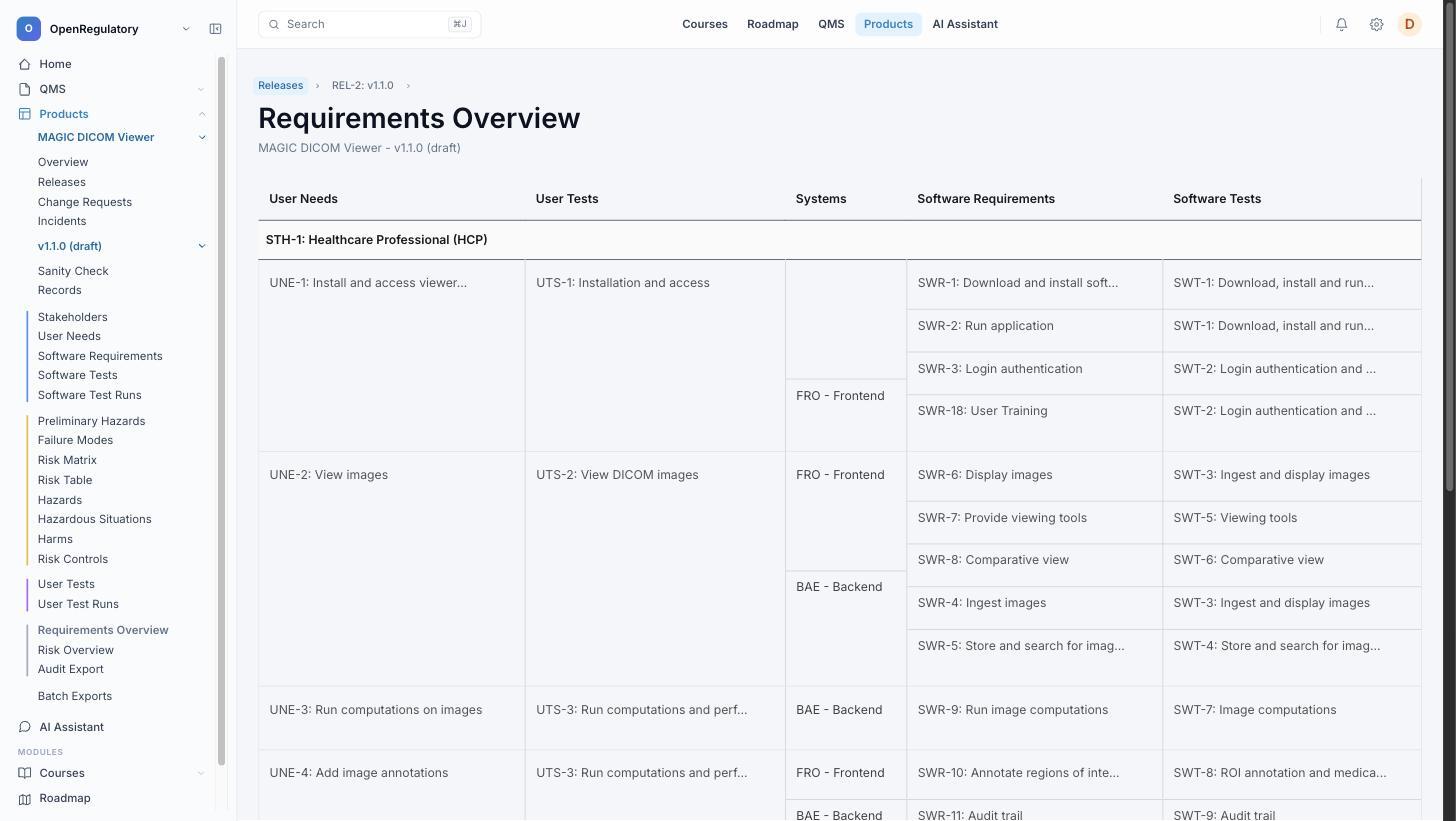
Formwork is a complete eQMS software and requirements management system for medical devices targeting EU MDR or US FDA approval.
Its in-browser document and record editing features include a rich-text editor, document versioning and FDA CFR 21 Part 11 e-signing compliance.
It also includes a user trainings feature to ensure that all employees are trained on relevant procedures.
The requirements feature covers technical documentation as per IEC 62304, risk management as per ISO 14971 and usability evaluation as per IEC 62366.

Inquir Compute is a self-hosted serverless platform designed to provide developers with full control over their infrastructure. It offers compatibility with AWS Lambda APIs, enabling seamless deployment of serverless functions using Python and Node.js on both cloud and on-premise environments. This flexibility allows organizations to run serverless applications without relying on third-party services, ensuring data privacy and compliance with internal policies.
Key Features and Functionality:
- AWS Lambda Compatibility: Inquir Compute supports AWS Lambda APIs, facilitating easy migration and integration for existing serverless applications.
- Multi-Language Support: Developers can deploy functions written in Python and Node.js, catering to a wide range of use cases.
- Flexible Deployment Options: The platform can be deployed on various infrastructures, including cloud services and on-premise servers, providing adaptability to different organizational needs.
- HTTP API Gateway: Inquir Compute includes an API Gateway that allows functions to be exposed as HTTP endpoints with flexible routing, multiple authentication methods, and built-in CORS and rate limiting support.
- Function Pipelines: The platform offers a visual pipeline builder for orchestrating multi-step workflows, supporting sequential execution, DAG workflows, and smart retry logic.
- Built-in Observability: With OpenTelemetry compatibility, Inquir Compute provides metrics, distributed tracing, and AI-powered insights, enabling developers to monitor and optimize performance effectively.
Primary Value and Problem Solved:
Inquir Compute addresses the need for organizations to run serverless applications while maintaining full control over their infrastructure. By offering a self-hosted solution compatible with AWS Lambda, it eliminates dependency on external cloud providers, enhancing data security and compliance. The platform's flexibility in deployment, support for multiple programming languages, and comprehensive observability tools empower developers to build, deploy, and manage serverless functions efficiently within their own environments.

Centreon Log Management is a comprehensive, scalable, and cost-effective solution designed to streamline log monitoring for modern IT environments. It enables organizations to efficiently collect, analyze, and manage logs from diverse sources, enhancing operational visibility and accelerating incident resolution. By integrating seamlessly with existing infrastructures, Centreon Log Management empowers IT teams to cut through the noise, troubleshoot faster, and scale with confidence.
Key Features and Functionality:
- Comprehensive Log Collection: Gathers logs from various IT environments—on-premises, cloud, or hybrid—using OpenTelemetry collectors, ensuring compatibility and flexibility.
- Data Normalization and Noise Reduction: Normalizes and standardizes log data upon ingestion, reducing storage requirements and simplifying queries by eliminating irrelevant or duplicate entries.
- Contextual Enrichment: Automatically enriches log entries with metadata such as host, location, service name, or business criticality, facilitating smarter filtering and correlation.
- Advanced Analysis Tools: Provides powerful filters, full-text search, and a built-in query language to quickly isolate significant events, aiding in rapid root cause analysis.
- Custom Dashboards: Offers intuitive dashboards with drag-and-drop widgets to monitor key log metrics, activity volumes, and error rates in real-time.
- Integrated Alerting: Allows for the definition of rule-based alerts for critical events, with seamless integration into existing workflows and ITSM systems for efficient response.
- Compliance and Security: Ensures secure log storage with configurable retention policies, role-based access control, and audit trails to meet regulatory requirements.
- Scalability and Cost Control: Features a transparent licensing model and built-in consumption tracking, enabling organizations to scale log monitoring without unexpected costs.
Primary Value and Problem Solved:
Centreon Log Management addresses the challenges of managing vast amounts of log data in complex IT infrastructures. By providing a unified platform for log collection, normalization, enrichment, and analysis, it enhances operational efficiency and accelerates incident resolution. The solution's scalability and cost-effectiveness ensure that organizations can maintain optimal performance and compliance without incurring unforeseen expenses.
Clarami AI is an intelligent research workspace for students, researchers, and professionals who need their writing grounded in evidence from start to finish.
Unlike general-purpose AI chatbots or standalone grammar tools, Clarami AI is purpose-built for academic and professional writing and structurally connecting your draft, sources, and citations so nothing falls through the cracks. Every drafted claim links back to the exact page and passage in your source, making evidence checks fast, transparent, and reliable.
What you can do with Clarami AI:
1. Write in a real document editor with inline AutoDraft suggestions grounded in your own references
2. Discover and import academic literature through integrated search (OpenAlex, Semantic Scholar, arXiv, CrossRef, and more)
3. Manage PDFs and pull source context directly into your writing
4. Cite in APA, Chicago, Harvard, IEEE, or Vancouver — with structured metadata and automatic bibliography generation
5. Use Clara, a document-aware AI assistant, for grounded drafting help that stays within your source context
6. Verify claim–evidence alignment with ClaimShield before submission
7. Review for tone, grammar, and clarity in dedicated passes
8. Export finished work in DOCX, PDF, or LaTeX
Clarami AI supports two structured workflows: long-form writing and STEM & coursework, and is built around a single principle: every claim should be traceable back to its source. Academic integrity isn't a feature bolted on at the end. It's the foundation the product is built on.
Free tier available. Pro and Platinum plans unlock expanded AI drafting, larger PDF uploads, and advanced features. No credit card required to start.