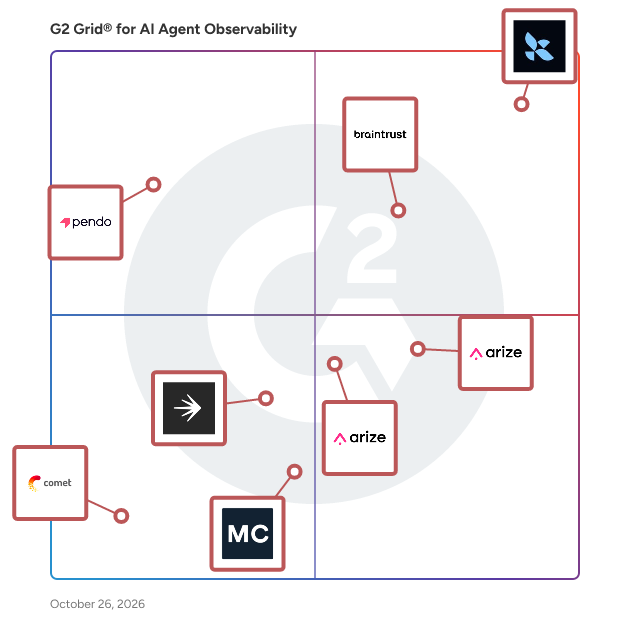
AI agent observability platforms are software tools that give engineering and data teams end-to-end visibility into the behavior, performance, and reliability of AI agents operating in production. As organizations deploy agents that orchestrate large language models (LLM) with external tools, memory, retrieval systems, and multi-step reasoning workflows, the complexity and non-deterministic nature of these systems make traditional monitoring approaches insufficient.
Core Capabilities of AI Agent Observability Software
To qualify for inclusion in the AI Agent Observability category, a product must:
- Provide end-to-end tracing of multi-step AI agent workflows, including LLM calls, tool invocations, retrieval steps, and intermediate reasoning states
- Support automated evaluation of agent outputs using methods such as LLM-as-judge, rule-based checks, or custom evaluators
- Monitor agent performance in production, including token usage, latency, cost attribution, and error rates
- Alert teams to quality degradations, behavioral regressions, or system failures in agentic workflows
- Address the non-deterministic nature of AI systems, not solely traditional application or infrastructure metrics
- Support deployment in production environments, not only offline testing or pre-release evaluation
Common use cases for AI Agent Observability Software
AI agent observability platforms are purpose-built to address this gap, providing the tracing, evaluation, and alerting capabilities teams need to detect, diagnose, and resolve issues across every layer of an agentic system.
AI agent observability platforms create value by closing the gap between AI deployment and AI accountability. They reduce the time required to identify and resolve production issues, enable continuous quality evaluation without manual review at scale, and give business and technical leaders the confidence to expand AI initiatives, knowing that performance is being monitored and measured. Rather than replacing engineering judgment, these platforms extend it, surfacing the signals that would otherwise require hours of manual investigation.
Organizations use AI agent observability platforms to understand not just what an agent produced, but why it produced it, tracing the full chain of reasoning, tool calls, retrieval steps, and model interactions that led to a given output. This level of visibility is essential for identifying failure modes such as hallucinations, prompt drift, degraded retrieval quality, runaway token costs, and silent performance regressions that would otherwise go undetected until they impact end users or business outcomes.
These platforms are used primarily by AI engineers and machine learning (ML) engineers who need to debug and optimize agent behavior, MLOps and platform engineers responsible for maintaining AI systems at scale, data teams ensuring that the inputs feeding agents are accurate and reliable, and governance and compliance teams that require audit trails and transparency into how AI systems arrive at decisions. They are deployed across industries where agentic AI systems are moving from pilot to production and where reliability and trust are prerequisites for continued investment.
How AI Agent Observability Software Differs from Other Tools
Unlike traditional application performance monitoring tools, which capture infrastructure and code-level telemetry, AI agent observability platforms are designed for the unique characteristics of AI systems: non-deterministic outputs, multi-step reasoning chains, prompt and context sensitivity, and quality dimensions that cannot be assessed through conventional error rates or latency metrics alone. They apply AI-native evaluation methods such as LLM-as-judge scoring, semantic similarity checks, and deterministic rule-based evaluations to assess output quality continuously and at scale. They are equally distinct from data observability platforms, which focus on the health and reliability of data pipelines, warehouses, and BI systems. While data observability ensures that the inputs feeding an AI system are accurate and timely, it does not monitor what the agent does with those inputs: the reasoning, tool calls, model behavior, and outputs that AI agent observability platforms are specifically built to surface.
These platforms integrate with systems such as large language models (LLMs), cloud data warehouses, vector databases, data observability platforms, and MLOps tools, positioning them as the monitoring and evaluation layer that makes production AI systems trustworthy, explainable, and operationally sustainable.
Insights from G2 on AI Agent Observability Software
Based on category trends on G2, end-to-end tracing of multi-step agent workflows and automated output evaluation stand out as key capabilities. AI engineers, ML engineers, and platform teams rely on production monitoring and alerts to catch hallucinations, regressions, and runaway token costs early.