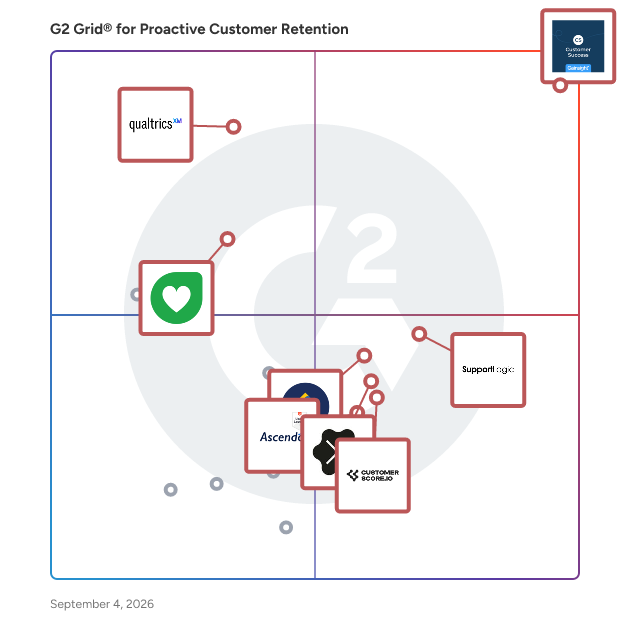
Proactive customer retention software detects the risk indicators that lead to customer churn and escalation. Churn occurs when customers haven’t received quality support in their customer service experience, such as when their concerns have a slow resolution or are ignored.
Core Capabilities of Proactive Customer Retention Software
To qualify for inclusion in the Proactive Customer Retention category, a product must:
- Use artificial intelligence to identify customer sentiment and topic trends
- Assist with intelligent, automated case assignment and routing
- Predict case escalations and customer churn risks
- Provide capabilities to analyze retention history, revenue impact, escalation history, or health scores
- Integrate with help desk software
Common use cases for Proactive Customer Retention Software
To proactively address concerns before escalation, this type of software uses natural language processing (NLP), natural language understanding (NLU), or natural language generation (NLG) technologies to recognize sentiments and content that indicate customer dissatisfaction. The dissatisfaction is quantified into a health score to indicate case urgency and severity. The company can administer immediate triage by routing the case to a qualified agent. Proactive customer service is the best defense against attrition.
These products are used by customer service and customer success teams to optimize response time and reduce the likelihood of customer churn. Reducing customer churn is one of the most cost-efficient ways for companies to accelerate growth.
How Proactive Customer Retention Software Differs from Other Tools
Proactive customer retention software will often integrate with contact center quality assurance software, customer success software, CRM software, and help desk software.
Insights from G2 on Proactive Customer Retention Software
Based on category trends on G2, AI sentiment detection, escalation prediction, and churn risk prediction stand out as primary strengths. Customer service and customer success teams use health scores and automated routing to act on at-risk customers sooner.