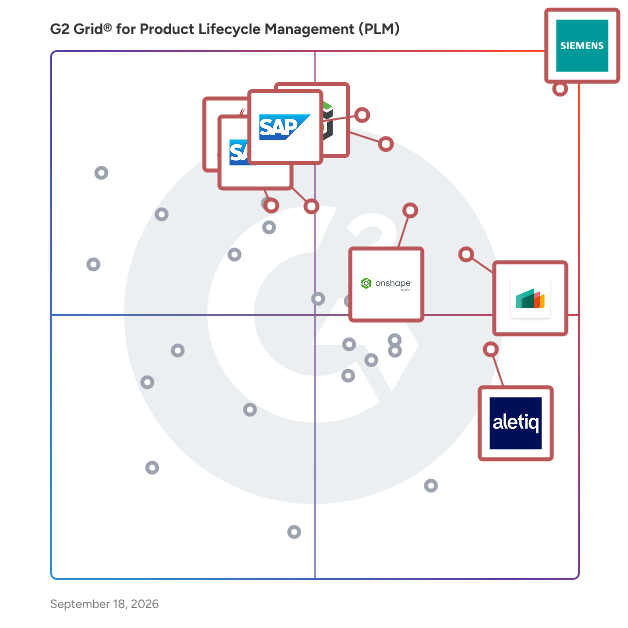
  # Best Enterprise Product Lifecycle Management (PLM) Software

  *By [Daniel Rivera](https://research.g2.com/insights/author/daniel-rivera)*

   Products classified in the overall Product Lifecycle Management (PLM) category are similar in many regards and help companies of all sizes solve their business problems. However, enterprise business features, pricing, setup, and installation differ from businesses of other sizes, which is why we match buyers to the right Enterprise Business Product Lifecycle Management (PLM) to fit their needs. Compare product ratings based on reviews from enterprise users or connect with one of G2&#39;s buying advisors to find the right solutions within the Enterprise Business Product Lifecycle Management (PLM) category.

In addition to qualifying for inclusion in the Product Lifecycle Management (PLM) Software category, to qualify for inclusion in the Enterprise Business Product Lifecycle Management (PLM) Software category, a product must have at least 10 reviews left by a reviewer from an enterprise business.


## How Many Product Lifecycle Management (PLM) Software Products Does G2 Track?
**Total Products under this Category:** 97

### Category Stats (May 2026)
- **Average Rating**: 4.3/5 (↑0.01 vs Apr 2026)
- **New Reviews This Quarter**: 147
- **Buyer Segments**: Mid-Market 49% │ Enterprise 32% │ Small-Business 19%
- **Top Trending Product**: Teamcenter (+0.003)
*Last updated: May 18, 2026*

  
## How Does G2 Rank Product Lifecycle Management (PLM) Software Products?

**Why You Can Trust G2's Software Rankings:**

- 30 Analysts and Data Experts
- 8,700+ Authentic Reviews
- 97+ Products
- Unbiased Rankings

G2's software rankings are built on verified user reviews, rigorous moderation, and a consistent research methodology maintained by a team of analysts and data experts. Each product is measured using the same transparent criteria, with no paid placement or vendor influence. While reviews reflect real user experiences, which can be subjective, they offer valuable insight into how software performs in the hands of professionals. Together, these inputs power the G2 Score, a standardized way to compare tools within every category.

  
## Which Product Lifecycle Management (PLM) Software Is Best for Your Use Case?

- **Best for Small Businesses:** [Teamcenter](https://www.g2.com/products/teamcenter/reviews)
- **Best for Mid-Market:** [Teamcenter](https://www.g2.com/products/teamcenter/reviews)
- **Best for Enterprise:** [Teamcenter](https://www.g2.com/products/teamcenter/reviews)
- **Highest User Satisfaction:** [Teamcenter](https://www.g2.com/products/teamcenter/reviews)
- **Best Free Software:** [Teamcenter](https://www.g2.com/products/teamcenter/reviews)

  
---

**Sponsored**

### Sibe

Sibe is a collaboration-first cloud PDM built for mechanical engineering teams using SOLIDWORKS. It helps teams manage CAD files, preserve references, control revisions, and collaborate securely without the cost and complexity of traditional PDM systems. With Sibe, engineers can check files in and out, manage versions, track history, and work on individual parts or subassemblies directly from a native SOLIDWORKS add-in. This helps prevent accidental overwrites, broken references, and merge conflicts, even when teams are working concurrently or offline. Sibe also includes web-based collaboration tools for non-CAD stakeholders. Teams can share projects, specific versions, or released revisions with vendors, customers, manufacturing teams, and reviewers on any device. Unlimited web visitors are free, and access controls help protect IP by managing roles, permissions, and download rights. Because Sibe is cloud-based, there are no servers, VPNs, or heavy admin work required. Teams can start quickly, avoid complex upfront migration, and build a controlled engineering workflow from design through approval and release.


[Visit website](https://www.g2.com/external_clickthroughs/record?secure%5Bad_program%5D=ppc&amp;secure%5Bad_slot%5D=category_product_list&amp;secure%5Bcategory_id%5D=184&amp;secure%5Bdisplayable_resource_id%5D=184&amp;secure%5Bdisplayable_resource_type%5D=Category&amp;secure%5Bmedium%5D=sponsored&amp;secure%5Bplacement_reason%5D=page_category&amp;secure%5Bplacement_resource_ids%5D%5B%5D=184&amp;secure%5Bprioritized%5D=false&amp;secure%5Bproduct_id%5D=1333984&amp;secure%5Bresource_id%5D=184&amp;secure%5Bresource_type%5D=Category&amp;secure%5Bsource_type%5D=category_page&amp;secure%5Bsource_url%5D=https%3A%2F%2Fwww.g2.com%2Fcategories%2Fproduct-lifecycle-management-plm%2Ff%2Fautocad-integration&amp;secure%5Btoken%5D=74b6622a248adac08376ecf3b1a20177defa088fbaef3b044f58e60bdc6f8fe9&amp;secure%5Burl%5D=https%3A%2F%2Fwww.sibe.io%2Fcloud-based-pdm&amp;secure%5Burl_type%5D=custom_url)

---

  ## What Are the Top-Rated Product Lifecycle Management (PLM) Software Products in 2026?
### 1. [Teamcenter](https://www.g2.com/products/teamcenter/reviews)
  Teamcenter® software is a modern, adaptable product lifecycle management (PLM) system designed to help organizations manage the entire lifecycle of a product from inception, through engineering design and manufacturing, to service and disposal. By connecting people and processes across functional silos, Teamcenter utilizes a digital thread to facilitate innovation and streamline product development. This comprehensive approach enables teams to collaborate effectively, ensuring that every stakeholder is engaged in the product development process. The target audience for Teamcenter encompasses a diverse range of professionals, including manufacturers, engineers, and product managers across industries such as automotive, aerospace, electronics, and consumer goods. These professionals often face complex challenges in product development, including managing intricate supply chains, ensuring compliance with regulations, and meeting customer demands for faster innovation. Teamcenter addresses these challenges by providing a centralized platform where teams can access critical information, share insights, and make informed decisions throughout the product lifecycle. Key features of Teamcenter include robust data management capabilities that allow users to organize and control product data efficiently. The software supports advanced visualization tools that enable teams to review and analyze designs collaboratively, which reduces errors and enhances decision-making. Additionally, Teamcenter&#39;s intuitive user interface simplifies navigation, making it easier for users to engage with the system and access the information they need. The platform also offers flexible deployment options, allowing organizations to choose between on-premises, cloud-based, or SaaS solutions via Teamcenter X, ensuring that they can adapt the software to their specific needs and infrastructure. The benefits of using Teamcenter are significant. Organizations can innovate faster by leveraging the software&#39;s comprehensive portfolio of solutions tailored to various aspects of product development. The integration of processes and data helps to eliminate silos, fostering collaboration and improving communication among teams. Furthermore, Teamcenter&#39;s scalability ensures that it can grow alongside an organization, accommodating increasing complexity and volume in product development efforts. By providing a unified platform for managing the entire product lifecycle, Teamcenter empowers organizations to deliver high-quality products more efficiently and effectively. In essence, Teamcenter serves as a vital tool for organizations looking to enhance their product development processes, ensuring that they can navigate the complexities of modern manufacturing and meet the evolving demands of the market.


  **Average Rating:** 4.3/5.0
  **Total Reviews:** 914
**How Do G2 Users Rate Teamcenter?**

- **Product Intelligence:** 8.5/10 (Category avg: 7.5/10)
- **Ease of Use:** 7.7/10 (Category avg: 8.3/10)
- **Development:** 8.7/10 (Category avg: 8.1/10)
- **ECO Management:** 8.6/10 (Category avg: 8.3/10)

**Who Is the Company Behind Teamcenter?**

- **Seller:** [Siemens Digital Industries Software](https://www.g2.com/sellers/siemens-digital-industries-software)
- **Company Website:** https://www.sw.siemens.com/
- **Year Founded:** 1980
- **HQ Location:** Plano, Texas
- **Twitter:** @siemenssoftware (36,966 Twitter followers)
- **LinkedIn® Page:** https://www.linkedin.com/company/28423178/ (20,658 employees on LinkedIn®)

**Who Uses This Product?**
  - **Who Uses This:** Application Engineer, Design Engineer
  - **Top Industries:** Automotive, Aviation &amp; Aerospace
  - **Company Size:** 50% Enterprise, 34% Mid-Market


#### What Are Teamcenter's Pros and Cons?

**Pros:**

- Ease of Use (122 reviews)
- Data Management (93 reviews)
- Integrations (91 reviews)
- Features (88 reviews)
- Product Lifecycle Management (79 reviews)

**Cons:**

- Difficult Usability (58 reviews)
- Learning Difficulty (58 reviews)
- Learning Curve (55 reviews)
- Complexity (50 reviews)
- Not Intuitive (35 reviews)

### 2. [Arena PLM &amp; QMS](https://www.g2.com/products/arena-plm-qms/reviews)
  Arena by PTC is a cloud-native product lifecycle management (PLM) and quality management system (QMS) that unifies product and quality information in a secure, single source of truth. By hosting all electrical, mechanical, and software information in a centralized product record, Arena enables every participant throughout the entire product lifecycle to work together anytime and anywhere, increasing visibility and traceability. This accelerates new product development (NPD) and new product introduction (NPI) by streamlining processes, automating review cycles, and reducing errors. Arena PLM keeps internal teams and supply chain partners on the same page. Our scalable and collaborative platform streamlines engineering change reviews, simplifies bill of materials (BOM) management and document control, mitigates supply chain risk, and helps speed product launches. Arena QMS connects quality and product record information into a single, secure system. Easily traceable closed-loop quality and product processes help you introduce high-quality products to market while ensuring compliance with quality standards and regulations, such as FDA 21 CFR Part 820, FDA 21 CFR Part 11, ISO 13485, and AS 9100. Arena Supply Chain Intelligence (SCI) provides real-time electronic component risk and compliance information to reduce supply chain risk throughout NPI and NPD. With Arena SCI embedded within Arena PLM, you can proactively monitor the health of your BOM and mitigate component issues throughout the product lifecycle, as well as ensure electronic component compliance as regulatory requirements evolve. Arena’s AI capabilities create smarter, more personalized experiences that empower every customer while adhering to its responsible AI policies. Arena AI Assistant uses a conversational interface to help users navigate Arena with ease and reduce onboarding time, while Arena AI Engine drives faster document reviews and comparisons to further speed workflows. Arena supports more than 1,500 complex high-tech electronics, medical device, and aerospace/defense companies around the world. Using Arena’s proven cloud-native solutions, your internal teams and external partners can leverage the most comprehensive product development platform to accelerate product launches while reducing expenses, increasing profitability, and speeding time to market.


  **Average Rating:** 4.2/5.0
  **Total Reviews:** 432
**How Do G2 Users Rate Arena PLM &amp; QMS?**

- **Product Intelligence:** 7.2/10 (Category avg: 7.5/10)
- **Ease of Use:** 8.1/10 (Category avg: 8.3/10)
- **Development:** 7.9/10 (Category avg: 8.1/10)
- **ECO Management:** 8.6/10 (Category avg: 8.3/10)

**Who Is the Company Behind Arena PLM &amp; QMS?**

- **Seller:** [PTC](https://www.g2.com/sellers/ptc)
- **Company Website:** https://www.ptc.com
- **Year Founded:** 1985
- **HQ Location:** Boston, Massachusetts
- **Twitter:** @PTC (37,582 Twitter followers)
- **LinkedIn® Page:** https://www.linkedin.com/company/1935/ (8,226 employees on LinkedIn®)

**Who Uses This Product?**
  - **Who Uses This:** Mechanical Engineer, Engineer
  - **Top Industries:** Medical Devices, Electrical/Electronic Manufacturing
  - **Company Size:** 58% Mid-Market, 25% Small-Business


#### What Are Arena PLM &amp; QMS's Pros and Cons?

**Pros:**

- Ease of Use (35 reviews)
- Document Management (17 reviews)
- Document Control (12 reviews)
- Intuitive (11 reviews)
- Customer Support (9 reviews)

**Cons:**

- Feature Limitations (10 reviews)
- Missing Features (10 reviews)
- Data Management (7 reviews)
- Inefficient Searching (7 reviews)
- Poor Search Functionality (7 reviews)

### 3. [SAP Integrated Product Development](https://www.g2.com/products/sap-integrated-product-development/reviews)
  SAP Integrated Product Development (IPD) is a comprehensive cloud solution that enables cross-functional, collaborative product lifecycle management (PLM) from concept to release. It centralizes product data, design, and regulatory information, breaking down silos between engineering, manufacturing, and compliance teams. By providing a single source of truth for the digital twin, IPD accelerates time-to-market, improves product quality, and ensures compliance through integrated governance and change management. IPD facilitates collaborative product definition, managing development projects, and synchronizing data seamlessly with SAP S/4HANA and other enterprise systems.


  **Average Rating:** 4.2/5.0
  **Total Reviews:** 66
**How Do G2 Users Rate SAP Integrated Product Development?**

- **Product Intelligence:** 8.2/10 (Category avg: 7.5/10)
- **Ease of Use:** 8.2/10 (Category avg: 8.3/10)
- **Development:** 8.6/10 (Category avg: 8.1/10)
- **ECO Management:** 8.0/10 (Category avg: 8.3/10)

**Who Is the Company Behind SAP Integrated Product Development?**

- **Seller:** [SAP](https://www.g2.com/sellers/sap)
- **Company Website:** https://www.sap.com/
- **Year Founded:** 1972
- **HQ Location:** Walldorf
- **Twitter:** @SAP (297,228 Twitter followers)
- **LinkedIn® Page:** https://www.linkedin.com/company/sap/ (141,341 employees on LinkedIn®)

**Who Uses This Product?**
  - **Top Industries:** Consulting, Computer Software
  - **Company Size:** 41% Enterprise, 37% Mid-Market


#### What Are SAP Integrated Product Development's Pros and Cons?

**Pros:**

- Ease of Use (12 reviews)
- Collaboration (11 reviews)
- Integrations (10 reviews)
- Functionality (8 reviews)
- Product Lifecycle Management (8 reviews)

**Cons:**

- Learning Curve (18 reviews)
- Complexity (17 reviews)
- Difficult Usability (7 reviews)
- Not Intuitive (7 reviews)
- Poor Interface Design (7 reviews)

### 4. [Windchill](https://www.g2.com/products/ptc-windchill/reviews)
  PTC&#39;s Market Leading PLM Solution, Windchill, is an application suite that manages all aspects of the product development lifecycle—from concept through service and retirement—by enabling a digital thread of product parts, materials, and configuration information.


  **Average Rating:** 4.1/5.0
  **Total Reviews:** 110
**How Do G2 Users Rate Windchill?**

- **Product Intelligence:** 8.2/10 (Category avg: 7.5/10)
- **Ease of Use:** 7.7/10 (Category avg: 8.3/10)
- **Development:** 8.2/10 (Category avg: 8.1/10)
- **ECO Management:** 9.3/10 (Category avg: 8.3/10)

**Who Is the Company Behind Windchill?**

- **Seller:** [PTC](https://www.g2.com/sellers/ptc)
- **Year Founded:** 1985
- **HQ Location:** Boston, Massachusetts
- **Twitter:** @PTC (37,582 Twitter followers)
- **LinkedIn® Page:** https://www.linkedin.com/company/1935/ (8,226 employees on LinkedIn®)
- **Ownership:** NASDAQ: PTC

**Who Uses This Product?**
  - **Who Uses This:** Design Engineer, Section Engineer
  - **Top Industries:** Automotive, Mechanical or Industrial Engineering
  - **Company Size:** 55% Enterprise, 33% Mid-Market


#### What Are Windchill's Pros and Cons?

**Pros:**

- CAD Integration (4 reviews)
- Data Management (4 reviews)
- Ease of Use (4 reviews)
- Collaboration (3 reviews)
- Product Lifecycle Management (3 reviews)

**Cons:**

- Learning Curve (3 reviews)
- Learning Difficulty (3 reviews)
- Complexity (2 reviews)
- Difficult Usability (2 reviews)
- Poor Interface Design (2 reviews)

### 5. [SAP PLM](https://www.g2.com/products/sap-plm/reviews)
  SAP Product Lifecycle Management (PLM) is a comprehensive software solution designed to manage the entire lifecycle of a product, from initial concept and design through production, service, and disposal. It integrates data, processes, business systems, and people within an extended enterprise, providing a single source of truth for product information and facilitating collaboration across different departments. By digitalizing product development, SAP PLM enables businesses to accelerate innovation, improve product quality, ensure compliance, and enhance profitability. Key Features and Functionality: - Product Development: Digitalize product development processes to improve decision-making and innovation, connecting supply chains to enhance speed, profitability, quality, and compliance. - Integrated Product Development: Accelerate innovation by digitalizing, connecting, and streamlining product development. - Engineering Control Center: Integrate design data with business data for seamless cross-discipline collaboration. - Product Lifecycle Costing: Maintain profit margins by managing costs early and simulating impacts throughout the product lifecycle. - System Integrations: Boost efficiency and collaboration with bidirectional integrations for unified product data across the entire supply chain. - Project Management: Plan, execute, and monitor projects and portfolios across the enterprise to optimize business performance and achieve strategic objectives. - Compliance: Ensure compliance, sustainability, and extended producer responsibility obligations throughout the product lifecycle to optimize material choices and accelerate product introductions. Primary Value and User Solutions: SAP PLM provides a unified platform that enhances collaboration, reduces time to market, and ensures product compliance and quality. By integrating product development with the entire supply chain, it optimizes efficiency and ensures seamless operations across the product lifecycle. This comprehensive approach enables businesses to deliver innovative and sustainable products faster, meeting customer demands and staying competitive in the market.


  **Average Rating:** 3.8/5.0
  **Total Reviews:** 59
**How Do G2 Users Rate SAP PLM?**

- **Product Intelligence:** 7.4/10 (Category avg: 7.5/10)
- **Ease of Use:** 6.7/10 (Category avg: 8.3/10)
- **Development:** 7.6/10 (Category avg: 8.1/10)
- **ECO Management:** 8.0/10 (Category avg: 8.3/10)

**Who Is the Company Behind SAP PLM?**

- **Seller:** [SAP](https://www.g2.com/sellers/sap)
- **Year Founded:** 1972
- **HQ Location:** Walldorf
- **Twitter:** @SAP (297,228 Twitter followers)
- **LinkedIn® Page:** https://www.linkedin.com/company/sap/ (141,341 employees on LinkedIn®)
- **Ownership:** NYSE:SAP

**Who Uses This Product?**
  - **Top Industries:** Automotive, Information Technology and Services
  - **Company Size:** 74% Enterprise, 17% Mid-Market


#### What Are SAP PLM's Pros and Cons?

**Pros:**

- Features (2 reviews)
- Product Lifecycle Management (2 reviews)
- BOM Management (1 reviews)
- Data Centralization (1 reviews)
- Data Management (1 reviews)

**Cons:**

- Missing Features (1 reviews)
- Poor Interface Design (1 reviews)

### 6. [Oracle Product Lifecycle Management (PLM)](https://www.g2.com/products/oracle-product-lifecycle-management-plm/reviews)
  Oracle&#39;s Agile PLM is the industry&#39;s most comprehensive enterprise PLM solution, and a key building block required to manage product value chains.


  **Average Rating:** 4.1/5.0
  **Total Reviews:** 78
**How Do G2 Users Rate Oracle Product Lifecycle Management (PLM)?**

- **Product Intelligence:** 7.9/10 (Category avg: 7.5/10)
- **Ease of Use:** 7.7/10 (Category avg: 8.3/10)
- **Development:** 8.2/10 (Category avg: 8.1/10)
- **ECO Management:** 8.6/10 (Category avg: 8.3/10)

**Who Is the Company Behind Oracle Product Lifecycle Management (PLM)?**

- **Seller:** [Oracle](https://www.g2.com/sellers/oracle)
- **Year Founded:** 1977
- **HQ Location:** Austin, TX
- **Twitter:** @Oracle (828,328 Twitter followers)
- **LinkedIn® Page:** https://www.linkedin.com/company/1028/ (199,301 employees on LinkedIn®)
- **Ownership:** NYSE:ORCL

**Who Uses This Product?**
  - **Top Industries:** Medical Devices, Electrical/Electronic Manufacturing
  - **Company Size:** 77% Enterprise, 28% Mid-Market


### 7. [Aras Innovator](https://www.g2.com/products/aras-innovator/reviews)
  Aras Innovator is a flexible and scalable Product Lifecycle Management (PLM) platform designed to help organizations manage complex product data, processes, and digital threads across the enterprise. Unlike traditional PLM systems, Aras Innovator is built on a resilient, low-code architecture that enables rapid customization and continuous upgrades without disruption. This ensures businesses can adapt to evolving requirements while maintaining a single source of truth for product information. With Aras Innovator, companies can manage the entire product lifecycle—from concept and design to manufacturing, service, and beyond. It supports advanced configuration management, change control, requirements engineering, and simulation management, making it ideal for industries with highly complex products, such as aerospace, defense, automotive, and industrial manufacturing. A key differentiator of Aras Innovator is its support for the Digital Thread, connecting critical data across disciplines and throughout the lifecycle. This connectivity enhances traceability, collaboration, and decision-making, ensuring teams can access up-to-date, accurate information in real time. Unlike legacy PLM solutions with rigid licensing models, Aras Innovator uses an enterprise subscription model with unlimited user access, enabling seamless collaboration across global teams. Organizations benefit from continuous innovation, regular updates, and expert support without the risk of version lock-in. Available in both cloud and on-premises deployments, Aras Innovator empowers organizations to transform product development, improve efficiency, and drive innovation. By eliminating barriers to scalability and flexibility, it serves as a future-ready foundation for managing the complexities of modern engineering and manufacturing.


  **Average Rating:** 4.4/5.0
  **Total Reviews:** 113
**How Do G2 Users Rate Aras Innovator?**

- **Product Intelligence:** 6.9/10 (Category avg: 7.5/10)
- **Ease of Use:** 7.9/10 (Category avg: 8.3/10)
- **Development:** 7.8/10 (Category avg: 8.1/10)
- **ECO Management:** 8.1/10 (Category avg: 8.3/10)

**Who Is the Company Behind Aras Innovator?**

- **Seller:** [Aras Corp](https://www.g2.com/sellers/aras-corp)
- **Company Website:** https://www.aras.com
- **Year Founded:** 2000
- **HQ Location:** Andover, Massachusetts
- **Twitter:** @aras_plm (3,372 Twitter followers)
- **LinkedIn® Page:** https://www.linkedin.com/company/213890/ (773 employees on LinkedIn®)

**Who Uses This Product?**
  - **Top Industries:** Manufacturing, Automotive
  - **Company Size:** 45% Enterprise, 42% Mid-Market


#### What Are Aras Innovator's Pros and Cons?

**Pros:**

- Customization Flexibility (7 reviews)
- Features (7 reviews)
- Customization (6 reviews)
- Ease of Use (5 reviews)
- Flexibility (4 reviews)

**Cons:**

- Slow Performance (5 reviews)
- Performance Issues (3 reviews)
- Poor Customer Support (3 reviews)
- Difficult Configuration (2 reviews)
- Difficult Setup (2 reviews)

### 8. [Propel](https://www.g2.com/products/propel-propel/reviews)
  Propel helps product companies grow revenue and increase business value with a unified platform that delivers PLM, QMS, PIM, and supplier management capabilities—all powered by embedded AI. Our solution connects commercial and product teams with a single, continuous product thread that accelerates decision-making, drives process efficiencies, and empowers teams to deliver compelling products and experiences across all customer touchpoints. Product Lifecycle Management (PLM): Propel PLM delivers practical, embedded AI that enhances everyday product and quality workflows with real-world use cases—accelerating change reviews, summarizing complex product records, identifying BOM and quality risks, and guiding users with context-aware insights. Built for modern enterprises, our PLM supports complex product structures, global teams, and regulated environments without sacrificing usability. Quality Management System (QMS): Propel QMS is a complete, enterprise-grade standalone solution that can be deployed independently with all core modules included out-of-the-box—CAPA, Complaints, NCMR, Audits, Deviations, Training, Equipment Calibration, and Supplier Quality. Purpose-built for medical device manufacturers, our cloud-native eQMS reduces validation burden with comprehensive documentation packages (FDA 21 CFR Part 820 &amp; Part 11, ISO 13485:2016, EU MDR) and delivers measurable results including 100% audit pass rates and 8-week rapid deployment. Product Information Management (PIM): Propel PIM is a purpose-built solution that centralizes product data, attributes, and digital assets into a single, trusted system of record—designed to support complex product catalogs and fast-moving go-to-market teams. With Propel One AI embedded directly into the platform, PIM becomes an intelligent, automated system that enriches product information, identifies missing or inconsistent attributes, and summarizes complex product data using trusted, governed sources—accelerating content readiness and maintaining consistency across channels while requiring no dependencies on PLM, ERP, or commerce platforms. Supplier Community: Propel&#39;s Supplier Community enables secure, authenticated user access for external suppliers with role-based permissions that protect IP while enabling efficient collaboration on parts, BOMs, quality records, and projects. Launch faster by directly connecting suppliers to internal engineering, quality, and operations teams in a shared workspace, eliminating handoff delays and reducing miscommunication—all without requiring Salesforce. Propel has a proven track record of improving product quality, accelerating time to revenue, and increasing customer satisfaction. Recognized multiple times as a Deloitte Technology Fast 500 winner, Propel drives product success for hyper-growth startups, corporate pioneers, and Fortune 500 leaders in the high-tech, medtech, and consumer goods industries.


  **Average Rating:** 4.3/5.0
  **Total Reviews:** 141
**How Do G2 Users Rate Propel?**

- **Product Intelligence:** 6.9/10 (Category avg: 7.5/10)
- **Ease of Use:** 8.5/10 (Category avg: 8.3/10)
- **Development:** 8.2/10 (Category avg: 8.1/10)
- **ECO Management:** 8.4/10 (Category avg: 8.3/10)

**Who Is the Company Behind Propel?**

- **Seller:** [Propel](https://www.g2.com/sellers/propel)
- **Company Website:** https://www.propelsoftware.com/
- **Year Founded:** 2015
- **HQ Location:** Redwood City, CA 
- **Twitter:** @PropelConverged (787 Twitter followers)
- **LinkedIn® Page:** https://www.linkedin.com/company/10086451/ (132 employees on LinkedIn®)

**Who Uses This Product?**
  - **Top Industries:** Medical Devices, Electrical/Electronic Manufacturing
  - **Company Size:** 49% Mid-Market, 42% Small-Business


#### What Are Propel's Pros and Cons?

**Pros:**

- Ease of Use (18 reviews)
- Features (16 reviews)
- Collaboration (15 reviews)
- Data Management (12 reviews)
- Efficiency (12 reviews)

**Cons:**

- Time-Consumption (12 reviews)
- Slow Performance (11 reviews)
- Learning Curve (10 reviews)
- Time Consumption (10 reviews)
- Complex Setup (9 reviews)

### 9. [ENOVIA](https://www.g2.com/products/enovia/reviews)
  Powered by the&amp;nbsp;3DEXPERIENCE® platform, ENOVIA is the place to plan your definition of success. With a broad portfolio of technical and business applications, ENOVIA enables stakeholders across the enterprise to contribute to sustainable innovation. ENOVIA provides a comprehensive and robust set of capabilities for product lifecycle management. With PLM capabilities on the platform, digital continuity ensures PLM data is accessible by everyone in the value network and that all relevant stakeholders are included in the PLM processes.


  **Average Rating:** 4.1/5.0
  **Total Reviews:** 70
**How Do G2 Users Rate ENOVIA?**

- **Product Intelligence:** 8.6/10 (Category avg: 7.5/10)
- **Ease of Use:** 7.1/10 (Category avg: 8.3/10)
- **Development:** 8.2/10 (Category avg: 8.1/10)
- **ECO Management:** 9.0/10 (Category avg: 8.3/10)

**Who Is the Company Behind ENOVIA?**

- **Seller:** [Dassault Systemes](https://www.g2.com/sellers/dassault-systemes)
- **Year Founded:** 1981
- **HQ Location:** Velizy-Villacoublay
- **Twitter:** @Dassault3DS (74,153 Twitter followers)
- **LinkedIn® Page:** https://www.linkedin.com/company/3896/ (27,256 employees on LinkedIn®)
- **Ownership:** EPA: DSY.PA

**Who Uses This Product?**
  - **Who Uses This:** Design Engineer
  - **Top Industries:** Information Technology and Services, Aviation &amp; Aerospace
  - **Company Size:** 53% Enterprise, 31% Mid-Market


### 10. [OpenBOM](https://www.g2.com/products/openbom/reviews)
  OpenBOM is a cloud-native Collaborative Workspace for engineering and manufacturing teams that connects design, BOMs, procurement, and production in one real-time platform. It delivers a unified combination of PDM, Digital BOM, PLM, and lightweight ERP capabilities built around a Product Knowledge Graph, enabling teams to manage product data, changes, costs, suppliers, and orders without spreadsheets or disconnected systems. OpenBOM helps engineering and manufacturing organizations: -Streamline CAD data management with built-in multi-CAD add-ins. -Automate EBOM/MBOM/SBOM creation and ensure accurate change control. -Improve procurement and production planning with RFQ, PO, and inventory tools. -Share data instantly with internal teams and external partners. -Transfer accurate data to ERP and maintain full lifecycle traceability. The result: fewer errors, earlier supply-chain visibility, lower operational cost, and a seamless digital thread from design to manufacturing.


  **Average Rating:** 4.2/5.0
  **Total Reviews:** 783
**How Do G2 Users Rate OpenBOM?**

- **Product Intelligence:** 6.9/10 (Category avg: 7.5/10)
- **Ease of Use:** 8.0/10 (Category avg: 8.3/10)
- **Development:** 7.6/10 (Category avg: 8.1/10)
- **ECO Management:** 7.1/10 (Category avg: 8.3/10)

**Who Is the Company Behind OpenBOM?**

- **Seller:** [OpenBOM(Newman Cloud Inc)](https://www.g2.com/sellers/openbom-newman-cloud-inc)
- **Company Website:** https://openbom.com
- **Year Founded:** 2016
- **HQ Location:** Boston, MA
- **Twitter:** @openbom (2,622 Twitter followers)
- **LinkedIn® Page:** https://www.linkedin.com/company/11809230/ (14 employees on LinkedIn®)

**Who Uses This Product?**
  - **Who Uses This:** Mechanical Engineer, Engineer
  - **Top Industries:** Mechanical or Industrial Engineering, Electrical/Electronic Manufacturing
  - **Company Size:** 75% Small-Business, 21% Mid-Market


#### What Are OpenBOM's Pros and Cons?

**Pros:**

- Ease of Use (106 reviews)
- BOM Management (96 reviews)
- CAD Integration (56 reviews)
- Features (41 reviews)
- Collaboration (37 reviews)

**Cons:**

- Learning Curve (41 reviews)
- Learning Difficulty (31 reviews)
- Missing Features (30 reviews)
- Poor Interface Design (27 reviews)
- Integration Issues (24 reviews)

### 11. [Autodesk Fusion Manage](https://www.g2.com/products/autodesk-fusion-manage/reviews)
  What is Autodesk Fusion Manage? Fusion Manage is cloud-based product lifecycle management that is easy to implement and use. Powerful PLM processes with data-driven workflows empower greater productivity across roles and responsibilities. As teams work together to bring product ideas to life, everyone uses the same data and live record of a product. Enjoy the flexibility, faster time to value, and low total cost of ownership of cloud PLM that adapts to your business. Implement what you need, when you need it with the simplicity of configurable, out-of-the-box workflows and an open API for integrations with other business systems. Key features: - New product introduction: Reduce delays and get to market faster with project templates, standardized phase-gate milestones, and automated workflows. - Product portfolio management: Build a competitive product portfolio with automation helping you manage the whole lifecycle of products from ideation through development to launch. - Quality management: Improve product quality and traceability with automated processes to manage non-conformance, return merchandise authorizations (RMA), corrective/preventative actions (CAPA), failure mode and effect analysis (FMEA), and supplier quality action reports (SCAR). Quality and engineering have a closed-loop change process to improve product designs, identify supplier problems, and make corrections. - Bill of Materials management: Ensure everyone is working with the most up-to-date information with centralized, structured BOMs and items. - Change management: Manage changes efficiently, including change requests, change orders, change tasks, electronic approvals, and problem reports with automated processes and full traceability. - Supplier collaboration: Stay connected to your supply chain with anytime, anywhere access to the information your extended stakeholders need for quoting, procurement, and product development processes. - Requirements management: Ensure that your products meet market and customer expectations by managing all requirements in a connected environment. Automated workflows manage approval signoffs, revision control, and track changes. - Ideas management: Drive innovation by capturing ideas and applying a formal process to review and implement those ideas and documentation of outcomes. - Comprehensive process template library: Increase productivity using the Fusion Manage template library. A collection of free, ready-to-implement business processes with pre-configured workspaces to reduce implementation time. Fusion Manage provides enterprise-wide access to data and collaboration for all involved in the product lifecycle—from engineering and supply chain to quality and manufacturing so you can bring better products to market faster and at lower cost.


  **Average Rating:** 4.3/5.0
  **Total Reviews:** 108
**How Do G2 Users Rate Autodesk Fusion Manage?**

- **Product Intelligence:** 9.0/10 (Category avg: 7.5/10)
- **Ease of Use:** 8.1/10 (Category avg: 8.3/10)
- **Development:** 9.0/10 (Category avg: 8.1/10)
- **ECO Management:** 8.9/10 (Category avg: 8.3/10)

**Who Is the Company Behind Autodesk Fusion Manage?**

- **Seller:** [Autodesk](https://www.g2.com/sellers/autodesk)
- **Company Website:** https://www.autodesk.com
- **Year Founded:** 1982
- **HQ Location:** San Francisco
- **Twitter:** @autodesk (274,917 Twitter followers)
- **LinkedIn® Page:** https://www.linkedin.com/company/autodesk/ (15,679 employees on LinkedIn®)

**Who Uses This Product?**
  - **Who Uses This:** Design Engineer
  - **Top Industries:** Automotive, Mechanical or Industrial Engineering
  - **Company Size:** 45% Mid-Market, 41% Small-Business


#### What Are Autodesk Fusion Manage's Pros and Cons?

**Pros:**

- Cloud Integration (3 reviews)
- Collaboration (3 reviews)
- Ease of Use (3 reviews)
- Real-time Collaboration (3 reviews)
- Workflow Efficiency (3 reviews)

**Cons:**

- Complexity (2 reviews)
- Workflow Issues (2 reviews)
- Configuration Issues (1 reviews)
- Difficult Configuration (1 reviews)
- Difficult Setup (1 reviews)

### 12. [Mars PLM](https://www.g2.com/products/fourteen-tec-mars-plm/reviews)
  Mars PLM is a native SAP extension to increase productivity during product ideation, design, manufacturing and customer service. Mars PLM automatically align information cross enterprise departments and platforms. Have your data in a single, visual-oriented, collaborative workspace has never been easier.


  **Average Rating:** 4.5/5.0
  **Total Reviews:** 13
**How Do G2 Users Rate Mars PLM?**

- **Product Intelligence:** 7.9/10 (Category avg: 7.5/10)
- **Ease of Use:** 9.1/10 (Category avg: 8.3/10)
- **Development:** 8.6/10 (Category avg: 8.1/10)
- **ECO Management:** 8.9/10 (Category avg: 8.3/10)

**Who Is the Company Behind Mars PLM?**

- **Seller:** [Mars PLM](https://www.g2.com/sellers/mars-plm-2742ca08-3987-47ab-8861-d505d3fe0bf9)
- **HQ Location:** N/A
- **Twitter:** @FourteenTEC (4 Twitter followers)
- **LinkedIn® Page:** https://www.linkedin.com/company/mars-plm/about/ (1 employees on LinkedIn®)

**Who Uses This Product?**
  - **Company Size:** 71% Enterprise, 21% Mid-Market


### 13. [Wrike](https://www.g2.com/products/wrike/reviews)
  Wrike is a comprehensive work management platform designed to help teams and organizations streamline their collaboration, project planning, and task execution. By centralizing all work-related activities in one accessible location, Wrike aims to simplify complex workflows, enhance productivity, and empower users to focus on their most impactful tasks. This platform caters to a diverse range of industries and team sizes, making it a versatile solution for any organization looking to improve its operational efficiency. The target audience for Wrike includes project managers, team leaders, and organizations of all sizes seeking to optimize their workflows. Whether in marketing, IT, or product development, teams can leverage Wrike&#39;s features to manage projects more effectively. Specific use cases encompass tracking project progress, assigning tasks, setting deadlines, and facilitating communication among team members. By providing a unified space for collaboration, Wrike helps eliminate silos and fosters a culture of transparency and accountability, which is crucial for successful project execution. Key features of Wrike include customizable dashboards, real-time collaboration tools, and advanced reporting capabilities. Users can create tailored workflows that align with their specific processes, ensuring that the platform adapts to their unique needs. The ability to visualize project timelines through Gantt charts and Kanban boards allows teams to monitor progress at a glance, making it easier to identify bottlenecks and adjust plans accordingly. Furthermore, Wrike&#39;s integration with popular tools such as Slack, Google Drive, and Microsoft Teams enhances its functionality, allowing users to work seamlessly across different applications and improving overall efficiency. The benefits of using Wrike extend beyond mere task management. By centralizing communication and documentation, teams can reduce the time spent on administrative tasks and focus on delivering results. The platform&#39;s scalability means that it can grow alongside an organization, accommodating increasing workloads and team expansions without compromising performance. With over 20,000 customers, including well-known brands like Estée Lauder and Siemens, Wrike has established itself as a reliable partner for organizations aiming to thrive in a competitive landscape, ensuring that teams can work smarter and achieve their goals more effectively.


  **Average Rating:** 4.2/5.0
  **Total Reviews:** 4,451
**How Do G2 Users Rate Wrike?**

- **Product Intelligence:** 5.0/10 (Category avg: 7.5/10)
- **Ease of Use:** 7.9/10 (Category avg: 8.3/10)
- **Development:** 10.0/10 (Category avg: 8.1/10)
- **ECO Management:** 5.8/10 (Category avg: 8.3/10)

**Who Is the Company Behind Wrike?**

- **Seller:** [Wrike, Inc.](https://www.g2.com/sellers/wrike-inc)
- **Company Website:** https://www.wrike.com
- **Year Founded:** 2006
- **HQ Location:** San Diego, CA
- **Twitter:** @wrike (13,587 Twitter followers)
- **LinkedIn® Page:** https://www.linkedin.com/company/612239/ (1,254 employees on LinkedIn®)

**Who Uses This Product?**
  - **Who Uses This:** Project Manager, Marketing Manager
  - **Top Industries:** Marketing and Advertising, Information Technology and Services
  - **Company Size:** 43% Mid-Market, 35% Small-Business


#### What Are Wrike's Pros and Cons?

**Pros:**

- Project Management (477 reviews)
- Team Collaboration (456 reviews)
- Task Management (450 reviews)
- Organization (383 reviews)
- Ease of Use (331 reviews)

**Cons:**

- Learning Curve (305 reviews)
- Not Intuitive (239 reviews)
- Missing Features (203 reviews)
- Limited Features (190 reviews)
- Complex Usability (171 reviews)

### 14. [ENOVIA SmarTeam](https://www.g2.com/products/enovia-smarteam/reviews)
  ENOVIA SmarTeam provides collaborative offerings focused on product development processes supporting design, engineering, and enterprise activities. A unified platform across all ENOVIA SmarTeam products enables collaboration between users across these different areas.


  **Average Rating:** 4.1/5.0
  **Total Reviews:** 22
**How Do G2 Users Rate ENOVIA SmarTeam?**

- **Product Intelligence:** 8.0/10 (Category avg: 7.5/10)
- **Ease of Use:** 8.2/10 (Category avg: 8.3/10)
- **Development:** 8.2/10 (Category avg: 8.1/10)
- **ECO Management:** 8.6/10 (Category avg: 8.3/10)

**Who Is the Company Behind ENOVIA SmarTeam?**

- **Seller:** [Inflow](https://www.g2.com/sellers/inflow)
- **Year Founded:** 2003
- **HQ Location:** Tampa, US
- **Twitter:** @goinflow (1,695 Twitter followers)
- **LinkedIn® Page:** https://www.linkedin.com/company/go-inflow (18 employees on LinkedIn®)

**Who Uses This Product?**
  - **Who Uses This:** Design Engineer
  - **Top Industries:** Automotive, Mechanical or Industrial Engineering
  - **Company Size:** 50% Enterprise, 31% Mid-Market


    ## What Is Product Lifecycle Management (PLM) Software?
  [CAD &amp; PLM Software](https://www.g2.com/categories/cad-plm)
  ## What Software Categories Are Similar to Product Lifecycle Management (PLM) Software?
    - [Product Data Management (PDM) Software](https://www.g2.com/categories/product-data-management-pdm)

  
---

## How Do You Choose the Right Product Lifecycle Management (PLM) Software?

###  What You Should Know About PLM Software

### What is PLM Software?

Getting a product to market is a long process, and PLM technology can be used to cover each step. The first point in the lifecycle is the conception of the product, wherein research is conducted to create a product catered to a targeted demographic. A PLM system can track the evolution of your product, even at this early stage.

Once a product is out of conception, it moves on to the design phase. Product designers create mockups and prototypes, as well as test the product; a PLM system is utilized to keep track of all the notes taken during this phase. From here, a product moves into production. The design is shipped off to be manufactured, and the organization must keep track of the sourcing of materials, costs, timelines, and more. A PLM system should be able to account for all of these different variables that go into creating your product.

The final step in the product lifecycle is distribution and maintenance. You’ll have to ensure your product is warehoused and distributed to the appropriate sales channels. You’ll then need to track sales and customer support data in order to fully understand your product’s performance. A PLM solution will easily keep track of these data points as your product moves onto the market.

Key Benefits of X Software

- Manage files, documents, drawings, and other data for a product in a centralized location
- Control and collect document revisions
- Improve employee communication and collaboration by centralizing data and designs
- Increase productivity by eliminating redundancies
- Minimize errors and inconsistencies across teams
- Shorten time to market for a product

### Why Use PLM Software?

**Quicker time to market –** A PLM solution will keep your team organized during the lifecycle of your product. All relevant data about a product is kept within this platform, which means your team has complete control over it. Having easy access to this information means that design teams can work faster, quickly transferring design data to production so the product can get manufactured in a timely matter.

**Enhance the quality of your product —** PLM tools allow you to easily control and manage the details that impact the overall quality of the product you are designing. With the help of this software, manufacturers take the notes given to them by product designers to ensure all details and procedures surrounding the manufacturing of this product are up to snuff. This is especially helpful if there are teams in multiple locations working on different phases of the product lifecycle.

**Meet compliance standards —** When designing and manufacturing a product, there are likely a number of compliance standards your product will need to meet. Companies must manage and maintain data pertaining to variables such as the contents of purchased goods and how products are built and modified. PLM systems reduce the risk of violating compliance standards, since these tools act as a single source of authority for this information.

### What are the top PLM software options for the aerospace industry?

For PLM software options suited for the aerospace industry, these are some of the top G2 rated software options:

- [PTC Windchill](https://www.g2.com/products/ptc-windchill/reviews): Known for its extensive features like collaboration tools, security measures, and multi-device compatibility. Dominates in managing complex product structures.
- [Teamcenter by Siemens](https://www.g2.com/products/teamcenter/reviews): Offers data management, digital thread integration, and compliance support features. Widely trusted in the aerospace industry.
- [Dassault Design &amp; Engineering Simulation Suite](https://www.g2.com/products/dassault-design-engineering-simulation/reviews): Also known as Dassault Systemes suite, these apps provide a broad range of PLM solutions catered to a variety industries, including aerospace.

### Which PLM platform is best for innovation management?

For innovation management, several PLM platforms stand out, each with its own unique strengths. According to G2 users, these are some of the best PLM platforms for innovation management:

- [Propel](https://www.g2.com/products/propel-propel/reviews): Cloud-native teams seeking agile, customer-driven product innovation and customizable workflows.
- [Oracle PLM](https://www.g2.com/products/oracle-product-lifecycle-management-plm/reviews): Offers AI-driven digital solutions and is best for enterprises that need to integrate with ERM, SCM, and innovation management.
- [Aras Innovator](https://www.g2.com/products/aras-innovator/reviews): Open-sourced PLM solution that provides flexibility and scalability for those looking for innovation management capabilities.

### Who Uses PLM Software?

Users with any hand in the creation of a product can benefit from the use of PLM software. Teams involved in the design of a product can use these tools to store various notes about the details of their designs. Product manufacturers take these notes and ensure all products they build are sound and meet company standards. A product manager needs to keep tabs on all phases of a product throughout its lifestyle, and a PLM system allows them to do so. These solutions are useful for the design and production of any product, from anything as small as a consumer-based product to something as large as a car.

### Kinds of PLM Software

PLM systems all typically serve the same purpose—to manage a product’s lifecycle, from conception to distribution. For that reason, there is not a lot of variety within the PLM ecosystem. However, there is a slight variation in the way these solutions may be deployed.

Some PLM systems come from an ERP vendor, as they can be featured directly in those suites. A number of PLM-specific vendors offer best-of-breed applications. These are a suite of modules that are used to manage all stages of the product lifecycle. You may also select a standalone PLM module to perform the tasks that you need.

### PLM Software Features

**Bill of materials (BOM) management —** A lot goes into building your product. You will need various materials and different quantities of each. PLM software helps keep track of this information and enables the management, visualization, and sharing of data across any team in your company.

**Change management —** Bringing a product to life is a difficult task, and there will likely be many changes along the way. Change management ensures that there is an orderly process to request, plan, implement, and evaluate the changes to a design or process related to the product.

**Reporting and analytics —** Product data storage is one of the key components of a PLM system. To best utilize the product information stored within the platform, a PLM solution should have robust reporting capabilities.

**Quality management —** These solutions offer workflows that coordinate, manage, and track cross-departmental product quality processes. All of this information will be stored in the PLM system, making it the single source of truth for quality management. This means you can easily improve product quality while you reduce time-to-closure.

**Supplier collaboration —** Getting your product to your target demographic is the end goal for anyone involved in its creation. A PLM system may have the functionality to help you find the best supplier for your particular product. You can approve vendors, manage their audits, and more with the help of a PLM tool.

**Product data management (PDM) —** One of the key benefits of a PLM tool is that it keeps track of all your product data, enabling the organization, management, and analysis of your information. Teams across your organization can add their own notes about revisions and releases as well. This encourages cross-departmental collaboration for product design and manufacturing.

Other Features of PLM Software: [AutoCAD Integration Capabilities](https://www.g2.com/categories/plm/f/autocad-integration), [BOM visualization Capabilities](https://www.g2.com/categories/plm/f/bom-visualization), [CAD Capabilities](https://www.g2.com/categories/plm/f/cad), [ERP Capabilities](https://www.g2.com/categories/plm/f/erp), [Ideation Capabilities](https://www.g2.com/categories/plm/f/ideation), [Inventor Integration Capabilities](https://www.g2.com/categories/plm/f/inventor-integration), [MES Capabilities](https://www.g2.com/categories/plm/f/mes), [Modular PLM Providers Capabilities](https://www.g2.com/categories/plm/f/modular-plm-providers), [Optimization Capabilities](https://www.g2.com/categories/plm/f/optimization), [Solid Edge Integration Capabilities](https://www.g2.com/categories/plm/f/solid-edge-integration), [Solidworks Integrations Capabilities](https://www.g2.com/categories/plm/f/solidworks-integration), [Virtual Testing Capabilities](https://www.g2.com/categories/plm/f/virtual-testing)

#### Additional PLM Features

**Kind —**

While it may not be universally offered by all PLM products, some solutions offer different CAD capabilities so that you may produce a 3D design of your product. Those tools that have computer-aided engineering (CAE) functionalities allow you to simulate products and identify weaknesses in the early design stages. PLM solutions may also offer computer-aided manufacturing (CAM), which communicates with the machinery used to make the product to ensure it follows the precise specifications you put into place. An efficient PLM system also automates a number of processes, so that the transition between each phase of the lifecycle is as smooth as possible. Workflows, task distribution, and communication between different departments may be automated with these systems.

Some PLM tools have [business intelligence](https://www.g2.com/categories/business-intelligence) functionalities. You can access updated reports, charts and graphs surrounding your product data within these platforms. PLM solutions equipped with this functionality should also give you the ability to display specific data the way you want to see it, enabling insight into trends and potential bottlenecks across your company.

### Potential Issues with PLM Software

**Potential data loss —** A number of documents are generated in the product design and manufacturing process. The fact that a PLM system houses all product information also has the potential to be its undoing; if your PLM system goes down, you lose access to all data. This includes different kinds of documents as well, such as CAD files, spreadsheets, pictures, and more. If your solution is not secure and reliable, there is always a chance you could lose your data—and with a PLM solution, that means you could lose everything.

**Revision errors —** A product goes through many changes throughout its lifecycle. Each change should be documented to better keep track of the most current version of the product. The more documentation, the more likely the chance of sending over an older version of the product to design or manufacturing. A misstep like this could cost your organization time and money.

**Lack of integration —** A smooth product lifecycle requires many moving parts and plenty . Sometimes that means integrating multiple products with your PLM solution. For example, if you do not have an efficient CAD solution, your PLM system may not automatically generate a BOM list for you. If a step like this gets skipped over, there will be a large disconnect between design and manufacturing.

### Software and Services Related to PLM Software

**CAD software —** The more detailed your data is, the smoother the product lifecycle will be. [CAD](https://www.g2.com/categories/cad) solutions are used to create 3D models of objects and structures, which provide more perspectives than a simple sketch. This means that, at the end of a product’s lifecycle, a manufacturer could catch potential product flaws before it is brought to market.

**Project management —** PLM software keeps the design and manufacturing of your product running smoothly. A [project management](https://www.g2.com/categories/project-management) tool will keep the people behind the creation of that product organized. These tools allow you to view task assignments across the entire span of the product lifecycle. This provides different teams with visibility into what other teams are working on.