# Best Equity Management Solutions - Page 4

  *By [Nathan Calabrese](https://research.g2.com/insights/author/nathan-calabrese)*

   Equity management software facilitates the administration of a company’s equity, or its assets minus its liabilities. Businesses use equity management software, sometimes referred to as cap table management software, to track and manage the complex processes involved with issuing equity, maintaining compliance, receiving 409A valuations, and staying on top of capitalization tables.

Equity management solutions are used by finance teams and management as a centralized location for all equity-related activities. The use of equity management software eliminates the need to involve legal teams for every issuance. These solutions can also help drive investment and expansion decision-making by providing management with a solid understanding of their cap table at any given point.

To qualify for inclusion in the Equity Management category, a product must:

- Provide cap table features
- Allow equity issuance and governance
- Model potential growth and exit scenarios


## How Many Equity Management Software Products Does G2 Track?
**Total Products under this Category:** 80

### Category Stats (May 2026)
- **Average Rating**: 4.5/5 (↑0.01 vs Apr 2026)
- **New Reviews This Quarter**: 116
- **Buyer Segments**: Mid-Market 44% │ Small-Business 43% │ Enterprise 13%
- **Top Trending Product**: Fidelity Private Shares (+0.007)
*Last updated: May 18, 2026*

  
## How Does G2 Rank Equity Management Software Products?

**Why You Can Trust G2's Software Rankings:**

- 30 Analysts and Data Experts
- 6,000+ Authentic Reviews
- 80+ Products
- Unbiased Rankings

G2's software rankings are built on verified user reviews, rigorous moderation, and a consistent research methodology maintained by a team of analysts and data experts. Each product is measured using the same transparent criteria, with no paid placement or vendor influence. While reviews reflect real user experiences, which can be subjective, they offer valuable insight into how software performs in the hands of professionals. Together, these inputs power the G2 Score, a standardized way to compare tools within every category.

  
## Which Equity Management Software Is Best for Your Use Case?

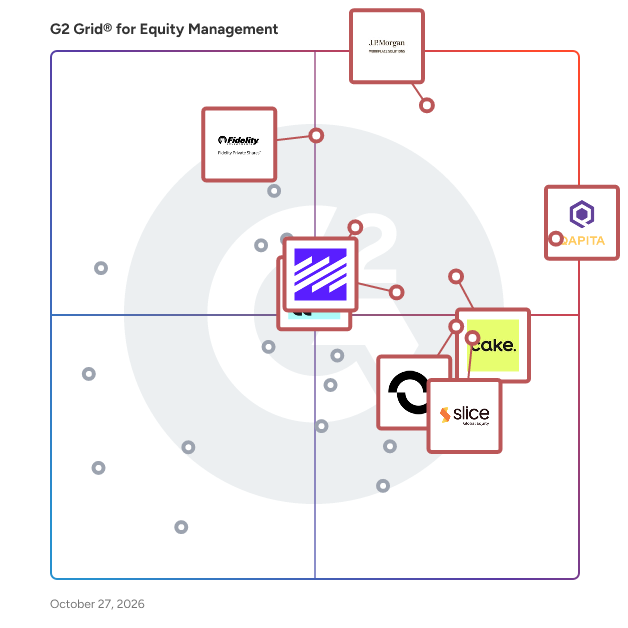
- **Leader:** [Eqvista](https://www.g2.com/products/eqvista/reviews)
- **Highest Performer:** [Optio Incentives](https://www.g2.com/products/optio-incentives/reviews)
- **Easiest to Use:** [Optio Incentives](https://www.g2.com/products/optio-incentives/reviews)
- **Top Trending:** [Eqvista](https://www.g2.com/products/eqvista/reviews)
- **Best Free Software:** [Qapita](https://www.g2.com/products/qapita/reviews)

  
  ## What Are the Top-Rated Equity Management Software Products in 2026?
### 1. [Tabulate](https://www.g2.com/products/tabulate/reviews)
  Tabulate is a full-stack ESOP, Cap Table, and Equity Compliance Management product designed to automate the entire process of issuing all kinds of securities including stock options, warrants, equity, convertible notes, phantom stock, and RSUs. Tabulate also provides comprehensive shareholder and board management tools for timely investor updates, conducting all kinds of resolutions, and shareholder participation. Tabulate&#39;s shareholder registry also automates the maintenance of MGT-1, SH-6, SH-1s and SHAs for complete equity transaction audit trails.


**Who Is the Company Behind Tabulate?**

- **Seller:** [Incentiv](https://www.g2.com/sellers/incentiv)
- **HQ Location:** N/A
- **LinkedIn® Page:** https://www.linkedin.com/company/No-Linkedin-Presence-Added-Intentionally-By-DataOps (1 employees on LinkedIn®)


### 2. [Tallect - Total Rewards Platform](https://www.g2.com/products/tallect-total-rewards-platform/reviews)
  Drive total rewards strategy, culture &amp; experience for employees, linking Talent Strategy to Total Rewards to bring pay transparency, equity &amp; competitiveness in rewards. Tallect helps companies manage, unify and optimize employee costs globally ,through a deep solve vertical SaaS platform, integrated external and internal analytics, vendor service layers, and future-driven programs. Transforming Total Rewards Management with Global Total Rewards Technology - Powerful engines to manage total rewards, catering to local and diverse nuances at the global level. Data &amp; Analytics - Leverage data &amp; analytics to provide real-time, actionable insights for better decision-making. Flexible, Compliant &amp; Future Ready - Meet all demands of the modern &amp; futuristic workforce. Ensuring global compliance. Compensation Planning - Design &amp; drive compensation strategy with well-defined pay philosophy, principles &amp; practices in areas like compensation structures, pay-mix, market positioning, etc. - Drive annual increment cycle with centrally held increment strategy &amp; budget and manage workflows efficiently - Manage round the year / off-cycle talent &amp; rewards decisions guided with data and analytics Market Benchmarking - Create pay-ranges leveraging both internal &amp; external data - Data-driven &amp; informed talent &amp; rewards decisions with real-time view into compa-ratio and benchmarks to maintain internal equity as well as market competitiveness


**Who Is the Company Behind Tallect - Total Rewards Platform?**

- **Seller:** [Tallect](https://www.g2.com/sellers/tallect)
- **Year Founded:** 2024
- **HQ Location:** Singapore, SG
- **LinkedIn® Page:** https://www.linkedin.com/company/tallect/ (8 employees on LinkedIn®)


### 3. [TOPPEQ](https://www.g2.com/products/toppeq/reviews)
  We draw on the power of AI and seasoned hedge fund industry experts to enable investors to take informed decisions regarding their portfolio companies, and help founders to maintain clean cap tables and keep track of their money.


**Who Is the Company Behind TOPPEQ?**

- **Seller:** [TOPPEQ](https://www.g2.com/sellers/toppeq)
- **Year Founded:** 2019
- **HQ Location:** Mumbai, IN
- **LinkedIn® Page:** http://www.linkedin.com/company/toppeq (5 employees on LinkedIn®)


### 4. [Uplaw](https://www.g2.com/products/uplaw/reviews)
  Uplaw is a comprehensive digital solution designed to streamline and automate the management of corporate shareholding and legal operations. Established in 2018, it offers a reliable and legally compliant platform tailored to French corporate law, enabling companies to efficiently oversee their shareholder structures, maintain up-to-date capitalization tables, and manage employee stock option plans. With over 12 billion euros in securities managed, Uplaw has become a trusted tool for businesses seeking to enhance their corporate governance processes. Key Features and Functionality: - Automated Shareholder Management: Uplaw provides tools to monitor and manage company shareholding structures, ensuring accurate and current records. - Real-Time Capitalization Tables: The platform maintains continuously updated capitalization tables, eliminating the need for manual tracking and reducing errors. - Digitalized Legal Registers: Uplaw digitizes all legal registers, including records of share movements and board meetings, anchoring them in blockchain for enhanced security and compliance. - Employee Stock Option Plan Management: The solution facilitates the deployment and administration of employee stock ownership plans, providing employees with a dedicated console to track their options, such as BSPCE, free shares, and stock options. - Automated Document Generation: Uplaw accelerates the production of corporate legal documents, including subscription forms, allocation letters, and movement orders, integrating seamlessly with electronic signature services like DocuSign. - Centralized Legal Document Repository: The platform offers a structured database for all corporate legal documents, equipped with a powerful search engine for quick information retrieval. Primary Value and User Solutions: Uplaw addresses the complexities of corporate legal management by automating and centralizing critical processes, thereby reducing the time and effort required for compliance and governance tasks. It ensures data accuracy and legal conformity, providing a reliable audit trail for all corporate actions. By integrating with existing tools and offering a user-friendly interface, Uplaw enhances productivity for CEOs, CFOs, legal departments, and HR professionals, allowing them to focus on strategic initiatives while maintaining robust corporate governance.


**Who Is the Company Behind Uplaw?**

- **Seller:** [Uplaw](https://www.g2.com/sellers/uplaw)
- **Year Founded:** 2018
- **HQ Location:** Paris, FR
- **LinkedIn® Page:** https://www.linkedin.com/company/go-uplaw (18 employees on LinkedIn®)


### 5. [Walter Equity Management](https://www.g2.com/products/walter-equity-management/reviews)
  Walter is a modern and highly secure equity management platform designed as a single source of truth for company builders and their lawyers to collaborate; streamlining equity management, stock option programs, and raising capital. The platform offers different tiers of functionality working to complement the core cap table and equity documentation. Walter pairs first-class integrations such as Word and DocuSign, to extend value via workflow transformations across different business functions of equity management like ESOP administration, private placement fundraising, and more. Integrated payment processing, multi-currency support, and highly flexible design architecture, coupled with first-class customer care, make Walter a great choice in equity management.


**Who Is the Company Behind Walter Equity Management?**

- **Seller:** [Walter Technologies](https://www.g2.com/sellers/walter-technologies-abc575d5-1033-4fc1-8a31-84904963ed5d)
- **HQ Location:** N/A
- **LinkedIn® Page:** https://www.linkedin.com/company/No-Linkedin-Presence-Added-Intentionally-By-DataOps (1 employees on LinkedIn®)


    ## What Is Equity Management Software?
  [Accounting &amp; Finance Software](https://www.g2.com/categories/accounting-finance)
  ## What Software Categories Are Similar to Equity Management Software?
    - [Stock Plan Administration Software](https://www.g2.com/categories/stock-plan-administration)

  
---

## How Do You Choose the Right Equity Management Software?

### What You Should Know About Equity Management Software

### What are Equity Management Software?

Equity management software helps in managing ownership of the company in relation to stakeholders of a company. It helps in tracking shares, communicating with stakeholders and the board of directors, staying compliant with laws and regulations, and maintaining company records and documents. Equity management software also consists of features for managing cap tables, equity issuance, equity transactions tracking, and conducting annual 409a valuations.

Equity management software is used by equity administrators, which is a part of the finance department of companies worldwide. It helps free up spare time that is otherwise spent on legal procedures, eliminates the risk of human errors, creates equity reports, and integrates with other finance and accounting-related software. **&amp;nbsp;**

### What are the Common Features of Equity Management Software?

Equity management software not only helps in tracking and managing all the shares of a company but also helps users in several other ways. The following are some core features an equity management software offers:

**409A valuation:** Equity management software has the capability of conducting a 409A valuation that determines the worth of the company. Before offering equity to potential investors, it is essential to decide a fair market price of the stock or share of the company. Equity management software performs 409A valuation to find out the right price before starting off with raising funds and helps generate reports that are simple and easy to understand for investors.

**Cap table management:** Cap table management is an intricate breakdown of all the equity of the shareholders of a company. This feature in the equity management software helps in automatically recording all types of securities such as stock, preferred shares, equity grants, convertible notes, bonds, warrants, etc. With expanding business, equity management software helps to access data in cap tables that are otherwise more complex to find manually.

**Investor relations and reporting:** A good equity management software must be capable of providing financial analytics dashboards for investors&#39; ease. The investor gets real-time access to their portfolios and can make informed decisions based on which share to buy, hold or sell, it also provides measurable KPIs like goals, investment, and measure risk tolerance.

### What are the Benefits of Equity Management Software?

Equity management software has many benefits over its archaic paper counterpart. Here are some of the benefits a company may get using an equity management tool:

**Organized equity management:** Equity management software streamlines work and allows the company to focus on bringing new investors instead of losing a lot of time on organizing documents. It automates the documentation process, ensuring compliance and managing capitalization tables, and is well known for simplifying tasks such as reserve, issue, and transfer of company shares, shareholder management, and 409 valuations.&amp;nbsp;

**Powerful analytics for scalable growth:** Built-in analytics in equity management software helps make financial management, forecasting, and capital restructuring decisions easy. On a single dashboard, all financial metrics are consolidated and updated automatically, which saves time and helps in making strategic decisions for the company’s scalable growth. Analytics in equity management software also allows round modeling and scenario modeling.

**Scalable system and support:** Equity management solutions are designed to cater to all types of businesses. It enables customization as per complex processes and requirements. While it might encounter technical issues or glitches during regular operation days, a team of technical experts is constantly on standby around the clock to assist in such circumstances.

### Who Uses Equity Management Software?

Equity management software is used by equity administrators, financial analysts, and managers in different companies.

**Equity administrators:** Equity administrators are responsible for handling equity management systems and processes of the companies. They conduct company valuations (409a valuation) and engage in tracking company equity transactions, shareholder management, and cap table management.

**Financial analysts:** Financial analysts use this software to do various analyses such as scenario modeling, round and exit modeling, and waterfall analysis and analyze different financial metrics to review the company’s financial health.

### What are the Alternatives to Equity Management Software?

An alternative to equity management software can replace this type of software, either partially or completely:

**Cap table management software** : Cap table management software guides the company’s equity distribution and helps business owners and investors understand the firm’s capital structure. Cap table management software facilitates automated equity management for the business. It is hosted on an online server and replaces the traditional way of managing cap tables on a spreadsheet manually.&amp;nbsp;

### Challenges with Equity Management Software

Some common challenges faced using equity management software are:&amp;nbsp;

**Internet connectivity:** Most equity management solutions available in the market are cloud-based solutions that require an internet connection. While these tools are hosted in the cloud and can be accessed anywhere, they have their share of disadvantages also. No internet or slow internet connection hinders the smooth operation of this software and possibly leads to errors in the work process.

**Finding desirable software:** Finding the right equity management software is a complex process. One should select software that works well with the business. Many equity management software come with basic features suitable for small size companies. But, small-scale solutions may not be able to handle higher volumes as the business grows. An ideal solution must offer advanced features like tracking or issuing equity, compliances, maintaining compliance, receiving 409A valuation, modeling, forecasting, analytics, reporting, etc.

### Which Companies Should Buy Equity Management Software?

Equity management software can be used by private companies to distribute ownership amongst the stakeholders. It can be used by businesses of all sizes having plans to offer equity or currently engaged in equity distribution. It supports the company’s stakeholders and helps onboard new investors with ease.

### **How to Buy Equity Management Software**

#### Requirements Gathering (RFI/RFP) for Equity Management Software

When selecting equity management software, it is important to first look at how the business operates, and then familiarize oneself with the different types of software available. There are a variety of options when it comes to equity management software products, including those designed for the business needs of small, medium, and enterprise-sized businesses.

After understanding the requirements, the buyer can reach out to different vendors and ask for product-related information through RFP or RFIs. Upon receiving RFP or RFIs, the buyer needs to look at the features, pricing, and contract agreements to understand what problems the new system will solve. Buyers need to carefully examine all relevant information and documents before opting for the vendor and product.

#### Compare Equity Management Software Products

**Create a long list**

Depending on the industry, the buyer might want to first create a long list of software that is designed to help businesses in the particular industry. A long list always helps select the right software from many products available for equity management. The buyer should keep in mind to look at the existing software and prioritize asking what problem the new software can solve. A long list must consist of products that qualify metrics like required feature offerings, reviews and ratings from buyers, vendor add-ons, price points, and overall popularity in the category.

**Create a short list**

A short list narrows down the options available on the long list. It is generally done by mapping existing requirements to the offerings of the software. A short list generally widdles down the long list based on the budget.

Buyers must keep in mind, however, that the more specialized a software is, the more expensive it gets. This is the case because the user base for specialized software is usually relatively small. If the company wants something specific to their industry or customized for the business, they should be ready to pay a premium.

**Conduct demos**

As a rule of thumb, companies should make sure to demo all of the products that end up on their short list. Software demos are crucial to understanding how compatible the product is with existing systems and processes. It helps meet the realistic expectations from the product. During demos, buyers should ask specific questions related to the functionalities they care most about; for example, one might ask to be walked through equity issuance or tracking features, how to create cap tables, how to check investor portfolios, or how look at real-time financial data.

#### Selection of Equity Management Software

**Choose a selection team**

A team consisting of managers who will be using the software, equity administrator, IT personnel, or consultants is required for the selection process. Every business is different and the equity administrator is most likely the best person to give an educated opinion about which one is the best choice for the particular needs of the business. Collaborative communication around different functionalities of the equity management solution and collecting individual feedback from the people going to be engaged with the software would help make a better decision.&amp;nbsp;

**Negotiation**

The negotiation process can happen upon receiving a price quote from the vendor.&amp;nbsp;Depending on the available budget, the buyer can offer a price to the vendor considering all the equity management features required for the business. Buyers shouldn’t forget to ask for a discount in return for an annual upfront payment, and many software providers are happy to make that deal. Other times, a software provider may offer unlimited usage or add-ons if the buyers pay upfront instead of paying in installments. A successful negotiation means a courteous and constructive interaction that is a win-win for both parties.

**Final decision**

The final decision should be based on all the information gathered, features offerings, and price agreed upon by both parties involved in the purchasing process of the product. Businesses should keep in mind to select the solution that meets most of, if not all of, their requirements.&amp;nbsp;

If possible, buyers must conduct a pilot program with a smaller sample size of users to identify how well the software is received. If the platform gets good remarks, the buyer should make the final purchase decision. If the tool is found to be not performing as expected, there might be some other software that meets the expectations.