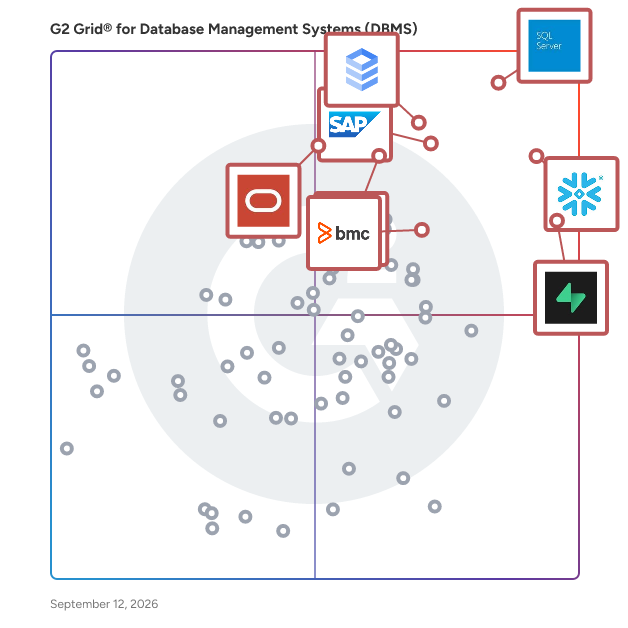
# Best Database Management Systems (DBMS) - Page 6

*By [Shalaka Joshi](https://research.g2.com/insights/author/shalaka-joshi)*


Database management systems (DBMS) are designed to define, store, retrieve, and manage the data within a database. It allows users to create, maintain, and manage databases. DBMS manipulates the database as per the user requirements. Using DBMS ensures that the data of an organization is clean, consistent, secure, relevant, and supports concurrency.

Along with the standard database functionalities (e.g., CRUD operations), DBMS software has much stronger management capabilities. These include functions like stronger metadata visibility and analysis, in-depth and custom reporting, performance monitoring, usage analytics, and compliance checks. Extensive solutions may offer capabilities of [database backup software](https://www.g2.com/categories/database-backup), [data replication software](https://www.g2.com/categories/data-replication), [disaster recovery software](https://www.g2.com/categories/disaster-recovery), or [disaster recovery as a service (DRaaS) software](https://www.g2.com/categories/disaster-recovery-as-a-service-draas), as well.

Typically used by database administrators, DBMS are integral to preserving database quality and integrity. They fall into a larger database-oriented stack, which can include solutions like database security and database monitoring.

DBMS is used as part of both relational and non-relational databases. DBMS software are of different types, in association with the database being managed and organized. Some of the more popular DBMS are as follows:

- Relational: Associated typically with [relational databases](https://www.g2.com/categories/relational-databases), the relational model organizes data tabularly (rows and columns approach) and is currently the most standard database model. DMBS focused on the relational model are referred to as RDBMS.
- Object oriented: [Object-oriented databases](https://www.g2.com/categories/object-oriented-databases) follow a programming-style, object-oriented approach to entering and organizing data. DBMS aligned with this model are referred to as OODMBS.
- Hierarchical: In a hierarchical model, data is organized with a tree-like structure, where associations (“branches&quot;) extend from a point of data. DBMS aligned with this model are sometimes referred to as HDBMS.
- Distributed: Under a distributed database model, data is decentralized and stored across several locations. These locations can be physically local (e.g., different servers in the same data center) or spread apart (perhaps connected via SD-WAN). DMBS aligned with the distributed database model are sometimes referred to as DDBMS.
- Non-relational DBMS or NoSQL DBMS: NoSQL DBMS support both structured and unstructured data. There is no set defined schema as compared to other data models. The key benefit of this DBMS is that users can process queries of various elements and not be limited by the structure.

To qualify for inclusion in the Database Management Systems (DBMS) category, a product must:

- Manage and align with a database model (e.g., relational, object-oriented, hierarchical, distributed, non-relational)
- Can also exist as a standalone tool to manage databases
- Provide database maintenance functionalities
- Provide extensive reporting and activity analytics


## Top Database Management Systems (DBMS) at a Glance
| # | Product | Rating | Best For | What Users Say |
|---|---------|--------|----------|----------------|
| 1 | [Microsoft SQL Server](https://www.g2.com/products/microsoft-sql-server/reviews) | 4.4/5.0 (2,127 reviews) | Microsoft-ecosystem relational data with SSMS administration | "[Reliable, Easy-to-Use Database Tool with Strong Reporting and Management Features](https://www.g2.com/survey_responses/microsoft-sql-server-review-12930873)" |
| 2 | [Snowflake](https://www.g2.com/products/snowflake/reviews) | 4.5/5.0 (707 reviews) | Elastic cloud data warehousing with workload isolation | "[Easy, Efficient Data Extraction with Clear Database Insights](https://www.g2.com/survey_responses/snowflake-review-12884116)" |
| 3 | [SAP HANA Cloud](https://www.g2.com/products/sap-hana-cloud-2025-10-01/reviews) | 4.3/5.0 (522 reviews) | In-memory HTAP analytics inside SAP ecosystems | "[Blazing-Fast In-Memory Performance with Seamless SAP Integration](https://www.g2.com/survey_responses/sap-hana-cloud-review-12419032)" |
| 4 | [Google Cloud SQL](https://www.g2.com/products/google-cloud-sql/reviews) | 4.5/5.0 (354 reviews) | Fully-managed relational databases inside GCP ecosystems | "[Secure, Highly Available, and Scalable Cloud SQL for Diverse Workloads](https://www.g2.com/survey_responses/google-cloud-sql-review-12804608)" |
| 5 | [Databricks](https://www.g2.com/products/databricks/reviews) | 4.6/5.0 (1,284 reviews) | Unified lakehouse ETL, analytics, and ML | "[Great Spark Scaling, But Slow Cluster Boot Times](https://www.g2.com/survey_responses/databricks-review-12905667)" |
| 6 | [Amazon Athena](https://www.g2.com/products/amazon-athena/reviews) | 4.4/5.0 (162 reviews) | Serverless ad-hoc querying on S3 data lakes | "[Athena Makes S3 Data Validation Fast and Infrastructure-Free](https://www.g2.com/survey_responses/amazon-athena-review-12876937)" |
| 7 | [SAS Viya](https://www.g2.com/products/sas-sas-viya/reviews) | 4.3/5.0 (758 reviews) | Unified analytics lifecycle with in-memory processing | "[Powerful &amp; Transforming Data into Decisions—Effortlessly and Intelligently.](https://www.g2.com/survey_responses/sas-viya-review-12682824)" |
| 8 | [TiDB](https://www.g2.com/products/tidb/reviews) | 4.6/5.0 (67 reviews) | MySQL-compatible HTAP with horizontal scalability | "[TiDB Delivers NoSQL-Scale with SQL Simplicity and MySQL Compatibility](https://www.g2.com/survey_responses/tidb-review-12342698)" |
| 9 | [Teradata Autonomous Knowledge Platform](https://www.g2.com/products/teradata-autonomous-knowledge-platform/reviews) | 4.3/5.0 (355 reviews) | Massively parallel enterprise data warehouse analytics | "[Teradata Vantage Fast Query Performance and Strong Analytics for Big Data](https://www.g2.com/survey_responses/teradata-autonomous-knowledge-platform-review-12821668)" |
| 10 | [SQL Developer](https://www.g2.com/products/sql-developer/reviews) | 4.3/5.0 (245 reviews) | Oracle-native PL/SQL development and schema administration | "[SQL Developer Makes Large Schema Queries Simple](https://www.g2.com/survey_responses/sql-developer-review-12738695)" |


## How Many Database Management Systems (DBMS) Products Does G2 Track?
**Total Products under this Category:** 253

### Category Stats (Jun 2026)
- **Average Rating**: 4.29/5 The average rating of products in this category, based on all submitted ratings
- **Top Trending Product**: BMC AMI Data (+0.96%) - Among all products in this category, BMC AMI Data recorded the largest rating increase compared to last month
*Last updated: June 18, 2026*


## How Does G2 Rank Database Management Systems (DBMS) Products?

**Why You Can Trust G2's Software Rankings:**

- 30 Analysts and Data Experts
- 11,100+ Authentic Reviews
- 253+ Products
- Unbiased Rankings

G2's software rankings are built on verified user reviews, rigorous moderation, and a consistent research methodology maintained by a team of analysts and data experts. Each product is measured using the same transparent criteria, with no paid placement or vendor influence. While reviews reflect real user experiences, which can be subjective, they offer valuable insight into how software performs in the hands of professionals. Together, these inputs power the G2 Score, a standardized way to compare tools within every category.


## Which Database Management Systems (DBMS) Is Best for Your Use Case?

- **Leader:** [Microsoft SQL Server](https://www.g2.com/products/microsoft-sql-server/reviews)
- **Highest Performer:** [DbVisualizer](https://www.g2.com/products/dbvisualizer/reviews)
- **Easiest to Use:** [Databricks](https://www.g2.com/products/databricks/reviews)
- **Top Trending:** [EDB Postgres AI for CloudNativePG](https://www.g2.com/products/edb-postgres-ai-for-cloudnativepg/reviews)
- **Best Free Software:** [DbVisualizer](https://www.g2.com/products/dbvisualizer/reviews)


---

**Sponsored**

### Couchbase

Couchbase’s operational data platform for AI is a scalable foundation for enterprise operational, analytical, mobile and AI workloads that replaces legacy infrastructure and data services.


[Visit website](https://www.g2.com/external_clickthroughs/record?secure%5Bad_program%5D=ppc&amp;secure%5Bad_slot%5D=category_product_list&amp;secure%5Bcategory_id%5D=303&amp;secure%5Bdisplayable_resource_id%5D=303&amp;secure%5Bdisplayable_resource_type%5D=Category&amp;secure%5Bmedium%5D=sponsored&amp;secure%5Bplacement_reason%5D=page_category&amp;secure%5Bplacement_resource_ids%5D%5B%5D=303&amp;secure%5Bprioritized%5D=false&amp;secure%5Bproduct_id%5D=1263&amp;secure%5Bresource_id%5D=303&amp;secure%5Bresource_type%5D=Category&amp;secure%5Bsource_type%5D=category_page&amp;secure%5Bsource_url%5D=https%3A%2F%2Fwww.g2.com%2Fcategories%2Fdatabase-management-systems-dbms%3Fpage%3D6&amp;secure%5Btoken%5D=347174075139612dcdaa4656df0eb6a6cea4adbd1d5dc8aefa31cdbf73ce31ee&amp;secure%5Burl%5D=https%3A%2F%2Fwww.couchbase.com%2F%3Futm_source%3Dg2%26utm_medium%3Ddisplay&amp;secure%5Burl_type%5D=custom_url)

---

## What Are the Top-Rated Database Management Systems (DBMS) Products in 2026?
### 1. [Redis Desktop Manager](https://www.g2.com/products/redis-desktop-manager/reviews)
Redis Desktop Manager is a cross-platform desktop management GUI.


**Average Rating:** 4.5/5.0
**Total Reviews:** 2
**How Do G2 Users Rate Redis Desktop Manager?**

- **Has the product been a good partner in doing business?:** 10.0/10 (Category avg: 8.8/10)

**Who Is the Company Behind Redis Desktop Manager?**

- **Seller:** [RedisDesktopManager](https://www.g2.com/sellers/redisdesktopmanager)
- **Year Founded:** 2011
- **HQ Location:** Mountain View, California, United States
- **LinkedIn® Page:** https://www.linkedin.com/company/redisinc (1,294 employees on LinkedIn®)

**Who Uses This Product?**
- **Company Size:** 50% Mid-Market, 50% Small-Business


#### What Are Recent G2 Reviews of Redis Desktop Manager?

**"[A little slow, but an excellent UI to interact with a Redis db.](https://www.g2.com/survey_responses/redis-desktop-manager-review-5128958)"**

**Rating:** 4.0/5.0 stars
*— Verified User in Computer Software*

[Read full review](https://www.g2.com/survey_responses/redis-desktop-manager-review-5128958)

---

**"[Best desktop Redis GUI on the market](https://www.g2.com/survey_responses/redis-desktop-manager-review-3959690)"**

**Rating:** 5.0/5.0 stars
*— Verified User in Consumer Electronics*

[Read full review](https://www.g2.com/survey_responses/redis-desktop-manager-review-3959690)

---


#### What Are G2 Users Discussing About Redis Desktop Manager?

- [What is Redis Desktop Manager used for?](https://www.g2.com/discussions/what-is-redis-desktop-manager-used-for)

### 2. [Rocket UniVerse](https://www.g2.com/products/rocket-universe/reviews)
Rocket UniVerse, a component of the MultiValue application platform, is a fast, flexible data server for developing enterprise apps. Its variable length, table-within-table architecture means speedy data access and low maintenance with user interfaces for Windows, Linux, and UNIX. Deployable to the cloud or on-premises, thousands of customers globally depend on UniVerse to run their businesses.


**Average Rating:** 3.5/5.0
**Total Reviews:** 2

**Who Is the Company Behind Rocket UniVerse?**

- **Seller:** [Rocket Software](https://www.g2.com/sellers/rocket-software)
- **Year Founded:** 1990
- **HQ Location:** Waltham, MA
- **Twitter:** @Rocket (3,532 Twitter followers)
- **LinkedIn® Page:** https://www.linkedin.com/company/10127/ (4,347 employees on LinkedIn®)

**Who Uses This Product?**
- **Company Size:** 50% Enterprise, 50% Mid-Market


#### What Are Rocket UniVerse's Pros and Cons?

**Pros:**

- Innovation (1 reviews)

**Cons:**

- Insufficient Documentation (1 reviews)
- Interface Issues (1 reviews)
- Performance Issues (1 reviews)
- Slow Performance (1 reviews)


### What Do G2 Reviewers Say About Rocket UniVerse?
*AI-generated summary from verified user reviews*

**Pros:**

- Users value the **innovation** of Rocket UniVerse, benefiting from modern support for Python and resilient development tools.

**Cons:**

- Users face **insufficient documentation** , which makes navigating and resolving performance issues more challenging.
- Users report **interface issues** with Rocket UniVerse, noting navigation difficulties and performance problems in documentation.
- Users experience **performance issues** and find navigation through documentation somewhat challenging at times.
- Users experience **slow performance** and find navigation through documentation a bit challenging at times.

#### What Are Recent G2 Reviews of Rocket UniVerse?

**"[Modernized, Resilient Tooling with Great New Python Support](https://www.g2.com/survey_responses/rocket-universe-review-12328899)"**

**Rating:** 4.5/5.0 stars
*— Pottipadu J.*

[Read full review](https://www.g2.com/survey_responses/rocket-universe-review-12328899)

---


#### What Are G2 Users Discussing About Rocket UniVerse?

- [What is Rocket UniVerse used for?](https://www.g2.com/discussions/what-is-rocket-universe-used-for)

### 3. [Sequoiadb](https://www.g2.com/products/sequoiadb/reviews)
SequoiaDB is a distributed relational database with a storage layer and a computing layer.


**Average Rating:** 4.0/5.0
**Total Reviews:** 2
**How Do G2 Users Rate Sequoiadb?**

- **Has the product been a good partner in doing business?:** 8.3/10 (Category avg: 8.8/10)
- **Data dictionary:** 6.7/10 (Category avg: 8.5/10)
- **Backup and Recovery:** 9.2/10 (Category avg: 8.5/10)
- **Data Migration:** 5.8/10 (Category avg: 8.4/10)

**Who Is the Company Behind Sequoiadb?**

- **Seller:** [Sequoiadb](https://www.g2.com/sellers/sequoiadb)
- **HQ Location:** N/A
- **LinkedIn® Page:** https://www.linkedin.com/company/No-Linkedin-Presence-Added-Intentionally-By-DataOps (1 employees on LinkedIn®)

**Who Uses This Product?**
- **Company Size:** 50% Mid-Market, 50% Small-Business


#### What Are Recent G2 Reviews of Sequoiadb?

**"[A Trusted Distributed Database Management System](https://www.g2.com/survey_responses/sequoiadb-review-8780455)"**

**Rating:** 4.0/5.0 stars
*— Mahinsha  N.*

[Read full review](https://www.g2.com/survey_responses/sequoiadb-review-8780455)

---

**"[One of the best alternative for multimodel data and distributed data storage](https://www.g2.com/survey_responses/sequoiadb-review-8773003)"**

**Rating:** 4.0/5.0 stars
*— Subham A.*

[Read full review](https://www.g2.com/survey_responses/sequoiadb-review-8773003)

---


### 4. [Tabular](https://www.g2.com/products/tabular-technologies-inc-tabular/reviews)
Tabular is the independent data platform built by the creators of Apache Iceberg. It is a cloud-native, SaaS storage engine that provides the simplest way to take advantage of the Iceberg table format. It includes support for a wide range of compute engines, auto-optimization for faster queries, and central role-based access control enforced down to the data table. Tabular was founded in 2021 by Netflix alumni Ryan Blue, Dan Weeks and Jason Reid. Blue also serves as the Iceberg PMC Chair and Weeks is an Iceberg PMC member.


**Average Rating:** 3.8/5.0
**Total Reviews:** 2
**How Do G2 Users Rate Tabular?**

- **Has the product been a good partner in doing business?:** 8.3/10 (Category avg: 8.8/10)
- **Data dictionary:** 8.3/10 (Category avg: 8.5/10)
- **Backup and Recovery:** 6.7/10 (Category avg: 8.5/10)
- **Data Migration:** 8.3/10 (Category avg: 8.4/10)

**Who Is the Company Behind Tabular?**

- **Seller:** [Tabular Technologies](https://www.g2.com/sellers/tabular-technologies)
- **Year Founded:** 2021
- **HQ Location:** San Jose, US
- **LinkedIn® Page:** http://www.linkedin.com/company/tabular-io (24 employees on LinkedIn®)

**Who Uses This Product?**
- **Company Size:** 100% Enterprise


#### What Are Tabular's Pros and Cons?

**Pros:**

- Dashboards (1 reviews)
- Ease of Use (1 reviews)
- Easy Integrations (1 reviews)
- Integrations (1 reviews)

**Cons:**

- Limitations (1 reviews)
- Limited Customization (1 reviews)
- Missing Features (1 reviews)


### What Do G2 Reviewers Say About Tabular?
*AI-generated summary from verified user reviews*

**Pros:**

- Users praise the **user-friendly dashboards** in Tabular, facilitating easy chart creation and seamless cloud integration.
- Users find Tabular&#39;s **ease of use** exceptional, effortlessly creating charts and dashboards regardless of their experience level.
- Users value the **easy integrations** with cloud services, enhancing workflow and collaboration effortlessly.
- Users value the **seamless integration** of Tabular with cloud services, enhancing their data management and collaboration experience.

**Cons:**

- Users feel that Tabular has **limited analytical functions and customization** compared to Excel or Python for data manipulation.
- Users feel that Tabular offers **limited customization** compared to Excel and Python for data manipulation tasks.
- Users note the **lack of advanced analytical functions** in Tabular compared to Excel or Python, limiting customization.

#### What Are Recent G2 Reviews of Tabular?

**"[Architect](https://www.g2.com/survey_responses/tabular-review-9352710)"**

**Rating:** 4.0/5.0 stars
*— Nitil D.*

[Read full review](https://www.g2.com/survey_responses/tabular-review-9352710)

---


### 5. [TileDB](https://www.g2.com/products/tiledb/reviews)
TileDB is foundational software designed by scientists for scientific discovery. TileDB structures all data types, including data that does not fit into relational databases built for structured tabular data. Built on a powerful shape-shifting array database, TileDB handles the complexities of non-traditional “unstructured” multimodal data, such as genomic variants, bulk and single-cell transcriptomics, proteomics, biomedical imaging, as well as the frontier data of the future. Used by big pharma and biotechs to power their multiomic FAIR data platforms, TileDB is the destination for scientific breakthroughs where frontier multimodal data is driving drug and target discovery.


**Average Rating:** 3.8/5.0
**Total Reviews:** 2
**How Do G2 Users Rate TileDB?**

- **Data dictionary:** 7.5/10 (Category avg: 8.5/10)
- **Backup and Recovery:** 7.5/10 (Category avg: 8.5/10)
- **Data Migration:** 7.5/10 (Category avg: 8.4/10)

**Who Is the Company Behind TileDB?**

- **Seller:** [TileDB](https://www.g2.com/sellers/tiledb)
- **Year Founded:** 2017
- **HQ Location:** Cambridge, Massachusetts, United States
- **LinkedIn® Page:** https://www.linkedin.com/company/tiledb-inc (70 employees on LinkedIn®)

**Who Uses This Product?**
- **Company Size:** 100% Enterprise


#### What Are Recent G2 Reviews of TileDB?

**"[Organizing my company’s information](https://www.g2.com/survey_responses/tiledb-review-9985821)"**

**Rating:** 4.5/5.0 stars
*— Emily  C.*

[Read full review](https://www.g2.com/survey_responses/tiledb-review-9985821)

---


### 6. [Trunao](https://www.g2.com/products/trunao/reviews)
Trunao is a platform that helps small to medium enterprises that are struggling with maintaining their databases in MS Excel due to the lack of technical and software solutions. Our mission is to help businesses convert or build their web application, generate customer and sales reports, and create surveys in real-time by maintaining a cloud form/database.


**Average Rating:** 5.0/5.0
**Total Reviews:** 2
**How Do G2 Users Rate Trunao?**

- **Has the product been a good partner in doing business?:** 10.0/10 (Category avg: 8.8/10)

**Who Is the Company Behind Trunao?**

- **Seller:** [Trunao](https://www.g2.com/sellers/trunao)
- **Year Founded:** 2017
- **HQ Location:** Fremont, US
- **Twitter:** @Trunaoo (9 Twitter followers)
- **LinkedIn® Page:** https://www.linkedin.com/company/trunao (3 employees on LinkedIn®)

**Who Uses This Product?**
- **Company Size:** 100% Small-Business


#### What Are Recent G2 Reviews of Trunao?

**"[Great Database Utility](https://www.g2.com/survey_responses/trunao-review-1319257)"**

**Rating:** 5.0/5.0 stars
*— Jeremy B.*

[Read full review](https://www.g2.com/survey_responses/trunao-review-1319257)

---

**"[Easy to convert from an Excel to online database](https://www.g2.com/survey_responses/trunao-review-4902336)"**

**Rating:** 5.0/5.0 stars
*— Hemant M.*

[Read full review](https://www.g2.com/survey_responses/trunao-review-4902336)

---


#### What Are G2 Users Discussing About Trunao?

- [What is Trunao used for?](https://www.g2.com/discussions/what-is-trunao-used-for)

### 7. [VisuaLeaf](https://www.g2.com/products/visualeaf/reviews)
VisuaLeaf is a MongoDB GUI designed for developers and data teams to build queries, aggregation pipelines, and explore database schemas visually.


**Average Rating:** 5.0/5.0
**Total Reviews:** 2
**How Do G2 Users Rate VisuaLeaf?**

- **Data Migration:** 10.0/10 (Category avg: 8.4/10)

**Who Is the Company Behind VisuaLeaf?**

- **Seller:** [SozoCode](https://www.g2.com/sellers/sozocode)
- **HQ Location:** Los Angeles, US
- **LinkedIn® Page:** https://www.linkedin.com/company/sozocode-llc/ (3 employees on LinkedIn®)

**Who Uses This Product?**
- **Company Size:** 50% Enterprise, 50% Small-Business


#### What Are Recent G2 Reviews of VisuaLeaf?

**"[Intuitive Aggregation Builder with Effortless Charting](https://www.g2.com/survey_responses/visualeaf-review-12762867)"**

**Rating:** 5.0/5.0 stars
*— Simona B.*

[Read full review](https://www.g2.com/survey_responses/visualeaf-review-12762867)

---

**"[Intuitive and Feature-Rich for Developers and Admin Tasks](https://www.g2.com/survey_responses/visualeaf-review-12815723)"**

**Rating:** 5.0/5.0 stars
*— Juan Antonio R.*

[Read full review](https://www.g2.com/survey_responses/visualeaf-review-12815723)

---


### 8. [webMethods Applinx](https://www.g2.com/products/ibm-webmethods-applinx/reviews)
Web- and service-enable character-based screens like 3270. Read more


**Average Rating:** 4.5/5.0
**Total Reviews:** 2
**How Do G2 Users Rate webMethods Applinx?**

- **Has the product been a good partner in doing business?:** 8.3/10 (Category avg: 8.8/10)
- **Data dictionary:** 8.3/10 (Category avg: 8.5/10)
- **Backup and Recovery:** 8.3/10 (Category avg: 8.5/10)
- **Data Migration:** 7.5/10 (Category avg: 8.4/10)

**Who Is the Company Behind webMethods Applinx?**

- **Seller:** [IBM](https://www.g2.com/sellers/ibm)
- **Year Founded:** 1911
- **HQ Location:** Armonk, New York, United States
- **Twitter:** @IBMSecurity (74,660 Twitter followers)
- **LinkedIn® Page:** https://www.linkedin.com/company/1009/ (328,202 employees on LinkedIn®)
- **Ownership:** SWX:IBM

**Who Uses This Product?**
- **Company Size:** 50% Enterprise, 50% Mid-Market


#### What Are Recent G2 Reviews of webMethods Applinx?

**"[Review for webMethods Applinx](https://www.g2.com/survey_responses/webmethods-applinx-review-9576517)"**

**Rating:** 4.5/5.0 stars
*— Verified User in Information Services*

[Read full review](https://www.g2.com/survey_responses/webmethods-applinx-review-9576517)

---

**"[Experience in WebMethod Applinx](https://www.g2.com/survey_responses/webmethods-applinx-review-10197185)"**

**Rating:** 4.5/5.0 stars
*— Sachidanand P.*

[Read full review](https://www.g2.com/survey_responses/webmethods-applinx-review-10197185)

---


### 9. [WorkMap.ai](https://www.g2.com/products/workmap-ai/reviews)
HyperBase allows you to simplify data collection through webforms and automate business processes with workflows and database apps – all in its anywhere accessible cloud database solution.


**Average Rating:** 3.7/5.0
**Total Reviews:** 13
**How Do G2 Users Rate WorkMap.ai?**

- **Has the product been a good partner in doing business?:** 8.3/10 (Category avg: 8.8/10)
- **Data dictionary:** 8.3/10 (Category avg: 8.5/10)
- **Backup and Recovery:** 6.7/10 (Category avg: 8.5/10)
- **Data Migration:** 8.3/10 (Category avg: 8.4/10)

**Who Is the Company Behind WorkMap.ai?**

- **Seller:** [HyperOffice](https://www.g2.com/sellers/hyperoffice)
- **HQ Location:** Rockville, MD
- **LinkedIn® Page:** https://www.linkedin.com/company/40617/ (18 employees on LinkedIn®)

**Who Uses This Product?**
- **Company Size:** 62% Small-Business, 38% Mid-Market


#### What Are Recent G2 Reviews of WorkMap.ai?

**"[Create Smooth Workflows for smooth operations of your Business](https://www.g2.com/survey_responses/workmap-ai-review-8197338)"**

**Rating:** 4.5/5.0 stars
*— Verified User in Computer Software*

[Read full review](https://www.g2.com/survey_responses/workmap-ai-review-8197338)

---

**"[Efficient web based tool for businesses](https://www.g2.com/survey_responses/workmap-ai-review-9174950)"**

**Rating:** 4.5/5.0 stars
*— Verified User in Information Technology and Services*

[Read full review](https://www.g2.com/survey_responses/workmap-ai-review-9174950)

---


#### What Are G2 Users Discussing About WorkMap.ai?

- [What is WorkMap.ai used for?](https://www.g2.com/discussions/what-is-workmap-ai-used-for)

### 10. [ASP Nuke](https://www.g2.com/products/asp-nuke/reviews)
ASP Nuke is portal software for Windows servers. Specifically, it is an Active Server Pages application for creating online communities. It is mainly a content publishing system centered around article publications. It contains a user registration module allowing visitors to the site to login and discuss the articles posted on the site and offer feedback. A good example of this type of system is SlashDot which has a huge following.


**Average Rating:** 0.5/5.0
**Total Reviews:** 1
**How Do G2 Users Rate ASP Nuke?**

- **Has the product been a good partner in doing business?:** 6.7/10 (Category avg: 8.8/10)
- **Data dictionary:** 10.0/10 (Category avg: 8.5/10)
- **Backup and Recovery:** 5.0/10 (Category avg: 8.5/10)
- **Data Migration:** 8.3/10 (Category avg: 8.4/10)

**Who Is the Company Behind ASP Nuke?**

- **Seller:** [ASP Nuke](https://www.g2.com/sellers/asp-nuke)
- **HQ Location:** N/A
- **LinkedIn® Page:** https://www.linkedin.com/company/No-Linkedin-Presence-Added-Intentionally-By-DataOps (1 employees on LinkedIn®)

**Who Uses This Product?**
- **Company Size:** 100% Small-Business


### 11. [AtroCore](https://www.g2.com/products/atrocore/reviews)
AtroCore is a flexible, configurable open-source data platform. This software empowers businesses to centralize, standardize, and maintain control over their master data, seamless data integration with any third-party system, supports business process management, file reference, data, digital asset management, and other features. Some of AtroCore’s features are: 1. Unlimited users and flexible role-based access control. 2. Configurable entities, relations, and layouts for tailored data structures. 3. Centralized management of all product and digital asset content. 4. Automated, bidirectional synchronization with ERPs, e-commerce platforms, and marketplaces. 5. Powerful import/export tools and full REST API for seamless integration. 6. Advanced classification, taxonomies, and hierarchical data organization. 7. AI-powered tagging, translations, and workflow automation. 8. Direct generation of datasheets, catalogs, and ERP documents from stored data. 9. Collaboration tools, including mentions, comments, tasks, and change history. 10. Mobile-friendly, customizable user interface for flexible access. The services provided by the AtroCore team include: 1. Implementation of their software solutions with each client’s business goals. 2. Consultation advises on the effective use of the software for business processes. 3. Migration transfers data seamlessly from other systems. 4. Ongoing support and continuous solution development. 5. Integration to connect AtroCore with third-party systems and automate data exchange. 6. Development to create additional functions and plugins to fit client processes.


**Average Rating:** 5.0/5.0
**Total Reviews:** 1
**How Do G2 Users Rate AtroCore?**

- **Data Migration:** 5.0/10 (Category avg: 8.4/10)

**Who Is the Company Behind AtroCore?**

- **Seller:** [AtroCore](https://www.g2.com/sellers/atrocore)
- **Year Founded:** 2020
- **HQ Location:** Regensburg, DE
- **Twitter:** @atrocore_global (29 Twitter followers)
- **LinkedIn® Page:** https://www.linkedin.com/company/atrocore-global/ (11 employees on LinkedIn®)

**Who Uses This Product?**
- **Company Size:** 100% Mid-Market


#### What Are AtroCore's Pros and Cons?

**Pros:**

- Innovation (1 reviews)
- Pricing (1 reviews)
- Security (1 reviews)

**Cons:**

- Complex Syntax (1 reviews)
- Migration Difficulties (1 reviews)


### What Do G2 Reviewers Say About AtroCore?
*AI-generated summary from verified user reviews*

**Pros:**

- Users praise the **innovation** in AtroCore, highlighting its customization, security, and affordability through tailored modules.
- Users appreciate the **affordable pricing** of AtroCore, valuing the customization and flexibility it offers.
- Users value the **strong security** features of AtroCore, ensuring their data is well protected and secure.

**Cons:**

- Users find the **initial migration complex** , suggesting it may overcomplicate basic data structures unnecessarily.
- Users find initial migration to AtroCore to be **quite complex** , especially for those with basic data structures.

#### What Are Recent G2 Reviews of AtroCore?

**"[Flexible and Affordable MDM](https://www.g2.com/survey_responses/atrocore-review-12117439)"**

**Rating:** 5.0/5.0 stars
*— Addison S.*

[Read full review](https://www.g2.com/survey_responses/atrocore-review-12117439)

---


### 12. [CA Database Management for DB2 for z/OS](https://www.g2.com/products/ca-database-management-for-db2-for-z-os/reviews)
Database Management for DB2 for z/OS solutions from CA Technologies provide a powerful and flexible set of tools designed to ensure optimal performance, efficient administration and reliable backup and recovery of your DB2® for z/OS databases. With the help of these interoperable solution suites, your enterprise can also improve service levels, data availability and application responsiveness—helping to cut your costs.


**Average Rating:** 4.5/5.0
**Total Reviews:** 1
**How Do G2 Users Rate CA Database Management for DB2 for z/OS?**

- **Has the product been a good partner in doing business?:** 10.0/10 (Category avg: 8.8/10)
- **Data dictionary:** 8.3/10 (Category avg: 8.5/10)
- **Backup and Recovery:** 8.3/10 (Category avg: 8.5/10)
- **Data Migration:** 6.7/10 (Category avg: 8.4/10)

**Who Is the Company Behind CA Database Management for DB2 for z/OS?**

- **Seller:** [Broadcom](https://www.g2.com/sellers/broadcom-ab3091cd-4724-46a8-ac89-219d6bc8e166)
- **Year Founded:** 1991
- **HQ Location:** San Jose, CA
- **Twitter:** @broadcom (63,909 Twitter followers)
- **LinkedIn® Page:** https://www.linkedin.com/company/broadcom/ (55,094 employees on LinkedIn®)
- **Ownership:** NASDAQ: CA

**Who Uses This Product?**
- **Company Size:** 100% Enterprise


#### What Are Recent G2 Reviews of CA Database Management for DB2 for z/OS?

**"[Comprehensive database management solution for IBM&#39;s DB2 for z/OS](https://www.g2.com/survey_responses/ca-database-management-for-db2-for-z-os-review-8214002)"**

**Rating:** 4.5/5.0 stars
*— Padhma M.*

[Read full review](https://www.g2.com/survey_responses/ca-database-management-for-db2-for-z-os-review-8214002)

---

**"[Very good](https://www.g2.com/survey_responses/ca-database-management-for-db2-for-z-os-review-2912470)"**

**Rating:** 4.0/5.0 stars
*— Verified User in Banking*

[Read full review](https://www.g2.com/survey_responses/ca-database-management-for-db2-for-z-os-review-2912470)

---


#### What Are G2 Users Discussing About CA Database Management for DB2 for z/OS?

- [What is CA Database Management for DB2 for z/OS used for?](https://www.g2.com/discussions/what-is-ca-database-management-for-db2-for-z-os-used-for)

### 13. [cardbox](https://www.g2.com/products/cardbox/reviews)
Cardbox is a database program. It lets you design your own databases, and you can make them hold anything – people’s contact details, books, abstracts, photographs, biographies, CVs of job applicants, personal records, lists of stolen antiques, museum catalogues, contracts and official documentation, confidential accident reports, poisoning incidents. Databases don’t just store textual information: they can also contain images (photographs, drawings, scanned documents), non-image files of any kind, such as spreadsheets or word-processed documents.


**Average Rating:** 5.0/5.0
**Total Reviews:** 1

**Who Is the Company Behind cardbox?**

- **Seller:** [cardbox](https://www.g2.com/sellers/cardbox)
- **HQ Location:** N/A
- **LinkedIn® Page:** https://www.linkedin.com/company/No-Linkedin-Presence-Added-Intentionally-By-DataOps (1 employees on LinkedIn®)


#### What Are Recent G2 Reviews of cardbox?

**"[the greatest piece of database software in my lifetime](https://www.g2.com/survey_responses/cardbox-review-6907541)"**

**Rating:** 5.0/5.0 stars
*— Khush J.*

[Read full review](https://www.g2.com/survey_responses/cardbox-review-6907541)

---


### 14. [CloudBeaver](https://www.g2.com/products/cloudbeaver/reviews)
CloudBeaver is a light modern web application for database management. Out-of-the-box CloudBeaver supports various SQL, NoSQL, and BigData datasources. It is really easy to set up CloudBeaver. In a few clicks, you can configure your server, add all your database connections and create users. That’s it. Just share the link within your team and start working together. CloudBeaver exists in two versions: Community and Enterprise.


**Average Rating:** 5.0/5.0
**Total Reviews:** 1
**How Do G2 Users Rate CloudBeaver?**

- **Has the product been a good partner in doing business?:** 8.3/10 (Category avg: 8.8/10)

**Who Is the Company Behind CloudBeaver?**

- **Seller:** [DBeaver Corporation](https://www.g2.com/sellers/dbeaver-corporation)
- **Year Founded:** 2017
- **HQ Location:** New York
- **Twitter:** @dbeaver_news (7,115 Twitter followers)
- **LinkedIn® Page:** https://www.linkedin.com/company/dbeaver/ (61 employees on LinkedIn®)

**Who Uses This Product?**
- **Company Size:** 100% Small-Business


#### What Are Recent G2 Reviews of CloudBeaver?

**"[Best in class to providdatabase services, analytics, data editor, sql editor, aws integration etc.](https://www.g2.com/survey_responses/cloudbeaver-review-6871173)"**

**Rating:** 5.0/5.0 stars
*— Akshay S.*

[Read full review](https://www.g2.com/survey_responses/cloudbeaver-review-6871173)

---


### 15. [CortexDB](https://www.g2.com/products/cortexdb/reviews)
The Cortex platform consists of a multi-model NoSQL database (CortexDB), a universal application (CortexUniplex), data import tools (CortexImplex and CortexJSAutoimport) and a collection of tools - eg CortexUniplexAPI (JSON HTTP API) enables developers and users to quickly and easily implement new applications, data analytics, and other requirements.


**Average Rating:** 4.0/5.0
**Total Reviews:** 1

**Who Is the Company Behind CortexDB?**

- **Seller:** [CortexDB](https://www.g2.com/sellers/cortexdb)
- **HQ Location:** Isernhagen, DE
- **Twitter:** @CortexAG (60 Twitter followers)
- **LinkedIn® Page:** https://www.linkedin.com/company/cortexag (6 employees on LinkedIn®)

**Who Uses This Product?**
- **Company Size:** 100% Mid-Market


#### What Are Recent G2 Reviews of CortexDB?

**"[CortexDB: High-Performance NoSQL That Simplifies Deep Data Integration](https://www.g2.com/survey_responses/cortexdb-review-12611155)"**

**Rating:** 4.0/5.0 stars
*— Verified User in Information Technology and Services*

[Read full review](https://www.g2.com/survey_responses/cortexdb-review-12611155)

---


### 16. [Cubrid](https://www.g2.com/products/cubrid/reviews)
CUBRID is an open source database management system highly optimized for web applications. CUBRID assures the high performance, stability, scalability, and high availability which are required for mission-critical Internet applications.


**Average Rating:** 3.5/5.0
**Total Reviews:** 1
**How Do G2 Users Rate Cubrid?**

- **Data dictionary:** 6.7/10 (Category avg: 8.5/10)
- **Backup and Recovery:** 6.7/10 (Category avg: 8.5/10)
- **Data Migration:** 6.7/10 (Category avg: 8.4/10)

**Who Is the Company Behind Cubrid?**

- **Seller:** [Cubrid](https://www.g2.com/sellers/cubrid)
- **Year Founded:** 2006
- **HQ Location:** Gangnam-gu, KR
- **Twitter:** @CUBRID (1,280 Twitter followers)
- **LinkedIn® Page:** https://www.linkedin.com/company/cubrid (19 employees on LinkedIn®)

**Who Uses This Product?**
- **Company Size:** 100% Mid-Market


#### What Are G2 Users Discussing About Cubrid?

- [What is Cubrid used for?](https://www.g2.com/discussions/cubrid-what-is-cubrid-used-for)
- [What is Cubrid used for?](https://www.g2.com/discussions/what-is-cubrid-used-for)

### 17. [D1Admin - A web based Cloudflare D1 DBA admin interface](https://www.g2.com/products/d1admin-a-web-based-cloudflare-d1-dba-admin-interface/reviews)
D1Admin is like phpMyAdmin for Cloudflare D1. Being a web based DBA tool it offers the full set of DevOps operations for operating a relational database, including inspecting, modifying tables, indexes, triggers, browsing and editing data, exporting and importing. All major DBMS systems have good DBA tools, so why not Cloudflare D1 to have one too.


**Average Rating:** 4.5/5.0
**Total Reviews:** 1
**How Do G2 Users Rate D1Admin - A web based Cloudflare D1 DBA admin interface?**

- **Has the product been a good partner in doing business?:** 10.0/10 (Category avg: 8.8/10)
- **Data dictionary:** 10.0/10 (Category avg: 8.5/10)
- **Backup and Recovery:** 6.7/10 (Category avg: 8.5/10)
- **Data Migration:** 6.7/10 (Category avg: 8.4/10)

**Who Is the Company Behind D1Admin - A web based Cloudflare D1 DBA admin interface?**

- **Seller:** [DidiSoft](https://www.g2.com/sellers/didisoft)
- **HQ Location:** N/A
- **LinkedIn® Page:** https://www.linkedin.com/company/No-Linkedin-Presence-Added-Intentionally-By-DataOps (1 employees on LinkedIn®)

**Who Uses This Product?**
- **Company Size:** 100% Small-Business


#### What Are Recent G2 Reviews of D1Admin - A web based Cloudflare D1 DBA admin interface?

**"[D1Admin helped me to be accurate with the db schema](https://www.g2.com/survey_responses/d1admin-a-web-based-cloudflare-d1-dba-admin-interface-review-9603132)"**

**Rating:** 4.5/5.0 stars
*— Richard K.*

[Read full review](https://www.g2.com/survey_responses/d1admin-a-web-based-cloudflare-d1-dba-admin-interface-review-9603132)

---


### 18. [Data Controller](https://www.g2.com/products/data-controller/reviews)
Data Controller enables business users to safely add, modify, and delete data in any database (SAS/Access engine required)


**Average Rating:** 4.5/5.0
**Total Reviews:** 1

**Who Is the Company Behind Data Controller?**

- **Seller:** [Data Controller](https://www.g2.com/sellers/data-controller)
- **HQ Location:** South Lakeland, GB
- **Twitter:** @datac0ntroller (3 Twitter followers)
- **LinkedIn® Page:** http://www.linkedin.com/company/macro-people (4 employees on LinkedIn®)

**Who Uses This Product?**
- **Company Size:** 100% Enterprise


#### What Are Recent G2 Reviews of Data Controller?

**"[Great tool for Data Management for many people industries](https://www.g2.com/survey_responses/data-controller-review-7194521)"**

**Rating:** 4.5/5.0 stars
*— Verified User in Oil &amp; Energy*

[Read full review](https://www.g2.com/survey_responses/data-controller-review-7194521)

---


### 19. [Db2 Big SQL](https://www.g2.com/products/db2-big-sql/reviews)
BM Db2 Big SQL is an enterprise-grade, hybrid ANSI-compliant SQL-on-Hadoop engine, delivering massively parallel processing (MPP) and advanced data query.


**Average Rating:** 5.0/5.0
**Total Reviews:** 1

**Who Is the Company Behind Db2 Big SQL?**

- **Seller:** [IBM](https://www.g2.com/sellers/ibm)
- **Year Founded:** 1911
- **HQ Location:** Armonk, New York, United States
- **Twitter:** @IBMSecurity (74,660 Twitter followers)
- **LinkedIn® Page:** https://www.linkedin.com/company/1009/ (328,202 employees on LinkedIn®)
- **Ownership:** SWX:IBM

**Who Uses This Product?**
- **Company Size:** 100% Mid-Market


#### What Are Recent G2 Reviews of Db2 Big SQL?

**"[A perfectly tuned platform for management of data.](https://www.g2.com/survey_responses/db2-big-sql-review-2958227)"**

**Rating:** 5.0/5.0 stars
*— Aaron O.*

[Read full review](https://www.g2.com/survey_responses/db2-big-sql-review-2958227)

---


#### What Are G2 Users Discussing About Db2 Big SQL?

- [What is Db2 Big SQL used for?](https://www.g2.com/discussions/what-is-db2-big-sql-used-for)

### 20. [dbForge Documenter for SQL Server](https://www.g2.com/products/dbforge-documenter-for-sql-server/reviews)
dbForge Documenter for SQL Server is a tool that automatically generates documentation of an entire SQL Server database with a wide range of options to customize the generated documentation to meet specific requirements.


**Average Rating:** 4.2/5.0
**Total Reviews:** 3
**How Do G2 Users Rate dbForge Documenter for SQL Server?**

- **Has the product been a good partner in doing business?:** 8.3/10 (Category avg: 8.8/10)

**Who Is the Company Behind dbForge Documenter for SQL Server?**

- **Seller:** [Devart](https://www.g2.com/sellers/devart)
- **Year Founded:** 1997
- **HQ Location:** Wilmington, Delaware, USA
- **Twitter:** @DevartSoftware (1,736 Twitter followers)
- **LinkedIn® Page:** https://www.linkedin.com/company/800325/ (252 employees on LinkedIn®)

**Who Uses This Product?**
- **Company Size:** 50% Small-Business, 25% Enterprise


#### What Are dbForge Documenter for SQL Server's Pros and Cons?

**Pros:**

- Database Management (1 reviews)
- Documentation (1 reviews)


### What Do G2 Reviewers Say About dbForge Documenter for SQL Server?
*AI-generated summary from verified user reviews*

**Pros:**

- Users appreciate the **ability to create useful documentation** for databases in various formats, aiding developers and consultants.
- Users value the **versatile documentation generation** of dbForge Documenter for SQL Server, aiding developers and consultants effectively.


#### What Are Recent G2 Reviews of dbForge Documenter for SQL Server?

**"[dbForge Review](https://www.g2.com/survey_responses/dbforge-documenter-for-sql-server-review-8433763)"**

**Rating:** 4.0/5.0 stars
*— Pawan Y.*

[Read full review](https://www.g2.com/survey_responses/dbforge-documenter-for-sql-server-review-8433763)

---

**"[Nice tools to write documentation](https://www.g2.com/survey_responses/dbforge-documenter-for-sql-server-review-10491372)"**

**Rating:** 4.0/5.0 stars
*— Luca Mauro M.*

[Read full review](https://www.g2.com/survey_responses/dbforge-documenter-for-sql-server-review-10491372)

---


### 21. [DxEnterprise](https://www.g2.com/products/dxenterprise/reviews)
DxEnterprise is Smart High Availability Clustering software for Windows, Linux, and containers. It is designed to drive overall downtime, data loss, and management complexity to zero. It can be used to manage SQL Server instances, availability groups, containers, and apps across both Windows and Linux environments. DxEnterprise also integrates Zero Trust Network Access (ZTNA) tunnels to allow you to build secure SQL Server clusters that span from anywhere, to anywhere, without VPNs or direct links. Some unique differentiators include: ✔️ Mix and match Windows and Linux servers in the same cluster ✔️ Mix and match any version of SQL Server, containers, HA instances, and Availability Groups ✔️ Deploy Kubernetes: On-premises or Cloud (AKS, EKS, Rancher, GKE) ✔️ Automatic failover for SQL Server AGs in Kubernetes ✔️ Sidecar deployment and Helm charts for the easiest path to HA SQL Server containers DH2i is a software provider with over 10 years of experience, helping customers around the world enhance their IT management and SQL Server capabilities with DxEnterprise.


**Average Rating:** 5.0/5.0
**Total Reviews:** 2
**How Do G2 Users Rate DxEnterprise?**

- **Has the product been a good partner in doing business?:** 10.0/10 (Category avg: 8.8/10)

**Who Is the Company Behind DxEnterprise?**

- **Seller:** [DH2i](https://www.g2.com/sellers/dh2i)
- **Year Founded:** 2010
- **HQ Location:** Fort Collins, US
- **Twitter:** @DH2i (1,285 Twitter followers)
- **LinkedIn® Page:** https://www.linkedin.com/company/dh2i (12 employees on LinkedIn®)

**Who Uses This Product?**
- **Company Size:** 50% Enterprise, 50% Mid-Market


#### What Are Recent G2 Reviews of DxEnterprise?

**"[Easiest failover software for SQL Server](https://www.g2.com/survey_responses/dxenterprise-review-4270894)"**

**Rating:** 5.0/5.0 stars
*— Brian G.*

[Read full review](https://www.g2.com/survey_responses/dxenterprise-review-4270894)

---

**"[Simple to use container management software](https://www.g2.com/survey_responses/dxenterprise-review-3103758)"**

**Rating:** 5.0/5.0 stars
*— Michael Y.*

[Read full review](https://www.g2.com/survey_responses/dxenterprise-review-3103758)

---


#### What Are G2 Users Discussing About DxEnterprise?

- [What is DxEnterprise used for?](https://www.g2.com/discussions/what-is-dxenterprise-used-for)

### 22. [ERBuilder](https://www.g2.com/products/erbuilder/reviews)
ERBuilder Data Modeler allows developers to graphically design databases by using entity relationship diagrams and automatically generates the most popular SQL databases. It also allows developers to easily deploy databases by offering a sophisticated visual data modeling environment. The software reduces errors in database development while improving productivity and simplifying data modeling. Developers can visualize physical model structures to understand their databases, create new tables, modify, analyze and optimize the solution. ERBuilder provides all the features you would expect from a professional database modeling and design tool, it’s extremely easy to use and understand. Developed for beginners and expert database designers alike, it is fairly simple to familiarize yourself with


**Average Rating:** 3.5/5.0
**Total Reviews:** 1
**How Do G2 Users Rate ERBuilder?**

- **Data dictionary:** 5.0/10 (Category avg: 8.5/10)

**Who Is the Company Behind ERBuilder?**

- **Seller:** [Softbuilder](https://www.g2.com/sellers/softbuilder)
- **Year Founded:** 2017
- **HQ Location:** Paris, FR
- **LinkedIn® Page:** https://www.linkedin.com/company/softbuilder-com (9 employees on LinkedIn®)

**Who Uses This Product?**
- **Company Size:** 100% Small-Business


#### What Are G2 Users Discussing About ERBuilder?

- [What is ERBuilder used for?](https://www.g2.com/discussions/what-is-erbuilder-used-for)

### 23. [filess](https://www.g2.com/products/filess/reviews)
We offer plan-based database services for developers.


**Average Rating:** 4.0/5.0
**Total Reviews:** 1

**Who Is the Company Behind filess?**

- **Seller:** [filess](https://www.g2.com/sellers/filess)
- **HQ Location:** N/A
- **LinkedIn® Page:** https://www.linkedin.com/company/filess-io/?trk=similar-pages (1 employees on LinkedIn®)

**Who Uses This Product?**
- **Company Size:** 100% Mid-Market


#### What Are Recent G2 Reviews of filess?

**"[Price-quality](https://www.g2.com/survey_responses/filess-review-5029046)"**

**Rating:** 4.0/5.0 stars
*— Jon L.*

[Read full review](https://www.g2.com/survey_responses/filess-review-5029046)

---


#### What Are G2 Users Discussing About filess?

- [What is filess used for?](https://www.g2.com/discussions/what-is-filess-used-for)

### 24. [HCL OneDB](https://www.g2.com/products/hcl-onedb/reviews)
HCL OneDB is a cloud native enterprise database that can accelerate digital transformation within your organization. OneDB offers the versatility, reliability, and ease-of-use needed to address today’s data management and application development challenges.


**Average Rating:** 5.0/5.0
**Total Reviews:** 1
**How Do G2 Users Rate HCL OneDB?**

- **Has the product been a good partner in doing business?:** 8.3/10 (Category avg: 8.8/10)
- **Data dictionary:** 10.0/10 (Category avg: 8.5/10)
- **Backup and Recovery:** 10.0/10 (Category avg: 8.5/10)
- **Data Migration:** 10.0/10 (Category avg: 8.4/10)

**Who Is the Company Behind HCL OneDB?**

- **Seller:** [HCL Technologies](https://www.g2.com/sellers/hcl-technologies)
- **Year Founded:** 1999
- **HQ Location:** Noida, Uttar Pradesh
- **Twitter:** @hcltech (425,043 Twitter followers)
- **LinkedIn® Page:** https://www.linkedin.com/company/1756/ (246,058 employees on LinkedIn®)
- **Ownership:** NSE - National Stock Exchange of India

**Who Uses This Product?**
- **Company Size:** 100% Enterprise


#### What Are Recent G2 Reviews of HCL OneDB?

**"[The best of the best](https://www.g2.com/survey_responses/hcl-onedb-review-5264887)"**

**Rating:** 5.0/5.0 stars
*— Mario G. B.*

[Read full review](https://www.g2.com/survey_responses/hcl-onedb-review-5264887)

---


### 25. [HPE CloudPhysics](https://www.g2.com/products/hpe-cloudphysics/reviews)
CloudPhysics provides predictive analytics for proactive virtual datacenter management.


**Average Rating:** 4.0/5.0
**Total Reviews:** 1
**How Do G2 Users Rate HPE CloudPhysics?**

- **Data dictionary:** 8.3/10 (Category avg: 8.5/10)
- **Backup and Recovery:** 10.0/10 (Category avg: 8.5/10)
- **Data Migration:** 10.0/10 (Category avg: 8.4/10)

**Who Is the Company Behind HPE CloudPhysics?**

- **Seller:** [HP Development Company](https://www.g2.com/sellers/hp-development-company)
- **Year Founded:** 1939
- **HQ Location:** Palo Alto, CA
- **Twitter:** @HPE (92,685 Twitter followers)
- **LinkedIn® Page:** https://www.linkedin.com/company/1025/ (88,985 employees on LinkedIn®)
- **Ownership:** NYSE: HPQ

**Who Uses This Product?**
- **Company Size:** 100% Small-Business


#### What Are Recent G2 Reviews of HPE CloudPhysics?

**"[Deep dive into the world of cloud physics](https://www.g2.com/survey_responses/hpe-cloudphysics-review-9131436)"**

**Rating:** 4.0/5.0 stars
*— Yogesh K.*

[Read full review](https://www.g2.com/survey_responses/hpe-cloudphysics-review-9131436)

---


## What Is Database Management Systems (DBMS)?

[Database Software](https://www.g2.com/categories/database-software)

## What Software Categories Are Similar to Database Management Systems (DBMS)?

- [Relational Databases](https://www.g2.com/categories/relational-databases)
- [Database as a Service (DBaaS) Providers](https://www.g2.com/categories/database-as-a-service-dbaas)
- [Analytics Platforms](https://www.g2.com/categories/analytics-platforms)
- [Data Science and Machine Learning Platforms](https://www.g2.com/categories/data-science-and-machine-learning-platforms)
- [Big Data Processing And Distribution Systems](https://www.g2.com/categories/big-data-processing-and-distribution)
- [Data Governance Tools](https://www.g2.com/categories/data-governance-tools)
- [SQL Integrated Development Environments (IDE) Software](https://www.g2.com/categories/sql-integrated-development-environments-ide)


---

## How Do You Choose the Right Database Management Systems (DBMS)?

### What You Should Know About Database Management Systems (DMBS) Software

### What are Database Management Systems (DBMS)?

A database management system (DBMS) is a software application that is designed to store, retrieve, define, and manage the data within a database. DBMS can be viewed as an interface between the user and the database. The software is used to manage the data, database engine, and database schema. Simply put, DBMS manipulates the database as per the user requirements. Using DBMS ensures that the data of an organization is clean, consistent, secure, relevant, and supports concurrency.

To understand database management systems, it’s important to clearly define a database. A database is a collection of structured data stored within a computer system. The control of this database is done via DBMS. Data is modeled into rows and columns to make it more structured for applications to query information as required by the user. The data can be accessed from the database via Structured Query Language (SQL) or NoSQL databases. Some popular database solutions include Oracle database (Oracle RDBMS offering), Microsoft SQL Server, IBM DB2, Amazon RDS, among others.

In addition, several DBMS products are open source in nature, which means it grants the users complete freedom to customize the data as per requirements. An open-source database has its code freely available for download, modification, and reuse. Open source is the opposite of a proprietary database wherein the code cannot be accessed by anyone. Some examples include MongoDB, MariaDB, PostgreSQL, MySQL, and so on.

**What does a database management system (DBMS) do?**

In addition to all the features shared above, DBMS supports change management, security, backup and recovery, analyzes performance management, concurrency, among several other features. All the data being generated is being logged in the database, and also undergoes continuous audits to ensure that the applications that access them get the correct data.

From a user perspective, DBMS is a unified repository where end users can access any data required. The software ensures that the end user can access the required information limited to the particular persona. The user does not have to be concerned about where the data is located, as long as they can obtain the data for running their applications. The DBMS will handle every request that comes from an end user or any application.

**Components of a DBMS**

To understand more about database management systems, it is a good idea to identify the various components that constitute a DBMS:

**Storage:** This is the database or the place where the company stores its data. DBMS will act as the interface between the computer and the user to provide the data. It acts as an interface between an operating system (OS) (such as Windows or Linux) and a file system to store any data that comes through.

**Access language:** The DBMS needs to have an access language that allows it to communicate with multiple parties. SQL is an example of this.

**Metadata catalog** : This is also known as a data dictionary. It is a storehouse of all the data objects created. This catalog serves as an index page for users to query the information, or verify data requests. This catalog can hold various levels of details such as schemas, programs, usage details, communication details, performance updates, and several others.

**Lock managers:** This component of DBMS ensures that all user access is restricted to what rights have been set for that persona. Only those with access can add, edit, or delete data.

**Changelog:** The changelog component keeps a track of all changes being made to the database application. A record of all changes is known as the log. DBMS uses a log manager to keep track of all the logs created.

**Additional features:** Some database management tools can also include other additional components such as backup, copy, data integrity checks, among several others.

**What Does DBMS Stand For?**

DBMS stands for database management systems. DBMS is involved with incoming data, or more specifically managing and running the data. Data is unprocessed and random in nature. When this data is organized, this is known as information. Database management systems involve processing or managing data, and not information. With the growth of big data, data-intensive applications and data-heavy workloads being used to drive well-informed decisions has become the new norm. Having a strong database management system in place which understands a company&#39;s data needs and manages the data accordingly is key to ensuring that the data is being used justifiably.

#### What Types of Database Management Systems (DBMS) Exist?

DBMS are based on the database models that it works with. Some of the best database management systems are as follows:

**Hierarchical data model**** :** In this data model, data elements have a 1:n (one-to-many) relationship. It is a tree structure of data. It is a good option to store data that involves features, attributes, child-parent relationships, and other types of data.

**Network data model:** In this type of data model, the data is structured as 1:1 or many-to-many. Data can have more than one parent node. A key benefit of this type of database model is that it can build several relationships among different data types, which makes it much more efficient.&amp;nbsp;

**Relational database model:** This is the most commonly used data model by companies. In this, data has a 2D relationship, where the data is organized into rows and columns. The data within the table is related to each other, hence the term relational. Data within one table can also be linked to data in another table by using keys.

**Object-Oriented data model:** In this database model, the data is stored in the form of objects and not within tables or rows. The object would contain all the required data within it, and the user needs to access the address of the object to obtain the data for usage. Object-oriented databases are highly compatible with several programming languages, key ones include Java, C++, Perl, and several others.

**No SQL data model:** NoSQL data models support both structured and unstructured data. There is no set defined schema as compared to other data models. The key benefit of this data model is that users can process queries of various elements and not be limited by the structure.

**Cloud-based data model:** Companies can also choose to store their databases online as a cloud database. Here, the DBaaS model comes into the picture, wherein databases are managed via the cloud provider, the user only needs to pay the subscription fee. There is no need for the user to procure any additional hardware, which allows companies to save a significant amount of money on initial investments.

### What are the Common Features of Database Management Systems (DBMS)?

The following are some core features within database management software that can help users in several ways:

**Data structure:** This is the key feature of DBMS. All the data is stored in a categorized structure so that it becomes easier for the user to call upon the data when it is required. It makes it easier for applications to understand the data structure. DBMS can also ensure continuous updates when the data is in a clear hierarchical structure.

**Minimized duplication and redundancy:** Databases are used across almost all functions within a company. Since there are several users, this could cause issues such as data duplication and redundancy. DBMS ensures that the data present is only in a single instance, thereby reducing redundancy significantly.

**Database maintenance:** Every transaction creates a large amount of unstructured data. Large enterprises will have tons of data that require cleaning, security, and even backup and recovery. DBMS allows enterprises to ensure that the tons of data being generated every minute are being processed and managed correctly.

**Permanent data storage:** DBMS ensures that the data being stored is permanent and that there is no loss to the data. In case a loss occurs due to any unforeseen activity, the DBMS ensures that the data is backed up and can be recovered by the user when needed.

**Data security support:** Data needs to be safe. Ensuring that the data does not fall in the wrong hands is a key concern for companies especially when there are several data breaches causing companies to lose critical information. The DBMS features allow companies to create “personas” who can access all the data or some of the data (for a specific function for example). These key personas create user identities and approve access to ensure that security is maintained to a maximum.

**Multi-user access** : In continuation of the above point, multiple users can be given access once certain limits are set. These limits ensure that the data can be accessed or viewed as per the rights given.

**Metadata support:** Metadata is defined as the data that summarizes the main data; it makes finding the actual data easier. It provides the user what all data is within it, such as related files and objects. It provides more context for the data being stored. DBMS has a key feature of providing metadata libraries, making it easier for applications to call out the required data.

### What are the Benefits of Database Management Systems (DBMS)?

**Improved process efficiency:** One of the key features of DBMS is that it ensures that there are no inconsistencies in the data, caused by duplication. This allows for a clean database and smoother data management which improves the process efficiency across the company. In addition, since data is shared, it does not require much storage space, further streamlining the process.

**Data consistency:** DBMS ensures that the data is the same which is being used across various functions within a company. There is no change to the data, regardless of who is viewing it.&amp;nbsp;

**Customization:** A key benefit of DBMS is that it keeps applications and the database separate. An application can be customized as per user requirements, but the data being called or used will remain the same. In addition, these applications need not use all the data called while using the DBMS, only the required data is used. Ideally, each employee will have different ways to access the database based on the front-end application that they have been given. For example, an employee will not be able to access other employees’ personal information but the HR department will have access to this.

**Data availability:** DBMS needs to ensure that the data is made accessible to different employees at any time and from anywhere. Multiple users can access data remotely 24 hours a day.

### Who Uses Database Management Systems (DBMS)?

Users of DBMS have an important job of ensuring that the valuable data of a company is handled efficiently. These users need to be mindful of who can/cannot access the critical data and ensure the right settings and permissions have been given. Other users are primarily developers and designers who need access to the data while creating a new product/application.

Some of the main users of DBMS have been listed below:

**Database administrator (DBA):** Key persona handling the DBMS. The schema is determined by the DBA. They are also responsible for setting up different user IDs and rights for those who can access the database. This persona also monitors the database, ensures security is maintained, monitors backup and recovery plans, tracks errors or failures, provides database support, and several other requirements.

**Database designers:** Under this persona, the designer uses the DBMS to create data tables, rows, columns, indexes, and other design structures.

**Software developers:** Programmers and software developers would need access to data when developing a software application or making changes to one. This persona will have access to the database to ensure that the software application development process goes smoothly. In addition, as long as the various programs being created use an application programming interface (API) for the database software that has been provided by the DBMS provider, developers need not modify any programs just because changes were made to a database. This API does not bother the developer to keep track of any changes done to the database, it will automatically make the modifications that the developer requires.

**Managers:** Managers can use the database temporarily or whenever they require new information. This persona doesn&#39;t use DBMS daily, as the other personas, only when the requirement arises.&amp;nbsp;

**Other users:** This includes users such as analysts, scientists who do not write a code, but use the DBMS to query some information as and when required. They have interactions with the database as per their data requirements.

### Challenges with Database Management Systems (DBMS)

DBMS software is critical for any organization that manages its data. The software needs to be effective in handling the data accurately and safely. However, DBMS software does come with its own set of challenges.&amp;nbsp;

**Security challenges:** Hacking of the database is the biggest concern companies face. Critical data, master data, financial data, and several other data points of a company could be breached by hackers, who could misuse this information. Having robust, secure, and high-performance DBMS to ensure that the database is fully protected is a necessity. Setting up user rights for the database, which limits to which section of data a user can access, is a must.

**Safety of data:** Data needs to be clean, concise, and without any errors. When data is being processed, no part of it should be lost. DBMS should ensure that the database does not have any duplicate data points, cannot be deleted without the correct user rights, and should have transactional guarantees to ensure that all the data generated by a transaction is pure.

**Increased cost:** As the amount of data increases, there is a need to purchase more memory and higher server processing power to process large amounts of data. Along with the cost of infrastructure, security costs, maintenance costs, staff training costs, and data center construction costs, several other additional costs could end up becoming a huge investment for the firm. Although the introduction of cloud database as a service (DBaaS) does alleviate the issue, not many customers might be keen to move all their critical data to cloud and would prefer it on-premises.

**Data integration:** There are numerous sources of data—from hardware points such as mobile phones, laptops, to social media to IoT and several others. Businesses need to ensure that all this valuable data is being recorded properly. It can be a huge task for the DBMS to ensure that all the data from all these various data points are being recorded properly. Ensuring that the data is clean and has no duplicates or errors is a strenuous task.

**Managing both cloud and on-premises databases:** Companies can choose to opt for a mix of cloud and on-premises databases as per requirements. This could be a major challenge for DBMS since it would need to handle requests of both the databases and treat it as one big database. The user of the database does not need to know where or how the data is located, but only how they can access it. In addition, the vendor will need to choose a DBMS that is scalable when cloud is involved.

### How to Buy Database Management Systems (DBMS)

#### Requirements Gathering (RFI/RFP) for Database Management Systems (DBMS)

When choosing a DBMS, some important criteria need to be considered. Factors such as usability, functionality, and security are key criteria that cannot be compromised on. Having features such as dashboards and visualizations is a great benefit to have, to ensure ease of analyzing the data and keeping track of several queries. Other important features to look out for are support and development—the hours when customer support is available, the willingness to solve user queries, and so on.

As a business grows, scalability is an important criterion to keep in mind. With tons of data being generated, it can get difficult for the customers’ DBMS to scale as per requirement and manage millions of rows and columns of data. Another key feature to ensure that the DBMS has is integration support. There are numerous other software that are a part of a company&#39;s environment such as CRM, ERP, and others. How these integrations are managed and how the company ensures all these software connect with the DBMS is critical for the smooth flow of data.

#### Compare Database Management Systems (DBMS) Products

**Create a long list**

In this step, buyers should keep their options open to consider the full range of products. Buyers have the freedom to explore numerous offerings that the database management software market has. In addition, this is the main step to evaluate the answers to the above questions. The long list can be made much more concise and smaller by addressing the goals.

**Create a short list**

Buyers can make much more granular comparisons on this step. In addition to this, buyers can use the G2 reviews to further narrow this list down.

**Conduct demos**

Once the list has been reduced to a couple of vendors, buyers may begin to request a demo. During the demo, buyers should seek out information that is related to their non-negotiable terms. This is a good stage where the buyer can delve more deeply into understanding how secure their database will be, if they can promise high-performance support, and what the features are—latency in loading databases, after-service support, staff training, and other additional features that can be provided when opting for their DBMS product.&amp;nbsp;

#### Selection of Database Management Systems (DBMS)

**Choose a selection team**

Choosing the right team to work together to decide the right DBMS is a critical part of the process since several personas would need to access the database applications as per requirements. The team should include a mix of different personas who have the required skills, the interest, and the time. Some roles include DBMS admins, CXOs, application developers, and others.

**Negotiation**

A buyer can choose to negotiate to trim costs. The buyer needs to note that if in the future there is a requirement for scaling, there would be additional costs or an increase to the subscription pricing. For example, in case a customer chooses to opt for DBaaS solutions in addition to on-premises DBMS, it would be a good practice to check with the DBMS vendor if they offer any cloud support, training, and other factors. Keeping such factors in mind will help the buyer to put forward better negotiation tactics for the specific functions that matter.

**Final decision**

Once all the steps are complete, the final decision is made weighing all factors and scenarios. Having a trial run of the DBMS using smaller databases is a good place to start. A small group of database admins can pass on their views to the team making the final decision.


---
## What Are the Most Common Questions About Database Management Systems (DBMS)?
*AI-generated · Last updated: June  3, 2026*
### Which DBMS offers the most advanced indexing capabilities
According to verified users, advanced indexing in this category is most often described through fast query optimization, execution plan visibility, and smoother performance tuning on large structured datasets. Recent reviewers repeatedly connect strong indexing with handling high-volume transactions, improving reporting speed, and reducing bottlenecks in ETL and analytics workflows. They also mention that indexing matters most when teams need consistent performance across growing workloads and concurrent usage. In the current review set, buyers most often praise indexing alongside query analyzers, stored procedures, partitioning, and centralized administration rather than as an isolated capability, so evaluation tends to focus on overall tuning experience and operational reliability.


### Which DBMS supports the widest range of data types
According to verified users, support for different data types usually shows up in reviews as the ability to work with structured records plus formats like JSON, semi-structured data, document-style content, graph, spatial, or time-series use cases. Recent reviewers frame this less as a checklist and more as a practical question of whether a platform can unify multiple workloads without forcing teams into separate systems. They also highlight that flexible data type support matters most for integrations, analytics, and evolving application requirements. In this review set, buyers frequently mention structured data first, then call out JSON, semi-structured data, multi-model processing, and vector or relational combinations as useful differentiators for broader database needs.


### Which DBMS offers the lowest total cost of ownership
According to verified users, total cost of ownership in this category depends on more than licensing alone. Recent reviews point to infrastructure overhead, scaling efficiency, administration effort, backup and recovery management, and how many separate tools a team needs around the database. Buyers often describe lower ownership costs when a platform reduces manual tuning, simplifies deployment, automates maintenance, or consolidates analytics, storage, and governance tasks. At the same time, reviewers frequently note that premium editions, complex enterprise pricing, and resource-heavy workloads can raise costs quickly. In practice, G2 reviewers evaluate cost through the balance of performance, reliability, support burden, and operational simplicity rather than through sticker price alone.


### What are the most important features in database management systems
According to verified users, the most important features in database management systems are reliability, performance, security, scalability, and ease of administration. Recent reviews also emphasize backup and recovery, high availability, query optimization, monitoring, and support for reporting or analytics workflows. Integration is another recurring theme, especially with cloud platforms, BI tools, ETL pipelines, and application environments. Buyers repeatedly mention that the best systems make it easier to centralize data, maintain a single source of truth, and keep workloads stable as usage grows. For many teams, the most valuable feature set is the one that combines dependable day-to-day operations with enough flexibility for analytics, automation, and future expansion.


### How do teams use Database Management Systems (DBMS) for reporting
According to verified users, teams use Database Management Systems (DBMS) for reporting by centralizing structured data, running queries across large datasets, and feeding dashboards or business intelligence tools with more consistent information. Recent reviews describe reporting workflows tied closely to ETL pipelines, stored procedures, fact tables, and scheduled data transformations. Buyers also mention using database platforms to improve data accessibility, reduce duplication, and create a single source of truth for operational and strategic decisions. In many cases, reporting use includes downstream integrations with visualization tools, cloud services, and analytics environments. The strongest review themes connect reporting value to faster decision-making, smoother daily operations, and more reliable access to current business data.