Tabstack
Who Is the Company Behind Tabstack?
- Seller: Tabstack
- HQ Location: N/A
-
LinkedIn® Page: www.linkedin.com
1 employees on LinkedIn®
Total Products under this Category: 974
Last updated: October 26, 2026
Why You Can Trust G2's Software Rankings:
G2's software rankings are built on verified user reviews, rigorous moderation, and a consistent research methodology maintained by a team of analysts and data experts. Each product is measured using the same transparent criteria, with no paid placement or vendor influence. While reviews reflect real user experiences, which can be subjective, they offer valuable insight into how software performs in the hands of professionals. Together, these inputs power the G2 Score, a standardized way to compare tools within every category.
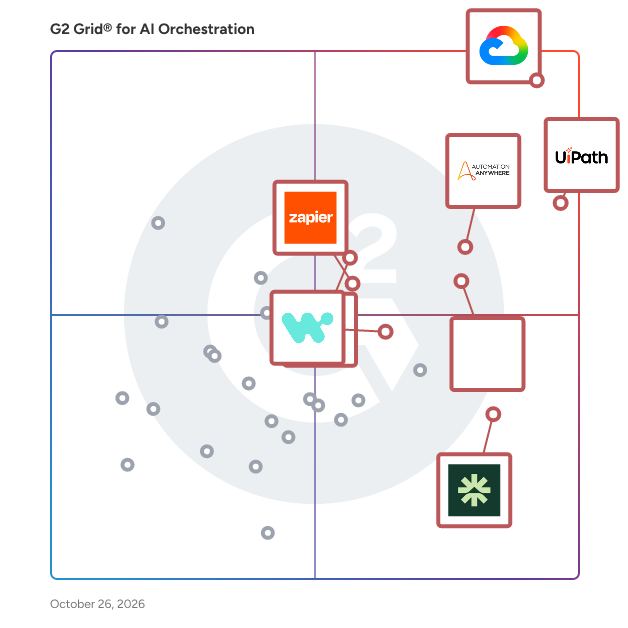
Highlighted products: Gemini platform, UiPath Agentic Automation, Automation Anywhere Agentic Process Automation, Langchain, MuleSoft Anypoint Platform, Zapier, Willow AI Governance Control Plane, and Workato.
Underlying data: [Grid® JSON](https://www.g2.com/categories/ai-orchestration/grids.json?focus%5B%5D=gemini-platform&focus%5B%5D=uipath-agentic-automation&focus%5B%5D=automation-anywhere-agentic-process-automation&focus%5B%5D=langchain&focus%5B%5D=mulesoft-anypoint-platform&focus%5B%5D=zapier&focus%5B%5D=willow-ai&focus%5B%5D=workato)
Tailor is a headless, composable Enterprise Resource Planning (ERP) platform designed to provide businesses with a flexible and customizable solution for managing operations. Unlike traditional ERP systems, Tailor offers a modular architecture that allows companies to select and integrate only the components they need, ensuring a tailored fit for their unique workflows. This approach enables rapid deployment, with businesses able to implement and customize the platform within weeks, significantly reducing the time and resources typically required for ERP integration. Key Features and Functionality: - Modular and Composable Architecture: Tailor's ERP system is built with a modular design, allowing businesses to activate only the necessary modules, such as inventory management, order processing, production management, and cost accounting. This flexibility ensures that companies can scale and adapt the system as their needs evolve. - API-First Design: The platform's open API-first approach facilitates seamless integration with a wide range of tools and services, including Shopify, ShipStation, Loop, and QuickBooks. This ensures a unified operation by connecting various off-the-shelf tools and omnichannel marketplaces on a single platform. - Low-Code Customization: Tailor provides a developer-friendly, low-code environment that enables rapid customization of out-of-the-box applications or the creation of entirely new ones. This empowers businesses to build solutions that precisely match their operational requirements without extensive development resources. - AI-Enhanced Inventory Management: The platform incorporates AI capabilities to automate inventory tasks, such as reading documents, filling in data, and maintaining accurate inventory across all channels. This reduces manual data entry and minimizes errors, leading to more efficient operations. - Secure and Scalable: Tailor is SOC 2 compliant, ensuring enterprise-grade data protection. Its architecture is designed for fast processing at scale, allowing businesses to handle millions of transactions without performance degradation. Primary Value and Solutions Provided: Tailor addresses the limitations of traditional ERP systems by offering a customizable and scalable solution that adapts to the specific needs of modern businesses. By enabling companies to integrate only the necessary modules and providing a low-code platform for rapid customization, Tailor reduces the complexity and cost associated with ERP implementation. Its API-first design ensures seamless integration with existing tools, facilitating unified operations across various channels. Additionally, the incorporation of AI-driven features automates routine tasks, enhances accuracy, and allows businesses to focus on strategic growth initiatives. Overall, Tailor empowers companies to streamline their operations, improve efficiency, and scale effectively in a dynamic business environment.
Connect G2 to Claude or ChatGPT for answers grounded in G2's trusted reviews, comparisons, and pricing from real user insights.
TalkOps is an open-source, multi-agent platform designed to revolutionize enterprise cloud operations by integrating GitOps principles across AWS, Azure, and Google Cloud environments. By leveraging conversational AI, TalkOps enables users to articulate their infrastructure needs—such as provisioning, deployment, observability, or incident response—in natural language, allowing specialized AI agents to execute these tasks autonomously and continuously. This approach simplifies complex DevOps processes, making them more accessible and efficient. Key Features and Functionality: - Kubernetes Agent: Automates the entire Kubernetes lifecycle, including Helm chart generation, active cluster operations, ArgoCD onboarding, observability setup, and cluster diagnostics. - CI-Copilot: Facilitates the creation, modification, and debugging of CI/CD pipelines through conversational interactions, ensuring seamless integration and deployment processes. - AWS Orchestrator: Employs multiple specialized sub-agents to generate enterprise-grade AWS Terraform modules, enhancing infrastructure as code practices with deep research analysis and security compliance validation. - SRE Agent: Acts as an incident commander, coordinating across various agents to manage triage, execute runbooks, track service level objectives (SLOs), and conduct post-incident analyses, thereby reducing operational toil through intelligent automation. - MCP Servers: Provides Model Context Protocol (MCP) servers for tools like Helm, ArgoCD, Argo Rollouts, Traefik, Terraform, Prometheus, and Alertmanager, enabling structured and secure interactions between AI agents and infrastructure tools. Primary Value and Problem Solving: TalkOps addresses several critical challenges in DevOps: - Knowledge Gap: By translating natural language requests into actionable tasks, TalkOps lowers the barrier for junior engineers, enabling them to manage complex cloud infrastructures safely and effectively. - Expert Bottleneck: Automating routine and complex tasks allows senior architects to focus on strategic initiatives rather than being bogged down by operational issues. - Documentation Rot: Dynamic, AI-driven processes replace static runbooks, ensuring that operational procedures remain current and relevant to the specific scenarios encountered. - Tool Sprawl: TalkOps integrates with existing tools and platforms, providing a unified interface that reduces the complexity associated with managing multiple tools, each with its own configurations and failure modes. By embedding governance and safety measures, such as human-in-the-loop approval gates and comprehensive audit trails, TalkOps ensures that automation is both secure and compliant. Its open-source, vendor-agnostic nature allows for flexibility and adaptability, making it a valuable asset for organizations aiming to enhance their DevOps capabilities through intelligent automation.
Team9.ai is an AI workspace that transforms AI agents into a reliable execution team for product development, engineering, and operational tasks. It enables organizations to assign outcomes, monitor progress, utilize playbooks, and maintain accountability for every agent within a unified platform. Key Features and Functionality: - Role-Based Agents: Create specialized agents for various functions such as engineering, growth, support, research, quality assurance, and operations. Each agent is assigned specific roles and responsibilities, ensuring clarity and efficiency. - Human-Grade Accountability: Maintain transparency with a shared timeline that records every update, blocker, decision, and handoff, fostering trust and collaboration between human team members and AI agents. - Shared Execution Board: Integrate human and AI workflows into a single queue, keeping priorities clear and preventing tasks from being lost in communication threads. - Outcome-Driven Workflows: Break down large projects into manageable tasks with defined owners, statuses, dependencies, and clear definitions of completion, facilitating structured and efficient execution. - Blocker Escalation: Equip agents to identify and escalate issues such as missing context, broken environments, or risky decisions, ensuring timely human intervention when necessary. - Live Progress Stream: Monitor work in real-time, review activity logs, and intervene only when human decisions are required, optimizing oversight without micromanagement. - Reusable Playbooks: Capture and codify successful workflows, including instructions, examples, tools, and decision rules, allowing for consistent and efficient execution of recurring tasks. - Unified Agent Dashboard: Oversee all agents, work queues, owners, and statuses from a centralized command center, providing comprehensive operational visibility. Primary Value and Solutions Provided: Team9.ai addresses the challenge of integrating AI agents into organizational workflows by providing a structured environment where AI agents can perform accountable, outcome-driven work. It ensures that AI agents are not merely generating responses but are actively contributing to tangible results. By maintaining human oversight and clear accountability, Team9.ai bridges the gap between human teams and AI capabilities, enhancing productivity and operational efficiency. The platform's emphasis on role definition, transparency, and reusable workflows empowers organizations to scale their operations effectively while maintaining control and trust in their AI integrations.
Associates AI Teammates — Managed AI Agent Systems We deploy multiple specialized AI agents that work together to handle your business operations 24/7. Each agent is tailored to a specific function—sales outreach, customer support, operations, marketing, technical work—and they collaborate seamlessly to eliminate repetitive work and free your team to focus on high-impact decisions. What makes Teammates different: • Custom-built, not generic. We study your workflows and build agents that fit how your business actually works. • Fully managed. Deployment, monitoring, optimization, and continuous improvement—all handled by us. • Multi-agent orchestration. Your agents work together intelligently, passing context and decisions between roles. • Self-improving. We monitor performance weekly and optimize prompts, workflows, and integrations based on real results. • No technical overhead. You focus on business. We handle infrastructure, scaling, and maintenance. The outcome: Your business runs on agents that never sleep, never make careless mistakes, and get smarter every week.
TENEX.AI is a cybersecurity company that utilizes AI and human expertise to help enterprises protect their digital assets.
TensorFoundry's AgentOS is an advanced agentic workflow system designed to orchestrate multiple AI agents, enabling seamless integration with enterprise software to achieve complex business objectives. By facilitating intelligent task delegation and agent-to-agent communication, AgentOS empowers organizations to automate intricate workflows and enhance operational efficiency. Key Features and Functionality: - Multi-Agent Coordination: AgentOS manages the collaboration of various AI agents, ensuring they work in unison to solve complex tasks through intelligent task delegation and dynamic workflow adaptation. - Enterprise Software Integration: The platform offers a unified integration framework, allowing agents to connect with existing enterprise systems, databases, APIs, and tools via pre-built connectors and custom API integrations. - Workflow Automation: With a visual workflow designer and pre-built templates, AgentOS enables the deployment of agentic workflows that automate complex business processes, incorporating human-in-the-loop controls and real-time monitoring. - Safety and Security: Built-in safety guardrails, output validation, and enterprise-grade security features, including configurable safety constraints, audit logging, and role-based access control, ensure agents operate within defined boundaries and comply with organizational policies. Primary Value and User Solutions: AgentOS addresses the challenge of managing and scaling autonomous AI agents within enterprise environments. By providing a robust orchestration layer, it allows organizations to automate complex workflows, coordinate multiple AI agents towards shared goals, and integrate AI capabilities into existing business systems without the need for custom infrastructure development. This results in enhanced operational efficiency, reduced manual intervention, and the ability to leverage AI-driven solutions effectively across various business functions.
Teptro is an AI-driven SaaS platform designed to streamline product operations for modern B2B teams by centralizing customer feedback management and AI gateway infrastructure. By integrating tools like Voxly for feedback collection and RouteIQ for AI operations, Teptro enhances collaboration, accelerates decision-making, and fosters product innovation. Key Features and Functionality: - Voxly – Customer Feedback Management: Aggregates feature requests, pain points, and votes from various channels into a unified view, enabling teams to identify themes and prioritize effectively. - RouteIQ – AI Gateway Infrastructure: Provides a robust AI gateway with support for multiple large language models (LLMs), offering observability, latency tracking, and agent traffic visibility, all while allowing teams to use their own LLM keys. - Embedded AI Analytics: Facilitates natural language queries within tables and reports, delivering answers, charts, and drill-down insights without the need for data warehouse migration. Primary Value and Solutions Provided: Teptro addresses the challenges of fragmented product tools and inefficient workflows by offering a cohesive platform that centralizes essential product operations. This integration reduces manual hand-offs, enhances privacy controls, and provides a clearer product signal from customer feedback. By adopting Teptro, teams can achieve better control, quicker collaboration, and more intelligent execution, ultimately leading to superior product outcomes.
Teralynk is an agentic AI platform that plans, delegates, and completes real work — not suggestions. Give the AI Orchestrator a goal in plain language. It breaks the work into tasks, assigns each one to the right specialist agent, executes across your connected tools and files, and delivers a finished result with a full audit trail of every step. 55 specialist agents cover Security, Legal, Finance, HR, Content, and Code. Agent Canvas lets you build and deploy multi-agent workflows visually — no code required. 17,000+ MCP integrations connect to virtually any tool or service. Compliance monitoring scans agent activity against HIPAA, GDPR, SOC 2, CCPA, PCI-DSS, FINRA, SEC, and 100+ frameworks in real time. Built for teams that are tired of AI that answers questions but leaves all the actual work to them.
Terminal Industries is revolutionizing yard logistics with its AI-native Yard Operating System™ (YOS™), a platform that leverages computer vision and autonomous decision intelligence to automate, orchestrate, and optimize yard operations from gate to dock. Founded in 2023 and headquartered in Austin, Texas, Terminal Industries aims to transform traditional yard management by introducing real-time visibility and control over transportation assets, thereby enhancing operational efficiency and resilience in the supply chain. Key Features and Functionality: - Autonomous AI-Driven Workflows: YOS™ employs agentic AI to manage workflows across the yard, enabling seamless coordination from gate check-ins to dock assignments without manual intervention. - Computer Vision Integration: The system utilizes advanced computer vision technology to monitor and manage yard activities, ensuring accurate tracking and management of assets. - Real-Time Visibility: Operators gain a comprehensive, real-time overview of yard operations through a unified platform, facilitating informed decision-making and swift response to dynamic conditions. - Scalability and Configurability: Designed to be easily deployable and scalable, YOS™ can be configured to meet the specific needs of various yard environments, integrating seamlessly with existing Warehouse Management Systems (WMS) and Transportation Management Systems (TMS). - Enhanced Operational Efficiency: By automating critical yard operations, YOS™ reduces manual tasks, minimizes errors, and increases throughput, leading to significant cost savings and improved performance benchmarks. Primary Value and Solutions Provided: Terminal Industries addresses the longstanding inefficiencies in yard operations by replacing manual workflows and outdated Yard Management Systems with an intelligent, AI-driven solution. YOS™ transforms the yard into a strategic asset by: - Eliminating Bottlenecks: By automating processes and providing real-time data, the system reduces delays and congestion, ensuring smoother operations. - Enhancing Decision-Making: The integration of AI and computer vision offers actionable insights, enabling operators to make informed decisions that optimize yard performance. - Improving Safety and Compliance: Automated monitoring and management contribute to a safer working environment and ensure adherence to regulatory standards. - Facilitating Scalability: The platform's configurability allows businesses to scale operations efficiently, adapting to changing demands without significant overhauls. By implementing Terminal Industries' YOS™, logistics operators can achieve a more efficient, resilient, and transparent supply chain, ensuring that goods move safely, consistently, and predictably.
Terraform RAG is an AI-powered knowledge base designed to enhance the management and utilization of Terraform modules. It offers a centralized platform for indexing, searching, composing, and auditing Terraform configurations, streamlining infrastructure as code (IaC) workflows. Key Features and Functionality: - Module Indexing: Automatically indexes Terraform modules, repositories, tags, resource types, versions, conventions, and usages, providing a comprehensive overview of available resources. - Semantic Search: Enables intent-based searches across modules, allowing users to find the right module by intent, not just name. - Agentic Composition: Allows users to describe infrastructure needs in plain English, with the system generating production-ready HCL configurations by exploring the module catalog and fetching relevant conventions. - Audit and Compliance: Conducts security and compliance reviews based on organizational conventions, quickly checking aspects like IAM policies, encryption standards, networking configurations, and tagging practices. - Optimization: Reviews existing code against real deployment patterns to identify version drifts, convention violations, and missing best practices. - IDE Integration: Integrates with development environments such as Claude Code, Cursor, and Windsurf, allowing direct queries to the module knowledge base from within the IDE. - Knowledge Layer: Learns how modules are used across consumer repositories, automatically distilling naming conventions, variable usage, tagging, and deployment practices. Primary Value and Problem Solved: Terraform RAG addresses the complexity and inefficiency often associated with managing Terraform modules in large-scale infrastructure deployments. By providing a centralized, AI-driven platform, it enhances discoverability, ensures compliance with organizational standards, and optimizes infrastructure configurations. This leads to improved productivity, reduced errors, and more efficient infrastructure management for DevOps teams.
