Ontraq AI
Who Is the Company Behind Ontraq AI?
- Seller: Ontraq AI
- Year Founded: 2023
- HQ Location: Austin, US
-
LinkedIn® Page: www.linkedin.com
1 employees on LinkedIn®
Total Products under this Category: 974
Last updated: October 26, 2026
Why You Can Trust G2's Software Rankings:
G2's software rankings are built on verified user reviews, rigorous moderation, and a consistent research methodology maintained by a team of analysts and data experts. Each product is measured using the same transparent criteria, with no paid placement or vendor influence. While reviews reflect real user experiences, which can be subjective, they offer valuable insight into how software performs in the hands of professionals. Together, these inputs power the G2 Score, a standardized way to compare tools within every category.
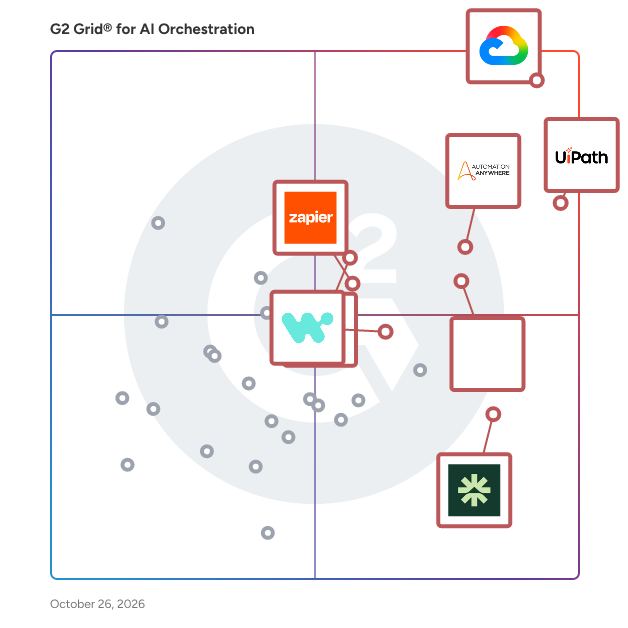
Highlighted products: Gemini platform, UiPath Agentic Automation, Automation Anywhere Agentic Process Automation, Langchain, MuleSoft Anypoint Platform, Zapier, Willow AI Governance Control Plane, and Workato.
Underlying data: [Grid® JSON](https://www.g2.com/categories/ai-orchestration/grids.json?focus%5B%5D=gemini-platform&focus%5B%5D=uipath-agentic-automation&focus%5B%5D=automation-anywhere-agentic-process-automation&focus%5B%5D=langchain&focus%5B%5D=mulesoft-anypoint-platform&focus%5B%5D=zapier&focus%5B%5D=willow-ai&focus%5B%5D=workato)
Onyx Security accelerates enterprise AI adoption, securely. The company’s secure AI control plane offers a single platform to serve security, governance, and infrastructure teams as they oversee how AI agents are used, ensure they are secure and compliant, and measure their effectiveness. Powered by its proprietary models and agentic technology, Onyx is already trusted by leading Fortune 500 companies. To maximize the value from AI and minimize the risks, visit onyx.security.
OODA AI is a comprehensive, GDPR-compliant platform that consolidates over 150 AI models into a unified environment, enabling organizations to adopt and scale AI solutions securely and efficiently. By integrating capabilities such as intelligent document processing, AI avatars, voice assistants, and autonomous workflows, OODA AI empowers businesses to enhance operations and drive innovation across various sectors. Key Features and Functionality: - Chat & Data Intelligence: Engage with data through natural language conversations, utilizing multiple AI models to gain instant insights. - Avatars & Agents: Develop photorealistic AI avatars and autonomous agents capable of real-time interactions and task execution. - Media & Content Generation: Generate high-quality images, videos, and audio content using advanced AI models, streamlining creative processes. - Workflows & Applications: Design and implement complex AI-driven workflows and applications with a visual builder, facilitating seamless integration into existing systems. - Extensive Integrations: Connect with over 70 native integrations, including data sources, CRMs, messaging channels, and productivity tools, ensuring compatibility with existing infrastructures. Primary Value and Solutions Provided: OODA AI addresses the challenge of fragmented AI tools by offering a centralized platform that unifies diverse AI capabilities, reducing complexity and accelerating adoption. Its model-agnostic approach eliminates vendor lock-in, providing access to a wide range of AI models from leading providers. With a strong emphasis on security and compliance, including GDPR adherence and EU-hosted infrastructure, OODA AI ensures data sovereignty and trust. By streamlining AI deployment and management, the platform enables organizations to enhance efficiency, foster innovation, and maintain a competitive edge in the rapidly evolving digital landscape.
Connect G2 to Claude or ChatGPT for answers grounded in G2's trusted reviews, comparisons, and pricing from real user insights.
OpenFang is an open-source Agent Operating System developed in Rust, designed to facilitate the deployment and management of autonomous AI agents. Unlike traditional frameworks that require constant user input, OpenFang enables agents to operate independently on predefined schedules, perform tasks such as building knowledge graphs, monitoring targets, generating leads, and managing social media accounts, all while reporting results to a centralized dashboard. The entire system compiles into a single, approximately 32MB binary, ensuring a streamlined and efficient setup. Key Features and Functionality: - Autonomous Hands: OpenFang includes seven pre-built autonomous agents, known as "Hands," each tailored for specific tasks: - Clip: Converts long-form videos into short clips with captions and thumbnails. - Lead: Conducts daily lead generation with Ideal Customer Profile (ICP) scoring. - Collector: Performs Open Source Intelligence (OSINT) monitoring with sentiment analysis. - Predictor: Provides superforecasting with calibrated probability estimates. - Researcher: Conducts fact-checking with multi-language support and structured reporting. - Twitter: Manages X (formerly Twitter) accounts with content scheduling and engagement tracking. - Browser: Automates web interactions, including form submissions and multi-step workflows. - Security Systems: The platform is fortified with 16 security layers, including a WebAssembly (WASM) dual-metered sandbox, Ed25519 manifest signing, Merkle audit trails, taint tracking, Server-Side Request Forgery (SSRF) protection, and secret zeroization, ensuring robust security and integrity. - Channel Adapters: OpenFang supports integration with 40 communication platforms, such as Telegram, Discord, Slack, WhatsApp, Microsoft Teams, IRC, and Matrix, allowing agents to operate seamlessly across multiple channels. - Built-In Tools and Protocols: The system offers 38 native tools, including web search, browser automation, image generation, text-to-speech, Docker management, and knowledge graph construction. It also supports the Model Context Protocol (MCP) and Agent-to-Agent (A2A) communication, facilitating inter-agent interactions and external integrations. - Memory Management: Utilizing SQLite-backed storage with vector embeddings, OpenFang ensures persistent memory, cross-channel canonical sessions, automatic LLM-based compaction, and JSONL session mirroring, enabling agents to maintain context across conversations and platforms. Primary Value and User Solutions: OpenFang addresses the need for truly autonomous AI agents capable of performing complex tasks without continuous user intervention. By providing a comprehensive, secure, and efficient operating system, it empowers developers and organizations to deploy AI agents that can: - Automate repetitive and time-consuming tasks, enhancing productivity. - Maintain consistent and accurate data collection and analysis through scheduled operations. - Ensure secure and isolated execution environments, mitigating potential security risks. - Seamlessly integrate with various communication platforms, ensuring broad accessibility and interaction capabilities. By consolidating these functionalities into a single, lightweight binary, OpenFang simplifies the deployment process, reduces system overhead, and provides a scalable solution for managing autonomous AI agents in production environments.
OICM (Open Innovation Cluster Manager) is a sovereign, vendor-agnostic AI platform that unifies orchestration and MLOps into a single intelligent layer. It manages GPU resources across cloud, on-premises, and air-gapped environments, optimizing utilization, cutting idle capacity, and eliminating vendor lock-in. OICM gives organizations full control to train, deploy, and scale AI efficiently, securely, and on their own terms.
Open Interpreter is an open-source platform designed to bridge the gap between language models and computer systems, enabling seamless interaction through code execution and system control. By providing a standardized interface, it allows language models to perform tasks such as executing code, browsing the web, managing files, and controlling third-party software. This empowers users to harness the capabilities of AI directly within their computing environments, enhancing productivity and automation. Key Features and Functionality: - Computer API: Introduces a standardized interface for language models to interact with computer systems, facilitating tasks like displaying content, mouse movements, and keyboard inputs. - OS Mode: Enables language models to control the operating system visually through mouse and keyboard inputs, allowing for direct interaction with on-screen elements. - Local Model Support: Provides robust support for running language models locally, ensuring privacy and offline functionality. - Vision Capabilities: Incorporates multimodal input and feedback, allowing language models to process visual information and generate visual outputs. - Safe Mode: Offers experimental safety features, including code scanning and execution controls, to enhance user security. Primary Value and User Solutions: Open Interpreter addresses the challenge of integrating advanced language models with everyday computing tasks. By providing a standardized interface and supporting local execution, it ensures user privacy and control. The platform's multimodal capabilities and safety features further enhance its utility, making it a versatile tool for developers and users seeking to leverage AI for system automation and interaction.
Open Orchestrators is a comprehensive directory and news platform dedicated to multi-agent orchestration systems. It serves as a centralized resource for tracking and comparing various open-source and publicly documented projects that focus on orchestrating multiple AI agents. The platform provides insights into builders, workspaces, company operating systems, coordination protocols, and visual systems, offering a holistic view of the multi-agent orchestration landscape. Key Features and Functionality: - Project Directory: A curated list of 31 multi-agent orchestration platforms, each accompanied by detailed profiles and GitHub statistics, enabling users to assess and compare different solutions. - News Updates: Regularly updated news section featuring 39 posts that highlight the latest developments, launches, and market signals within the multi-agent orchestration domain. - Categorization: Projects are organized based on their focus areas, such as personal AI assistants, autonomous agents, workflow builders, and company-level orchestration systems, facilitating targeted exploration. - Community Engagement: Encourages community participation by providing directory notes and measuring builder outcomes, fostering a collaborative environment for knowledge sharing and innovation. Primary Value and User Solutions: Open Orchestrators addresses the need for a centralized repository of information on multi-agent orchestration platforms. By aggregating and categorizing diverse projects, it simplifies the process for developers, researchers, and organizations to discover, evaluate, and select appropriate orchestration solutions tailored to their specific requirements. The platform's news updates keep users informed about the latest trends and advancements, ensuring they stay ahead in the rapidly evolving field of AI agent orchestration. Ultimately, Open Orchestrators empowers users to make informed decisions, streamline development processes, and foster innovation in multi-agent systems.
Describe your workflow in plain English and run it across your tools without building or configuring anything. Operator23 executes it with clear steps, shows what happens, and lets you review before actions run, so you can trust automation from day one.
Operon is an advanced AI-driven platform designed to streamline and enhance business operations by automating complex workflows and decision-making processes. By integrating cutting-edge machine learning algorithms, Operon enables organizations to optimize efficiency, reduce operational costs, and improve overall productivity. Key Features and Functionality: - Automated Workflow Management: Operon automates routine tasks and processes, allowing teams to focus on strategic initiatives. - Data-Driven Insights: The platform analyzes vast amounts of data to provide actionable insights, facilitating informed decision-making. - Scalability: Operon is designed to scale with business growth, accommodating increasing data volumes and complexity. - Integration Capabilities: It seamlessly integrates with existing systems and tools, ensuring a smooth implementation process. - User-Friendly Interface: The intuitive design allows users to easily navigate and utilize the platform without extensive training. Primary Value and Solutions Provided: Operon addresses the challenge of managing complex business operations by offering a solution that automates and optimizes workflows. This leads to significant time savings, cost reductions, and enhanced decision-making capabilities. By leveraging Operon, organizations can achieve higher operational efficiency, adapt to market changes swiftly, and maintain a competitive edge in their industry.
TAHO, developed by Opnbook, is an advanced infrastructure software designed to enhance the performance of AI, Cloud, and High-Performance Computing (HPC) workloads. By introducing an efficient execution layer, TAHO doubles compute throughput without necessitating additional hardware, containers, or complex configurations. This innovative solution optimizes resource utilization, reduces energy consumption, and minimizes operational costs, enabling organizations to scale their computing capabilities effectively. Key Features and Functionality: - Instantaneous Deployment: TAHO achieves operational readiness in microseconds, eliminating the prolonged boot times associated with traditional systems. - Optimized for High-Performance Workloads: Tailored for AI, Cloud, and HPC applications, TAHO enhances throughput and performance without the need for hardware upgrades. - Efficient Distributed Processing: The software intelligently distributes workloads across environments, reducing GPU waste and eliminating bottlenecks to maximize performance. - Automated Deployment: TAHO self-deploys and optimizes without manual intervention, streamlining operations and reducing complexity. - Hybrid Compatibility: Capable of running across cloud, on-premises, and edge environments, TAHO integrates seamlessly with existing infrastructures without requiring rewrites. Primary Value and Problem Solved: TAHO addresses the escalating demands and inefficiencies in AI, Cloud, and HPC infrastructures. By eliminating the overhead associated with traditional orchestration layers and reducing energy consumption, TAHO enables organizations to achieve higher performance and scalability without incurring additional hardware costs. This leads to significant cost savings, improved resource utilization, and a reduced environmental footprint, allowing businesses to focus on innovation and growth.
OpsBrief is an AI-powered operations intelligence platform designed to consolidate incidents, releases, deployments, and campaigns from various tools into a single, daily digest. By integrating with platforms such as Slack, Microsoft Teams, GitHub, PagerDuty, Datadog, and more, OpsBrief provides teams with a unified view of critical events, reducing noise and enhancing situational awareness across departments. Key Features and Functionality: - Unified Event Collection: Aggregates events from multiple tools into a centralized timeline, ensuring comprehensive visibility. - AI-Powered Analysis: Utilizes artificial intelligence to categorize events, identify patterns, and highlight significant occurrences, minimizing alert fatigue. - Daily Digest: Delivers concise, AI-generated summaries of key events directly to users' inboxes or chat platforms, facilitating quick and informed decision-making. - Advanced Analytics: Offers service dependency graphs and activity heatmaps to visualize service relationships, detect incident patterns, and expedite root cause analysis. - Multi-Department Support: Serves various teams—including engineering, product, marketing, and operations—by providing tailored insights relevant to each department's needs. Primary Value and Problem Solved: OpsBrief addresses the challenge of information overload and fragmented communication within organizations. By consolidating critical operational data into a single, AI-curated digest, it ensures that teams stay informed without being overwhelmed by excessive notifications. This streamlined approach leads to a significant reduction in Mean Time to Resolution (MTTR), decreases alert noise, and enhances on-call satisfaction, ultimately fostering a more efficient and responsive operational environment.
OpsPilots specializes in developing private AI systems, n8n automation workflows, and AI agents tailored for B2B operations. These solutions are deployed directly on clients' Virtual Private Servers (VPS) within 48 hours, ensuring that all data remains within the client's infrastructure, eliminating SaaS fees and vendor lock-in. By automating repetitive tasks, OpsPilots helps teams recover 15–25 hours per week, allowing them to focus on strategic initiatives. Key Features and Functionality: - Private AI Systems: Custom AI models trained exclusively on a company's internal data, including Standard Operating Procedures (SOPs), contracts, product catalogs, and support histories. These models operate on the client's VPS, providing accurate, context-aware responses without internet dependency or per-query costs. - AI Agents: Automated agents capable of handling tasks such as lead qualification, document routing, and support ticket responses. By managing these repetitive decisions, AI agents can recover significant time for teams. - Workflow Automation: Integration of various tools—such as CRM systems, email platforms, Slack, spreadsheets, and databases—into seamless n8n automation pipelines. This connectivity eliminates manual steps, ensuring efficient and error-free operations. - AI Knowledge Base: Transformation of company documents, including SOPs, product documentation, contracts, and support histories, into a searchable AI-driven knowledge base. This enables employees and customers to receive instant, accurate answers without the need for manual searches or support queues. Primary Value and Solutions Provided: OpsPilots addresses the inefficiencies associated with manual, repetitive tasks that consume valuable time and resources. By implementing their AI-driven solutions, businesses can: - Enhance Productivity: Automating routine processes allows teams to focus on higher-value activities, leading to increased overall productivity. - Ensure Data Security and Compliance: With all AI systems deployed on the client's own infrastructure, sensitive data remains secure, aiding in compliance with regulations such as GDPR. - Achieve Cost Efficiency: Eliminating SaaS fees and reducing manual labor costs contribute to significant financial savings. - Improve Decision-Making: Access to an AI-powered knowledge base and intelligent agents provides timely and accurate information, supporting better business decisions. By leveraging OpsPilots' solutions, companies can streamline their operations, safeguard their data, and drive growth through intelligent automation.
