Best AI Orchestration Software - Page 20

How Many AI Orchestration Software Products Does G2 Track?

Total Products under this Category: 974

Category Stats (Oct 2026)

  • Average Rating: 4.61/5 (↑0.01 vs Sep 2026) The average rating of products in this category, based on all submitted ratings
  • Top Trending Product: Crewai (+2.21%) - Among all products in this category, Crewai recorded the largest rating increase compared to last month

Last updated: October 26, 2026

How Does G2 Rank AI Orchestration Software Products?

Why You Can Trust G2's Software Rankings:

  • 30 Analysts and Data Experts
  • 24,800+ Authentic Reviews
  • 974+ Products
  • Unbiased Rankings

G2's software rankings are built on verified user reviews, rigorous moderation, and a consistent research methodology maintained by a team of analysts and data experts. Each product is measured using the same transparent criteria, with no paid placement or vendor influence. While reviews reflect real user experiences, which can be subjective, they offer valuable insight into how software performs in the hands of professionals. Together, these inputs power the G2 Score, a standardized way to compare tools within every category.

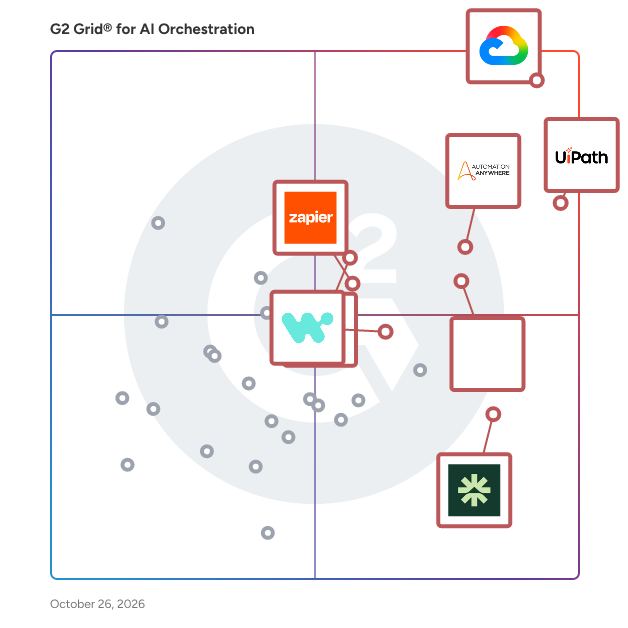
G2 Grid® for AI Orchestration Software

G2 Grid® for AI Orchestration Software plotting products by satisfaction and market presence

Highlighted products: Gemini platform, UiPath Agentic Automation, Automation Anywhere Agentic Process Automation, Langchain, MuleSoft Anypoint Platform, Zapier, Willow AI Governance Control Plane, and Workato.

Underlying data: [Grid® JSON](https://www.g2.com/categories/ai-orchestration/grids.json?focus%5B%5D=gemini-platform&focus%5B%5D=uipath-agentic-automation&focus%5B%5D=automation-anywhere-agentic-process-automation&focus%5B%5D=langchain&focus%5B%5D=mulesoft-anypoint-platform&focus%5B%5D=zapier&focus%5B%5D=willow-ai&focus%5B%5D=workato)

ComplyFlow

ComplyFlow is AI-powered contractor management software from Australia. It holds the full contractor lifecycle on one record: company prequalification, worker licences and inductions, site access and sign-in, permits, inspections, incidents, plant, and risk. Because the record is shared, a status set at prequalification is the status the site gate reads, and a lapsed document is visible before work starts. Procedures are digitised and automated rather than adopted: organisations build their own requirement sets, workflows, and approval routes, and chasing, expiry tracking, and escalation run without anyone driving them. The AI layer performs three functions: review, grading documents, prequalification responses, and safe work method statements against criteria the organisation defines and showing its reasoning; drafting, producing inspection checklists and inductions from existing material; and question answering against the live record, read-only if you want it to be. The review agents are built by the organisation itself, without code, by choosing a form type, its questions, and the criteria to grade against. This makes checking every submission economic rather than sampling. The platform is reachable from ChatGPT, Claude, and Copilot. Contractors carry one licence across every client using the platform. ComplyFlow has operated from Sydney since 2009 and has been ISO 27001 certified since 2019.

Who Is the Company Behind ComplyFlow?

Concourse

Who Is the Company Behind Concourse?

Connic

Connic is an AI agent deployment platform that enables developers to build, deploy, and manage production AI agents without infrastructure expertise. It provides a managed runtime environment where teams define agents declaratively using YAML configuration files, write custom tools as standard Python functions, and deploy through a Git-based workflow that handles scaling, monitoring, and integrations automatically. Connic is designed for software engineering teams and SaaS companies that need to move AI agents from prototype to production. Typical users include backend developers building AI-powered features into existing products, DevOps teams looking to avoid the complexity of self-hosting agent infrastructure, and product teams deploying customer-facing AI workflows such as support automation, document processing, or data enrichment. The platform addresses a common bottleneck in AI agent development: the gap between a working prototype and a production-grade system. Running agents at scale requires isolated execution environments, concurrency control, retry logic, observability, and integrations with external systems. Connic handles these concerns so developers can focus on agent logic rather than infrastructure. Key capabilities include: - Declarative agent configuration: Agents are defined in YAML with support for LLM agents, sequential pipelines, and tool-calling agents. Custom tools are written as typed Python functions. The Composer SDK validates configurations locally before deployment. - Git-based deployment: Pushing to a connected Git repository triggers automatic builds and versioned deployments. Every deployment supports instant rollback. A CLI alternative is available for teams not using Git integrations. - Enterprise connectors: 12 built-in connectors bridge agents to external systems, including webhooks, cron schedules, Apache Kafka, Amazon SQS, Amazon S3, PostgreSQL (via LISTEN/NOTIFY), WebSockets, MCP (Model Context Protocol), email (IMAP), Stripe, and Telegram. Connectors can be inbound (triggering agents), outbound (delivering results), or synchronous (request-response). - Built-in observability: Every agent run is recorded with full execution traces, token usage tracking, latency metrics, and cost breakdowns. Custom dashboards allow teams to monitor agent performance across deployments and environments. - Knowledge base and managed database: Agents can query uploaded documents via semantic search for retrieval-augmented generation (RAG), or use a managed relational database for persistent state and structured data storage. Connic supports all major LLM providers, including OpenAI, Anthropic, Google, and others, using the team's own API keys. Additional platform features include guardrails for real-time input/output filtering, human-in-the-loop approval workflows for sensitive agent actions, A/B testing with traffic splitting, and automated evaluation using LLM-based judges. The platform offers a free tier with no credit card required, along with paid plans starting at $390 per month. Pricing is based on agent run time (minutes) and number of runs, with pay-per-use billing beyond included limits. Connic is available in 10 deployment regions and provides SOC 2 security practices, a data processing agreement, and EU AI Act compliance documentation.

Who Is the Company Behind Connic?

AI can help you find the answers. G2 helps you trust them.

Connect G2 to Claude or ChatGPT for answers grounded in G2's trusted reviews, comparisons, and pricing from real user insights.

How it works

Construct Computer

Construct Computer lets you delegate work to an AI that has its own computer. From researching and writing code to sending emails and updating your apps, it handles complete workflows instead of just answering questions.

Who Is the Company Behind Construct Computer?

Context

Who Is the Company Behind Context?

  • Seller: LexisNexis
  • Year Founded: 1970
  • HQ Location: New York
  • Twitter: @NexisSolutions
    1,258 Twitter followers
  • LinkedIn® Page: www.linkedin.com
    9,857 employees on LinkedIn®

CoPlane

CoPlane is an AI-powered platform that enables finance and accounting teams to design, run, monitor, and adapt operational workflows.

Who Is the Company Behind CoPlane?

CorpusIQ

CorpusIQ is a private AI acceleration layer that seamlessly integrates with over 25 business tools, enabling users to pose questions in natural language and receive precise, source-cited answers. By connecting platforms such as QuickBooks, Shopify, Gmail, and Google Drive, CorpusIQ transforms AI assistants like ChatGPT, Claude, and Perplexity into comprehensive business intelligence solutions. Key Features and Functionality: - Unified Integration: Acts as a single connector within AI platforms, providing read-only access to a wide array of business tools without the need for multiple integrations. - Pre-Built Skills: Offers over 133 pre-configured skills that intelligently route user queries, determine the appropriate questions to ask, and extract data from relevant tools to generate coherent analyses. - Contextual Memory: Remembers past decisions, thresholds, and rules set by the user, building a persistent knowledge base to enhance future interactions without requiring re-explanation. - Actionable Insights: Delivers clear verdicts and concrete recommendations, such as suggesting budget reallocations between marketing channels based on computed metrics like true Return on Ad Spend (ROAS) and Customer Acquisition Cost (CAC). Primary Value and User Solutions: CorpusIQ addresses the challenge of fragmented business data by consolidating information from multiple platforms into a single, intelligent interface. This integration allows users to ask complex business questions in plain English and receive synthesized, actionable insights without the need for manual data compilation or analysis. By streamlining access to critical business information, CorpusIQ enhances decision-making efficiency, reduces the time spent on data retrieval, and empowers businesses to make informed choices swiftly.

Who Is the Company Behind CorpusIQ?

  • Seller: Corpusiq
  • Year Founded: 2025
  • HQ Location: Scottsdale, US
  • LinkedIn® Page: linkedin.com
    2 employees on LinkedIn®

Cortexlabs

Cortex is a pioneering blockchain platform that seamlessly integrates artificial intelligence (AI) into decentralized applications (dApps). By enabling on-chain execution of AI models, Cortex empowers developers to create intelligent, responsive dApps without relying on off-chain processing. This integration is facilitated through the Cortex Virtual Machine (CVM), which leverages GPU resources for efficient AI inference, and Synapse, a deterministic AI inference engine ensuring consistent results across diverse computing environments. Additionally, Cortex introduces ZkMatrix, a Layer 2 zkRollup solution that aggregates batch transactions, significantly enhancing transaction throughput and reducing fees. By fostering an open-source ecosystem, Cortex incentivizes AI researchers and developers to share their models, promoting innovation and collaboration within the blockchain community. Key Features and Functionality: - Cortex Virtual Machine (CVM): An EVM-compatible virtual machine that supports on-chain AI inference by utilizing GPU processing, enabling efficient execution of complex AI models directly on the blockchain. - Synapse AI Inference Engine: A deterministic engine that guarantees consistent AI inference results across various computing environments, ensuring reliability and accuracy in AI-powered dApps. - AI Smart Contracts and dApps: Developers can integrate machine learning models into smart contracts and dApps using Solidity, allowing for the creation of AI-enhanced decentralized applications tailored to real-world use cases. - ZkMatrix Layer 2 Solution: Utilizes zkRollup technology to aggregate batch transactions on a side chain into a single transaction on the main chain, significantly increasing transaction per second (TPS) and reducing transaction fees. - Decentralized AI Research: Encourages an open-source ecosystem where AI researchers and developers are incentivized to share their models on the blockchain, fostering innovation and collaboration. Primary Value and Problem Solved: Cortex addresses the challenge of executing machine learning models directly on the blockchain, a task previously deemed inefficient and impractical. Traditional blockchains struggled with on-chain AI execution due to limitations in virtual machine capabilities and processing power. Cortex overcomes these obstacles by introducing the CVM, which leverages GPU processing for efficient AI inference, and the Synapse engine, ensuring deterministic results. This innovation eliminates the need for off-chain AI processing, maintaining the decentralized and transparent nature of blockchain applications. By providing a platform where AI models can be executed on-chain, Cortex enables the development of intelligent, responsive dApps, opening new possibilities for decentralized finance, gaming, insurance, and more. Furthermore, the introduction of ZkMatrix enhances scalability and reduces transaction costs, making AI-powered dApps more accessible and efficient.

Who Is the Company Behind Cortexlabs?

Corveil

Corveil is a comprehensive platform designed to streamline and enhance the management of workers' compensation claims. By integrating advanced technology with industry expertise, Corveil offers a suite of solutions that improve efficiency, reduce costs, and ensure compliance for organizations handling workplace injuries. Key Features and Functionality: - Claims Management: Automates the entire claims process, from initial reporting to resolution, ensuring timely and accurate handling. - Medical Bill Review: Analyzes medical bills to identify discrepancies and ensure appropriate charges, leading to significant cost savings. - Case Management: Provides tools for case managers to monitor and coordinate care, facilitating better outcomes for injured employees. - Compliance Monitoring: Ensures adherence to state and federal regulations, reducing the risk of penalties and legal issues. - Data Analytics: Offers comprehensive reporting and analytics to identify trends, assess performance, and inform decision-making. Primary Value and Solutions: Corveil addresses the complexities of workers' compensation by offering an integrated platform that simplifies claims processing, enhances accuracy, and reduces administrative burdens. By leveraging Corveil's solutions, organizations can achieve faster claim resolutions, lower costs, and improved care for injured workers, ultimately fostering a safer and more efficient workplace environment.

Who Is the Company Behind Corveil?

Coverbase

Today, third-party risk management (TPRM) involves more admin than risk mitigation. Coverbase is a TPRM copilot that automates 90% of third-party risk assessments for regulated industries using AI: - Automate data collection: Coverbase has risk intel on 7,000+ companies and products assessed by your industry peers, built up by AI agents performing due diligence requests. - AI gap analysis: AI risk assessor reviews questionnaires, security, financial, and legal documents to ensure alignment with your instructions. - Conduct continuous diligence: Real-time failure monitoring and prediction across your third-parties. Coverbase spans six stages of the vendor lifecycle: intake, zero-touch assessment, risk copilot, continuous monitoring, inspection, and contracts. Modules work out of the box or can be customized to your exact workflow and specifications. The platform connects into systems across identity, security, and GRC to procurement, ERP, contracts, HR, and external risk data, then stitches it all into one coherent supplier data fabric. Allowing procurement, finance, IT, legal, and security teams to spend their time on strategy, not paperwork.

Who Is the Company Behind Coverbase?

  • Seller: Coverbase
  • Year Founded: 2024
  • HQ Location: San Francisco, US
  • LinkedIn® Page: www.linkedin.com
    19 employees on LinkedIn®

Crewship

The developer-first platform for running AI agent workflows. Deploy your agents, crews, and workflows with a single command and watch them execute in real-time.

Who Is the Company Behind Crewship?

Crun.ai

Unified API for 100+ AI models. One OpenAI-compatible integration instead of juggling multiple provider APIs and SDKs.

Who Is the Company Behind Crun.ai?

Crun.ai API

Crun.ai API is a unified AI API platform that allows developers and businesses to access multiple AI models through a single interface. It simplifies AI integration for content generation, automation, and intelligent applications, reducing development cost and complexity. Ideal for SaaS products, AI agents, and enterprise workflows.

Who Is the Company Behind Crun.ai API?

Bijou Barry
BB
Researched and written by Bijou Barry
Updated April 9, 2026