Best Artificial Neural Network Software

How Many Artificial Neural Network Software Products Does G2 Track?

Total Products under this Category: 119

Category Stats (Sep 2026)

  • Average Rating: 4.28/5 The average rating of products in this category, based on all submitted ratings
  • Top Trending Product: Google Cloud Deep Learning VM Image (+1.18%) - Among all products in this category, Google Cloud Deep Learning VM Image recorded the largest rating increase compared to last month

Last updated: September 05, 2026

How Does G2 Rank Artificial Neural Network Software Products?

Why You Can Trust G2's Software Rankings:

  • 30 Analysts and Data Experts
  • 500+ Authentic Reviews
  • 119+ Products
  • Unbiased Rankings

G2's software rankings are built on verified user reviews, rigorous moderation, and a consistent research methodology maintained by a team of analysts and data experts. Each product is measured using the same transparent criteria, with no paid placement or vendor influence. While reviews reflect real user experiences, which can be subjective, they offer valuable insight into how software performs in the hands of professionals. Together, these inputs power the G2 Score, a standardized way to compare tools within every category.

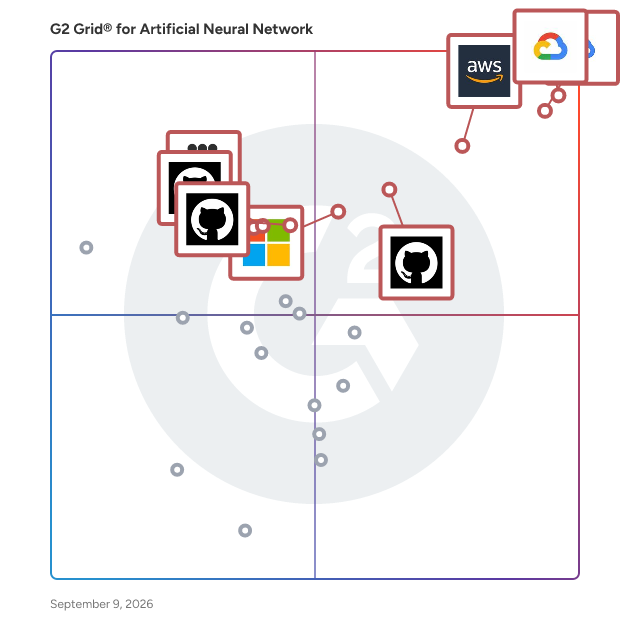
G2 Grid® for Artificial Neural Network Software

G2 Grid® for Artificial Neural Network Software plotting products by satisfaction and market presence

Highlighted products: Google Cloud Deep Learning VM Image, Google Cloud Deep Learning Containers, AWS Deep Learning AMIs, AIToolbox, Microsoft Cognitive Toolkit (Formerly CNTK), Knet, Merlin, and ConvNetJS.

Underlying data: [Grid® JSON](https://www.g2.com/categories/artificial-neural-network/grids.json?focus%5B%5D=google-cloud-deep-learning-vm-image&focus%5B%5D=google-cloud-deep-learning-containers&focus%5B%5D=aws-deep-learning-amis&focus%5B%5D=aitoolbox&focus%5B%5D=microsoft-cognitive-toolkit-formerly-cntk&focus%5B%5D=knet&focus%5B%5D=merlin&focus%5B%5D=convnetjs)

Google Cloud Deep Learning VM Image

Deep Learning VM Image Preconfigured VMs for deep learning applications.

Average Rating: 4.3/5.0

Total Reviews: 49

How Do G2 Users Rate Google Cloud Deep Learning VM Image?

  • Ease of Use: 8.6/10 (Category avg: 8.1/10)
  • Quality of Support: 8.0/10 (Category avg: 8.1/10)

Who Is the Company Behind Google Cloud Deep Learning VM Image?

  • Seller: Google
  • Year Founded: 1998
  • HQ Location: Mountain View, CA
  • Twitter: @google
    31,899,995 Twitter followers
  • LinkedIn® Page: www.linkedin.com
    301,144 employees on LinkedIn®
  • Ownership: NASDAQ:GOOG

Who Uses This Product?

  • Top Industries: Information Technology and Services, Computer Software
  • Company Size: 41% Small, 33% Medium

What Are Recent G2 Reviews of Google Cloud Deep Learning VM Image?

Google Cloud Deep Learning Containers

Preconfigured and optimized containers for deep learning environments.

Average Rating: 4.5/5.0

Total Reviews: 42

How Do G2 Users Rate Google Cloud Deep Learning Containers?

  • Ease of Use: 8.8/10 (Category avg: 8.1/10)
  • Quality of Support: 8.6/10 (Category avg: 8.1/10)

Who Is the Company Behind Google Cloud Deep Learning Containers?

  • Seller: Google
  • Year Founded: 1998
  • HQ Location: Mountain View, CA
  • Twitter: @google
    31,899,995 Twitter followers
  • LinkedIn® Page: www.linkedin.com
    301,144 employees on LinkedIn®
  • Ownership: NASDAQ:GOOG

Who Uses This Product?

  • Top Industries: Information Technology and Services, Computer Software
  • Company Size: 42% Small, 33% Medium

What Are Recent G2 Reviews of Google Cloud Deep Learning Containers?

What Are G2 Users Discussing About Google Cloud Deep Learning Containers?

AWS Deep Learning AMIs

The AWS Deep Learning AMIs is designed to equip data scientists, machine learning practitioners, and research scientists with the infrastructure and tools to accelerate work in deep learning, in the cloud, at any scale.

Average Rating: 4.4/5.0

Total Reviews: 24

How Do G2 Users Rate AWS Deep Learning AMIs?

  • Ease of Use: 9.1/10 (Category avg: 8.1/10)
  • Quality of Support: 8.8/10 (Category avg: 8.1/10)

Who Is the Company Behind AWS Deep Learning AMIs?

  • Seller: Amazon Web Services (AWS)
  • Year Founded: 2006
  • HQ Location: Seattle, WA
  • Twitter: @awscloud
    2,232,483 Twitter followers
  • LinkedIn® Page: www.linkedin.com
    147,094 employees on LinkedIn®
  • Ownership: NASDAQ: AMZN

Who Uses This Product?

  • Top Industries: Computer Software
  • Company Size: 46% Large, 29% Medium

What Are Recent G2 Reviews of AWS Deep Learning AMIs?

AIToolbox

AIToolbox is a comprehensive Swift framework designed to facilitate the development and implementation of artificial intelligence algorithms. It offers a suite of AI modules that cater to various machine learning tasks, making it a valuable resource for developers and researchers working within the Swift ecosystem. Key Features and Functionality: - Graphs and Trees: Provides data structures and algorithms for constructing and manipulating graphs and trees, essential for tasks like decision-making processes and hierarchical data representation. - Support Vector Machines (SVMs): Includes tools for implementing SVMs, enabling classification and regression analysis by finding optimal hyperplanes in high-dimensional spaces. - Neural Networks: Offers components to build and train neural networks, facilitating deep learning applications such as image and speech recognition. - Principal Component Analysis (PCA): Contains modules for dimensionality reduction through PCA, aiding in data visualization and noise reduction. - K-Means Clustering: Provides algorithms for partitioning datasets into clusters, useful in pattern recognition and data mining. - Genetic Algorithms: Includes tools for optimization problems using genetic algorithms, simulating natural selection processes to find optimal solutions. Primary Value and User Solutions: AIToolbox addresses the need for a native Swift library that encompasses a broad range of AI functionalities. By integrating multiple machine learning modules into a single framework, it simplifies the development process for Swift developers, eliminating the need to rely on external libraries or languages. This consolidation enhances efficiency, promotes code consistency, and accelerates the deployment of AI-driven applications on Apple platforms.

Average Rating: 4.4/5.0

Total Reviews: 35

How Do G2 Users Rate AIToolbox?

  • Ease of Use: 8.8/10 (Category avg: 8.1/10)
  • Quality of Support: 8.9/10 (Category avg: 8.1/10)

Who Is the Company Behind AIToolbox?

Who Uses This Product?

  • Top Industries: Information Technology and Services, Computer Software
  • Company Size: 54% Small, 40% Medium

What Do G2 Reviewers Say About AIToolbox?

AI-generated summary from verified user reviews

Pros
  • Users value the ease of use of AIToolbox, enabling quick integration and efficient management of AI tools.
  • Users value the model variety in AIToolbox, enabling easy experimentation with multiple AI tools in one platform.
  • Users appreciate the advanced AI technology of AIToolbox, enabling efficient data flow and quick development integration.
  • Users find the easy integration of AIToolbox with popular AI modules enhances their development efficiency significantly.
  • Users appreciate the wide range of AI tools in AIToolbox, enhancing functionality and saving time through seamless access.
Cons
  • Users face issues with inaccuracy as the AI frequently flags transactions without clear reasoning and makes logic errors.
  • Users note that AIToolbox has limited features that can hinder advanced use cases and require additional manual setup.
  • Users face AI limitations with unclear transaction flags, hallucinations in risk analysis, and quick errors affecting larger scale operations.
  • Users face compatibility issues with AIToolbox, disrupting production and causing crashes during high-frequency database operations.
  • Users find the complex setup of AIToolbox cumbersome, wishing for more presets and easier configurations.

What Are Recent G2 Reviews of AIToolbox?

What Are G2 Users Discussing About AIToolbox?

FAQs About Artificial Neural Network Software

Generated using AI

Last updated: June 3, 2026

Artificial Neural Network tools offering flexible training workflows and straightforward conversion to optimized inference formats

According to verified users, buyers looking for flexible training workflows often value preconfigured environments, support for common frameworks, and fewer setup steps before experimentation begins. Reviews also point to the importance of smooth conversion or export into optimized inference formats for deployment on edge devices, mobile apps, or other production targets. Users mention that strong options reduce dependency conflicts, simplify dataset-to-model iteration, and help teams move from prototype to inference faster. Common review themes also include GPU readiness, Python-based development, and support for formats or runtimes that make deployment more efficient without requiring extensive manual tuning.

Neural Network libraries with proven object detection and visual recognition capabilities in production logistics environments

According to verified users, object detection and visual recognition use cases in logistics center on dependable model training, real-time inference, and deployment in operational environments. Reviews describe teams using neural network tools to detect cases on pallets, support robotic picking, and enable computer vision workflows that connect training to production. Buyers may want to look for tools that support custom datasets, optimized export formats, and efficient execution on edge hardware. Review themes also highlight the value of high-level APIs, easier experimentation, and deployment paths that reduce the complexity of converting models for practical industrial vision applications.

Neural Network platforms with easy-to-use Python APIs for rapid prototyping of convolutional models across vision tasks

According to verified users, easy-to-use Python APIs matter because they shorten the time between an idea and a working vision model. Reviews repeatedly emphasize rapid prototyping, simpler debugging, and the ability to experiment without heavy configuration. Buyers evaluating these platforms may want to focus on how easily teams can build, test, and iterate on convolutional or other vision models using familiar Python workflows. Review content also points to the benefit of preinstalled frameworks, intuitive interfaces, and support for GPU-backed experimentation. At the same time, some users mention setup complexity, compatibility issues, or production deployment tradeoffs once projects move beyond prototyping.

What are the most important features in neural network software

G2 reviewers mention that the most important features in neural network software are usually fast environment setup, support for popular frameworks, GPU acceleration, and flexible experimentation workflows. Buyers also appear to value Python-friendly development, preconfigured dependencies, and tools that reduce configuration friction during training. For production use, reviews point to export and inference options, easier deployment to cloud or edge environments, and enough customization to match project requirements. Documentation quality and debugging support also come up often. In practice, users favor software that helps them move quickly from setup to model training while keeping deployment, iteration, and maintenance manageable for technical teams.

How does Artificial Neural Network integrate with Python

G2 reviewers mention Python as a primary way teams interact with artificial neural network tools, especially for prototyping, model training, and experimentation. Recent reviews highlight Python-ready environments with preinstalled libraries, SDK support, and APIs that make it easier to build workflows without extensive manual setup. Buyers may find that Python integration is strongest when frameworks, drivers, and dependencies are already configured, since that reduces compatibility issues and speeds up testing. Review themes also connect Python workflows to database querying, model experimentation, and vision tasks. In general, users value products that let developers stay in familiar Python-based workflows from initial testing through inference preparation.

Microsoft Cognitive Toolkit (Formerly CNTK)

Microsoft Cognitive Toolkit is an open-source, commercial-grade toolkit that empowers user to harness the intelligence within massive datasets through deep learning by providing uncompromised scaling, speed and accuracy with commercial-grade quality and compatibility with the programming languages and algorithms already use.

Average Rating: 4.2/5.0

Total Reviews: 22

How Do G2 Users Rate Microsoft Cognitive Toolkit (Formerly CNTK)?

  • Ease of Use: 8.0/10 (Category avg: 8.1/10)
  • Quality of Support: 8.1/10 (Category avg: 8.1/10)

Who Is the Company Behind Microsoft Cognitive Toolkit (Formerly CNTK)?

  • Seller: Microsoft
  • Year Founded: 1975
  • HQ Location: Redmond, Washington
  • Twitter: @microsoft
    13,091,739 Twitter followers
  • LinkedIn® Page: www.linkedin.com
    232,750 employees on LinkedIn®
  • Ownership: MSFT

Who Uses This Product?

  • Top Industries: Computer Software, Information Technology and Services
  • Company Size: 68% Large, 27% Small

What Do G2 Reviewers Say About Microsoft Cognitive Toolkit (Formerly CNTK)?

AI-generated summary from verified user reviews

Pros
  • Users commend the workflow efficiency of Microsoft Cognitive Toolkit, enhancing productivity and streamlining processes.
Cons
  • Users find Microsoft Cognitive Toolkit overwhelmingly complex, leading to difficulties in navigating and utilizing its capabilities effectively.
  • Users find the learning curve overwhelming, making it challenging to fully utilize Microsoft Cognitive Toolkit.

What Are Recent G2 Reviews of Microsoft Cognitive Toolkit (Formerly CNTK)?

What Are G2 Users Discussing About Microsoft Cognitive Toolkit (Formerly CNTK)?

Knet

Knet (pronounced "kay-net") is a deep learning framework implemented in Julia that allows the definition and training of machine learning models using the full power and expressivity of Julia.

Average Rating: 4.3/5.0

Total Reviews: 12

How Do G2 Users Rate Knet?

  • Ease of Use: 8.9/10 (Category avg: 8.1/10)
  • Quality of Support: 9.0/10 (Category avg: 8.1/10)

Who Is the Company Behind Knet?

  • Seller: Knet
  • Year Founded: 1990
  • HQ Location: Kuwait, Kuwait
  • Twitter: @knet
    68 Twitter followers
  • LinkedIn® Page: www.linkedin.com
    246 employees on LinkedIn®

Who Uses This Product?

  • Company Size: 42% Large, 33% Medium

What Are Recent G2 Reviews of Knet?

Merlin

Merlin is a deep learning framework written in Julia, it aims to provide a fast, flexible and compact deep learning library for machine learning.

Average Rating: 3.6/5.0

Total Reviews: 10

How Do G2 Users Rate Merlin?

  • Ease of Use: 8.9/10 (Category avg: 8.1/10)
  • Quality of Support: 6.4/10 (Category avg: 8.1/10)

Who Is the Company Behind Merlin?

  • Seller: Merlin
  • Year Founded: 1993
  • HQ Location: London, GB
  • LinkedIn® Page: www.linkedin.com
    428 employees on LinkedIn®

Who Uses This Product?

  • Company Size: 50% Small, 30% Medium

What Are Recent G2 Reviews of Merlin?

What Are G2 Users Discussing About Merlin?

ConvNetJS

ConvNetJS is a Javascript library for training Deep Learning models (Neural Networks) entirely in a browser.

Average Rating: 3.8/5.0

Total Reviews: 13

How Do G2 Users Rate ConvNetJS?

  • Ease of Use: 9.3/10 (Category avg: 8.1/10)
  • Quality of Support: 8.0/10 (Category avg: 8.1/10)

Who Is the Company Behind ConvNetJS?

Who Uses This Product?

  • Company Size: 38% Small, 38% Large

What Are Recent G2 Reviews of ConvNetJS?

NVIDIA Deep Learning GPU Training System (DIGITS)

NVIDIA Deep Learning GPU Training System (DIGITS) deep learning for data science and research to quickly design deep neural network (DNN) for image classification and object detection tasks using real-time network behavior visualization.

Average Rating: 4.5/5.0

Total Reviews: 22

How Do G2 Users Rate NVIDIA Deep Learning GPU Training System (DIGITS)?

  • Ease of Use: 8.3/10 (Category avg: 8.1/10)
  • Quality of Support: 7.8/10 (Category avg: 8.1/10)

Who Is the Company Behind NVIDIA Deep Learning GPU Training System (DIGITS)?

  • Seller: NVIDIA
  • Year Founded: 1993
  • HQ Location: Santa Clara, CA
  • Twitter: @nvidia
    2,582,827 Twitter followers
  • LinkedIn® Page: www.linkedin.com
    51,762 employees on LinkedIn®
  • Ownership: NVDA

Who Uses This Product?

  • Top Industries: Computer Software
  • Company Size: 52% Small, 35% Medium

What Are Recent G2 Reviews of NVIDIA Deep Learning GPU Training System (DIGITS)?

What Are G2 Users Discussing About NVIDIA Deep Learning GPU Training System (DIGITS)?

Keras

Keras is a neural networks library, written in Python and capable of running on top of either TensorFlow or Theano.

Average Rating: 4.6/5.0

Total Reviews: 64

How Do G2 Users Rate Keras?

  • Ease of Use: 8.9/10 (Category avg: 8.1/10)
  • Quality of Support: 7.8/10 (Category avg: 8.1/10)

Who Is the Company Behind Keras?

  • Seller: Keras
  • Year Founded: 2016
  • HQ Location: N/A
  • Twitter: @keras
    26 Twitter followers
  • LinkedIn® Page: www.linkedin.com
    26 employees on LinkedIn®

Who Uses This Product?

  • Who Uses This: Data Scientist
  • Top Industries: Computer Software, Information Technology and Services
  • Company Size: 38% Small, 32% Medium

What Are Recent G2 Reviews of Keras?

What Are G2 Users Discussing About Keras?

node-fann

FANN (Fast Artificial Neural Network Library) is a free open source neural network library, which implements multilayer artificial neural networks with support for both fully connected and sparsely connected networks.

Average Rating: 4.2/5.0

Total Reviews: 12

How Do G2 Users Rate node-fann?

  • Ease of Use: 8.5/10 (Category avg: 8.1/10)
  • Quality of Support: 9.0/10 (Category avg: 8.1/10)

Who Is the Company Behind node-fann?

Who Uses This Product?

  • Company Size: 50% Medium, 42% Small

What Are Recent G2 Reviews of node-fann?

What Are G2 Users Discussing About node-fann?

SuperLearner

SuperLearner is a package that implements the super learner prediction method and contains a library of prediction algorithms to be used in the super learner.

Average Rating: 4.5/5.0

Total Reviews: 13

How Do G2 Users Rate SuperLearner?

  • Ease of Use: 9.3/10 (Category avg: 8.1/10)
  • Quality of Support: 8.5/10 (Category avg: 8.1/10)

Who Is the Company Behind SuperLearner?

Who Uses This Product?

  • Company Size: 38% Small, 31% Large

What Are Recent G2 Reviews of SuperLearner?

What Are G2 Users Discussing About SuperLearner?

Neuton AutoML

Neuton (https://neuton.ai), a new AutoML solution, allows users to build compact AI models with just a few clicks and without any coding. Neuton also happens to be the most EXPLAINABLE Neural Network Framework and AutoML solution currently available on the market. It allows users to evaluate the model quality from various perspectives and interpret prediction results. Neuton Explainability Office: - Exploratory Data Analysis - Feature Importance Matrix with class granularity - Model Interpreter - Feature Influence Matrix - Validate Model on New Data - Model-to-Data Relevance Indicators historical and for every prediction - Model Quality Index - Confidence Interval - Extensive list of supported metrics with Radar Diagram

Average Rating: 4.5/5.0

Total Reviews: 17

How Do G2 Users Rate Neuton AutoML?

  • Ease of Use: 9.1/10 (Category avg: 8.1/10)
  • Quality of Support: 8.5/10 (Category avg: 8.1/10)

Who Is the Company Behind Neuton AutoML?

Who Uses This Product?

  • Company Size: 35% Large, 35% Small

What Are Recent G2 Reviews of Neuton AutoML?

What Are G2 Users Discussing About Neuton AutoML?

Torch

Torch is a scientific computing framework with wide support for machine learning algorithms that puts GPUs first.

Average Rating: 4.4/5.0

Total Reviews: 14

How Do G2 Users Rate Torch?

  • Ease of Use: 8.9/10 (Category avg: 8.1/10)
  • Quality of Support: 8.1/10 (Category avg: 8.1/10)

Who Is the Company Behind Torch?

  • Seller: Torch Leadership Labs
  • Year Founded: 2017
  • HQ Location: San Francisco, US
  • Twitter: @torchlabs
    3,063 Twitter followers
  • LinkedIn® Page: www.linkedin.com
    329 employees on LinkedIn®

Who Uses This Product?

  • Top Industries: Computer Software
  • Company Size: 40% Small, 40% Large

What Are Recent G2 Reviews of Torch?

gobrain

gobrain is a neural networks written in go that includes just basic Neural Network functions such as Feed Forward and Elman Recurrent Neural Network.

Average Rating: 4.5/5.0

Total Reviews: 11

How Do G2 Users Rate gobrain?

  • Ease of Use: 8.6/10 (Category avg: 8.1/10)
  • Quality of Support: 8.9/10 (Category avg: 8.1/10)

Who Is the Company Behind gobrain?

Who Uses This Product?

  • Company Size: 64% Small, 36% Medium

What Are Recent G2 Reviews of gobrain?

What Are G2 Users Discussing About gobrain?

Tian Lin
TL
Researched and written by Tian Lin
Updated April 9, 2026

Learn More About Artificial Neural Network Software

What is Artificial Neural Network Software?

Artificial neural network (ANN) software, often used synonymously with deep learning software, automates tasks for users by leveraging artificial neural networks to produce an output, often in the form of a prediction. Although some will distinguish between ANNs and deep learning (arguing that the latter refers to the training of ANNs), this guide will use the terms interchangeably. These solutions are typically embedded into various platforms and have use cases across various industries. Solutions built on artificial neural networks improve the speed and accuracy of desired outputs by constantly refining them as the application digests more training data.

Deep learning software improves processes and introduces efficiency to multiple industries, from financial services to agriculture. Applications of this technology include process automation, customer service, security risk identification, and contextual collaboration. Notably, end users of deep learning-powered applications do not interact with the algorithm directly. Rather, deep learning powers the backend of the artificial intelligence (AI) that users interact with. Some prime examples include chatbots software and automated insurance claims management software.

What Types of Artificial Neural Network Software Exist?

There are two main types of artificial neural network software: recurrent neural networks (RNNs) and convolutional neural networks (CNNs). The type of neural network doesn’t generally affect the end product that customers will use but might affect the accuracy of the outcome. For example, whether an image recognition tool is built using CNNs or RNNs matters little to the companies that employ it to deal with customers. Companies care more about the potential impact of deploying a well-made virtual assistant to their business model.

Convolutional neural networks (CNNs)

Convolutional neural networks (CNNs) extract features directly from data, such as images, eliminating the need for manual feature extraction. Manual feature extraction would require the data scientist to go in and determine the various components and aspects of the data. With this technology, the neural network determines this by itself. None of the features are pre-trained; instead, they are learned by the network when it trains on the given set of images. This automated feature extraction characteristic makes deep learning models highly effective for object classification and other computer vision applications.

Recurrent neural networks (RNNs)

Recurrent neural networks (RNNs) use sequential data or time series data. These deep learning algorithms are commonly used for ordinal or temporal problems. They are primarily leveraged using time series data to make predictions about future events, such as sales forecasting.

What are the Common Features of Artificial Neural Network Software?

Core features within artificial neural network software help users improve their applications, allowing for them to transform their data and derive insights from it in the following ways:

Data: Connection to third-party data sources is the key to the success of a machine learning application. To function and learn properly, the algorithm must be fed large amounts of data. Once the algorithm has digested this data and learned the proper answers to typically asked queries, it can provide users with an increasingly accurate answer set. Often, deep learning applications offer developers sample datasets to build their applications and train their algorithms. These prebuilt datasets are crucial for developing well-trained applications because the algorithm needs to see a ton of data before it’s ready to make correct decisions and give correct answers. In addition, some solutions will include data enrichment capabilities, like annotating, categorizing, and enriching datasets.

Algorithms: The most crucial feature of any machine learning offering, deep learning or otherwise, is the algorithm. It is the foundation on which everything else is based. Solutions either provide prebuilt algorithms or allow developers to build their own in the application.

What are the Benefits of Artificial Neural Network Software?

Artificial neural network software is useful in many different contexts and industries. For example, AI-powered applications typically use deep learning algorithms on the backend to provide end users with answers to queries.

Application development: Artificial neural network software drives the development of AI applications that streamline processes, identify risks, and improve effectiveness.

Efficiency: Deep learning-powered applications are constantly improving because of the recognition of their value and the need to stay competitive in the industries in which they are used. They also increase the efficiency of repeatable tasks. A prime example of this can be seen in eDiscovery, where deep learning has created massive leaps in the efficiency with which legal documents are looked through, and relevant ones are identified.

Risk reduction: Risk reduction is one of the most significant use cases in financial services for machine learning applications. Deep learning-powered AI applications identify potential risks and automatically flag them based on historical data of past risky behaviors. This eliminates the need for manual identification of risks, which is prone to human error. Deep learning-driven risk reduction is useful in the insurance, finance, and regulation industries, among others.

Who Uses Artificial Neural Network Software?

AI software has applications across nearly every industry. Some industries that benefit from deep learning applications include financial services, cybersecurity, recruiting, customer service, energy, and regulation.

Marketing: Deep learning-powered marketing applications help marketers identify content trends, shape content strategy, and personalize marketing content. Marketing-specific algorithms segment customer bases, predict customer behavior based on past behavior and customer demographics, identify high potential prospects, and more.

Finance: Financial services institutions are increasing their use of machine learning-powered applications to stay competitive with others in the industry who are doing the same. Through robotic process automation (RPA) applications, which are typically powered by machine learning algorithms, financial services companies are improving the efficiency and effectiveness of departments, including fraud detection, anti-money laundering, and more. However, the departments in which these applications are most effective are ones in which there is a great deal of data to manage and many repeatable tasks that require little creative thinking. Some examples may include trawling through thousands of insurance claims and identifying ones with a high potential to be fraudulent. The process is similar, and the machine learning algorithm can digest the data to achieve the desired outcome much quicker.

Cybersecurity: Deep learning algorithms are being deployed in security applications to better identify threats and automatically deal with them. The adaptive nature of certain security-specific algorithms allows applications to tackle evolving threats more easily.

What are the Alternatives to Artificial Neural Network Software?

Alternatives to artificial neural network software that can replace it either partially or completely include:

Natural language processing (NLP) software: Businesses focused on language-based use cases (e.g., examining large swaths of review data to better understand the reviewers’ sentiment) can also look to NLP solutions, such as natural language understanding software, for solutions specifically geared toward this type of data. Use cases include finding insights and relationships in text, identifying the language of the text, and extracting key phrases from a text.

Image recognition software: For computer vision or image recognition, companies can adopt image recognition software. These tools can enhance their applications with features such as image detection, face recognition, image search, and more.

Software Related to Artificial Neural Network Software

Related solutions that can be used together with artificial neural network software include:

Chatbots software: Businesses looking for an off-the-shelf conservational AI solution can leverage chatbots. Tools specifically geared toward chatbot creation helps companies use chatbots off the shelf, with little to no development or coding experience necessary.

Bot platforms software: Companies looking to build their own chatbot can benefit from bot platforms, which are tools used to build and deploy interactive chatbots. These platforms provide development tools such as frameworks and API toolsets for customizable bot creation.

Challenges with Artificial Neural Network Software

Software solutions can come with their own set of challenges. 

Automation pushback: One of the biggest potential issues with applications powered by ANNs lies in the removal of humans from processes. This is particularly problematic when looking at emerging technologies like self-driving cars. By completely removing humans from the product development lifecycle, machines are given the power to decide in life or death situations. 

Data quality: With any deployment of AI, data quality is key. As such, businesses must develop a strategy around data preparation, ensuring there are no duplicate records, missing fields, or mismatched data. A deployment without this crucial step can result in faulty outputs and questionable predictions. 

Data security: Companies must consider security options to ensure the correct users see the correct data. They must also have security options that allow administrators to assign verified users different levels of access to the platform.

Which Companies Should Buy Machine Learning Software?

Pattern recognition can help businesses across industries. Effective and efficient predictions can help these businesses make data-informed decisions, such as dynamic pricing based upon a range of data points.

Retail: An e-commerce site can leverage a deep learning API to create rich, personalized experiences for every user.

Finance: A bank can use this software to improve its security capabilities by identifying potential problems, such as fraud, early on.

Entertainment: Media organizations are able to leverage recommendation algorithms to serve their customers with relevant and related content. With this enhancement, businesses can continue to capture the attention of their viewers.

How to Buy Artificial Neural Network Software

Requirements Gathering (RFI/RFP) for Artificial Neural Network Software

If a company is just starting out and looking to purchase their first artificial neural network software, wherever they are in the buying process, g2.com can help select the best machine learning software for them.

Taking a holistic overview of the business and identifying pain points can help the team create a checklist of criteria. The checklist serves as a detailed guide that includes both necessary and nice-to-have features, including budget, features, number of users, integrations, security requirements, cloud or on-premises solutions, and more. Depending on the scope of the deployment, it might be helpful to produce an RFI, a one-page list with a few bullet points describing what is needed from a machine learning platform.

Compare Artificial Neural Network Software Products

Create a long list

From meeting the business functionality needs to implementation, vendor evaluations are an essential part of the software buying process. For ease of comparison, after the demos are complete, it helps to prepare a consistent list of questions regarding specific needs and concerns to ask each vendor.

Create a short list

From the long list of vendors, it is advisable to narrow down the list of vendors and come up with a shorter list of contenders, preferably no more than three to five. With this list in hand, businesses can produce a matrix to compare the features and pricing of the various solutions.

Conduct demos

To ensure the comparison is thoroughgoing, the user should demo each solution on the short list with the same use case and datasets. This will allow the business to evaluate like for like and see how each vendor stacks up against the competition.

Selection of Machine Learning Software

Choose a selection team

Before getting started, creating a winning team that will work together throughout the entire process, from identifying pain points to implementation, is crucial. The software selection team should consist of organization members with the right interest, skills, and time to participate in this process. A good starting point is to aim for three to five people who fill roles such as the main decision maker, project manager, process owner, system owner, or staffing subject matter expert, as well as a technical lead, IT administrator, or security administrator. In smaller companies, the vendor selection team may be smaller, with fewer participants multitasking and taking on more responsibilities.

Negotiation

Prices on a company's pricing page are not always fixed (although some companies will not budge). It is imperative to open up a conversation regarding pricing and licensing. For example, the vendor may be willing to give a discount for multi-year contracts or for recommending the product to others.

Final decision

After this stage, and before going all in, it is recommended to roll out a test run or pilot program to test adoption with a small sample size of users. If the tool is well used and well received, the buyer can be confident that the selection was correct. If not, it might be time to go back to the drawing board.

What Does Artificial Neural Network Software Cost?

Artificial neural network software is generally available in different tiers, with the more entry-level solutions costing less than the enterprise-scale ones. The former will usually lack features and may have caps on usage. Vendors may have tiered pricing, in which the price is tailored to the users’ company size, the number of users, or both. This pricing strategy may come with some degree of support, either unlimited or capped at a certain number of hours per billing cycle.

Once set up, they do not often require significant maintenance costs, especially if deployed in the cloud. As these platforms often come with many additional features, businesses looking to maximize the value of their software can contract third-party consultants to help them derive insights from their data and get the most out of the software.

Return on Investment (ROI)

Businesses decide to deploy deep learning software to derive some degree of an ROI. As they are looking to recoup the losses from the software purchase, it is critical to understand the costs associated with it. As mentioned above, these platforms are typically billed per user, sometimes tiered depending on the company size. 

More users will typically translate into more licenses, which means more money. Users must consider how much is spent and compare that to what is gained, both in terms of efficiency as well as revenue. Therefore, businesses can compare processes between pre- and post-deployment of the software to better understand how processes have been improved and how much time has been saved. They can even produce a case study (either for internal or external purposes) to demonstrate the gains they have seen from their use of the platform.