

Sagar Joshi
Sagar Joshi is a former content marketing specialist at G2 in India. He is an engineer with a keen interest in data analytics and cybersecurity. He writes about topics related to them. You can find him reading books, learning a new language, or playing pool in his free time.
What is workload capacity?
Workload capacity measures tasks, activities, or projects that an employee or a team can undertake in a given time period. It considers the number of subtasks within a task, their complexities, and the time required to complete them.
Analyzing workload capacity helps businesses understand the scope, importance, and priority of tasks and processes to enhance productivity while staying efficient and effective. Many organizations use work management software to manage their team’s workload more effectively. These tools help teams plan, prioritize, and allocate resources, ensuring employees stay focused on the right tasks based on their skills and capacity.
TL;DR: Workload capacity definition, management, and challenges
Workload capacity is the amount of work a team or individual can handle within a given timeframe based on time, skills, and task complexity. Planning it effectively helps organizations allocate resources, set realistic expectations, and avoid burnout. By analyzing workloads, estimating effort, prioritizing tasks, and tracking performance, teams can improve efficiency and balance demand.


What are the benefits of planning workload capacity?
Planning workload capacity helps organizations allocate resources effectively, improve productivity, and make better strategic decisions. By aligning people, tasks, and timelines, businesses can ensure teams stay focused, avoid burnout, and deliver projects more efficiently.
Here’s a closer look at the key benefits:
- Better resource management: Resource allocation is a crucial part in planning any project. Businesses should direct people with relevant skills to the workload that best fits their interests and expertise. It’s best to plan early and avoid any surprises that might emerge due to the unavailability of skilled resources. Many enterprises leverage resource management software to track, schedule, and optimize human and material resources required for project management.
- Higher efficiency: Workload capacity planning helps businesses set the right expectations for the people involved. With a pre-calculated workload capacity, employees are more focused on important tasks and activities that fall within the project’s scope. It helps companies avoid overburdening employees with lots of tasks, preventing burnout. On the contrary, it ensures that optimum duties are assigned to people, making it exciting and a little challenging for them.
- Improved strategic planning: Organizations work on multiple projects simultaneously. Workload capacity planning helps enterprises to forecast resource requirements for the foreseeable future. It helps to plan and allocate resources well before their requirements become critical to ongoing projects.
How to manage workload capacity
Effective workload capacity planning depends on visibility, accurate estimation, prioritization, and continuous tracking. By analyzing current workloads, forecasting time requirements, accounting for dependencies, and adapting strategies, teams can ensure balanced workloads and efficient execution.
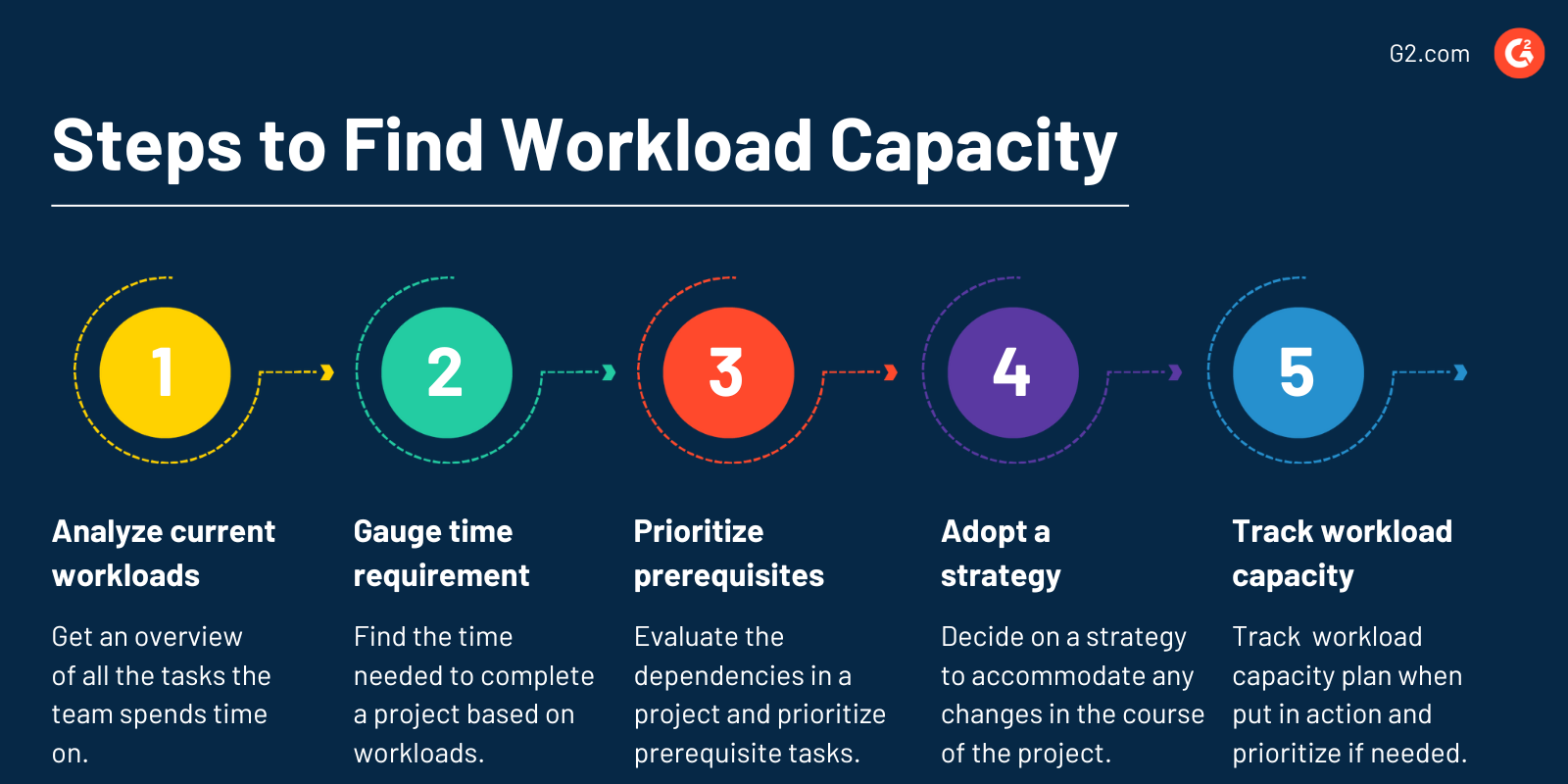
Here’s a step-by-step approach to managing workload capacity:
- Analyze current workloads: Get an overview of all the tasks that team members spend their time on. Project managers can send out a survey where every contributor fills in the number of hours they spent on particular tasks in a small company. However, enterprises can use task management software to calculate the time spent.
- Gauge time requirement: Find the total time required to complete a project based on the analysis of current workloads. For each role, list individual tasks, map them to their corresponding time requirement, and sum up. Check the sum against the total duration of any past project to see whether the calculations add up.
- Prioritize prerequisites: Evaluate the dependencies in a project and prioritize prerequisite tasks and activities. While planning workload capacity, businesses should consider the availability of resources, employee expertise, and the desired frequency of task execution.
- Adopt a workload capacity planning strategy: Organizations should decide on a workload capacity planning strategy to accommodate any unforeseen changes in the course of the project. Businesses can add workload capacity by forecasting an increased demand, following a conservative approach, and adding capacity only when current resources are fully utilized, or making small additions in response to changing market dynamics.
- Track workload capacity: Businesses need to track their workload capacity plan when put in action, ensure that employees aren’t overburdened, and prioritize pre-requisite tasks based on the project’s schedule.
What are the key strategies to manage workload capacity?
Managing workload capacity requires thoughtful planning, balanced resource allocation, and realistic expectations. By organizing tasks effectively, aligning resources, setting achievable deadlines, and tracking dependencies, teams can improve productivity without overloading employees. Here’s how to apply these strategies in practice:
- Put optimal effort and time into planning: Take time to plan tasks and projects. This helps businesses reflect on and prioritize critical activities that need to be handled. Set an estimate for each task with its start and end dates, define its frequency, and set a specific milestone.
- Ensure proper resource allocation: Businesses should get to know their available resources and plan tasks beforehand based on workload capacity. Managers should be aware of all constraints, including whether anyone has planned to take paid time off during the project. Based on these considerations, managers can assign resources to a project in advance.
- Set realistic expectations and deadlines: Managers need to set achievable deadlines for task completion. Even when the workload capacity of team members indicates the available time for handling more tasks, it’s a good practice to set a buffer to manage any unforeseen situations that may arise.
- Set objective expectations: Managers should set objective expectations after assessing the workload capacity of their teams, except for projects where tasks are subjective in nature. It’s best to provide a granular view to team members by dividing big tasks into smaller subtasks and setting an estimate for each.
- Evaluate task dependencies and measure utilization rates: Plans should prioritize pre-requisite tasks to complete other tasks. Identifying co-dependencies early goes a long way in workload management. Businesses should also measure the utilization rate to analyze productivity and check whether the work is actually in demand. It helps managers to optimize workload capacity management in a better way.
What are common challenges in workload capacity planning?
Organizations often struggle with workload capacity planning due to difficulty estimating task effort, limited resources, and the risk of employee burnout. Without accurate forecasting and visibility, teams may overcommit, misallocate resources, and impact productivity and morale. These challenges typically fall into a few key areas:
- Estimating effort: Accurately gauging time for non-routine or creative tasks can be difficult because these tasks don’t follow predictable patterns. Teams often rely on assumptions or past experience, which may not always apply. This can lead to underestimation, missed deadlines, or overallocation of resources.
- Resource constraints: Organizations frequently need to balance increasing workloads with limited staff, budgets, or tools. Skill gaps or employee availability can further complicate planning. Without proper visibility into resources, teams may struggle to distribute work effectively and maintain productivity.
-
Burnout prevention: When workload consistently exceeds capacity, employees can become overwhelmed and disengaged. This not only impacts morale but also reduces the quality of work and increases turnover risk. Proactively managing capacity helps maintain a sustainable pace and supports long-term team performance.
What is the difference between workload capacity planning and resource planning?
Workload capacity planning and resource planning are similar concepts. However, the former is adopted during high-level planning while the latter is put to use at a granular operational level. Here's how this key difference plays out across multiple factors:
| Factor | Workload capacity planning | Resource planning |
| Level | Workload capacity planning | Operational (granular) |
| Purpose | Determines how much work a team can handle in a given time period | Allocates resources efficiently across projects |
| Focus | Balancing total workload with available capacity | Assigning specific resources (people, tools) to tasks |
| Timing | Used during early planning stages | Used during execution and ongoing operations |
| Scope | Evaluates overall team or organizational capacity | Focuses on individual resource allocation based on skills |
| Outcome | Prevents overloading and ensures realistic planning | Ensures optimal utilization of resources across projects |
Related resources:
Frequently asked questions about workload capacity planning
Here are the frequently asked questions about workload capacity.
Q1. What is workload capacity in project management?
Workload capacity in project management refers to the total amount of work a team can complete within a project timeline based on available time and resources.
Q2. How do you measure workload capacity?
You measure workload capacity by analyzing available working hours, task complexity, and the time required to complete each activity.
Q3. Why is workload capacity planning important?
It helps prevent employee burnout, improves efficiency, and ensures projects are completed on time with proper resource allocation.
Explore top-rated project management tools on G2 to plan workloads, allocate resources, and track team performance more effectively.


