  # Best Video Translation Software - Page 7

  *By [Shalaka Joshi](https://research.g2.com/insights/author/shalaka-joshi)*

   Video translation software, also known as dubbing software, facilitates the dubbing process by translating the source language of a video and generating new speech in a target language, using AI voice cloning, lip-sync tools, and synchronization features to produce high-quality dubbed video with natural-sounding multilingual output.

### Core Capabilities of Video Translation Software

To qualify for inclusion in the Video Translation category, a product must:

- Support different input formats for videos and languages
- Have lip-syncing tools to synchronize dubbed dialogues
- Be able to adjust timing, translation, accent, and tone
- Have real-time monitoring of dubbing and other automation features

### Common Use Cases for Video Translation Software

Content creators, media companies, and global marketing teams use video translation software to make video content accessible across languages and regions. Common use cases include:

- Dubbing marketing videos, explainer content, and training materials into multiple languages at scale
- Cloning a speaker&#39;s voice to generate natural-sounding dubbed audio in target languages
- Automating the translation and synchronization pipeline for pre-recorded video libraries

### How Video Translation Software Differs from Other Tools

Video translation software replaces the original audio track with a different language, distinguishing it from [localization software](https://www.g2.com/categories/localization), which adapts content more broadly for different languages and cultures, accounting for dialects, cultural references, and context rather than simply swapping audio. AI video generation software also differs by generating the entire video from scratch using machine learning models, whereas video translation works with existing video content to produce a dubbed version.

### Insights from G2 on Video Translation Software

Based on category trends on G2, lip-sync accuracy and voice cloning quality stand out as standout capabilities. Faster multilingual content delivery and reduced professional dubbing costs stand out as primary outcomes of adoption.


## How Many Video Translation Software Products Does G2 Track?
**Total Products under this Category:** 126

### Category Stats (May 2026)
- **Average Rating**: 4.52/5
- **New Reviews This Quarter**: 120
- **Buyer Segments**: Small-Business 74% │ Mid-Market 16% │ Enterprise 10%
- **Top Trending Product**: Vozo AI (+0.133)
*Last updated: May 18, 2026*

  
## How Does G2 Rank Video Translation Software Products?

**Why You Can Trust G2's Software Rankings:**

- 30 Analysts and Data Experts
- 17,100+ Authentic Reviews
- 126+ Products
- Unbiased Rankings

G2's software rankings are built on verified user reviews, rigorous moderation, and a consistent research methodology maintained by a team of analysts and data experts. Each product is measured using the same transparent criteria, with no paid placement or vendor influence. While reviews reflect real user experiences, which can be subjective, they offer valuable insight into how software performs in the hands of professionals. Together, these inputs power the G2 Score, a standardized way to compare tools within every category.

  
## Which Video Translation Software Is Best for Your Use Case?

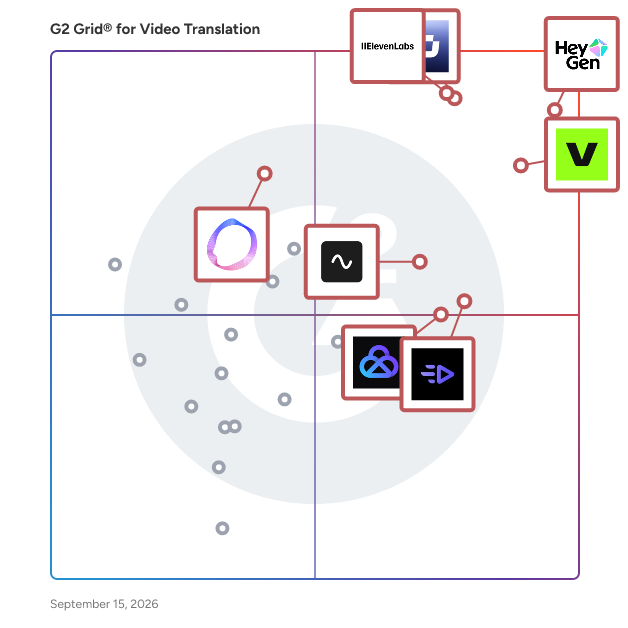
- **Leader:** [HeyGen](https://www.g2.com/products/heygen/reviews)
- **Highest Performer:** [Creatify AI](https://www.g2.com/products/creatify-labs-inc-creatify-ai/reviews)
- **Easiest to Use:** [Creatify AI](https://www.g2.com/products/creatify-labs-inc-creatify-ai/reviews)
- **Top Trending:** [ElevenLabs](https://www.g2.com/products/elevenlabsio/reviews)
- **Best Free Software:** [HeyGen](https://www.g2.com/products/heygen/reviews)


    ## What Is Video Translation Software?
  [Artificial Intelligence Software](https://www.g2.com/categories/artificial-intelligence)
  ## What Software Categories Are Similar to Video Translation Software?
    - [Text to Speech Software](https://www.g2.com/categories/text-to-speech)
    - [AI Video Generators](https://www.g2.com/categories/ai-video-generators)
    - [Video Content Creation Software](https://www.g2.com/categories/video-content-creation)

  
---

## How Do You Choose the Right Video Translation Software?

### What You Should Know About Video Translation Software

Video translation software, often powered by [artificial intelligence (AI) technologies](https://www.g2.com/articles/what-is-artificial-intelligence), converts audio and visual content into multiple languages, making it accessible to a wider audience. It is commonly used for creating multilingual marketing campaigns, localizing educational videos, and enhancing international communication during virtual events.&amp;nbsp;

With the growing popularity of video as a medium for communication, education, and entertainment, businesses, content creators, educators, and event organizers use this software to adapt their content for global viewers.&amp;nbsp;

### What are the common features of AI video translators?

Video translation software has several features that make it a powerful tool for adapting content to an international audience. Here are some of the key functionalities that the best video translators often have:

- **Audio translation:** Video translators convert spoken words in videos into text or other languages. This feature is essential for creating [voiceovers](https://www.g2.com/glossary/voiceover-definition) and subtitles, enabling seamless communication across different languages.
- **Subtitles and captions:** Many video translating software automatically generates subtitles and captions and ensures accessibility for viewers.
- **Multilingual support:** The best video translation software auto-translates audio into multiple languages like English, Spanish, Mandarin Chinese, and Hindi. It allows businesses to cater to diverse markets without requiring separate tools for each language.
- **Voice dubbing:** Most video translation software includes a voice dubbing feature that adds translated audio tracks matching the tone and delivery of the original speaker. Advanced tools include voice cloning to replicate the original speaker&#39;s voice in the translated audio and AI voice synthesis for natural-sounding voiceovers and dubbing.
- **Integration with video editing tools:** Many AI video translators sync with popular [video editing software](https://www.g2.com/categories/video-editing), making it easy to add and edit translations within existing projects.

### What types of video translation software exist?&amp;nbsp;

Video translation software comes in different types, each designed to address specific needs and use cases. Here are the main types:

1. **Subtitling software:** Auto subtitle generators automatically generate subtitles for videos and audio in multiple languages. They are ideal for translating dialogue or narration into text that appears on the screen. It makes videos inclusive for viewers who are deaf or hard of hearing or for those watching without sound.
2. **Dubbing and voiceover software:** Video dubbing tools replace the original audio with translated versions or overlay voiceovers in the target language. This is commonly used in the media and entertainment industries to localize movies, TV shows, and marketing videos.
3. **Automatic speech recognition (ASR) and translation software:** ASR-based tools, also called [voice recognition software](https://www.g2.com/articles/free-voice-recognition-software), transcribe spoken words from video into text and then translate the text into other languages. These are particularly useful for live events, meetings, webinars, and real-time applications where quick and accurate transcription and translation are essential.

### How to translate a video into any language using AI video translators&amp;nbsp;

Translating a video into any language using video translation software is a straightforward process. Here&#39;s a step-by-step guide:

**Upload the video:** Start by uploading the video file to the video translation software. You can either upload directly from the device or paste the link from a [cloud storage](https://learn.g2.com/cloud-storage) account like Google Drive or Dropbox. Most platforms support popular formats like MP4, MOV, and AVI.&amp;nbsp;

**Select the source and target languages:** Choose the language your video is currently in and the desired language you want to translate to. Many tools support over 50 languages.

**Choose the translation method**

- **Subtitles:** Generate subtitles in the target language, which can be auto-synced to the video.
- **Voiceovers:** Replace or overlay the original audio with translated voiceovers.
- **Dubbing:** Create audio tracks in the target language, mimicking the original tone and delivery.
- **AI-powered translation:** Use AI to process the video, transcribe audio, and translate it into the selected language.&amp;nbsp;

**Customize and edit:** Review the translated text, adjust timing for subtitles, and fine-tune voiceover synchronization to ensure the translation aligns perfectly with the visuals.

**Export the final video:** Once satisfied with the translation, export the video in your preferred format. Some software even offers direct integration with[video hosting platforms](https://www.g2.com/categories/video-hosting-platforms) for easy sharing.

### Benefits of automatic video translation software

Businesses, online video content creators, social media influencers, educators, and marketers aiming to expand their reach get great benefits from video translation software. Here are the key benefits:

- **Enhanced accessibility:** By adding subtitles and multilingual voiceovers, video translation software ensures that content is inclusive for viewers with different language preferences and those with hearing impairments.
- **Increased revenue opportunities:** Expanding into international markets by translating content can unlock new revenue streams, especially for businesses using platforms like [e-commerce sites](https://www.g2.com/categories/e-commerce-platforms), video-on-demand services, and digital marketing.
- **Improved viewer engagement:** Localized content resonates better with viewers and can lead to higher engagement on [social media platforms](https://www.g2.com/categories/social-networks) like Instagram, TikTok, and YouTube, where personalized experiences drive performance.
- **SEO and discoverability optimization** : Adding multilingual subtitles, captions, and metadata improves video rankings on search engines. Moreover, it ensures content is discoverable on platforms like Google, YouTube, and Vimeo.
- **Enhanced learning and training:** Educational videos and corporate training materials can be localized to reach learners in different regions, improving learning outcomes and participation.
- **Real-time translation for live events:** For live events, meetings, and webinars, real-time translation ensures unbroken interactions with multilingual audiences.
- **Time and cost efficiency:** Unlike traditional methods of manual subtitling and dubbing, AI-powered video translation provides precise results in a fraction of the time. Translated videos can be posted anywhere within minutes and a few clicks, which significantly reduces turnaround times.

### Who uses video translators?

From digital content creators to multinational businesses, video translation software empowers professionals across industries to break linguistic barriers and connect with global audiences. Here are some of the key users:

- **Content creators and social media marketers** like YouTubers, vloggers, and streamers use video translation apps to localize their videos and [vlogs](https://www.g2.com/glossary/vlog-definition), reaching non-native speakers and multiplying their viewership.
- **Game developers** use video translation software to make their content accessible to players worldwide. By localizing in-game dialogues, cutscenes, and promotional videos, they ensure their game resonates with audiences across different cultures and markets.
- **Businesses,** specifically marketing teams, use video translation to adapt promotional materials and create localized campaigns that connect with customers in new markets. Corporate training teams also use it to produce training materials and ensure consistent communication among employees across regions.
- **Online event organizers** hosting webinars, virtual conferences, or live events use video translation software to provide real-time translations or localized recordings.
- **Educational institutions** , such as [e-learning platforms](https://www.g2.com/categories/online-learning-platform) and universities, use video translation to make instructional videos and course materials accessible to international students. This ensures diverse learners can access educational content without language barriers.
- **Translators** use video translation software to manage large-scale projects and adapt video content into multiple languages efficiently, ensuring accuracy and consistency in their work.

### How much does it cost to translate a video?

The cost of video translation depends on factors like the translation method, video length, language pair, and content complexity.&amp;nbsp;

Manual [video translation services](https://www.g2.com/categories/video-translation), such as translation, subtitling, voiceover, and dubbing services, are typically charged on a per-word, per-minute, or per-hour basis.&amp;nbsp;

Translation services start from $0.07 per word and can go higher depending on the language pair and content complexity. Subtitling, voiceover, and dubbing involve higher costs due to the additional resources and expertise needed.

AI video translators provide an affordable alternative, automating the process at a fraction of the cost. Here are the common pricing models for video translation software:&amp;nbsp;

- **Pay-per-minute or pay-per-hour model:&amp;nbsp;** This model charges based on the duration of the video content being translated. It’s cost-effective for short-term or occasional projects, as payment is required only for the specific amount of content processed.&amp;nbsp;
- **Subscription-based model:** Designed for ongoing translation needs, this model involves a monthly or annual fee in exchange for access to features and usage limits. The subscription model provides predictable costs, making it suitable for consistent workloads. Plans start at around $20 per month for individual or small business use. Mid-tier plans offer additional minutes and advanced features like application programming interface (API) access or premium voices, with costs ranging from $100 to $750 per month. Enterprise options are customizable and include unlimited video duration and 4K quality for businesses with large-scale projects.&amp;nbsp;

Many AI video translators offer free tiers within their subscription models, allowing users to explore basic features with some limitations like restricted output length or limited monthly usage.&amp;nbsp;&amp;nbsp;

- **Credits-based pricing model** :&amp;nbsp;In this flexible system, users purchase credits to access various services within the software. Each translation task deducts a certain number of credits, depending on factors like video length and complexity. This model is scalable and works well for fluctuating translation needs, as credits can be bought as required.

### What are the alternatives to AI video translators?

While video translation software offers a comprehensive solution for translating and localizing video content, there are other tools that can fulfill similar needs, depending on your requirements:

- **Subtitling and captioning software:** These tools specialize in adding subtitles or captions to videos, either manually or through automated processes. While they don&#39;t directly translate video content, many support importing translations for subtitles, which makes them useful for multilingual audiences.
- [Audio and speech recognition software](https://www.g2.com/categories/voice-recognition) **:** This type of software converts spoken language in videos into text, often as a transcription. The transcriptions can then be translated using separate translation tools. It’s a helpful option when you need accurate speech-to-text conversion as a first step.
- [Machine translation software](https://www.g2.com/categories/machine-translation) **:** Machine translation tools focus on translating text-based content, which can include video transcriptions or subtitles. While they lack the video-specific features of translation software, integrating them with subtitling or transcription tools can optimize the translation process for videos.

### Software and services related to video translation solutions

Several software and services complement video translation software by addressing specific aspects of the video localization process. Here are some key categories:

- [Transcription software](https://www.g2.com/categories/transcription) **:** This tool is designed to convert audio from interviews, conversations, dictations, video footage, and more into text. This text serves as a foundation for translation and subtitling, enabling video translation software to focus on adapting the content into multiple languages.&amp;nbsp;Many transcription tools come with automated speech recognition features, speeding up the process and reducing manual effort.
- [Subtitling and captioning services](https://www.g2.com/categories/closed-captioning-services): These services help create and embed subtitles or captions into videos. Some subtitling software also supports importing translations, enabling you to add subtitles in multiple languages efficiently.
- **Speech-to-text (STT) and**[](https://www.g2.com/categories/text-to-speech)[text-to-speech (TTS) software](https://www.g2.com/categories/text-to-speech) **:** STT software transforms spoken language into text, which can then be translated or captioned. On the other hand, TTS software converts translated text back into spoken language, helping localize voiceovers or audio tracks in different languages. These tools are often integrated into video translation workflows to handle both audio and text localization needs.

### Challenges with AI video translators&amp;nbsp;

Using video translation software can significantly simplify the localization process, but it also comes with its own set of challenges that users need to navigate:

- **Maintaining translation accuracy and context:** Ensuring that translations convey the original message accurately can be tricky, especially with idiomatic expressions or industry-specific terminology. Poorly translated content risks miscommunication or confusion for the audience.
- **Handling regional and cultural nuances:** Language variations and cultural differences across regions can complicate the translation process. For example, words or phrases may have different meanings or cultural significance in different areas and might require careful adaptation to resonate with the target audience.
- **Accuracy in speech recognition:** For online video translation software that relies on speech recognition, capturing spoken content accurately can be challenging, especially with background noise, overlapping speakers, or heavy accents. Errors in transcription can lead to flawed translations.
- **Syncing subtitles and voiceover timing:** Properly timing subtitles or translated voiceovers with the video content is crucial for a smooth viewing experience. Even minor misalignments can distract viewers and reduce the impact of the localized content.

Overcoming these challenges often requires a mix of software capabilities and human oversight to ensure high-quality results.

### Which companies should buy online video translator apps?

Companies that should consider investing in such software include:

- **Media and entertainment companies:** Film studios, television networks, and streaming platforms can use video translation software to localize content, making it accessible to viewers worldwide.
- **Educational institutions:** Universities and online learning platforms can translate lectures and educational materials, broadening their reach to non-native speakers and international students.
- **Marketing and advertising agencies:** These agencies can create multilingual campaigns to effectively target diverse markets, ensuring messages resonate across different languages and cultures.
- **Corporate training departments:** Multinational corporations can translate training videos and internal communications to ensure all employees, regardless of location, receive consistent information.
- **Healthcare organizations:** Hospitals and medical institutions can translate informational videos to better serve patients from various linguistic backgrounds, improving patient care and communication.
- **E-commerce businesses:** Online retailers can translate product videos and tutorials to cater to international customers, enhancing user experience and potentially increasing sales.

### Video translation software trends

The video translation software market is rapidly evolving, driven by advancements in technology and growing global demand for localized content. Here are some notable trends shaping the industry:

- **Increased use of AI and machine learning:** [Generative AI](https://www.g2.com/articles/what-is-generative-ai) has significantly influenced the video translation software landscape by introducing advanced capabilities that enhance the quality and efficiency of translations. Tools powered by generative AI can create more natural-sounding voiceovers, mimic original speaker tones through voice cloning, and generate subtitles with improved context awareness. These innovations reduce the dependency on manual adjustments.
- **Adoption of real-time translation:** Real-time translation is becoming a game-changer for live events, webinars, and virtual meetings. It allows businesses to engage multilingual audiences instantly, a feature especially valuable in an increasingly globalized and remote-first world.
- **Emphasis on regional dialects and cultural nuances:** With businesses prioritizing localized content, the demand for software that supports regional dialects and culturally sensitive translations is rising. This trend ensures that messages resonate with diverse audiences while maintaining authenticity.

**Researched and written by** [Shalaka Joshi](https://research.g2.com/insights/author/shalaka-joshi)

**Edited by** [Monishka Agrawal](https://learn.g2.com/author/monishka-agrawal)


