  # Best Systems Engineering &amp; MBSE Tools - Page 2

  *By [Subhransu Sahu](https://research.g2.com/insights/author/subhransu-sahu)*

   Systems engineering software provides graphical programming and drag and drop modeling features to model complex systems and simulate industrial system performance. Systems engineers use systems engineering software to simplify the development of complex industrial systems as well as to create diagrams of how an industrial system should function. Industrial systems are often made up of many different elements and components which can make it hard to understand which components work together to produce a functioning unit. Systems engineering software simplifies this by displaying which elements must work together to produce effective system results. Systems engineering software is often used to create smart machines, IoT systems, and other industrial equipment. Model-based systems engineering (MBSE) is the formalized application of modeling to support system requirements, design, analysis, verification and validation activities. Systems engineers use MBSE to cost-effectively explore and document system characteristics.

To qualify for inclusion in the Systems Engineering category, a product must:

- Provide drag and drop modeling features for either graphical programming or component modeling
- Provide features to simulate and analyze system performance
- Provide features for requirements verification and analysis


## How Many Systems Engineering &amp; MBSE Tools Products Does G2 Track?
**Total Products under this Category:** 42

### Category Stats (May 2026)
- **Average Rating**: 4.21/5
- **New Reviews This Quarter**: 2
- **Buyer Segments**: Mid-Market 80% │ Small-Business 20%

*Last updated: May 18, 2026*

  
## How Does G2 Rank Systems Engineering &amp; MBSE Tools Products?

**Why You Can Trust G2's Software Rankings:**

- 30 Analysts and Data Experts
- 800+ Authentic Reviews
- 42+ Products
- Unbiased Rankings

G2's software rankings are built on verified user reviews, rigorous moderation, and a consistent research methodology maintained by a team of analysts and data experts. Each product is measured using the same transparent criteria, with no paid placement or vendor influence. While reviews reflect real user experiences, which can be subjective, they offer valuable insight into how software performs in the hands of professionals. Together, these inputs power the G2 Score, a standardized way to compare tools within every category.

  
## Which Systems Engineering &amp; MBSE Tools Is Best for Your Use Case?

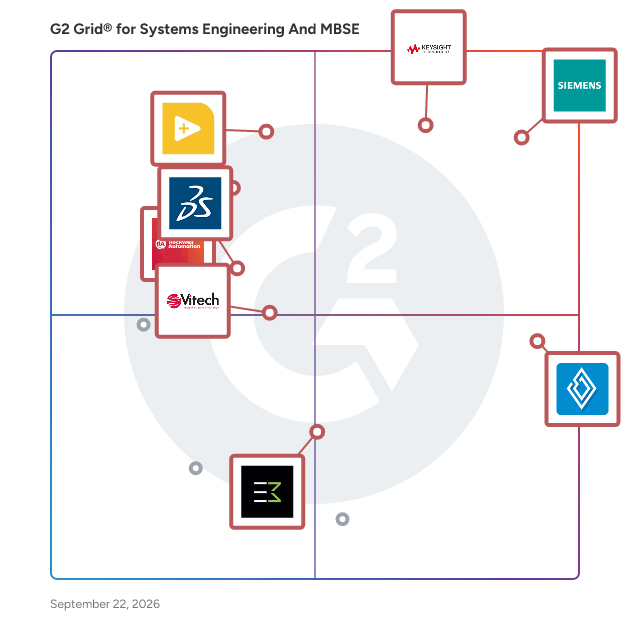
- **Leader:** [PathWave System Design](https://www.g2.com/products/pathwave-system-design/reviews)
- **Highest Performer:** [Innoslate](https://www.g2.com/products/innoslate/reviews)
- **Easiest to Use:** [Innoslate](https://www.g2.com/products/innoslate/reviews)
- **Top Trending:** [Flow Engineering](https://www.g2.com/products/flow-engineering/reviews)
- **Best Free Software:** [LabVIEW](https://www.g2.com/products/labview/reviews)

  
---

**Sponsored**

### Visure Requirements

Visure offers a modern enterprise AI-powered ALM platform and requirements management software for organizations in safety-critical industries, enabling them to ease their compliance process, gain full traceability across the development cycle, reduce rework, and accelerate their requirements elicitation phase. It offers product and system development teams out-of-the-box features, including full traceability, tight integration with MS Word/Excel, FMEA risk management, test management, bug tracking, requirements testing, requirements quality analysis, requirement versioning and baselining, powerful reporting and standard compliance templates for ISO 26262, IEC 62304, IEC 61508, CENELEC 50128, DO-178B/C, DO-254, FMEA, SPICE, CMMI, and more. It supports round-trip integrations with MS Word, Excel, JIRA, and DOORS and the most popular engineering tools


[Visit website](https://www.g2.com/external_clickthroughs/record?secure%5Bad_program%5D=ppc&amp;secure%5Bad_slot%5D=category_product_list&amp;secure%5Bcategory_id%5D=2489&amp;secure%5Bdisplayable_resource_id%5D=2489&amp;secure%5Bdisplayable_resource_type%5D=Category&amp;secure%5Bmedium%5D=sponsored&amp;secure%5Bplacement_reason%5D=page_category&amp;secure%5Bplacement_resource_ids%5D%5B%5D=2489&amp;secure%5Bprioritized%5D=false&amp;secure%5Bproduct_id%5D=88966&amp;secure%5Bresource_id%5D=2489&amp;secure%5Bresource_type%5D=Category&amp;secure%5Bsource_type%5D=category_page&amp;secure%5Bsource_url%5D=https%3A%2F%2Fwww.g2.com%2Fcategories%2Fsystems-engineering-and-mbse%3Fpage%3D2&amp;secure%5Btoken%5D=c5c5ea910709d0e237776e73f40a81aa5fbea97c15be22d0932022bd38c7a34f&amp;secure%5Burl%5D=https%3A%2F%2Fvisuresolutions.com%2Fwatch-a-demo&amp;secure%5Burl_type%5D=product_website)

---

  ## What Are the Top-Rated Systems Engineering &amp; MBSE Tools Products in 2026?
### 1. [Instrument Studio](https://www.g2.com/products/instrument-studio/reviews)
  InstrumentStudio is free application software that provides an integrated approach to interactive PXI measurements. InstrumentStudio enables you to unify your display, export instrument configurations to code, and monitor and debug your automated test system. You can view data on unified displays with large, high-resolution monitors, and then capture multi-instrument screenshots and measurement results. Save project-level configurations for easier test repeatability with specific DUTs, or export instrument configurations to programming environments to simplify your code and guarantee measurement correlation. You can use InstrumentStudio in parallel with your code to monitor and debug running test applications.


  **Average Rating:** 3.5/5.0
  **Total Reviews:** 1
**How Do G2 Users Rate Instrument Studio?**

- **Ease of Use:** 6.7/10 (Category avg: 8.4/10)
- **Requirements analysis:** 10.0/10 (Category avg: 8.3/10)
- **Drag and Drop:** 5.0/10 (Category avg: 8.5/10)

**Who Is the Company Behind Instrument Studio?**

- **Seller:** [NI](https://www.g2.com/sellers/ni)
- **Year Founded:** 1976
- **HQ Location:** Austin, TX
- **Twitter:** @NIglobal (26,252 Twitter followers)
- **LinkedIn® Page:** https://www.linkedin.com/company/3433 (7,996 employees on LinkedIn®)
- **Ownership:** NASDAQ: NATI

**Who Uses This Product?**
  - **Company Size:** 100% Enterprise


### 2. [PHM Technology](https://www.g2.com/products/phm-technology/reviews)
  PHM Technology is an advanced engineering company that is committed to developing ‘model-based’ engineering tools for the design, safety, reliability and health management of complex systems.


  **Average Rating:** 3.0/5.0
  **Total Reviews:** 1
**How Do G2 Users Rate PHM Technology?**

- **Ease of Use:** 5.0/10 (Category avg: 8.4/10)

**Who Is the Company Behind PHM Technology?**

- **Seller:** [PHM Technology](https://www.g2.com/sellers/phm-technology)
- **Year Founded:** 2006
- **HQ Location:** Melbourne, AU
- **LinkedIn® Page:** https://www.linkedin.com/company/1710096 (41 employees on LinkedIn®)

**Who Uses This Product?**
  - **Company Size:** 100% Small-Business


### 3. [Relatics](https://www.g2.com/products/relatics/reviews)
  Relatics is the leading Model-Based Systems Engineering software application for construction projects. It is a comprehensive tool that gives professionals access to all project information and offers a complete overview of the growing number of dependencies between all disciplines in today’s projects. This ensures nothing is overlooked, giving you the confidence to make well-informed and timely decisions. Established over 20 years ago in the Netherlands, Relatics has emerged as the trusted partner for governments, contractors, and engineering firms worldwide. Over the years, Relatics has played an important role in the realization of thousands of construction projects, ranging from smaller-scale initiatives to multibillion-dollar mega projects. These projects span a diverse spectrum, including buildings, highways, bridges, tunnels, railways, canals, dams, ports, airports, and energy infrastructure.


  **Average Rating:** 4.0/5.0
  **Total Reviews:** 2
**How Do G2 Users Rate Relatics?**

- **Ease of Use:** 9.2/10 (Category avg: 8.4/10)

**Who Is the Company Behind Relatics?**

- **Seller:** [Relatics](https://www.g2.com/sellers/relatics)
- **Year Founded:** 2003
- **HQ Location:** Ridderkerk, NL
- **Twitter:** @Relatics (47 Twitter followers)
- **LinkedIn® Page:** https://www.linkedin.com/company/relatics (48 employees on LinkedIn®)

**Who Uses This Product?**
  - **Company Size:** 50% Enterprise, 50% Mid-Market


### 4. [SweepMe!](https://www.g2.com/products/sweepme/reviews)
  SweepMe! is a modular test and measurement software that allows users to quickly combine measurement instruments and technical equipment from different vendors by plug&amp;play. The modular nature of the SweepMe! allows to easily share contents between all users of the software. For example, all SweepMe! instrument drivers are made available free and open-source to everyone. Typical applications are wafer level testing in combinations with electrical chacterization equipment, electro-optical experiments in silicon photonics, control of process chambers as used for thin film vacuum deposition, characterization of solar cells, LEDs, sensors, batteries and many more. The main program can be downloaded and used for free: https://sweep-me.net/download\_sweepme


  **Average Rating:** 5.0/5.0
  **Total Reviews:** 1
**How Do G2 Users Rate SweepMe!?**

- **Ease of Use:** 8.3/10 (Category avg: 8.4/10)
- **Requirements analysis:** 8.3/10 (Category avg: 8.3/10)
- **Drag and Drop:** 10.0/10 (Category avg: 8.5/10)

**Who Is the Company Behind SweepMe!?**

- **Seller:** [SweepMe! GmbH](https://www.g2.com/sellers/sweepme-gmbh)
- **Year Founded:** 2018
- **HQ Location:** Dresden, DE
- **LinkedIn® Page:** https://linkedin.com/company/sweepme (5 employees on LinkedIn®)

**Who Uses This Product?**
  - **Company Size:** 100% Mid-Market


### 5. [VeriStand](https://www.g2.com/products/veristand/reviews)
  VeriStand application software helps you configure I/O channels, data logging, stimulus generation, and host communication for NI real-time hardware. You can also import simulation models and control algorithms, respond to events with configurable alarms, and enable test automation with macro recording, TestStand, .NET, and other software. You can interact with and monitor application data, alarm states, and system execution metrics using a run-time editable user interface. Although you don&#39;t need programming knowledge, you can also use a variety of software environments such as LabVIEW, ANSI C/C++, Python, and ASAM XIL to add custom functionality to VeriStand.


  **Average Rating:** 4.5/5.0
  **Total Reviews:** 1
**How Do G2 Users Rate VeriStand?**

- **Ease of Use:** 10.0/10 (Category avg: 8.4/10)
- **Requirements analysis:** 8.3/10 (Category avg: 8.3/10)
- **Drag and Drop:** 10.0/10 (Category avg: 8.5/10)

**Who Is the Company Behind VeriStand?**

- **Seller:** [NI](https://www.g2.com/sellers/ni)
- **Year Founded:** 1976
- **HQ Location:** Austin, TX
- **Twitter:** @NIglobal (26,252 Twitter followers)
- **LinkedIn® Page:** https://www.linkedin.com/company/3433 (7,996 employees on LinkedIn®)
- **Ownership:** NASDAQ: NATI

**Who Uses This Product?**
  - **Company Size:** 100% Small-Business


### 6. [51Sim](https://www.g2.com/products/51sim/reviews)
  51Sim is a service provider of advanced simulation platforms designed to accelerate the development and deployment of autonomous driving technologies. Their flagship product, SimOne, offers a comprehensive suite of tools for creating high-fidelity, data-driven simulation environments that closely replicate real-world driving conditions. By integrating cutting-edge 3D scene reconstruction and sensor simulation capabilities, 51Sim enables developers to efficiently test and validate autonomous driving algorithms, significantly reducing development time and costs.


**Who Is the Company Behind 51Sim?**

- **Seller:** [51Sim](https://www.g2.com/sellers/51sim)
- **Year Founded:** 2017
- **HQ Location:** San Jose, US
- **LinkedIn® Page:** https://www.linkedin.com/company/real51sim/ (6 employees on LinkedIn®)


### 7. [ASDIP Structural Software](https://www.g2.com/products/asdip-structural-software-asdip-structural-software/reviews)
  Our intuitive and reliable structural engineering software lets you easily analyze, design, optimize, and check your structural members immediately. The ASDIP SUITE comprises 4 intuitive software packages with over 16 modules to help you with all your engineering design tasks. ASDIP structural engineering software was conceived by and designed for structural engineers to offer a series of modular screens throughout the implementation of specific design methodologies. Download our free trial and start experiencing everything that ASDIP has to offer!


**Who Is the Company Behind ASDIP Structural Software?**

- **Seller:** [ASDIP Structural Software](https://www.g2.com/sellers/asdip-structural-software)
- **Year Founded:** 1992
- **HQ Location:** Orlando, US
- **LinkedIn® Page:** https://www.linkedin.com/company/asdip-structural-software (2 employees on LinkedIn®)


### 8. [AVSnap](https://www.g2.com/products/avsnap/reviews)
  Design software for diagram, layout and anything else that needs to be designed.


**Who Is the Company Behind AVSnap?**

- **Seller:** [AVSnap](https://www.g2.com/sellers/avsnap)
- **HQ Location:** N/A
- **LinkedIn® Page:** https://www.linkedin.com/company/No-Linkedin-Presence-Added-Intentionally-By-DataOps (1 employees on LinkedIn®)


### 9. [CORE](https://www.g2.com/products/vitech-corporation-core/reviews)
  CORE is Vitech’s original and most featurerich systems engineering software. With unmatched power and a proven heritage, CORE continues to deliver critical systems engineering support for existing projects as well as new customers seeking a focused, stand-alone systems engineering environment.


**Who Is the Company Behind CORE?**

- **Seller:** [Vitech](https://www.g2.com/sellers/vitech-5e09b488-3c9d-4e22-9737-7bb9dba07028)
- **Year Founded:** 1992
- **HQ Location:** Blacksburg, VA
- **Twitter:** @vitechcorp (459 Twitter followers)
- **LinkedIn® Page:** https://www.linkedin.com/company/vitech-corporation/ (47 employees on LinkedIn®)


### 10. [HBM Prenscia](https://www.g2.com/products/hbm-prenscia/reviews)
  HBM Prenscia offers a range of solutions for engineers to efficiently transform data into decisions.


**Who Is the Company Behind HBM Prenscia?**

- **Seller:** [HBM](https://www.g2.com/sellers/hbm)
- **Year Founded:** 1942
- **HQ Location:** London, England, United Kingdom
- **LinkedIn® Page:** https://www.linkedin.com/company/hbkworld-test-and-measurement (1,446 employees on LinkedIn®)


### 11. [IBM Engineering Systems Design Rhapsody](https://www.g2.com/products/ibm-engineering-systems-design-rhapsody/reviews)
  IBM Engineering Systems Design Rhapsody is a comprehensive Model-Based Systems Engineering (MBSE tool that enables engineers to design, analyze, and validate complex systems and software. By utilizing industry-standard languages such as UML, SysML, and AUTOSAR, Rhapsody facilitates the creation of visual models that enhance understanding and communication across multidisciplinary teams. Its capabilities include real-time simulation, automatic code generation, and seamless integration with other engineering lifecycle tools, streamlining the development process and ensuring consistency between design and implementation. Rhapsody supports compliance with industry standards like DO-178B/C and ISO 26262, making it suitable for safety-critical applications. By providing a collaborative environment with version control and configuration management, Rhapsody helps teams manage the complexities of modern system development, reducing errors and accelerating time-to-market. Key Features and Functionality: - Model-Based Design: Enables the creation of visual representations of system architectures, behavioral models, and state machines using UML, SysML, and AUTOSAR. - Simulation and Analysis: Allows real-time simulation and analysis of system behavior to validate designs and identify potential issues early in the development process. - Automatic Code Generation: Generates production-quality code in languages such as C, C++, Java, and Ada directly from models, ensuring consistency between design and implementation. - Integration with Engineering Lifecycle Tools: Seamlessly integrates with other IBM Engineering Lifecycle Management tools, including requirements management and workflow management, to provide end-to-end traceability. - Compliance Support: Facilitates adherence to industry standards like DO-178B/C and ISO 26262, essential for safety-critical systems. - Collaborative Development Environment: Supports concurrent work by multiple team members with version control and configuration management, enhancing collaboration and reducing errors. Primary Value and Problem Solved: IBM Engineering Systems Design Rhapsody addresses the challenges of developing complex systems by providing a unified platform for model-based design, simulation, and code generation. It enhances collaboration among multidisciplinary teams, ensures early validation of designs through simulation, and maintains consistency between models and code. By supporting compliance with industry standards, Rhapsody reduces the risk of errors and rework, ultimately accelerating development cycles and improving product quality.


**Who Is the Company Behind IBM Engineering Systems Design Rhapsody?**

- **Seller:** [IBM](https://www.g2.com/sellers/ibm)
- **Year Founded:** 1911
- **HQ Location:** Armonk, NY
- **Twitter:** @IBM (709,223 Twitter followers)
- **LinkedIn® Page:** https://www.linkedin.com/company/1009/ (324,553 employees on LinkedIn®)
- **Ownership:** SWX:IBM


### 12. [ITEM ToolKit](https://www.g2.com/products/item-toolkit/reviews)
  It is an integrated platform offering scalable analysis, saving you time and resources.


**Who Is the Company Behind ITEM ToolKit?**

- **Seller:** [Item](https://www.g2.com/sellers/item)
- **Year Founded:** 1984
- **HQ Location:** Irvine, US
- **LinkedIn® Page:** http://www.linkedin.com/company/item-software (8 employees on LinkedIn®)


### 13. [MapleMBSE](https://www.g2.com/products/maplembse/reviews)
  MapleMBSE is an Excel-based tool that allows stakeholders across your entire organization to collaborate in the systems engineering process.


**Who Is the Company Behind MapleMBSE?**

- **Seller:** [MapleSoft Enterprises](https://www.g2.com/sellers/maplesoft-enterprises)
- **HQ Location:** N/A
- **LinkedIn® Page:** https://www.linkedin.com/company/No-Linkedin-Presence-Added-Intentionally-By-DataOps (1 employees on LinkedIn®)


### 14. [MES Model &amp; Refactor (MoRe)](https://www.g2.com/products/mes-model-refactor-more/reviews)
  With the help of the &quot;Auto Layout&quot; functions, MES Model &amp; Refactor (MoRe) facilitates your daily modeling tasks in Simulink. MoRe simplifies and accelerates model creation and model refactoring. Your MoRe benefits: - Auto Layout: MoRe automates the layout of Simulink models, allowing for a guideline-compliant layout at the touch of a button, and ensuring uniform models for the entire company. - Quality: Create high-quality, readable, and comprehensible models that are easily expandable and maintainable. - Efficiency: Edit and expand models quickly and effectively and welcome changing requirements, even late in development. Fast and easy model changes enable agile development.


**Who Is the Company Behind MES Model &amp; Refactor (MoRe)?**

- **Seller:** [Model Engineering Solutions](https://www.g2.com/sellers/model-engineering-solutions)
- **Year Founded:** 2006
- **HQ Location:** Berlin, DE
- **LinkedIn® Page:** https://www.linkedin.com/company/model-engineering-solutions-gmbh/ (42 employees on LinkedIn®)


### 15. [Palladium Emulation](https://www.g2.com/products/palladium-emulation/reviews)
  The Cadence Palladium Emulation Platform is a high-performance solution for verifying and debugging complex System-on-Chips (SoCs) and systems. Providing unmatched scalability, it handles multi-billion-gate designs with ease, offering superior performance that’s 1.5X faster than its predecessor. With advanced debugging capabilities, including at-speed triggers and modular compilers for rapid turnaround, it ensures efficient analysis without the need for recompilation. The platform supports diverse applications, from in-circuit emulation to dynamic power analysis, making it ideal for early hardware/software co-verification and system-level testing. Accelerate your design cycles and achieve first-pass silicon success with Palladium.


**Who Is the Company Behind Palladium Emulation?**

- **Seller:** [Cadence Design Systems](https://www.g2.com/sellers/cadence-design-systems)
- **Year Founded:** 1988
- **HQ Location:** San Jose, California
- **Twitter:** @Cadence (20,063 Twitter followers)
- **LinkedIn® Page:** https://www.linkedin.com/company/2157/ (10,784 employees on LinkedIn®)
- **Ownership:** CDNS


### 16. [PTC Modeler](https://www.g2.com/products/ptc-modeler/reviews)
  By guiding engineers with appropriate industry standards (including UML, SysML 1, SysML 2, and UAF) and automating repetitive tasks, PTC Modeler reduces development time, effort, and cost. It also simplifies the development process and improves product quality by helping to find potential design problems much earlier.


**Who Is the Company Behind PTC Modeler?**

- **Seller:** [PTC](https://www.g2.com/sellers/ptc)
- **Year Founded:** 1985
- **HQ Location:** Boston, Massachusetts
- **Twitter:** @PTC (37,582 Twitter followers)
- **LinkedIn® Page:** https://www.linkedin.com/company/1935/ (8,226 employees on LinkedIn®)
- **Ownership:** NASDAQ: PTC


### 17. [Syndeia](https://www.g2.com/products/syndeia/reviews)
  Syndeia® is the digital thread platform for integrated digital engineering. It enables engineering teams to collaboratively and concurrently develop and manage a digital thread for any complex system/product by federating models and data from diverse ecosystems of modeling and simulation tools, enterprise applications, and data repositories. This diverse set of tools and repositories includes, for example, SysML modeling tools (e.g., SysML v2, Cameo, Rhapsody, GENESYS), PLM systems (e.g., Teamcenter, Windchill, Aras Innovator), CAD systems (e.g., Solidworks PDM, NX, Creo), ALM systems (e.g., Azure DevOps, GitHub, JIRA, GitLab), Project Management Systems (e.g., JIRA), Requirements Management Systems (e.g.,Polarion, Codebeamer, Jama Connect, DOORS-NG), Simulation tools (e.g., MATLAB/Simulink), Databases (e.g., MySQL, Neo4j), and in general any enterprise data available via a standard REST API.


**Who Is the Company Behind Syndeia?**

- **Seller:** [Intercax](https://www.g2.com/sellers/intercax)
- **Year Founded:** 2007
- **HQ Location:** Atlanta, US
- **LinkedIn® Page:** https://www.linkedin.com/company/intercax-llc/ (21 employees on LinkedIn®)


    ## What Is Systems Engineering &amp; MBSE Tools?
  [CAD Software](https://www.g2.com/categories/cad)

  
---

## How Do You Choose the Right Systems Engineering &amp; MBSE Tools?

### What You Should Know About Systems Engineering Software

### What is Systems Engineering Software?

Systems engineering is an interdisciplinary field of engineering that focuses on how complex engineering projects and complex industrial systems are designed and managed. When engineers build complex machinery such as smart machinery, internet of things (IoT) connected systems, or industrial systems, they must ensure that the various parts of the systems work together to create a functioning system that meets their design requirements. An example of this would be a systems engineer creating a complex system such as an aircraft. The engineer would put in all of their requirements for the aircraft such as speed, capacity, weight, and load pressure. The systems engineer would then have to execute the connection of various parts of the system such as the airframe, propulsion, navigation, and the guidance to ensure that all requirements and parts are connected so the aircraft will not only take off but also fly smoothly and safely. Since there are so many different components that go into creating a complex system such as an aircraft, systems engineers need a simple way to visualize all the necessary components and requirements of their designs. Systems engineering software helps engineers visualize all the necessary components of their designs by providing features such as model based design (diagramming), requirements analysis, and simulation.

Key Benefits of Systems Engineering Software

- Allows systems engineers to simplify the design of complex industrial systems
- Allows systems engineers to collaborate more effectively by sharing designs across various teams
- Allows systems engineers to test the performance of their designs with simulation features
- Speeds up design times by providing change management and simple model-based engineering 

### Why Use Systems Engineering Software?

Systems engineering software provides a multitude of features for systems engineers to simplify and speed up complex designs. From collaboration features to drag-and-drop systems modeling, systems engineering is all about making the complex task of systems engineering as simple and intuitive as possible.

**Speed up design time —** Systems engineering software provides drag-and-drop modeling and diagramming features which speeds up design time and makes system visualization as easy as possible.

**Collaboration —** Designing a complex industrial system requires a lot of cross team collaboration. While most teams opt for sharing a spreadsheet between all workers across several teams, this is far from the ideal way of sharing and collaborating on industrial system design. Systems engineering software provides more context with model based designs, more explanations with design feedback and collaboration tags, and more alerts with emails and notifications whenever another team member needs to take a look at the design.

### Who Uses Systems Engineering Software?

Systems engineering software is not only about designing complex systems but also about the management of complex systems. This revolves around teams that not only design but also teams that handle logistics, manufacturing, project management and more. It is a software that is used by any team that has to do with the design as well as implementation of a system design. Here is how both systems engineers and project managers utilize systems engineering software.

**Systems engineers —** Systems engineering software will most often be used by various engineers that deal with designing and implementing complex systems.These are industrial engineers, mechanical engineers, production engineers, electrical engineers, and much more. All of these job functions rely on creating systems that require various components that must work together to function. Systems engineering software helps them with diagramming features that easily displays how these components work in synergy to create one functioning system.

**Project managers —** Project management plays a big role in systems engineering. Various types of engineers must work on a complex system for the system to be completed. A project manager uses the diagramming features in a systems engineering software to assign roles and job functions to completing certain tasks. This will make it easier for systems engineers to visualize where they need to focus their attention.

### Kinds of Systems Engineering Software

Almost all systems engineering software will provide some sort of model-based systems engineering. Model-based systems engineering is essentially a diagramming function that allows for easy system visualization. Other systems engineering software provide a graphical programming function on top of this model-based systems engineering software which allows users to code the various functions of the systems they’re creating as well as integrate the software with hardware. Here are the differences between model-based systems engineering and graphical systems engineering.

**Model-based systems engineering —** Some systems engineering software are strictly model based. Model-based systems engineering software allows engineers to diagram operational systems to display the sequences of exchanges that must happen inside a given system for it to function.

**Graphical systems engineering —** Graphical systems engineering is a type of systems engineering software that relies more heavily on coding and hardware integration. With graphical systems engineering features, users integrate the software with hardware to dramatically simplify and speed up design. With the hardware integration users design all the electronic components and IoT signals that may need to be present within an industrial system.

### Systems Engineering Software Features

Systems engineering software provides a variety of features for systems engineers to conceptualize, design, and manage the development of an industrial system.

**Requirements traceability —** When systems engineers begin to design industrial systems, they always start out with a list of requirements that need to be met. Once the requirements and parameters are set forth, systems engineers then must design the individual components of the design that will link together to meet those requirements. Requirements traceability features alert the systems engineer if a design requirement is not being met as they begin to design the system. This allows rapid analysis and ensures that requirements are always being met throughout the design.

**Simulation —** Most systems engineering tools provide simulation and model execution features. This allows users to simulate the performance of a design before it’s gone into production. This provides early design validation and eliminates the need for reworks following production.

**Team and stakeholder collaboration —** Most systems engineering software is accessed through a web browser. Owners grant sharing and collaboration permissions to all relevant parties so various teams and stakeholders sign in and collaborate or make comments on a design.

**Reusability —** Reusability features of systems engineering software allow models to be reused for future system designs. This helps speed up the design process which in turn reduces costs and saves time.

**Model diagramming —** Model diagramming is the cornerstone of systems engineering software. Model diagramming allows users to diagram the various components of an industrial design so the entire system is easily visualized. This shows which system functions must connect to create one functioning unit.

**Debugging —** Debugging features provide systems engineers with features that detect any bugs in the systems engineering code. This allows engineers to quickly identify issues and resolve them at a quicker pace.

### Software and Services Related to Systems Engineering Software

[**Low-code development platforms**](https://www.g2.com/categories/low-code-development-platforms) **—** Low-code development platforms are used alongside of or as an alternative to the coding features that are available in some systems engineering software. While systems engineering software provides some features for drag and drop graphical programming, some provide strictly model-based engineering which don’t have as extensive coding features. Low-code development platforms are a great complimentary software so systems engineers can prototype, build, or scale applications without developing complex infrastructures.

[**Industrial IoT software**](https://www.g2.com/categories/industrial-iot) **—** Many systems engineers are tasked with creating complex industrial systems that are IoT connected. These are systems that are connected in a network to other software or devices which enhances the functionality of the system. An example would be a smart manufacturing system that is connected via sensors to other assets in a factory such as inventory counts or energy management software. Systems engineering software provides the diagramming features to display which systems should be connected to create an IoT connected device but Industrial IoT software is also a helpful complimentary software to use. Industrial IoT software provides assistance with configuring, managing, and monitoring IoT devices used in manufacturing operations.


