Process ERP Software Resources
Articles, Discussions, and Reports to expand your knowledge on Process ERP Software
Resource pages are designed to give you a cross-section of information we have on specific categories. You'll find articles from our experts, discussions from users like you, and reports from industry data.
Process ERP Software Articles
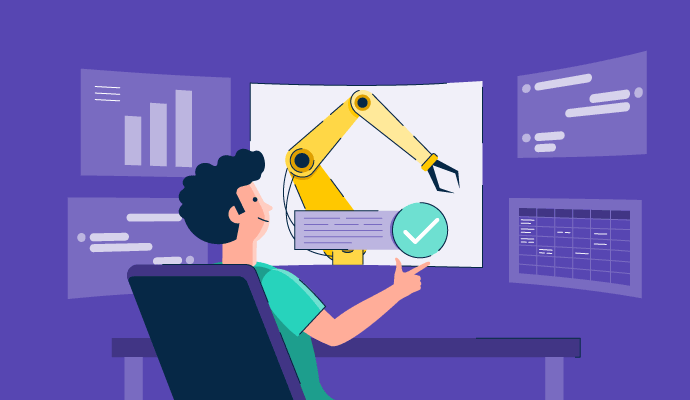
How Will the Fourth Industrial Revolution Impact Remote Work?
When we think about remote work, we usually imagine employees performing the same tasks they complete in the office at home. This means that anyone who works in a physical environment such as a warehouse, manufacturing facility, or retail store cannot work remotely.
by Gabriel Gheorghiu
Production Scheduling: Your Path to Manufacturing Excellence
The roadmap to manufacturing excellence is hidden somewhere in a task board.

by Harshita Tewari
Highlights From the G2 Spring 2022 ERP Reports
Enterprise resource planning (ERP) is probably one of the most mature software markets, which usually experiences few significant advancements other than the occasional merger or acquisition. At the same time, many changes in the industry may not be considered groundbreaking but can considerably impact ERP buyers and users.

by Gabriel Gheorghiu
How Cloud ERP Helps Manufacturers with Resource Management
In June 2021, I wrote an article that described how cloud enterprise resource planning (ERP) can help solve manufacturing challenges and highlighted integrated systems as the main benefit of software as a service (SaaS) ERP systems.
by Gabriel Gheorghiu
2021 Trends in E-Commerce and Industry 4.0
This post is part of G2's 2021 digital trends series. Read more about G2’s perspective on digital transformation trends in an introduction from Michael Fauscette, G2's chief research officer and Tom Pringle, VP, market research, and additional coverage on trends identified by G2’s analysts.
by Gabriel Gheorghiu
How Industry 4.0 Will Change Project Management
Project management software and methodologies are a form of automation that has been used in business for nearly 50 years. New technologies such as artificial intelligence (AI) and the Internet of Things (IoT) have the potential to automate project management—but, how far will they go?
by Gabriel Gheorghiu
How Project-Based Software Helps Companies
Most tasks we do at work are either process or project-based. Processes are made of repetitive tasks that we do repeatedly, with little to no variation. Project work can vary significantly from one project to another and can change based on internal or customer requirements.
by Gabriel Gheorghiu
How SMBs Can Benefit from Industry 4.0
Most Industry 4.0 success stories mention large multinational companies such as GE or ABB.
by Gabriel Gheorghiu
The Pros and Cons of Different Automation Types
The concept of automation is straightforward: create tools that perform tasks with minimal human involvement. And the motivation for more automation is simple: Companies can do more with less. “More” means companies can sell and deliver a higher volume of products and services than ever before. “Less” refers to the fact that, thanks to automation, fewer resources are required.
by Gabriel Gheorghiu
The G2 on Industry 4.0: Understanding Industrial Revolution on a Global Scale
If you work in manufacturing or supply chain, you’ve probably heard of Industry 4.0. While the term may be used together with buzzwords like digital transformation, interconnectivity, or end-to-end value chain, Industry 4.0 refers to a new industrial revolution.
by Gabriel Gheorghiu
How Business Digital Transformation Works In The Real World
Business digital transformation is a buzzword that is misused and not completely clear. For instance, the Wikipedia definition is incomplete and vague: “Digital Transformation (DT) is the use of new, fast-changing digital technology to solve problems often utilizing cloud computing, reducing reliance on user-owned hardware but increasing reliance on subscription-based cloud services.”
by Gabriel Gheorghiu
Process ERP Software Discussions
0
Question on: Infor SyteLine
What are your deployment options?
What are the deployment options for Infor SyteLine ERP?
Show More
Show Less
If we can change the batch orders in each time bucket in the order scheduling through the grant chart., it’s great.
Show More
Show Less
Infor SyteLine ERP is available On-premises, Hosted, in the Cloud/SaaS, or as a Hybrid deployment.
Show More
Show Less
0
Question on: SAP ECC
What is SAP ERP used for?
Show More
Show Less
SAP is used for managing and automating core business processes like finance, human resources, procurement, and supply chain management within an organization, providing a unified platform for data and process integration.
Show More
Show Less
SAP ERP used for various functions starting from Manufacturing , finance , QMS, Production planning and many more
Show More
Show Less
0
Question on: Priority ERP
What is Priority ERP used for?
Show More
Show Less
Priority ERP is used to run and manage the day-to-day operations of a business in one system.
At a practical level, it brings together data and processes across departments so teams aren’t working in silos or relying on disconnected tools.
What businesses use Priority ERP for
Financial management
Track revenues, expenses, cash flow, budgets, and financial reporting—all in real time, with support for multi-entity and multi-currency operations.
Sales and customer management (CRM)
Manage leads, customers, quotes, orders, and customer interactions from first touch to ongoing service.
Supply chain and inventory
Control purchasing, suppliers, inventory levels, and stock movements across warehouses with full visibility.
Manufacturing and production
Plan and manage production, bills of materials (BOMs), scheduling, and shop floor operations, including cost tracking.
Warehouse and logistics (WMS, ADP, POD)
Run warehouse operations, optimize delivery routes, and track deliveries with proof of delivery—all within the same platform.
Project and service management
Manage projects, resources, timelines, and service workflows, including time tracking and billing.
HR and payroll
Handle employee data, onboarding, attendance, and payroll processes.
Automation and workflows
Use built-in business process management (BPM) tools to automate approvals, alerts, and routine tasks.
Reporting and analytics
Get real-time dashboards and insights across finance, operations, and sales to support faster decision-making.
AI-powered assistance (aiERP)
Use natural language to query data, automate tasks with AI agents, and get real-time recommendations based on live business activity.
Show More
Show Less
Process ERP Software Reports
Grid® Report for Process ERP
Summer 2026
G2 Report: Grid® Report
Enterprise Grid® Report for Process ERP
Summer 2026
G2 Report: Grid® Report
Mid-Market Grid® Report for Process ERP
Summer 2026
G2 Report: Grid® Report
Momentum Grid® Report for Process ERP
Summer 2026
G2 Report: Momentum Grid® Report
Mid-Market Grid® Report for Process ERP
Spring 2026
G2 Report: Grid® Report
Momentum Grid® Report for Process ERP
Spring 2026
G2 Report: Momentum Grid® Report
Enterprise Grid® Report for Process ERP
Spring 2026
G2 Report: Grid® Report
Grid® Report for Process ERP
Spring 2026
G2 Report: Grid® Report
Grid® Report for Process ERP
Winter 2026
G2 Report: Grid® Report
Enterprise Grid® Report for Process ERP
Winter 2026
G2 Report: Grid® Report