  # Best Decision Management Software - Page 6

  *By [Bijou Barry](https://research.g2.com/insights/author/bijou-barry)*

   Decision management Software, also known as business rule management systems (BRMS), help businesses author, store, and test business rules. Multiple business rules, essentially if-then scenarios, can be considered together to make business decisions. With these tools, businesses can optimize and automate their processes, improving overall efficiency in day-to-day functions. It is used by analysts, developers, and subject matter experts. Analysts examine business rules to map them, and developers can use the platform to integrate these rules into other applications or workflows. Subject matter experts are required to ensure business rules are captured accurately.

This software provides users with a platform for writing, maintaining, and mapping business rules and decision logic, which can include custom vocabulary that allows users to create rules in a language unique to their business. Once a decision has been written, users can test their logic and verify that it works as expected and achieves the desired outcome. Integrations with other tools allow them to better execute the intent of the business through automated and augmented decisions. Depending on how the decision is defined, the decision process can execute any number of logic steps and actions to arrive at a decision. Some of these platforms allow users to create or host applications built on top of these business rules. Finally, this software provides analytics that deliver visibility and insights into business decisions through KPI analysis, dashboards, and more.

Decision management platforms share features and functionality with other solutions, and it is important to understand the differences between the different offerings. Although many of them provide some degree of decision simulation, businesses looking for more robust business process simulation tools should look at [business process simulation software](https://www.g2.com/categories/business-process-simulation) as it is geared toward simulating business processes and systems. In addition, this software differs from [business process management (BPM) software](https://www.g2.com/categories/business-process-management) inasmuch, it is focused on decision management and business rules, as opposed to business processes. It is critical to note that decision management platforms are built to optimize and automate business rules. Therefore, users looking for simpler collaboration tools which assist business leaders in making decisions can check out [decision-making software](https://www.g2.com/categories/decision-making).

Decision management Software cannot work in isolation. Therefore, they have the ability integrate with other technologies, such as [ERP systems](https://www.g2.com/categories/erp-systems), [CRM software](https://www.g2.com/categories/crm), [supply chain suites](https://www.g2.com/categories/supply-chain-suites), among many others.

To qualify for inclusion in the Decision Management category, a product must:

- Author business rules for the purpose of making decisions
- Test business rules in order to make sure they work properly and are optimized
- Give users the ability to manage business rules
- Provide analytics capabilities to better understand business decisions
- Have capabilities for automating business decisions
- Provide APIs or other development tools for integrating with other applications


  ## How Many Decision Management Software Products Does G2 Track?
**Total Products under this Category:** 92

  
## How Does G2 Rank Decision Management Software Products?

**Why You Can Trust G2's Software Rankings:**

- 30 Analysts and Data Experts
- 1,900+ Authentic Reviews
- 92+ Products
- Unbiased Rankings

G2's software rankings are built on verified user reviews, rigorous moderation, and a consistent research methodology maintained by a team of analysts and data experts. Each product is measured using the same transparent criteria, with no paid placement or vendor influence. While reviews reflect real user experiences, which can be subjective, they offer valuable insight into how software performs in the hands of professionals. Together, these inputs power the G2 Score, a standardized way to compare tools within every category.

  
## Which Decision Management Software Is Best for Your Use Case?

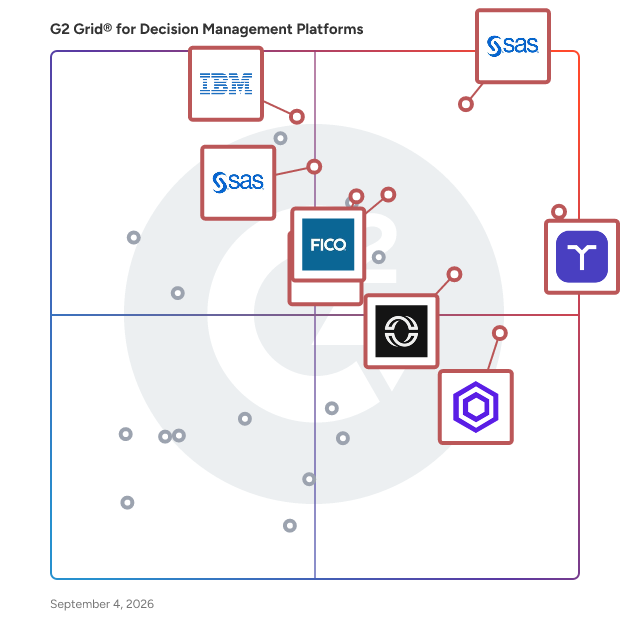
- **Leader:** [SAS Viya](https://www.g2.com/products/sas-sas-viya/reviews)
- **Highest Performer:** [DecisionRules](https://www.g2.com/products/decisionrules/reviews)
- **Easiest to Use:** [Taktile](https://www.g2.com/products/taktile/reviews)
- **Top Trending:** [Taktile](https://www.g2.com/products/taktile/reviews)
- **Best Free Software:** [DecisionRules](https://www.g2.com/products/decisionrules/reviews)

  
---

**Sponsored**

### Hive

Hive is a type of project management software solution designed to help teams streamline their workflows and enhance collaboration. This platform provides a comprehensive suite of tools that cater to various project management needs, enabling users to manage tasks, track progress, and communicate effectively within their teams. Hive&#39;s flexibility allows organizations to tailor their project management experience to fit their unique requirements, ensuring that teams can work in a way that suits them best. Targeted at businesses of all sizes, Hive is particularly beneficial for teams that require a high level of customization in their project management processes. Whether it&#39;s a marketing team coordinating campaigns, a product development team managing timelines, or a remote team collaborating on deliverables, Hive offers the versatility needed to adapt to different workflows. The platform is designed to accommodate diverse use cases, making it a valuable asset for organizations looking to improve efficiency and productivity. One of the key features of Hive is its flexible project views, which allow users to visualize their work in a manner that aligns with their preferences. Users can choose from various layouts, such as Kanban boards, Gantt charts, or list views, providing multiple ways to manage tasks and deadlines. This adaptability ensures that teams can find the most effective way to organize their projects, leading to increased clarity and focus. Additionally, Hive offers extensive customization options, enabling users to create workflows that reflect their specific processes. This includes the ability to set custom fields, automate repetitive tasks, and integrate with other tools that teams may already be using. Such features not only save time but also enhance the overall project management experience by allowing teams to work more efficiently and effectively. Another standout aspect of Hive is its commitment to user success. The platform is designed with the understanding that every team has unique needs, and Hive is willing to build additional tools or features to meet those needs. This level of support ensures that organizations can fully leverage the capabilities of the software, ultimately leading to improved project outcomes and faster execution of tasks. By adopting Hive, teams can expect to enhance their project management processes and foster a more collaborative work environment.


[Visit website](https://www.g2.com/external_clickthroughs/record?secure%5Bad_program%5D=ppc&amp;secure%5Bad_slot%5D=category_product_list&amp;secure%5Bcategory_id%5D=2646&amp;secure%5Bdisplayable_resource_id%5D=14&amp;secure%5Bdisplayable_resource_type%5D=Category&amp;secure%5Bmedium%5D=sponsored&amp;secure%5Bplacement_reason%5D=neighbor_category&amp;secure%5Bplacement_resource_ids%5D%5B%5D=1698&amp;secure%5Bprioritized%5D=false&amp;secure%5Bproduct_id%5D=27036&amp;secure%5Bresource_id%5D=2646&amp;secure%5Bresource_type%5D=Category&amp;secure%5Bsource_type%5D=category_page&amp;secure%5Bsource_url%5D=https%3A%2F%2Fwww.g2.com%2Fcategories%2Fdecision-management-platforms%3Fpage%3D6&amp;secure%5Btoken%5D=82db1fad00b48ca4e60d149c74c047232b95b85079797137e3f730b110413ab4&amp;secure%5Burl%5D=https%3A%2F%2Fhive.com%2F&amp;secure%5Burl_type%5D=company_website)

---

  
    ## What Is Decision Management Software?
  [Process Automation Software](https://www.g2.com/categories/process-automation)
  ## What Software Categories Are Similar to Decision Management Software?
    - [Business Process Management Software](https://www.g2.com/categories/business-process-management)
    - [Workflow Management Software](https://www.g2.com/categories/workflow-management)

  
---

## How Do You Choose the Right Decision Management Software?

### What You Should Know About Decision Management Platforms

### What are Decision Management Platforms?

Decision management platforms are business software designed to automate and improve an organization’s decision-making processes. The fundamental idea is to model and optimize decisions, which typically involve several rules or criteria and can be complex to manage manually.&amp;nbsp;

Key features of this software often include a graphical user interface for designing decision logic, rule engines, simulation capabilities, and reporting and analytics tools. For example, a business could use a decision management platform to automate credit approval processes based on a set of predefined rules (income level, credit score, etc.).

#### What Types of Decision Management Platforms Exist?

Indeed, decision management platforms come in various forms, each designed to meet different business needs. The types of decision management tools can be classified based on the methods they use to assist in decision making:

**Business rules engines (BRE)**

These platforms base decisions on a set of pre-determined rules. The rules can be set up and maintained by business users, IT staff, or a combination of both. They are useful for operational decisions that can be clearly defined in a ruleset, such as eligibility determination or regulatory compliance.

**Real-time decision platforms**

These platforms are designed to make decisions in real time, often within milliseconds. They are typically used in fraud detection, real-time marketing, and dynamic pricing, allowing businesses to keep track of their processes in real time.

### What are the Common Features of Decision Management Platforms?

The following are core features within decision management platforms that help users in business rule management, predictive analytics, and automated decision making:

**Business rule management:** Allows users to define, deploy, monitor, and maintain the logic that drives decisions within the systems. Users leverage the business rule management functionality in a decision management platform to set up complex decision logic based on predefined rules.

**Predictive analytics:** Decision management platforms often come equipped with predictive analytics capabilities. This helps businesses use historical data to predict future outcomes. It can be extremely beneficial in risk assessment, sales forecasting, and customer behavior prediction.

**Automated decision making:** One of the main benefits of decision management tools is the ability to automate decision-making processes. This involves using algorithms and models to make decisions based on a set of input data. Automated decision making can increase efficiency and consistency in decision making, allowing businesses to make decisions at a much larger scale than would be possible manually.

### What are the Benefits of Decision Management Platforms?

**Increased efficiency:** By automating decision-making processes, businesses can significantly increase operational efficiency, reducing the time and resources required for manual decision making.

**Consistency:** Decision management platforms ensure that decisions are made consistently, based on the same set of rules, which increases fairness and transparency.

**Agility:** These platforms enable businesses to rapidly respond to changes by allowing them to modify decision rules as the business environment or regulatory landscape changes.

### Who Uses Decision Management Platforms?

Decision management platforms are used by a wide range of roles within an organization, including:

**Business analysts:** These platforms model, test, and modify decision logic based on business rules and analytics.

**Data scientists:** They create predictive models based on historical data and use these models in decision-making processes.

**IT professionals:** Such professionals integrate decision services with other business applications and manage the deployment of decision logic.

### What are the Alternatives to Decision Management Platforms?

Alternatives to this software might not encompass the full range of capabilities of a comprehensive decision management platform, but they can provide similar functionalities:

[Business intelligence tools](https://www.g2.com/categories/business-intelligence) **:** Business intelligence (BI) tools are an alternative that focuses more on data analysis and reporting. While they don&#39;t offer the same level of rule management or decision automation level, they can provide deep insights into business data that drive informed decisions. For businesses whose primary need is understanding their data rather than automating decisions, a BI tool might be more suitable.

[Workflow management software](https://www.g2.com/categories/workflow-management) **:** Workflow management tools are designed to automate business processes and workflows and are an alternative for companies primarily interested in the automation aspect of decision management platforms. These tools allow for the automation of repetitive tasks, and some also offer decision logic features, although generally not as comprehensive as those found in decision management platforms.

[Predictive analytics software](https://www.g2.com/categories/predictive-analytics) **:** This software is centered around forecasting future outcomes based on historical data, akin to the predictive analytics feature of decision management platforms. If the main need of a business is predictive modeling and forecasting rather than decision automation or rule management, predictive analytics software is a viable alternative.

[Business process simulation software](https://www.g2.com/categories/business-process-simulation) **:** This software primarily focuses on simulating, modeling, and visualizing business processes for analysis and optimization. While it lacks the decision rules management and decision automation capabilities that decision management platforms provide, it is instrumental in industries where understanding and optimizing complex processes are the primary concern. For organizations that need to optimize business processes and workflows rather than automate decision making, business process simulation software may be a suitable alternative.

#### Software Related to Decision Management Platforms

Related solutions that can be used together with decision management platforms include:

[Customer relationship management (CRM) software](https://www.g2.com/categories/crm) **:** CRM systems manage and analyze customer interactions throughout the customer lifecycle. The customer data and insights generated can feed into the decision management platforms to make more customer-centric decisions, thereby improving customer satisfaction and loyalty.

[Enterprise resource planning (ERP) software](https://www.g2.com/categories/erp) **:** ERP systems integrate various business processes into a unified system. Decision management platforms can connect with ERP systems to utilize comprehensive business data, helping to drive decisions that affect multiple areas of the organization, including finance, HR, supply chain logistics, and more.

[Project management software](https://www.g2.com/categories/project-management) **:** This software allows teams to collaborate, track project progress, and manage resources. The data from project management tools can be valuable in decision management platforms for resource allocation and project prioritization decisions.

[Supply chain management software](https://www.g2.com/categories/supply-chain-management) **:** This software manages and oversees the flow of goods, data, and finances involved in manufacturing, delivering products and services from suppliers to customers. Information from supply chain management software can enhance decision making in procurement, inventory, and logistics within decision management platforms.

### Challenges with Decision Management Platforms

Here are some challenges that users may experience with decision management platforms:

**Data quality:** Platforms need high-quality data for effective decision making. If the data is inaccurate, incomplete, or outdated, the decisions derived from it may be flawed. To overcome this challenge, businesses should implement robust data quality measures, including data validation, data cleansing, and regular data audits. Investing in data quality software may also be beneficial.

**Integration with existing systems:** Like many software, decision management platforms need to integrate with existing systems and data sources to function effectively. Poor integration can result in data silos and disjointed decision-making processes. To address this issue, organizations should ensure that the selected platform can seamlessly integrate with their existing infrastructure. It may be necessary to leverage APIs or hire a team with integration expertise.

**Complexity of use:** Decision management platforms can be complex and require a certain level of technical knowledge to navigate and utilize to their full potential. This can lead to a slower adoption rate among employees. To mitigate this, all users should be provided adequate training, and ongoing support should be readily available. Additionally, businesses should consider platforms known for user-friendly interfaces and good user experience.

**Compliance requirements:** Depending on the industry, certain compliance requirements might be associated with data handling. In some sectors, decisions also need to be explainable and auditable. Non-compliance can lead to legal and financial consequences. To manage this, businesses should ensure that the decision management platform is compliant with relevant regulations and that it provides necessary reporting features. Consulting with a legal team during the selection process could be beneficial.

### Which Companies Should Buy Decision Management Platforms?

Decision Management Platforms can benefit a wide range of organizations, from small businesses to large corporations, across various industries. They provide a structured approach to decision making that can lead to improved outcomes, efficiency, and consistency.

**Financial institutions:** Banks, insurance companies, and other financial institutions can greatly benefit from decision management platforms. These tools assist in decision making related to risk assessment, credit scoring, and fraud detection. The ability to make data-driven decisions can enhance service delivery, customer experience, and risk management capabilities.

**Healthcare organizations** : Healthcare providers, hospitals, and other healthcare organizations can leverage decision management tools to improve patient care and operational efficiency. These platforms assist in making critical decisions related to patient treatment plans, resource allocation, and policy adherence. By making data-driven decisions, these organizations can improve patient outcomes and operational efficiency.

**Retail companies:** Retail businesses can use decision management platforms to optimize inventory management, pricing strategies, and customer service. By leveraging these tools, they can make informed decisions that can lead to increased sales, better customer satisfaction, and efficient operations.

**Manufacturing companies:** Manufacturing firms use decision management platforms to optimize production planning, inventory management, and quality control. The platform assists in decision making to enhance operational efficiency, reduce waste, and improve product quality. By making data-driven decisions, these companies can boost production efficiency and profitability.

### How to Buy Decision Management Platforms

#### Requirements Gathering (RFI/RFP) for Decision Management Platforms

The first step in purchasing a decision management platform is to gather and prioritize your business requirements. This involves identifying what decision-making processes the user wants to automate, the type of data they use, and the levels of integration and customization required.

Once the buyer has collected and ranked their needs, they can create a request for information (RFI) or a request for proposal (RFP) to distribute to potential vendors. It&#39;s essential that this document clearly outlines the buyer&#39;s business needs, expectations for the platform, and evaluation criteria.

#### Compare Decision Management Platforms Products

**Create a long list**

To create a long list of potential decision management platforms, buyers must consider factors such as vendor reputation, platform features, scalability, and pricing structure. They can use online resources, customer reviews, and analyst reports to guide their selection. Buyers should prioritize vendors specializing in their industry or with proven experience addressing similar business needs.

**Create a short list**

After comparing the products on the long list, the buyer must narrow down their choices based on their key requirements and vendor responses to their RFI or RFP. They should schedule demos or trials with the shortlisted vendors to get a hands-on understanding of their platform.

**Conduct demos**

During demos, it&#39;s crucial to ask the right questions. Buyers must ask the vendor about the platform&#39;s decision-making logic, data handling capabilities, ease of integration, and customization options. It&#39;s important to note how intuitive the platform is and whether it offers the level of complexity the buyer&#39;s organization requires.

#### Selection of Decision Management Platforms

**Choose a selection team**

Ideally, the selection team should comprise individuals from key business units who will use the platform, including data scientists, business analysts, IT specialists, and decision-making executives.

**Negotiation**

Buyers must negotiate terms and conditions with the vendor, focusing on pricing, support services, software updates, and customization options. They must always ensure they have a clear understanding of any additional costs that might be involved.

**Final decision**

The final decision is usually made by high-ranking decision makers in the company. Considerations should include platform functionality, vendor support, integration capabilities, and ROI.

### What Does Decision Management Platforms Cost?

Most decision management platforms follow a SaaS pricing model, charging a recurring subscription fee. Initial costs include implementation and training, while ongoing expenses might involve license renewals, maintenance, and upgrades. Additional costs can occur for consultation and customization.

#### Return on Investment (ROI)

Factors influencing ROI include license cost, additional costs, improved decision making efficiency, and time saved. Calculating ROI involves comparing these benefits against the total cost of owning and operating the platform.

### Implementation of Decision Management Platforms

**How are Decision Management Platforms Implemented?**

Implementation of these platforms involves data integration, setting up decision logic, and training users. This can be done by the vendor, a third party, or in house.

**Who is Responsible for Decision Management Platforms Implementation?**

Teams responsible for implementation often include project managers, IT specialists, and subject matter experts from the vendor and the purchasing company.

**What Does the Implementation Process Look Like for Decision Management Platforms?**

The process typically includes data migration, system configuration, pilot testing, training, going live, and ongoing change management.

**When Should You Implement Decision Management Platforms?**

It&#39;s best to implement these platforms during a period of strategic change or process improvement. Stages include data migration, pilot testing, training, and go-live.

### Decision Management Platforms Trends

**Artificial intelligence (AI) and machine learning (ML) advancements**

The use of AI and ML in decision management platforms is becoming increasingly prevalent. These technologies enhance the ability of these platforms to process vast amounts of data and automate complex decision-making processes.&amp;nbsp;

As AI and ML algorithms become more sophisticated, these platforms learn from previous decisions and improve their accuracy and efficiency over time. This not only reduces human errors but also enables faster, data-driven decisions that can significantly improve business performance.

**Cloud-based platforms**

The shift towards cloud-based decision management platforms is another significant trend in the industry. Cloud-based solutions offer several advantages over traditional on-premises platforms, including greater scalability, accessibility, and cost efficiency.&amp;nbsp;

They allow businesses of all sizes to leverage advanced decision management capabilities without substantial upfront investment in IT infrastructure. Furthermore, cloud platforms are typically easier to update and maintain, ensuring businesses can always access the latest features and security updates.

**Enhanced integration capabilities**

As businesses continue using a growing range of software tools and data sources, effective integration has become more critical than ever. Decision management platforms are responding to this trend by offering enhanced integration capabilities. This includes APIs and other tools that enable seamless data exchange between different software applications. By integrating these platforms with other business systems (like CRM, ERP, and data analytics tools), businesses can achieve a more unified view of their data, leading to more informed and effective decision making.


