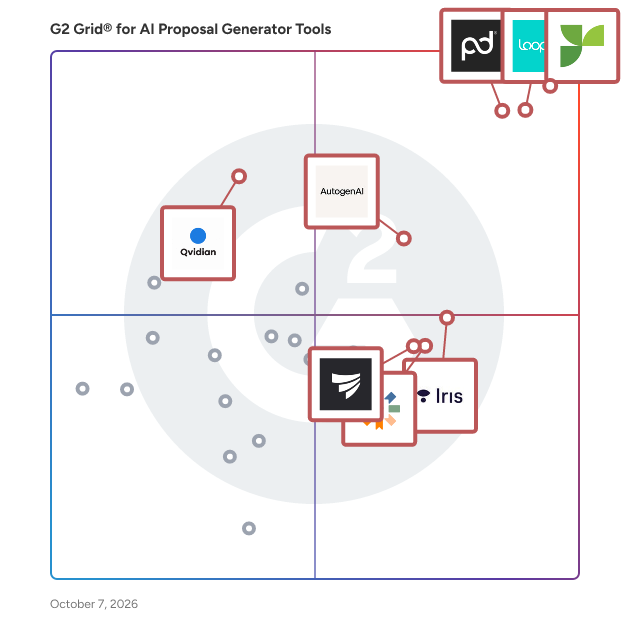
AI proposal generator tools help organizations automate, generate, and manage responses to requests for proposals (RFP), requests for information (RFI), security questionnaires, and due diligence questionnaires using artificial intelligence to accelerate response creation, improve content accuracy, and increase win rates.
Responding to formal procurement requests has historically required proposal teams to manually search through past responses, coordinate across subject matter experts (SME), and assemble complex documents under tight deadlines. AI proposal generator tools transform this process by using large language models (LLM), natural language processing (NLP), and machine learning (ML) to parse incoming documents, auto-draft tailored responses from approved content libraries, and surface the most relevant answers from an organization's institutional knowledge. Rather than maintaining static repositories of prior responses, these platforms create intelligent, self-improving knowledge systems that adapt to an organization's evolving messaging, products, and compliance requirements.
Organizations use AI proposal generator tools to reduce response time, improve consistency across submissions, increase the volume of proposals their teams can handle, and improve the quality of individual bids. Core workflows include document ingestion and requirement extraction, AI-assisted first-draft generation, SME assignment and review routing, compliance and completeness checking, and performance analytics that track win rates and content effectiveness over time.
These tools are primarily used by proposal managers, bid writers, sales engineers, pre-sales teams, and revenue operations leaders across industries where formal procurement processes are standard, including enterprise technology, professional services, healthcare, financial services, and government contracting. They typically integrate with CRM platforms, cloud storage and file management tools, e-signature software, and communication platforms to fit into existing revenue workflows.
Unlike general-purpose AI writing assistants, which generate content from public data, AI proposal tools draw exclusively from an organization's own vetted and approved content, ensuring responses are accurate, compliant, and brand-consistent. As opposed to contract management software, which governs the post-award document lifecycle, AI proposal tools focus on the pre-award competitive response process, helping teams win business before any agreement is in place.
AI proposal tools sit within the broader revenue intelligence and sales enablement ecosystem as a specialized content automation capability for high-stakes, structured procurement workflows. As AI agents become more capable of executing multi-step tasks autonomously, leading platforms are beginning to support end-to-end agentic proposal workflows—from bid/no-bid scoring at intake to final submission—with minimal human intervention.
To qualify for inclusion in the AI Proposal Generator category, a product must:
- Use artificial intelligence or machine learning to generate, recommend, or automate responses to RFPs, RFIs, security questionnaires, or similar structured procurement documents
- Maintain or connect to a governed content library of approved organizational knowledge used to populate proposal responses
- Support collaborative review and approval workflows involving multiple stakeholders or subject matter experts
- Enable document parsing and requirement extraction from incoming RFP or questionnaire documents
- Provide analytics or reporting on proposal performance, response quality, or content library health