AI-Generated Results
Finding matches…
Not seeing what you're looking for?
Dive deeper into "Merlin" on G2 AI


Ornexia is French PMO software for organisations that steer their
projects through committees. Generalist tools plan and execute. Ornexia
covers what happens after the meeting: who does what, where it stands,
what is slipping.
Prepare a committee in one click, with the slide deck, minutes and
action list generated together. Turn meeting notes into a structured
action plan, with AI extracting the decisions and RACI ownership making
each role explicit. Keep a living risk register with periodic reviews,
criticality matrices and resolution plans. Consolidate progress across
projects and programmes.
Every profile is productive from day one, from the PMO to the occasional
contributor.
Ornexia complements Jira, Monday, Asana or MS Project rather than
replacing them. Project governance accounts for 15 to 35% of a team's
capacity, and that is the ground it covers.
Plans start at EUR 5 per month for a single user and EUR 18 per user per
month for teams. Data hosted in France.

Convene in Teams (CIT) is a Microsoft meeting management solution built for teams in Teams for all types of leadership meetings.




BoardSync offers Agenda and Meeting Management solutions.


A web-based video conferencing and online meeting solution that allows teams to host secure virtual calls, real-time.

Hronaut gives your coding agent its own visible desktop browser instead of your personal Chrome. Each project or client gets a named, isolated workspace with its own tabs, cookies and storage that stay available between agent sessions. You can watch the agent, pause it, and take over for sign-in or 2FA, then hand back. Works over MCP with Codex, Claude Code, Cursor, Cline, VS Code/GitHub Copilot and Gemini CLI. Runs on Windows, macOS and Linux; the MCP server is local by default. Paid app: 10-day trial with no card, then $4/month or $24/year per named user.
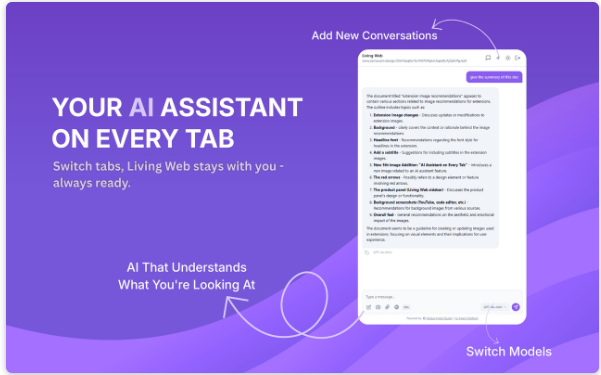
Living Web Agent is a browser companion that cuts the usual research hassle. Instead of digging through long PDFs, scrubbing long tutorials, or
jumping between a dozen open tabs, you click once and it reads the page, video, or document for you. Then you just ask questions—“Where do they talk about the Q3
deficit?” or “What are the main steps in this video?”—and get answers with citations. Setup is simple: install the agent, point it at a URL or dashboard, and start
chatting. Users report cutting research time in half and understanding content a lot faster. It works with PDFs, videos, articles, and dashboards, and stays available
in the background so you don’t have to switch tools or copy-paste. It’s part of the Scale Vibe Agent suite. James Harrington, Managing Partner at Sovereign Capital
Ventures, said it cut his investor-call prep from three hours down to about 25 minutes. The idea is pretty straightforward: spend less time browsing and more time
actually using what you find.

Room Booking lets employees find and book meeting rooms, filtered by time window, capacity, area and equipment. The app creates a Microsoft Graph event from a service mailbox, with the room as a resource attendee, the booker required and invitees optional. Rooms are either booked directly or go through an approval request. Users can cancel a booking with a reason, and bookings changed in Exchange are marked as changed externally. The app runs as a standalone web app and as a Staffbase widget, in German and English.


SummaBooking helps small offices, coworking and shared spaces, churches, community centers and property managers run their shared rooms without a spreadsheet or a whiteboard.
An admin creates a workspace, adds rooms with seats, location, amenities, opening hours and a photo, and invites members. Members search by time and seat count, see each room's availability for the day, and book, modify or cancel in a click. The database refuses overlapping bookings, so two people can never hold the same room at the same time.
Admins control the rules: the longest booking, how far ahead people can book, weekly minutes and active bookings per member, room-capacity enforcement, recurring series, and check-in with automatic release of no-show rooms. Reports show usage and export to CSV.
People can also set up and use a workspace from Claude, Claude Code or ChatGPT: find a free room, book a weekly series or change the rules by asking. Sign-in is passwordless. Each workspace's data is isolated at the database level, there are no ads or tracking cookies, and customer data is not used to train AI models.
