Konan Technology
Who Is the Company Behind Konan Technology?
- Seller: Konan Technology
- Year Founded: 1999
- HQ Location: Seoul, KR
-
LinkedIn® Page: www.linkedin.com
67 employees on LinkedIn®
Total Products under this Category: 488
Last updated: September 01, 2026
Why You Can Trust G2's Software Rankings:
G2's software rankings are built on verified user reviews, rigorous moderation, and a consistent research methodology maintained by a team of analysts and data experts. Each product is measured using the same transparent criteria, with no paid placement or vendor influence. While reviews reflect real user experiences, which can be subjective, they offer valuable insight into how software performs in the hands of professionals. Together, these inputs power the G2 Score, a standardized way to compare tools within every category.
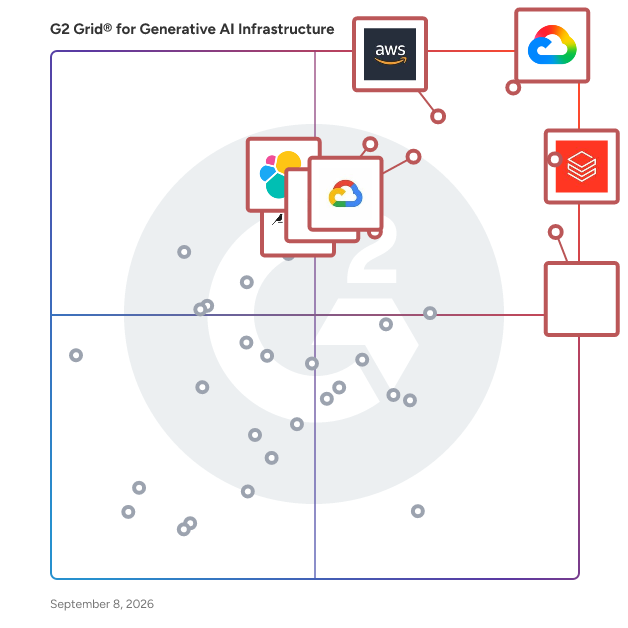
Highlighted products: Gemini Enterprise Agent Platform, Databricks, AWS Bedrock, Langchain, Google Cloud AI Infrastructure, IBM watsonx.ai, Dataiku, and Elasticsearch.
Underlying data: [Grid® JSON](https://www.g2.com/categories/generative-ai-infrastructure/grids.json?focus%5B%5D=gemini-enterprise-agent-platform&focus%5B%5D=databricks&focus%5B%5D=aws-bedrock&focus%5B%5D=langchain&focus%5B%5D=google-cloud-ai-infrastructure&focus%5B%5D=ibm-watsonx-ai&focus%5B%5D=dataiku&focus%5B%5D=elastic-elasticsearch)
Krira Augment is a production-ready Retrieval-Augmented Generation (RAG) pipeline designed to streamline the deployment of enterprise-grade AI applications. By abstracting the complexities of modern AI infrastructure, Krira Augment enables organizations to implement sophisticated AI solutions efficiently, reducing development time from months to minutes. This fully managed platform handles embedding, indexing, and vector search, transforming raw data into actionable context for large language models (LLMs). Key Features and Functionality: - RAG Pipelines: End-to-end ingestion engines utilizing Rust-based chunking and vector orchestration for efficient data processing. - Fine-Tuning: Advanced low-rank adaptation techniques for specialized model customization, enhancing accuracy and performance. - Agentic Systems: Autonomous multi-agent architectures designed for complex reasoning tasks, facilitating sophisticated AI workflows. - MCP Integration: Seamless support for the Model Context Protocol, enabling efficient tool exchange and interoperability. - Developer Coding Tools: A comprehensive suite including version control, debugging, and automated deployment pipelines to support robust development practices. Primary Value and User Solutions: Krira Augment addresses the challenges of building and deploying AI applications by providing a unified infrastructure that eliminates the need for specialized engineering resources. By offering a managed RAG pipeline, it allows organizations to focus on developing intelligent applications without the overhead of managing complex AI stacks. This accelerates time-to-market, enhances scalability, and ensures performance, making sophisticated AI engineering accessible to a broader range of developers and enterprises.
Lambda was founded in 2012 by published AI engineers with the vision to enable a world where Superintelligence enhances human progress, by making access to computation as effortless and ubiquitous as electricity. Today, the world’s leading AI teams trust Lambda to deploy gigawatt-scale AI Factories for training and inference, engineered for security, reliability, and mission-critical performance.
Average Rating: 4.5/5.0
Total Reviews: 4
AI-generated summary from verified user reviews
"Fast, Accurate Face Recognition That Streamlines Onboarding and Security"
Rating: 5.0/5.0 stars
— Mohamed S.
"Fast Recognition and Easy Integration with Clear API Docs"
Rating: 4.0/5.0 stars
— Shashank P.
LambdAI offers enterprise-grade AI infrastructure solutions tailored for organizations requiring secure, high-performance environments for AI workloads. Leveraging NVIDIA H100 GPUs, LambdAI provides dedicated and shared compute resources optimized for AI inference, private large language model (LLM) deployments, and sovereign AI applications. Key Features and Functionality: - GPU Cloud: Dedicated and shared NVIDIA H100 compute infrastructure optimized for AI workloads, inference pipelines, and model experimentation. - Private LLM Hosting: Secure, isolated deployments for enterprise-grade large language models, embeddings, retrieval-augmented generation (RAG) pipelines, and internal AI assistants. - Inference APIs: Scalable AI APIs with optimized runtime orchestration, low latency, monitoring, and controlled access for enterprise applications. - Sovereign AI: Private infrastructure tailored for regulated industries and sensitive workloads, ensuring organizations maintain control over data and model execution. - AI Runtime Management: Tools to deploy, monitor, and operate model runtimes using containerized GPU environments, orchestration, and workload isolation. - Vector & RAG Infrastructure: Support for retrieval-augmented generation, vector databases, document processing, and secure enterprise knowledge systems. - Dedicated Clusters: Reserved H100 nodes providing predictable performance, dedicated capacity, and private networking for organizations with specific requirements. - Enterprise Support: Comprehensive services including architecture guidance, onboarding, operational monitoring, and SLA-based support for critical AI workloads. Primary Value and Solutions Provided: LambdAI addresses the complexities and challenges associated with deploying and managing AI infrastructure by offering predictable GPU capacity, secure private deployments, and enterprise-grade support. This enables organizations to focus on developing and scaling AI applications without the operational overhead typically associated with managing AI infrastructure. By providing dedicated resources and tailored solutions, LambdAI ensures that enterprises can deploy AI workloads efficiently, securely, and in compliance with regulatory requirements.
Lampi AI offers a customizable and confidential artificial intelligence platform tailored to meet the unique needs of enterprises. By integrating advanced large language models (LLMs) with proprietary data, Lampi AI enables businesses to deploy secure, fine-tuned AI agents that enhance operational efficiency and decision-making processes. The platform is designed with a strong emphasis on data security, ensuring that sensitive information remains protected through private deployments and stringent confidentiality standards. Key Features and Functionality: - Customizable AI Models: Lampi AI processes, adjusts, and adapts state-of-the-art models to better handle specific tasks or specialize in particular business verticals. This involves a meticulous process of selection, training, iteration, and optimization to ensure the AI aligns with enterprise requirements. - Confidential Infrastructure: The platform can be deployed privately within a tailored infrastructure, utilizing dedicated GPUs or integrating into an organization's existing IT framework. This approach safeguards sensitive data and respects enterprise data permissions. - Flexible Deployment Options: Lampi AI offers multiple deployment models, including Software as a Service (SaaS), cloud infrastructure, and private deployments such as Virtual Private Cloud (VPC) and on-premises solutions, providing flexibility to meet diverse organizational needs. - Role-Based Access Control: The platform allows for the definition of roles and permissions based on data sensitivity levels, ensuring that end-users access only the information they are authorized to view. - Accelerated Deployment: Lampi AI includes connectors to common data sources, facilitating rapid integration and deployment within existing enterprise systems. Primary Value and Solutions Provided: Lampi AI addresses the critical need for secure and customized AI solutions in the enterprise sector. By offering a platform that integrates seamlessly with existing infrastructures while maintaining the highest standards of data confidentiality, Lampi AI empowers organizations to leverage AI capabilities without compromising sensitive information. The platform's adaptability ensures that businesses can fine-tune AI models to their specific operational requirements, leading to improved value creation, enhanced return on investment (ROI), and increased employee satisfaction. By deploying impactful AI solutions, enterprises can gain a significant competitive advantage in their respective industries.
LaunchFlow is an open-source command-line tool designed to simplify the deployment of APIs, web applications, and various other services to cloud platforms like AWS and GCP. By leveraging AI-powered blueprints, it enables developers to generate production-ready Infrastructure as Code (IaC) configurations swiftly, facilitating efficient and consistent cloud infrastructure management. Key Features and Functionality: - AI-Powered Blueprints: Utilizes expert-designed patterns combined with AI generation to produce reliable and consistent IaC configurations, reducing the need for manual coding and minimizing errors. - Production-Ready Code: Generates complete Terraform configurations that are ready for immediate deployment, allowing for customization to fit specific project requirements. - Seamless Integration: Works with existing tools and workflows, ensuring that generated code can be owned, modified, and integrated into current development processes without disruption. - Multi-Environment Support: Manages multiple environments (e.g., development, staging, production) within dedicated Virtual Private Clouds (VPCs), enabling easy switching and consistent configurations across different stages of development. - Framework Integrations: Offers integrations with popular Python frameworks, simplifying the connection to cloud resources and reducing boilerplate code. Primary Value and Problem Solved: LaunchFlow addresses the complexities associated with cloud infrastructure deployment by automating the creation of IaC configurations through AI-driven blueprints. This approach eliminates the need for extensive manual coding, reduces the potential for errors, and accelerates the deployment process. By providing production-ready code and supporting multiple environments, LaunchFlow enables development teams to focus on building and scaling applications efficiently, without being bogged down by the intricacies of cloud infrastructure management.
Lemony is a plug-and-play, on-premise artificial intelligence (AI) solution designed to provide businesses with secure, private, and scalable AI capabilities without relying on cloud services. This hardware-based node enables organizations to run advanced AI workflows locally, ensuring data privacy and compliance with industry regulations. By eliminating the need for cloud connectivity, Lemony addresses concerns related to data sovereignty and security, making it particularly suitable for sectors such as healthcare, legal, finance, and government. Key Features and Functionality: - Plug-and-Play Deployment: Lemony offers a straightforward setup process, allowing businesses to integrate AI capabilities without requiring specialized technical knowledge. - Scalable Architecture: The system supports stackable and modular AI compute clusters, enabling seamless expansion to accommodate growing user needs. - Comprehensive AI Stack: Each node comes preloaded with a curated set of high-performance open-source models, including IBM's Granite family and Meta's Llama variants, facilitating a wide range of AI applications. - Data Privacy and Compliance: Operating entirely on-premise, Lemony ensures that all data remains within the organization's infrastructure, adhering to privacy standards such as GDPR, AI Act, and ISO certifications. - Multi-User Support: Each node can support multiple users, with the ability to connect additional nodes to scale up for larger teams or more complex AI tasks. Primary Value and Problem Solved: Lemony addresses the critical need for secure and private AI deployment within organizations that handle sensitive information. By providing an on-premise solution, it eliminates the risks associated with cloud-based AI services, such as data breaches and compliance violations. This empowers businesses to harness the benefits of generative AI while maintaining full control over their data and ensuring adherence to regulatory requirements. Additionally, Lemony's user-friendly design and scalability make it accessible for teams of various sizes, enabling efficient AI adoption without significant infrastructure investments.
Lexi is an AI optimization platform designed to reduce token usage and associated costs without requiring changes to existing codebases. By acting as an intermediary between your application and AI models, Lexi restructures the context of each request, ensuring fewer tokens are sent while maintaining the quality of responses. This approach allows users to achieve significant cost savings without compromising performance. Key Features and Functionality: - Broad Compatibility: Supports 33 models across 7 major AI providers, including OpenAI, Anthropic, Google, Mistral, xAI, DeepSeek, and Meta. - Seamless Integration: Requires only a single URL change in your existing code, facilitating quick and effortless adoption. - Cost Efficiency: Operates on a performance-based pricing model, charging 40% of the savings achieved. If no savings are realized, no fee is incurred. - Session Optimization: Utilizes the STONE (Semantic Token Optimization and Natural Encoding) engine to maintain a consistent context size, ensuring efficient long-running AI sessions. Primary Value and User Benefits: Lexi addresses the escalating costs associated with AI token usage by optimizing the data sent to AI models. This optimization leads to substantial cost reductions, especially in extended AI interactions. By preserving the integrity and quality of AI responses, Lexi enables businesses to scale their AI applications more affordably and efficiently.
LIFT is an advanced platform that transforms live data into actionable intelligence through real-time AI processing and a decentralized physical infrastructure network (DePIN). By leveraging AI-driven insights, LIFT enables faster and more informed decision-making across various industries. Key Features and Functionality: - LIFT Studio and DataBridge: Tools for training AI agents to analyze and comprehend content in real-time. - Node Network: A decentralized computing framework that extracts and processes data instantaneously. - AI Machines: Mechanisms for staking $LIFT and ETH to validate and verify agentic oracles, ensuring data integrity. - Streaming API: Provides a unified source of real-time intelligence, allowing applications to anticipate and adapt to real-world events. Primary Value and Solutions: LIFT addresses the need for immediate, cost-effective data insights by offering a platform that is ten times faster and 90% more economical than traditional methods. It empowers businesses to scale seamlessly through pay-per-use models, enterprise subscriptions, and a dynamic data marketplace. By securing the AI data layer with modular Proof-of-Stake nodes and utilizing the $LIFT token as a native transaction medium, LIFT ensures data integrity and trust within its ecosystem. This comprehensive approach enables organizations to harness real-time intelligence for enhanced decision-making and operational efficiency.
LightOn is a pioneering European company specializing in generative artificial intelligence (GenAI) solutions tailored for enterprises and public services. Established in 2016, LightOn has developed the Paradigm platform, enabling organizations to deploy large-scale AI while ensuring data confidentiality and strategic independence. This platform facilitates seamless integration of GenAI into business workflows, enhancing productivity and competitiveness across various sectors. Key Features and Functionality: - Private Chat: Offers secure, AI-driven conversational agents that can be customized to meet specific business needs. - Enhanced Knowledge (RAG): Utilizes Retrieval-Augmented Generation to process and analyze vast amounts of data, including text, images, tables, and graphs, providing precise and contextually relevant insights. - Custom Business Cases: Allows organizations to build and deploy tailored AI tools directly through the platform, addressing unique operational requirements. - Secure Deployment Options: Supports various deployment configurations, including on-premises, private cloud, and air-gapped environments, ensuring data sovereignty and compliance with enterprise security standards. Primary Value and Solutions Provided: LightOn's Paradigm platform addresses the critical need for secure and efficient integration of generative AI into enterprise operations. By offering a sovereign AI solution, it ensures that organizations maintain full control over their data, mitigating risks associated with data breaches and compliance violations. The platform's advanced capabilities in processing and analyzing complex, multimodal data empower businesses to make informed decisions swiftly, thereby enhancing operational efficiency and fostering innovation. Additionally, its customizable nature allows for the development of AI tools tailored to specific business cases, ensuring relevance and effectiveness in diverse industry applications.
Lingchuan Technology is a high-tech enterprise specializing in the research and development of transcoding and artificial intelligence (AI) chips. Established in March 2024 and headquartered in Haidian, Beijing, China, the company focuses on creating high-performance AI chips and hardware-based software solutions tailored for large-scale model applications. Their expertise lies in advanced video transcoding and intelligent inference, aiming to enhance the efficiency and capabilities of AI-driven processes. (, ) Key Features and Functionality: - High-Performance AI Chips: Development of cutting-edge AI chips designed to handle complex computations efficiently. - Advanced Video Transcoding: Specialization in video transcoding technologies that optimize media processing and delivery. - Intelligent Inference Solutions: Provision of hardware-based software solutions that facilitate intelligent inference for large-scale AI models. Primary Value and User Solutions: Lingchuan Technology addresses the growing demand for efficient AI processing by offering specialized hardware and software solutions that enhance the performance of large-scale AI applications. Their products are particularly beneficial for industries requiring advanced video processing and intelligent inference capabilities, providing users with faster, more reliable, and scalable AI solutions.
Infrastructure and productivity tooling for off-cloud artificial intelligence; we support businesses who cannot use cloud-based AI solutions, implement secure alternatives within their businesses
LocalAI is a free, open-source application designed to facilitate offline AI experimentation without the need for a GPU. Built with a Rust backend, it offers a compact and memory-efficient solution for managing, verifying, and running AI models locally. Users can easily load models and start inference sessions with just a few clicks, ensuring a seamless and private AI experience. Key Features and Functionality: - Powerful Native App: LocalAI's Rust-based architecture ensures efficient performance across platforms, with a compact size of less than 10MB on Mac M2, Windows, and Linux systems. - CPU Inferencing: The application supports CPU-based inferencing, adapting to available threads and utilizing GGML quantization methods such as q4, 5.1, 8, and f16. - Model Management: Users can centralize their AI models in a chosen directory, benefiting from features like a resumable, concurrent downloader, usage-based sorting, and directory agnosticism. - Digest Verification: LocalAI ensures the integrity of downloaded models through robust BLAKE3 and SHA256 digest computations, providing features like digest computation, known-good model API, license and usage indicators, quick BLAKE3 checks, and detailed model information cards. - Inferencing Server: The application allows users to start a local streaming server for AI inferencing with minimal effort, offering a quick inference UI, markdown output, inference parameter settings, and support for remote vocabulary. Primary Value and User Solutions: LocalAI addresses the need for private, offline AI experimentation by providing a user-friendly platform that eliminates the complexities of technical setup. Its lightweight design and comprehensive feature set empower users to manage and run AI models efficiently on local machines, ensuring data privacy and accessibility without the reliance on external hardware or cloud services.
