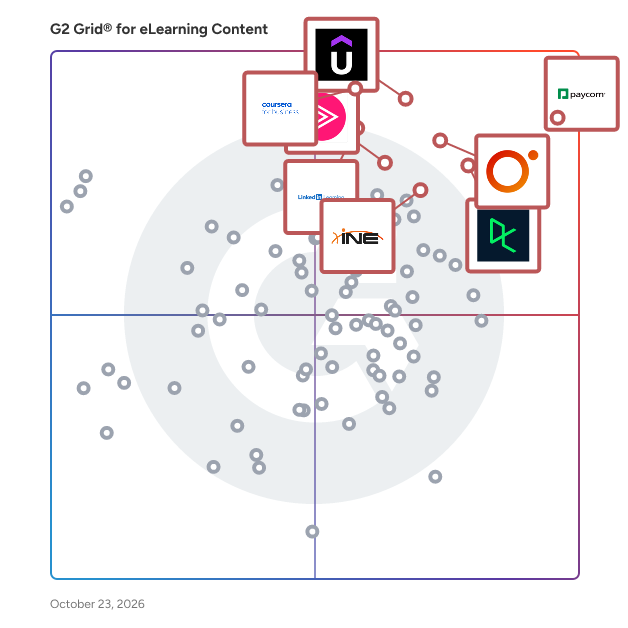
eLearning content platforms offer businesses and professionals access to off-the-shelf content libraries, including cloud-based courses, lessons, videos, and books. Subject matter may include business skills, leadership, IT, and employee health and safety (EHS) compliance training, typically via subscription or enterprise licensing.
Core capabilities of eLearning content software
To qualify for inclusion in the eLearning Content Platforms category, a product must:
- Provide businesses and professionals with a large content library
- Include access across a variety of devices, including web and mobile
- Offer a learning management system (LMS) for purchase or provide integration options
- Provide relevant and regularly updated content
Common use cases for eLearning content software
Learning and development teams use eLearning content platforms to upskill employees and meet compliance training requirements under local and national HR laws. Common use cases include:
- Delivering compliance and safety training across distributed teams
- Supporting employee onboarding and skills development programs
- Providing certifications and course completions for professional development
How eLearning content software differs from other tools
Some eLearning content systems also offer corporate learning management systems (LMS) or LMS integrations to help manage employee training progress alongside their content libraries. Providers may also integrate with training management systems to support broader training operations.
Insights from G2 on eLearning content software
Based on category trends on G2, the breadth of the content library and multi-device accessibility stand out as core strengths. The availability of LMS integrations and up-to-date course content stands out as a deciding factor in platform selection.