Best Cloud Infrastructure Automation Software - Page 2

How Many Cloud Infrastructure Automation Software Products Does G2 Track?

Total Products under this Category: 116

Category Stats (Aug 2026)

  • Average Rating: 4.57/5 The average rating of products in this category, based on all submitted ratings
  • Top Trending Product: Progress Chef (+1.95%) - Among all products in this category, Progress Chef recorded the largest rating increase compared to last month

Last updated: August 06, 2026

How Does G2 Rank Cloud Infrastructure Automation Software Products?

Why You Can Trust G2's Software Rankings:

  • 30 Analysts and Data Experts
  • 6,500+ Authentic Reviews
  • 116+ Products
  • Unbiased Rankings

G2's software rankings are built on verified user reviews, rigorous moderation, and a consistent research methodology maintained by a team of analysts and data experts. Each product is measured using the same transparent criteria, with no paid placement or vendor influence. While reviews reflect real user experiences, which can be subjective, they offer valuable insight into how software performs in the hands of professionals. Together, these inputs power the G2 Score, a standardized way to compare tools within every category.

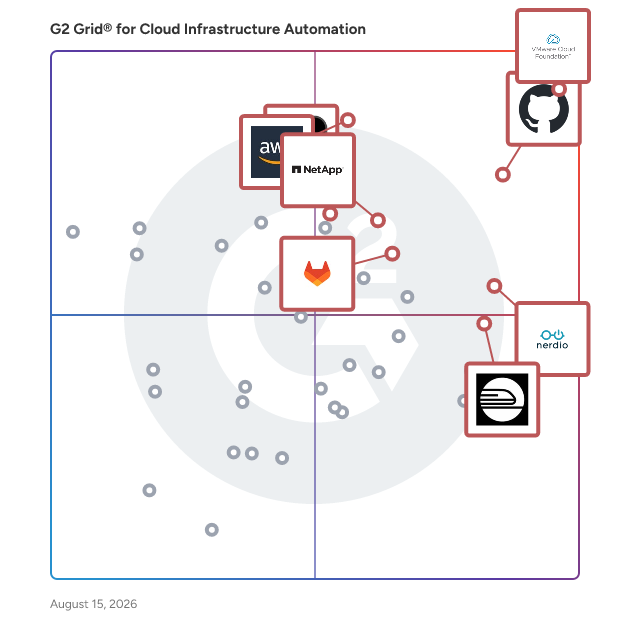
G2 Grid® for Cloud Infrastructure Automation Software

G2 Grid® for Cloud Infrastructure Automation Software plotting products by satisfaction and market presence

Highlighted products: VMware Cloud Foundation (VCF), GitHub, AWS CloudFormation, Nerdio Manager, Railway, NetApp ONTAP Data Management Software, GitLab, and Red Hat Ansible Automation Platform.

Underlying data: [Grid® JSON](https://www.g2.com/categories/cloud-infrastructure-automation/grids.json?focus%5B%5D=vmware-cloud-foundation-vcf&focus%5B%5D=github&focus%5B%5D=aws-aws-cloudformation&focus%5B%5D=nerdio-manager&focus%5B%5D=railway&focus%5B%5D=netapp-ontap-data-management-software&focus%5B%5D=gitlab&focus%5B%5D=red-hat-ansible-automation-platform)

Sponsored

JFrog

JFrog Ltd. (Nasdaq: FROG), the creators of the unified DevOps, DevSecOps, DevGovOps and MLOps platform, is on a mission to create a world of software delivered without friction from development to production. Driven by a “Liquid Software” vision to keep software continuously flowing, secure, and always up to date, the JFrog Platform serves as the definitive software supply chain system of record. It is uniquely engineered to power organizations as they build, manage, and distribute trusted software with unprecedented speed, security, and scale across hybrid and multi-cloud environments. As software engineering evolves in the AI era, JFrog’s newest offerings address the industry's most pressing trend: the rise of agentic software development and the hidden security risks of "Shadow AI." In response to threat actors increasingly targeting developer workflows including a massive surge in malicious open-source AI models and infected packages; JFrog has expanded its platform capabilities to deliver absolute end-to-end visibility and automated compliance. Key new innovations include the JFrog AI Catalog, which enables organizations to centralize, govern, and control the lifecycle of AI models approved for enterprise use. To secure autonomous coding environments, JFrog introduced the Universal MCP Registry and the Agent Skills Registry (developed alongside NVIDIA). These new solutions establish the industry’s first enterprise-grade trust layer to safely manage and store AI agent skills, monitor connections, and instantly block unsafe developer tools or malicious coding extensions right where developers work. Furthermore, the integration of advanced DevGovOps and Runtime Security tools allows teams to replace slow, manual compliance audits with continuous, background policy enforcement. By shifting security left directly into the binary pipeline, JFrog ensures that the volume of AI-assisted code does not outpace an organization's ability to verify its safety. Today, millions of users and approximately 6,600 organizations worldwide, including a majority of the Fortune 100, depend on the universal JFrog Platform to eliminate point-solution fatigue, bridge the governance gap, and securely embrace digital transformation. Learn more at www.jfrog.com or follow us on X @JFrog.

Visit website

kestra

Kestra is an open-source workflow orchestration and automation platform that enables organizations to define, schedule, and monitor both event-driven and time-based workflows. It brings Infrastructure-as-Code principles to orchestration, allowing teams to manage processes through YAML definitions or an intuitive user interface. Kestra is designed for data engineers, developers, and DevOps teams who need to automate data pipelines, integrate distributed systems, or coordinate multi-step workflows across hybrid or cloud environments. Core Capabilities Declarative orchestration: Workflows are defined in YAML and automatically synchronized with changes made through the UI or API. Event-driven and scheduled triggers: Supports automation initiated by timers or external events such as file arrivals, API calls, or message queues (Kafka, Redis, Pulsar, AMQP, MQTT, NATS, AWS SQS, Google Pub/Sub, Azure Event Hubs). Visual workflow design: Build and modify workflows directly in the browser with syntax validation, auto-completion, and real-time DAG visualization. Scalability and resilience: Distributed architecture provides high availability, fault tolerance, retries, and backfill management for millions of executions. Plugin ecosystem: Hundreds of integrations for databases, APIs, cloud platforms, and languages including Python, Node.js, Go, R, and Shell. Key Benefits Unified orchestration layer: Manage scheduled and event-based workflows in one system instead of maintaining separate schedulers or automation tools. Version control integration: Workflows can be stored in Git repositories, supporting CI/CD pipelines and Terraform for Infrastructure-as-Code management. Multi-environment flexibility: Deploy locally, in containers, or across Kubernetes clusters and major cloud providers (AWS, GCP, Azure). Observability and notifications: Track executions, manage inputs and outputs, and send alerts via Slack, PagerDuty, or email. Extensibility: Users can develop custom plugins to extend functionality and standardize internal operations. Typical Use Cases Data orchestration: Build and schedule ETL pipelines, batch or streaming data processes, and big-data workflows with tools like Spark and BigQuery. AI and ML automation: Coordinate model training, evaluation, and deployment workflows. Infrastructure automation: Replace cron jobs or legacy schedulers with declarative, event-driven execution. Microservice coordination: Connect APIs and services into reliable end-to-end processes. Getting Started Kestra can be launched locally in one command using Docker or deployed in production environments with Docker Compose, Kubernetes, or AWS CloudFormation. Users can create and run their first “Hello World” workflow in minutes via the built-in editor or API. Community and Support Kestra is distributed under the Apache 2.0 License and maintained by an active open-source community.

Average Rating: 4.6/5.0

Total Reviews: 24

How Do G2 Users Rate kestra?

  • Ease of Admin: 10.0/10 (Category avg: 8.7/10)
  • Quality of Support: 9.8/10 (Category avg: 9.0/10)
  • Has the product been a good partner in doing business?: 10.0/10 (Category avg: 9.0/10)
  • Ease of Use: 9.6/10 (Category avg: 8.8/10)

Who Is the Company Behind kestra?

Who Uses This Product?

  • Top Industries: Computer Software
  • Company Size: 83% Small, 8% Medium

What Do G2 Reviewers Say About kestra?

AI-generated summary from verified user reviews

Pros
  • Users value the centralized management features of Kestra, enhancing collaboration and streamlining workflow integration across teams.
  • Users commend Kestra for its responsive support, excellent documentation, and role in enhancing collaboration and efficiency.
  • Users value the customization options in Kestra, enhancing collaboration and integration within diverse data workflows.
  • Users commend Kestra for its exceptional data security, enhancing collaboration and reliability in data and automation pipelines.
  • Users praise the excellent documentation of Kestra, which supports easy growth and aids in efficient tool usage.
Cons
  • Users find the alert overload in Kestra's UI overwhelming and hard to filter effectively.
  • Users find the UI overwhelming, particularly in the Logging/Task Runs menu, which complicates navigation and filtering.

What Are Recent G2 Reviews of kestra?

Encore

Encore helps you scale your engineering, not your DevOps, by providing a complete toolset for local application development, CI/CD, cloud infrastructure automation, and production monitoring. By automating infrastructure and DevOps in your cloud on AWS and GCP, Encore's average user reported benefits are: - 137% faster time to market for new features - 93% less ongoing DevOps work - $100k+ annual savings in reduced DevOps overhead and cloud costs Key features include: - One command to run complex distributed systems locally - Service Catalog and automatic API Documentation - Distributed Tracing, logging, and metrics - Preview Environments per Pull Request - Automated deployments and infrastructure in your cloud on AWS / GCP

Average Rating: 4.6/5.0

Total Reviews: 33

How Do G2 Users Rate Encore?

  • Ease of Admin: 8.8/10 (Category avg: 8.7/10)
  • Quality of Support: 9.0/10 (Category avg: 9.0/10)
  • Has the product been a good partner in doing business?: 8.3/10 (Category avg: 9.0/10)
  • Ease of Use: 9.2/10 (Category avg: 8.8/10)

Who Is the Company Behind Encore?

  • Seller: Encore
  • Year Founded: 2020
  • HQ Location: Stockholm, Stockholm County, Sweden
  • LinkedIn® Page: www.linkedin.com
    20 employees on LinkedIn®

Who Uses This Product?

  • Top Industries: Computer Software
  • Company Size: 55% Small, 12% Medium

What Do G2 Reviewers Say About Encore?

AI-generated summary from verified user reviews

Pros
  • Users appreciate the cloud-first nature of Encore, enabling quick development and seamless sharing of applications.
  • Users appreciate the ease of use in Encore, finding the setup quick and the development process streamlined.
  • Users praise the fast setup and API responses in Encore, enabling rapid development without complexity.
  • Users find the setup ease of Encore exceptional, facilitating a smooth development and deployment experience.
  • Users value the automation efficiency of Encore, simplifying local development and deployment processes seamlessly.
Cons
  • Users find missing features in Encore, requiring custom solutions and workarounds for advanced use cases and integrations.
  • Users find the complex setup of Encore challenging, especially when customizing beyond its opinionated framework.
  • Users experience integration issues with Encore, facing limitations in database support and advanced feature functionality.
  • Users find the poor documentation challenging, especially for advanced customizations and deployment configuration.
  • Users find the access restrictions of Encore limiting, wishing for more flexibility and improved community support.

What Are Recent G2 Reviews of Encore?

Google Cloud Infrastructure Manager

Google Cloud Infrastructure Manager is a fully managed service that automates the deployment and management of Google Cloud resources using Terraform configurations. By integrating Terraform's infrastructure as code (IaC) capabilities directly into the Google Cloud ecosystem, Infrastructure Manager enables users to define, provision, and manage cloud infrastructure in a declarative and consistent manner. Key Features and Functionality: - Managed Terraform Service: Infrastructure Manager handles the execution of Terraform configurations, including state management and locking, eliminating the need for users to maintain separate toolchains or manage remote state backends. - Preview Deployments: Users can preview infrastructure changes before applying them, allowing for validation and ensuring that deployments align with expectations. - Quota Validation: The service proactively checks for quota limits, preventing deployments that would exceed project quotas and thereby reducing the risk of deployment failures. - GitOps Integration: Infrastructure Manager supports integration with Git repositories, enabling automated deployments triggered by changes in the repository, which facilitates continuous integration and delivery workflows. - Native Google Cloud Integration: The service is deeply integrated with Google Cloud's ecosystem, providing seamless access to Identity and Access Management (IAM), logging, monitoring, and security features without additional configuration. Primary Value and Problem Solved: Infrastructure Manager streamlines the process of managing Google Cloud infrastructure by providing a native, managed Terraform service. It reduces operational overhead by automating state management and deployment processes, enhances reliability through preview and validation features, and ensures consistency across environments. By integrating with existing Google Cloud services, it offers a cohesive and efficient solution for infrastructure management, enabling teams to focus on delivering value rather than managing deployment complexities.

Average Rating: 4.2/5.0

Total Reviews: 11

How Do G2 Users Rate Google Cloud Infrastructure Manager?

  • Ease of Admin: 8.6/10 (Category avg: 8.7/10)
  • Quality of Support: 9.2/10 (Category avg: 9.0/10)
  • Has the product been a good partner in doing business?: 8.1/10 (Category avg: 9.0/10)
  • Ease of Use: 7.7/10 (Category avg: 8.8/10)

Who Is the Company Behind Google Cloud Infrastructure Manager?

  • Seller: Google
  • Year Founded: 1998
  • HQ Location: Mountain View, CA
  • Twitter: @google
    31,899,995 Twitter followers
  • LinkedIn® Page: www.linkedin.com
    341,888 employees on LinkedIn®
  • Ownership: NASDAQ:GOOG

Who Uses This Product?

  • Company Size: 55% Small, 27% Medium

What Do G2 Reviewers Say About Google Cloud Infrastructure Manager?

AI-generated summary from verified user reviews

Pros
  • Users value the automation efficiency of Google Cloud Infrastructure Manager, enhancing operations and minimizing manual errors.
  • Users appreciate the efficiency of Google Cloud Infrastructure Manager, simplifying resource management and reducing errors significantly.

What Are Recent G2 Reviews of Google Cloud Infrastructure Manager?

SUSE Multi-Linux Manager

True open source infrastructure management solution designed to simplify and secure your entire mixed Linux environment — at the core, on the edge or in the cloud(s). Maintain infrastructure security & compliance at any scale — from 10 to 1 million clients — from a single console. Manual or inconsistent patch management is a leading cause of cyber-attacks. SUSE Manager helps to secure your entire mixed Linux environments – from automated patch management to centralized monitoring and management. Automate infrastructure security & compliance Secure your infrastructure with automated patch and configuration management including auto-remediation. Validate your system security against SCAP protocols and perform audit scans on client systems through openSCAP. Ensure system compliance with internal and external requirements. Centralized control and reporting at any scale Scale out your infrastructure and centralize reporting for up to 1 million Linux clients using SUSE Manager’s Hub architecture. Use Prometheus to monitor real-time data and Grafana for visual dashboards. Simplify and automate deployment with the new rearchitected proxy for resource constrained environments. Manage any Linux, anywhere One console to manage and monitor all of your Linux distros wherever thy are located. One-click automation for provisioning, patching, and configuration, which leads to faster, consistent and repeatable server employments. Easy, in-place migration for SUSE Solutions, including openSUSE to SLE, service pack migrations and major version upgrades.

Average Rating: 4.6/5.0

Total Reviews: 47

How Do G2 Users Rate SUSE Multi-Linux Manager?

  • Ease of Admin: 8.2/10 (Category avg: 8.7/10)
  • Quality of Support: 9.1/10 (Category avg: 9.0/10)
  • Has the product been a good partner in doing business?: 9.0/10 (Category avg: 9.0/10)
  • Ease of Use: 8.5/10 (Category avg: 8.8/10)

Who Is the Company Behind SUSE Multi-Linux Manager?

  • Seller: SUSE
  • Company Website:
  • Year Founded: 1992
  • HQ Location: Nürnberg, DE
  • Twitter: @SUSE
    64,779 Twitter followers
  • LinkedIn® Page: www.linkedin.com
    2,729 employees on LinkedIn®

Who Uses This Product?

  • Top Industries: Information Technology and Services
  • Company Size: 45% Large, 31% Medium

What Do G2 Reviewers Say About SUSE Multi-Linux Manager?

AI-generated summary from verified user reviews

Pros
  • Users appreciate the ease of use of SUSE Multi-Linux Manager for central management of diverse Linux distributions.
  • Users value the automation capabilities of SUSE Multi-Linux Manager, greatly enhancing efficiency in managing Linux infrastructures.
  • Users find the efficiency of patch management in SUSE Multi-Linux Manager invaluable for managing multiple Linux systems.
  • Users value the centralized monitoring features of SUSE Multi-Linux Manager, enhancing efficiency across diverse Linux systems.
  • Users highly value the reliability of SUSE Multi-Linux Manager for seamless, centralized management across diverse Linux environments.
Cons
  • Users are frustrated by the missing add-on support, limiting customization and integration capabilities in SUSE Multi-Linux Manager.
  • Users face a challenging learning curve with SUSE Multi-Linux Manager, requiring significant time and expertise for effective usage.
  • Users find the complex setup of SUSE Multi-Linux Manager time-consuming, especially without centralized Linux management experience.
  • Users find the learning difficulty of SUSE Multi-Linux Manager challenging, particularly for those new to centralized Linux management.
  • Users find the complexity of SUSE Multi-Linux Manager daunting, especially during initial setup and major upgrades.

What Are Recent G2 Reviews of SUSE Multi-Linux Manager?

What Are G2 Users Discussing About SUSE Multi-Linux Manager?

JFrog

JFrog Ltd. (Nasdaq: FROG), the creators of the unified DevOps, DevSecOps, DevGovOps and MLOps platform, is on a mission to create a world of software delivered without friction from development to production. Driven by a “Liquid Software” vision to keep software continuously flowing, secure, and always up to date, the JFrog Platform serves as the definitive software supply chain system of record. It is uniquely engineered to power organizations as they build, manage, and distribute trusted software with unprecedented speed, security, and scale across hybrid and multi-cloud environments. As software engineering evolves in the AI era, JFrog’s newest offerings address the industry's most pressing trend: the rise of agentic software development and the hidden security risks of "Shadow AI." In response to threat actors increasingly targeting developer workflows including a massive surge in malicious open-source AI models and infected packages; JFrog has expanded its platform capabilities to deliver absolute end-to-end visibility and automated compliance. Key new innovations include the JFrog AI Catalog, which enables organizations to centralize, govern, and control the lifecycle of AI models approved for enterprise use. To secure autonomous coding environments, JFrog introduced the Universal MCP Registry and the Agent Skills Registry (developed alongside NVIDIA). These new solutions establish the industry’s first enterprise-grade trust layer to safely manage and store AI agent skills, monitor connections, and instantly block unsafe developer tools or malicious coding extensions right where developers work. Furthermore, the integration of advanced DevGovOps and Runtime Security tools allows teams to replace slow, manual compliance audits with continuous, background policy enforcement. By shifting security left directly into the binary pipeline, JFrog ensures that the volume of AI-assisted code does not outpace an organization's ability to verify its safety. Today, millions of users and approximately 6,600 organizations worldwide, including a majority of the Fortune 100, depend on the universal JFrog Platform to eliminate point-solution fatigue, bridge the governance gap, and securely embrace digital transformation. Learn more at www.jfrog.com or follow us on X @JFrog.

Average Rating: 4.2/5.0

Total Reviews: 154

How Do G2 Users Rate JFrog?

  • Ease of Admin: 8.4/10 (Category avg: 8.7/10)
  • Quality of Support: 8.4/10 (Category avg: 9.0/10)
  • Has the product been a good partner in doing business?: 8.5/10 (Category avg: 9.0/10)
  • Ease of Use: 8.1/10 (Category avg: 8.8/10)

Who Is the Company Behind JFrog?

  • Seller: JFrog Ltd
  • Company Website:
  • Year Founded: 2008
  • HQ Location: Sunnyvale, CA
  • Twitter: @jfrog
    23,186 Twitter followers
  • LinkedIn® Page: www.linkedin.com
    2,364 employees on LinkedIn®

Who Uses This Product?

  • Who Uses This: Software Engineer, DevOps Engineer
  • Top Industries: Information Technology and Services, Computer Software
  • Company Size: 50% Large, 31% Medium

What Do G2 Reviewers Say About JFrog?

AI-generated summary from verified user reviews

Pros
  • Users appreciate the comprehensive integration and multi-format support of JFrog, streamlining their DevOps processes effectively.
  • Users appreciate JFrog's centralized artifact management, enhancing efficiency in storing and tracking components across environments.
  • Users value the seamless deployment integration of JFrog, enhancing CI/CD pipelines and security management effectively.
  • Users value the seamless integrations of JFrog, enhancing their CI/CD processes across various package formats.
  • Users value the easy integrations of JFrog with various tools, enhancing their CI/CD workflows seamlessly.
Cons
  • Users find JFrog's platform to be overly complex, requiring significant training to navigate its extensive features effectively.
  • Users find JFrog to be expensive, with costs posing challenges for smaller teams and individual developers.
  • Users often face a steep learning curve with JFrog, requiring significant time to master its complexity.
  • Users find the difficult learning curve of JFrog requires extensive training to navigate its complex features effectively.
  • Users find JFrog to have a steep learning curve, requiring significant time and effort to reach proficiency.

What Are Recent G2 Reviews of JFrog?

What Are G2 Users Discussing About JFrog?

Qovery

Qovery is the Agentic Infrastructure Platform. It sits between AI coding agents and production infrastructure: agents express intent, Qovery executes it as deterministic, policy-checked, fully audited operations on Kubernetes in the customer's own cloud. Founded in 2020 in Paris, Qovery serves 200+ companies. Learn more at www.qovery.com

Average Rating: 4.7/5.0

Total Reviews: 69

How Do G2 Users Rate Qovery?

  • Ease of Admin: 8.8/10 (Category avg: 8.7/10)
  • Quality of Support: 9.3/10 (Category avg: 9.0/10)
  • Has the product been a good partner in doing business?: 9.4/10 (Category avg: 9.0/10)
  • Ease of Use: 9.3/10 (Category avg: 8.8/10)

Who Is the Company Behind Qovery?

  • Seller: Qovery
  • Year Founded: 2020
  • HQ Location: San Francisco, California
  • Twitter: @Qovery_
    3,123 Twitter followers
  • LinkedIn® Page: www.linkedin.com
    35 employees on LinkedIn®

Who Uses This Product?

  • Who Uses This: CTO
  • Top Industries: Computer Software, Information Technology and Services
  • Company Size: 83% Small, 11% Medium

What Do G2 Reviewers Say About Qovery?

AI-generated summary from verified user reviews

Pros
  • Users value the ease of use of Qovery, praising its friendly UI and quick deployment capabilities.
  • Users value the simplicity of deploying applications with Qovery, enhancing efficiency and speed for developers.
  • Users love the deployment ease of Qovery, significantly reducing DevOps complexities and saving valuable time.
  • Users value the ease of team collaboration with Qovery's intuitive UI and expert support for efficient deployments.
  • Users praise the friendly and responsive customer support of Qovery, enhancing their overall experience significantly.
Cons
  • Users find the pricing expensive, especially for startups, creating uncertainty in budgeting and planning.
  • Users find the pricing issues frustrating due to frequent increases, creating uncertainty for budgeting and long-term planning.
  • Users note the slow performance of Qovery, particularly regarding extended build and deployment times compared to previous platforms.
  • Users experience longer build times on Qovery compared to previous platforms, impacting their workflow efficiency.
  • Users find the complex setup challenging initially, but helpful documentation and support ease the process.

What Are Recent G2 Reviews of Qovery?

What Are G2 Users Discussing About Qovery?

JHipster

JHipster is a development platform to generate, develop and deploy Spring Boot + Angular Web applications and Spring microservices.

Average Rating: 4.4/5.0

Total Reviews: 83

How Do G2 Users Rate JHipster?

  • Ease of Admin: 7.5/10 (Category avg: 8.7/10)
  • Quality of Support: 7.9/10 (Category avg: 9.0/10)
  • Has the product been a good partner in doing business?: 7.5/10 (Category avg: 9.0/10)
  • Ease of Use: 8.7/10 (Category avg: 8.8/10)

Who Is the Company Behind JHipster?

  • Seller: JHipster
  • Year Founded: 2013
  • HQ Location: Paris, FR
  • Twitter: @jhipster
    18,383 Twitter followers
  • LinkedIn® Page: www.linkedin.com
    12 employees on LinkedIn®

Who Uses This Product?

  • Who Uses This: Java Developer, Software Engineer
  • Top Industries: Computer Software, Information Technology and Services
  • Company Size: 63% Small, 23% Medium

What Are Recent G2 Reviews of JHipster?

What Are G2 Users Discussing About JHipster?

Firefly Cloud Infrastructure Automation

Firefly is a cloud infrastructure automation platform that empowers Platform and DevOps teams to simplify, secure, and scale their cloud operations. Built to address the challenges of managing sprawling, dynamic cloud environments, Firefly enables seamless automation, Infrastructure-as-Code (IaC) adoption, and governance. By combining continuous cloud scanning, AI-assisted remediation, and orchestration, Firefly provides unified visibility and control across your entire cloud footprint. What sets Firefly apart is its ability to bridge the gap between live cloud environments and IaC, ensuring your infrastructure is always optimized, compliant, and in sync. From scaling startups to global enterprises like Paramount, Cisco and 2K Games, Firefly helps organizations finally uncomplicate their cloud while accelerating cloud innovation and maintaining security and performance at scale.

Average Rating: 4.8/5.0

Total Reviews: 12

How Do G2 Users Rate Firefly Cloud Infrastructure Automation?

  • Ease of Admin: 8.0/10 (Category avg: 8.7/10)
  • Quality of Support: 9.7/10 (Category avg: 9.0/10)
  • Has the product been a good partner in doing business?: 10.0/10 (Category avg: 9.0/10)
  • Ease of Use: 9.1/10 (Category avg: 8.8/10)

Who Is the Company Behind Firefly Cloud Infrastructure Automation?

  • Seller: Firefly
  • Year Founded: 2021
  • HQ Location: Tel Aviv, Israel
  • LinkedIn® Page: www.linkedin.com
    115 employees on LinkedIn®

Who Uses This Product?

  • Company Size: 42% Small, 42% Medium

What Do G2 Reviewers Say About Firefly Cloud Infrastructure Automation?

AI-generated summary from verified user reviews

Pros
  • Users appreciate the ease of use of Firefly Cloud Infrastructure Automation, streamlining cloud resource management and organization.
  • Users appreciate the automation efficiency of Firefly Cloud Infrastructure Automation, streamlining cloud management and accelerating deployment.
  • Users value the easy integrations with existing tools, enhancing efficiency and speeding up deployment without errors.
  • Users value the efficiency Firefly brings, significantly improving cloud deployment speed and reducing errors.
  • Users benefit from the efficiency and simplicity of Firefly Cloud Infrastructure Automation, streamlining cloud resource management and security.
Cons
  • Users find the difficult learning process of Firefly Cloud Infrastructure Automation challenging, particularly for newcomers and small teams.
  • Users find Firefly Cloud Infrastructure Automation to be expensive, especially for smaller teams with budget constraints.
  • Users find the learning difficulty with Firefly Cloud Infrastructure Automation challenging, especially for teams unfamiliar with IaC.
  • Users find the pricing issues of Firefly Cloud Infrastructure Automation problematic, especially for small teams and startups.
  • Users find the steep learning curve of Firefly Cloud Infrastructure Automation challenging, particularly for newcomers to IaC.

What Are Recent G2 Reviews of Firefly Cloud Infrastructure Automation?

Azure Automation

Azure Automation delivers a cloud-based automation and configuration service that provides consistent management across your Azure and non-Azure environments. It consists of process automation, update management, and configuration features.

Average Rating: 4.5/5.0

Total Reviews: 32

How Do G2 Users Rate Azure Automation?

  • Ease of Admin: 8.3/10 (Category avg: 8.7/10)
  • Quality of Support: 8.5/10 (Category avg: 9.0/10)
  • Has the product been a good partner in doing business?: 8.0/10 (Category avg: 9.0/10)
  • Ease of Use: 8.7/10 (Category avg: 8.8/10)

Who Is the Company Behind Azure Automation?

  • Seller: Microsoft
  • Year Founded: 1975
  • HQ Location: Redmond, Washington
  • Twitter: @microsoft
    13,091,739 Twitter followers
  • LinkedIn® Page: www.linkedin.com
    231,632 employees on LinkedIn®
  • Ownership: MSFT

Who Uses This Product?

  • Top Industries: Computer Software, Information Technology and Services
  • Company Size: 55% Large, 31% Small

What Are Recent G2 Reviews of Azure Automation?

What Are G2 Users Discussing About Azure Automation?

Cloudify

Bridging the Gap between Applications & Cloud Environments Turn clouds, tools, and technologies into self-managed environments Cloudify provides infrastructure automation using ‘Environment as a Service’ technology to deploy and continuously manage any cloud, private data center, or Kubernetes service from one central point while leveraging existing toolchains; Terraform, Ansible, and more. Use Cloudify to import existing automation templates and scripts and automatically convert them into certified environments. Manage them using the Cloudify console or export these environments to ServiceNow and enable users to deploy, continuously manage and maintain them as part of approval workflows. Key Values: Speed up deployments of your Test/Dev/Production environments. Manage customers' heterogeneous cloud environments. Enable Continuous Updates (Day-2) for your Production environments. A clean API to work on top of all your tools that can easily be used within ServiceNow. Manage Kubernetes clusters at scale. Key Features: Application Configuration Management - Manage application configuration in a scalable and reliable way Infrastructure Orchestration - Integrate with your existing and future infrastructure Environment Management - Enable developers to create new environments whenever needed Deployment Management - Implement a Continuous Delivery or Continuous Deployment (CD) approach Role-Based Access Control - Manage who can do what in a scalable way Self-service Catalog (via ITSM) - Enable users to deploy, continuously manage and maintain environments as part of the approval workflow About Cloudify: Founded in 2016, Cloudify is an open-source DevOps automation platform delivering an 'Environment as a Service' technology that packages infrastructure, technologies, and existing automation tools into certified blueprints. Cloudify is designed to manage heterogeneous cloud environments at scale and to bridge the gap between DevOps and IT Service Management processes. Integration with ServiceNow ITOM: The deep integration of Cloudify with Now Platform components (catalog, flow manager, etc.) enables developers to manage their cloud environments in non-production environments while enabling DevOps teams to dramatically accelerate infrastructure provisioning.

Average Rating: 4.1/5.0

Total Reviews: 18

How Do G2 Users Rate Cloudify?

  • Ease of Admin: 7.3/10 (Category avg: 8.7/10)
  • Quality of Support: 7.9/10 (Category avg: 9.0/10)
  • Has the product been a good partner in doing business?: 8.3/10 (Category avg: 9.0/10)
  • Ease of Use: 7.7/10 (Category avg: 8.8/10)

Who Is the Company Behind Cloudify?

  • Seller: Dell Technologies
  • Year Founded: 1984
  • HQ Location: Round Rock, TX
  • Twitter: @Dell
    799,086 Twitter followers
  • LinkedIn® Page: www.linkedin.com
    128,424 employees on LinkedIn®
  • Ownership: NYSE: DELL

Who Uses This Product?

  • Top Industries: Telecommunications
  • Company Size: 47% Small, 32% Medium

What Are Recent G2 Reviews of Cloudify?

What Are G2 Users Discussing About Cloudify?

DuploCloud

DuploCloud is a low-code/no-code platform designed to simplify DevOps and Infrastructure-as-Code (IaC) processes, enabling users to automate operational workflows and maintain compliance standards without the need for extensive coding. This solution is particularly beneficial for application developers who wish to concentrate on building and deploying applications rather than getting bogged down by the complexities of infrastructure management. Targeted at organizations of all sizes, DuploCloud is ideal for development teams that seek to streamline their operations and enhance productivity. The platform provides a user-friendly interface that empowers developers to implement infrastructure automation and cloud security measures effectively. By reducing the time and effort required to manage cloud resources, DuploCloud minimizes the risk of errors that can arise from manual coding, allowing teams to focus on their core development tasks. Key features of DuploCloud include its intuitive low-code/no-code interface, which allows users to define infrastructure requirements and compliance needs through simple visual workflows. This eliminates the necessity of writing extensive scripts, making it accessible to those with limited coding experience. Furthermore, the platform integrates seamlessly with existing cloud environments, enabling users to leverage their current infrastructure while enhancing security and compliance measures. This flexibility ensures that organizations can adopt DuploCloud without overhauling their existing systems. The benefits of using DuploCloud extend beyond ease of use. By automating operational workflows, organizations can achieve faster deployment times and improved consistency across their cloud environments. The platform also incorporates built-in compliance checks and security features, ensuring that applications meet industry standards from the outset. This proactive approach to cloud security helps organizations mitigate risks and maintain regulatory compliance more effectively, which is crucial in today’s fast-paced digital landscape. DuploCloud distinguishes itself in the realm of DevOps and IaC solutions by offering a comprehensive, user-friendly platform that democratizes access to cloud infrastructure management. Its focus on low-code/no-code automation not only enhances operational efficiency but also empowers developers to prioritize innovation and application development. By streamlining processes and reducing the complexity of infrastructure management, DuploCloud ultimately drives business success and fosters an environment where creativity and productivity can thrive.

Average Rating: 4.6/5.0

Total Reviews: 40

How Do G2 Users Rate DuploCloud?

  • Ease of Admin: 8.9/10 (Category avg: 8.7/10)
  • Quality of Support: 9.4/10 (Category avg: 9.0/10)
  • Has the product been a good partner in doing business?: 9.7/10 (Category avg: 9.0/10)
  • Ease of Use: 8.6/10 (Category avg: 8.8/10)

Who Is the Company Behind DuploCloud?

  • Seller: DuploCloud
  • Company Website:
  • Year Founded: 2018
  • HQ Location: San Jose, California
  • Twitter: @DuploCloud
    151 Twitter followers
  • LinkedIn® Page: www.linkedin.com
    164 employees on LinkedIn®

Who Uses This Product?

  • Who Uses This: CTO
  • Top Industries: Computer Software
  • Company Size: 63% Small, 30% Medium

What Do G2 Reviewers Say About DuploCloud?

AI-generated summary from verified user reviews

Pros
  • Users value the self-service deployment feature of DuploCloud, significantly enhancing productivity and operational efficiency.
  • Users find easy deployment with DuploCloud enhances productivity, simplifies management, and streamlines CI/CD processes efficiently.
  • Users praise DuploCloud for its efficiency, significantly boosting developer productivity with streamlined deployments and automated CI/CD processes.
  • Users commend the reliability of DuploCloud, ensuring safe, compliant, and efficient self-service deployments for developers.
  • Users value the enhanced security with DuploCloud, ensuring safe and compliant deployments while boosting developer productivity.
Cons
  • Users find a slight integration challenge with legacy systems, needing extra effort during the migration process.
  • Users find the platform requires a bit of a learning curve to fully utilize its capabilities and migrate data.
  • Users find the platform has a learning curve that can be challenging, especially for complete functionality.
  • Users find the UI interface outdated, which can detract from the overall user experience despite its functionality.
  • Users find the UI interface outdated, which detracts from their overall experience despite its functional capabilities.

What Are Recent G2 Reviews of DuploCloud?

What Are G2 Users Discussing About DuploCloud?

Azure Resource Manager

Azure Resource Manager (ARM) is Microsoft's deployment and management service for Azure, providing a unified layer to create, update, and delete resources within your Azure account. It enables users to manage their infrastructure through declarative templates, ensuring consistent and repeatable deployments across various environments. By organizing resources into groups, ARM simplifies monitoring, access control, and billing, offering a streamlined approach to resource management. Key Features and Functionality: - Declarative Resource Deployment: Utilize ARM templates to define and deploy Azure resources in a consistent and repeatable manner, facilitating infrastructure as code practices. - Resource Grouping: Organize related resources into resource groups, allowing for collective management actions such as deployment, monitoring, and deletion. - Access Control: Implement role-based access control (RBAC) to manage permissions effectively, ensuring that only authorized users can perform specific actions on resources. - Tagging and Organization: Assign tags to resources for better categorization, aiding in cost management and operational oversight. - Consistent Management Layer: Interact with Azure resources through a consistent API, whether using the Azure portal, PowerShell, CLI, or REST APIs, ensuring uniformity across management tools. Primary Value and User Solutions: Azure Resource Manager addresses the complexities of cloud resource management by providing a centralized and consistent framework. It enhances operational efficiency by enabling infrastructure as code, which leads to faster deployments and easier scalability. The ability to group resources and apply access controls ensures better security and compliance. Additionally, ARM's tagging and organizational features simplify cost tracking and resource monitoring, empowering users to manage their Azure environments more effectively.

Average Rating: 4.2/5.0

Total Reviews: 35

How Do G2 Users Rate Azure Resource Manager?

  • Ease of Admin: 7.5/10 (Category avg: 8.7/10)
  • Quality of Support: 8.4/10 (Category avg: 9.0/10)
  • Has the product been a good partner in doing business?: 8.7/10 (Category avg: 9.0/10)
  • Ease of Use: 7.7/10 (Category avg: 8.8/10)

Who Is the Company Behind Azure Resource Manager?

  • Seller: Microsoft
  • Year Founded: 1975
  • HQ Location: Redmond, Washington
  • Twitter: @microsoft
    13,091,739 Twitter followers
  • LinkedIn® Page: www.linkedin.com
    231,632 employees on LinkedIn®
  • Ownership: MSFT

Who Uses This Product?

  • Top Industries: Information Technology and Services, Computer Software
  • Company Size: 48% Large, 28% Medium

What Do G2 Reviewers Say About Azure Resource Manager?

AI-generated summary from verified user reviews

Pros
  • Users value the automation efficiency of Azure Resource Manager, enhancing streamlined management across complex environments.
  • Users value the sophisticated code management capabilities of Azure Resource Manager, enabling efficient resource organization and integration.
  • Users value the seamless collaboration of Azure Resource Manager with Microsoft tools for efficient resource management.
  • Users appreciate the ease of use of Azure Resource Manager, benefiting from streamlined resource management and integration.
  • Users appreciate the efficient management capabilities of Azure Resource Manager, enhancing resource organization and scalability.
Cons
  • Users find automation issues in Azure Resource Manager, particularly regarding its complexity and limited flexibility compared to alternatives.
  • Users find the complexity of Azure Resource Manager overwhelming, especially for beginners and short projects.
  • Users find the complex setup of Azure Resource Manager daunting, especially beginners struggling with templates and resource management.
  • Users often face software bugs with Azure Resource Manager, leading to complexities and challenges during deployment management.
  • Users face storage limitations with Azure Resource Manager, impacting scalability and resource management in diverse projects.

What Are Recent G2 Reviews of Azure Resource Manager?

What Are G2 Users Discussing About Azure Resource Manager?

Pulumi

Pulumi lets you build, deploy, and manage cloud infrastructure in the programming languages you already use, on any cloud. Developers and platform engineers write infrastructure in TypeScript, Python, Go, C#, Java, or YAML, with the same loops, functions, classes, package managers, IDEs, and test frameworks they use everywhere else. No domain-specific language to learn. Application and platform teams work from one codebase and one workflow, whether they're shipping to public, private, hybrid, or multiple clouds. Pulumi combines open source IaC with a managed platform that handles state, secrets, governance, and self-service. Infrastructure as Code (open source) - Define infrastructure in TypeScript, Python, Go, C#, Java, or YAML, using the libraries, IDEs, and test frameworks from your language. - Provision across AWS, Azure, Google Cloud, Kubernetes, and DigitalOcean, plus 150+ providers like Datadog, New Relic, and Cloudflare. - Build containers, serverless functions, VMs, or static sites, and ship them through your existing CI/CD pipelines. - Package reusable patterns as Components and Templates, published to a private registry with built-in documentation, search, and semantic versioning. - Convert existing Terraform, AWS CloudFormation, Azure ARM, Kubernetes YAML, and Helm charts to Pulumi without touching live infrastructure. Pulumi Cloud (managed platform) - Get automatic, secure state management with concurrent state locking, full history, and rollback. Or manage state yourself in AWS S3, Azure Blob Storage, Google Cloud Storage, or the filesystem. - Pulumi ESC (Environments, Secrets & Configuration) centralizes configuration and secrets across environments, with native integrations for AWS KMS, Azure Key Vault, GCP KMS, HashiCorp Vault, 1Password, and OIDC for short-lived credentials. - Pulumi Deployments orchestrates deployments through Git Push to Deploy, click-to-deploy, REST API, and remote automation. - Pulumi Insights searches and analyzes managed and unmanaged resources across every cloud using natural-language queries. - Pulumi CrossGuard enforces security, compliance, and cost rules with 150+ built-in policies and automatic remediation. - Identity and access cover SAML/SSO and SCIM with Okta, Microsoft Entra ID, Active Directory, Google Workspace, GitHub, and GitLab, alongside role-based access control, audit logging, and a programmable REST API with webhooks. Pulumi is open source under Apache 2.0 and SOC 2 Type 2 compliant, with 3,500+ organizations and 350,000+ developers using it today.

Average Rating: 4.8/5.0

Total Reviews: 25

How Do G2 Users Rate Pulumi?

  • Ease of Admin: 10.0/10 (Category avg: 8.7/10)
  • Quality of Support: 9.2/10 (Category avg: 9.0/10)
  • Has the product been a good partner in doing business?: 9.4/10 (Category avg: 9.0/10)
  • Ease of Use: 9.1/10 (Category avg: 8.8/10)

Who Is the Company Behind Pulumi?

  • Seller: Pulumi
  • Year Founded: 2017
  • HQ Location: Seattle, WA
  • Twitter: @PulumiCorp
    16,922 Twitter followers
  • LinkedIn® Page: www.linkedin.com
    121 employees on LinkedIn®

Who Uses This Product?

  • Top Industries: Information Technology and Services
  • Company Size: 48% Small, 28% Large

What Do G2 Reviewers Say About Pulumi?

AI-generated summary from verified user reviews

Pros
  • Users value the ease of use of Pulumi, enabling seamless IaC development across multiple languages and cloud providers.
  • Users commend infrastructure automation with Pulumi, enabling seamless management across multiple cloud providers effortlessly.
  • Users value the automation efficiency of Pulumi, enabling quicker, safer infrastructure management across multiple cloud providers.
  • Users value the automation capabilities of Pulumi, enabling seamless testing and deployment across multiple cloud environments.
  • Users value the versatility of Pulumi, enabling seamless integration and management across multiple cloud providers and languages.
Cons
  • Users find the difficult learning curve challenging, particularly with documentation and specific implementation details in Pulumi.
  • Users find the learning curve steep for Pulumi, requiring adjustments to overcome initial cognitive challenges.
  • Users mention missing features as some SDKs lack full language support, but improvements are ongoing with community help.
  • Users find the insufficient documentation for Pulumi challenging, especially for newcomers and resource examples.
  • Users find the learning difficulty of Pulumi high, particularly due to its implementation of promises and limited examples.

What Are Recent G2 Reviews of Pulumi?

What Are G2 Users Discussing About Pulumi?
Resolve

Resolve is creating the future of agentic automation and orchestration for IT teams to drive resilience, agility, and innovation across the business. The Resolve platform gives IT and network operations teams time back to focus on strategic priorities with automation and orchestration capabilities that reduce alert noise by up to 80%, resolve incidents in minutes instead of hours, and scale operations efficiently. Forward-thinking global enterprises trust Resolve to drive operational efficiency and scale autonomous IT and network operations. Learn more at resolve.io.

Average Rating: 4.6/5.0

Total Reviews: 47

How Do G2 Users Rate Resolve?

  • Ease of Admin: 8.6/10 (Category avg: 8.7/10)
  • Quality of Support: 9.3/10 (Category avg: 9.0/10)
  • Has the product been a good partner in doing business?: 9.4/10 (Category avg: 9.0/10)
  • Ease of Use: 9.1/10 (Category avg: 8.8/10)

Who Is the Company Behind Resolve?

  • Seller: Resolve
  • Year Founded: 2014
  • HQ Location: Campbell, California
  • LinkedIn® Page: www.linkedin.com
    126 employees on LinkedIn®

Who Uses This Product?

  • Top Industries: Information Technology and Services, Telecommunications
  • Company Size: 55% Large, 34% Medium

What Do G2 Reviewers Say About Resolve?

AI-generated summary from verified user reviews

Pros
  • Users praise the unparalleled customer support of Resolve, highlighting prompt assistance and impactful user experience enhancements.
  • Users praise the exceptional efficiency of Resolve, significantly boosting productivity and streamlining issue resolution for teams.
  • Users highlight the significant productivity improvements achieved through seamless integration and quick issue resolution with Resolve.
  • Users value the scalability and reusable code blocks of Resolve, greatly enhancing project completion speed.
  • Users value the collaborative features of Resolve, enabling swift project completion and versatile code development.
Cons
  • Users face dependency issues with Resolve, particularly in managing permissions and integrating with other platforms.
  • Users face a learning curve with Espressive's features, requiring training and attention to maximize value.
  • Users struggle with access limitations that complicate permissions management across different environments in Resolve.
  • Users face challenges with access restrictions, making it difficult to manage permissions for different features effectively.
  • Users face challenges with permissions management, complicating access to specific features within Resolve's secure system.

What Are Recent G2 Reviews of Resolve?

What Are G2 Users Discussing About Resolve?

mogenius

mogenius is the AI-powered engine for modern cloud-native IT. The company helps organizations adopt and operate Kubernetes quickly, securely, and with clarity by automating cloud-native infrastructure built on open standards. With built-in best practices, intelligent automation, and secure self-service, mogenius reduces operational overhead and accelerates IT modernization. *mogenius is ISO 27001 certified and a Certified Kubernetes Product.*

Average Rating: 4.4/5.0

Total Reviews: 21

How Do G2 Users Rate mogenius?

  • Ease of Admin: 9.2/10 (Category avg: 8.7/10)
  • Quality of Support: 9.0/10 (Category avg: 9.0/10)
  • Has the product been a good partner in doing business?: 9.4/10 (Category avg: 9.0/10)
  • Ease of Use: 9.3/10 (Category avg: 8.8/10)

Who Is the Company Behind mogenius?

  • Seller: mogenius
  • HQ Location: Cologne, DE
  • Twitter: @mogenius
    208 Twitter followers
  • LinkedIn® Page: www.linkedin.com
    13 employees on LinkedIn®

Who Uses This Product?

  • Top Industries: Information Technology and Services
  • Company Size: 48% Small, 43% Medium

What Do G2 Reviewers Say About mogenius?

AI-generated summary from verified user reviews

Pros
  • Users appreciate the ease of deployment with Mogenius, streamlining processes and saving valuable time on projects.
  • Users value the deployment ease of mogenius, enjoying its intuitive interface and time-saving automation features.
  • Users appreciate the ease of use of mogenius, simplifying deployment and saving valuable time for projects.
  • Users value the easy deployment of mogenius, highlighting its intuitive interface and efficient automation for web applications.
  • Users appreciate the scalability of mogenius, efficiently managing traffic and automating server adjustments, saving valuable time.
Cons
  • Users find mogenius has limited features on the free tier, affecting bot usage and deployment speed.
  • Users face resource limitations on mogenius, affecting control, scalability, and deployment speed, especially on the free tier.
  • Users find the slow performance of Mogenius frustrating, especially during concurrent build pipelines and deployments.
  • Users face storage limitations on the free tier, affecting bot usage and deployment speeds on the mogenius platform.
  • Users find the pricing not competitive after the trial period, especially with many free alternatives available.

What Are Recent G2 Reviews of mogenius?

Adam Crivello
AC
Researched and written by Adam Crivello
Updated October 3, 2024