Best AI Software Testing Tools - Page 18

How Many AI Software Testing Tools Products Does G2 Track?

Total Products under this Category: 268

Category Stats (Sep 2026)

  • Average Rating: 4.59/5 (↓0.01 vs Aug 2026) The average rating of products in this category, based on all submitted ratings
  • Top Trending Product: Thunders (+2.78%) - Among all products in this category, Thunders recorded the largest rating increase compared to last month

Last updated: September 15, 2026

How Does G2 Rank AI Software Testing Tools Products?

Why You Can Trust G2's Software Rankings:

  • 30 Analysts and Data Experts
  • 14,800+ Authentic Reviews
  • 268+ Products
  • Unbiased Rankings

G2's software rankings are built on verified user reviews, rigorous moderation, and a consistent research methodology maintained by a team of analysts and data experts. Each product is measured using the same transparent criteria, with no paid placement or vendor influence. While reviews reflect real user experiences, which can be subjective, they offer valuable insight into how software performs in the hands of professionals. Together, these inputs power the G2 Score, a standardized way to compare tools within every category.

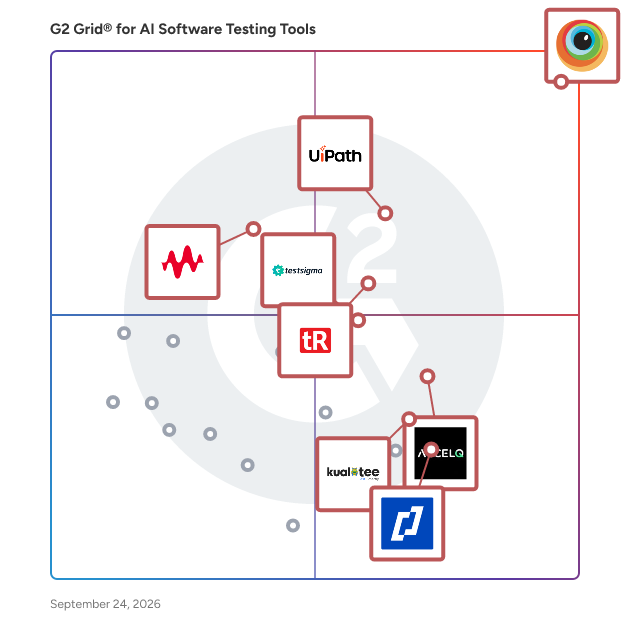
G2 Grid® for AI Software Testing Tools

G2 Grid® for AI Software Testing Tools plotting products by satisfaction and market presence

Highlighted products: BrowserStack, UiPath Agentic Automation, testRigor, ACCELQ, Testsigma, Keysight Eggplant, Kualitee, and Thunders.

Underlying data: [Grid® JSON](https://www.g2.com/categories/ai-software-testing-tools/grids.json?focus%5B%5D=browserstack&focus%5B%5D=uipath-agentic-automation&focus%5B%5D=testrigor&focus%5B%5D=accelq&focus%5B%5D=testsigma&focus%5B%5D=keysight-eggplant&focus%5B%5D=kualitee&focus%5B%5D=thunders)

tsigma.ai

T-Sigma is TickingMinds' AI-native quality engineering and product assurance platform, built for regulated industries like BFSI, such as banking, insurance, capital markets, credit unions; where a regression escape doubles as an audit finding. It runs on three pillars sharing one knowledge graph: Knowledge Base™ — captures every product requirement, data mapping rule and piece of system knowledge into a living, queryable graph. Not a wiki or shared drive: it traces how requirements, regulations and data mappings relate to each other, validates ETL and data-migration mappings before they hit production, drafts new user stories that stay consistent with what's already captured, and generates steering docs for AI code generators. Integrates natively with Azure DevOps, Jira, GitLab and GitHub. Test Studio™ — pulls user stories from your DevOps tools and generates test scenarios, cases and data straight from the Knowledge Base graph. Runs regression-impact analysis so coverage targets what actually changed, not the whole suite every time. Converts cases into automated scripts on Playwright and Selenium (C# and Java), with a confirmed-locator-only policy — locators are verified against the live rendered DOM, never guessed. Supports React/Vite/Radix, Angular, Next.js and Vue front ends. Attest™ — an independent certification service for autonomous AI agents, separate from test coverage entirely. Every assessment runs in a scoped, time-boxed sandbox on synthetic data, with irreversible actions routed to a mocked tool layer — never production. Agents are scored across 15 dimensions in three tiers (capability & correctness, robustness/safety/security, operational & governance) and issued a Pass, Conditional, or Fail verdict. A Tier-2 safety failure caps the verdict at Conditional regardless of task performance. Certificates are scoped to a specific agent version, use case, and assessment window, and void automatically if the model or prompt changes. Maps to EU AI Act, NIST AI RMF, ISO/IEC 42001, and DPDP. Together, the three pillars cover the full lifecycle: requirement capture, coverage generation and agent certification. One platform and one graph, not three vendors stitched together.

Who Is the Company Behind tsigma.ai?

TuringOne

Who Is the Company Behind TuringOne?

  • Seller: TuringOne
  • Year Founded: 2026
  • HQ Location: Luxembourg, LU
  • LinkedIn® Page: www.linkedin.com
    1 employees on LinkedIn®

Tusk AI

Tusk AI is an advanced automated testing platform designed to enhance software quality by generating and maintaining unit and integration tests. By integrating seamlessly into your continuous integration (CI) pipeline, Tusk AI analyzes your codebase and documentation to suggest verified test cases, enabling faster and safer code deployment. Its AI agent autonomously reads your code to identify and create tests for both standard and edge cases, ensuring comprehensive coverage without disrupting developer workflows. Key Features and Functionality: - Automated Test Generation: Tusk AI automatically generates unit and integration tests for your code changes, covering both happy paths and edge cases. - Self-Healing Tests: The platform self-iterates on its tests if it encounters errors during execution, maintaining the accuracy and relevance of your test suites. - CoverBot: An intelligent system that identifies and prioritizes files with low test coverage, creating comprehensive test suites to backfill unit test coverage over time. - Seamless CI Integration: Tusk AI integrates within your CI pipeline, enforcing test coverage requirements without disrupting engineers' flow. - Push in One Click: Review test cases and results before committing Tusk-generated tests to a branch or raising a separate pull request, streamlining the testing process. Primary Value and Problem Solved: Tusk AI addresses the challenge of maintaining high-quality code by automating the generation and maintenance of unit and integration tests. This automation reduces the manual effort required for test creation, accelerates release cycles, and ensures comprehensive test coverage. By catching bugs that other agents might miss and providing verified test suggestions, Tusk AI empowers development teams to ship faster with confidence, fostering a quality-first engineering culture.

Who Is the Company Behind Tusk AI?

  • Seller: Tusk AI
  • Year Founded: 2023
  • HQ Location: San Francisco, US
  • LinkedIn® Page: www.linkedin.com
    6 employees on LinkedIn®

UserTrace

UserTrace is a platform to simulate users on Conversational AI Agents across complex scenarios in minutes. Focus is on improving quality and reliability before reaching users.

Who Is the Company Behind UserTrace?

Usetrace

An intuitive test automation platform for functional testing, which is paired with 450 hours of complimentary expert support to get clients to 80% test automation coverage within 90 days. It's simple enough for product managers and manual testers to use, yet powerful enough to handle testing AI centric applications and do dynamic element identification.

Who Is the Company Behind Usetrace?

  • Seller: Tarmac.IO
  • Year Founded: 2012
  • HQ Location: Minneapolis , US
  • Twitter: @TarmacIO
    114 Twitter followers
  • LinkedIn® Page: www.linkedin.com
    259 employees on LinkedIn®

Veria Labs

Veria Labs offers an AI-driven security platform that autonomously maps, exploits, and secures your entire attack surface. Founded by members of the top-ranked U.S. competitive hacking team, Veria Labs leverages advanced AI agents to continuously analyze applications, identifying and addressing vulnerabilities faster and more effectively than traditional methods. Key Features and Functionality: - Comprehensive Integration: Seamlessly connects to Git repositories and cloud environments, defining the scope for thorough security assessments. - Deep Vulnerability Analysis: Conducts in-depth evaluations of code paths and cloud configurations to uncover potential security flaws. - Automated Exploitation: Generates proof-of-concept exploits against staging environments, ensuring identified vulnerabilities are real and actionable. - Actionable Reporting: Provides detailed reports with suggested patches, enabling rapid remediation of security issues. Primary Value and Problem Solved: Veria Labs addresses the critical need for continuous, automated security testing in modern development workflows. Traditional penetration testing is often infrequent, costly, and unable to keep pace with rapid code deployments, leaving applications vulnerable. By integrating AI-powered agents directly into the development pipeline, Veria Labs ensures that security assessments are continuous and comprehensive, effectively eliminating the trade-off between development speed and application security. This proactive approach empowers organizations to identify and fix vulnerabilities promptly, significantly reducing the risk of security breaches.

Who Is the Company Behind Veria Labs?

Vibesec

VibeSec is an AI-powered security tool designed to help developers identify and address code vulnerabilities efficiently. By integrating advanced scanning technologies, VibeSec ensures that both public and private GitHub repositories are secure before deployment. Key Features and Functionality: - Real Vulnerability Scanning: Utilizes AI and Semgrep to perform targeted scans, identifying high-risk issues with precision. - AI-Powered Security Reports: Generates actionable reports detailing detected vulnerabilities, their significance, and recommended fixes. - Private & Public Repository Support: Securely scans both public and private GitHub repositories without the need for agents or SDKs. - Lightning-Fast Scans: Conducts comprehensive AI scans in seconds directly from the dashboard. - No SDKs Required: Simplifies the process by eliminating the need for additional installations; users can connect and scan effortlessly. - Developer Community: Offers a platform for developers to seek assistance and provide feedback through a dedicated Discord community. Primary Value and User Solutions: VibeSec empowers developers to integrate security measures early in the development process, enabling them to detect and remediate vulnerabilities before code is shipped. This proactive approach reduces the risk of security breaches, ensures compliance with best practices, and enhances overall code quality. By providing detailed, AI-generated reports and supporting both public and private repositories, VibeSec streamlines the security auditing process, allowing developers to focus on building robust applications with confidence.

Who Is the Company Behind Vibesec?

Welltested

Welltested AI was a tool designed to automate the generation of unit, widget, and integration tests for Flutter applications. By analyzing codebases, it aimed to produce comprehensive test suites, reducing manual effort and enhancing code reliability. Key Features and Functionality: - Automated Test Generation: Automatically created unit, widget, and integration tests for Flutter projects. - IDE Integration: Provided commands like `Generate Unit Tests` for seamless test generation within the development environment. - Cross-Platform Support: Offered command-line tools compatible with Linux, macOS, and Windows for generating tests. - Test Maintenance: Allowed re-running commands to update tests intelligently when code changes were made. Primary Value and User Solutions: Welltested AI addressed the challenge of manually writing extensive test cases in Flutter development. By automating this process, it saved developers significant time and effort, ensuring robust test coverage and improving code quality. This automation facilitated faster development cycles and more reliable applications. Please note that Welltested AI has been deprecated. Users are encouraged to visit CommandDash for similar services.

Who Is the Company Behind Welltested?

Wopee.io

AI-powered autonomous testing agents for web applications. Wopee.io helps software teams achieve faster, more reliable testing with minimal maintenance through autonomous AI agents that automatically detect, execute, and maintain tests.

Who Is the Company Behind Wopee.io?

  • Seller: Wopee.io
  • Year Founded: 2023
  • HQ Location: Prague, CZ
  • LinkedIn® Page: www.linkedin.com
    4 employees on LinkedIn®

Xalgorix

Xalgorix is an Apache-2.0 open-source autonomous AI pentesting platform for authorized security testing. Unlike scanners that stop at plausible alerts, Xalgorix uses an AI agent to work through a structured 22-phase methodology and a separate verifier to independently reproduce each candidate finding before it is reported. Teams receive exploit-verified evidence, CVSS scoring, proof-of-concept details, remediation guidance, and branded PDF reports. The self-hosted Go and TypeScript project runs locally, keeps scan data in your infrastructure, and supports OpenAI, Anthropic, Gemini, DeepSeek, Groq, Ollama, MiniMax, and other OpenAI-compatible gateways. It includes a local web dashboard, CLI, Docker image, browser-assisted DAST, source-code review and provision-and-test modes, live telemetry, API and GraphQL testing, authentication and session analysis, injection, SSRF, IDOR/BOLA, file upload, deserialization/RCE, cloud, and WebSocket testing. The public repository is free and open source. The optional hosted Xalgorix service removes setup and adds managed scans, schedules, team workspaces, REST API access, CI gating, webhooks, and reports. A free GitHub App reviews pull-request diffs for security issues. Use Xalgorix only on systems you own or have explicit permission to test.

Who Is the Company Behind Xalgorix?

Adam Crivello
AC
Researched and written by Adam Crivello
Updated April 9, 2026