SprintAI
Who Is the Company Behind SprintAI?
- Seller: SprintOS
- Year Founded: 2025
- HQ Location: Paris, FR
-
LinkedIn® Page: www.linkedin.com
1 employees on LinkedIn®
Total Products under this Category: 268
Last updated: September 15, 2026
Why You Can Trust G2's Software Rankings:
G2's software rankings are built on verified user reviews, rigorous moderation, and a consistent research methodology maintained by a team of analysts and data experts. Each product is measured using the same transparent criteria, with no paid placement or vendor influence. While reviews reflect real user experiences, which can be subjective, they offer valuable insight into how software performs in the hands of professionals. Together, these inputs power the G2 Score, a standardized way to compare tools within every category.
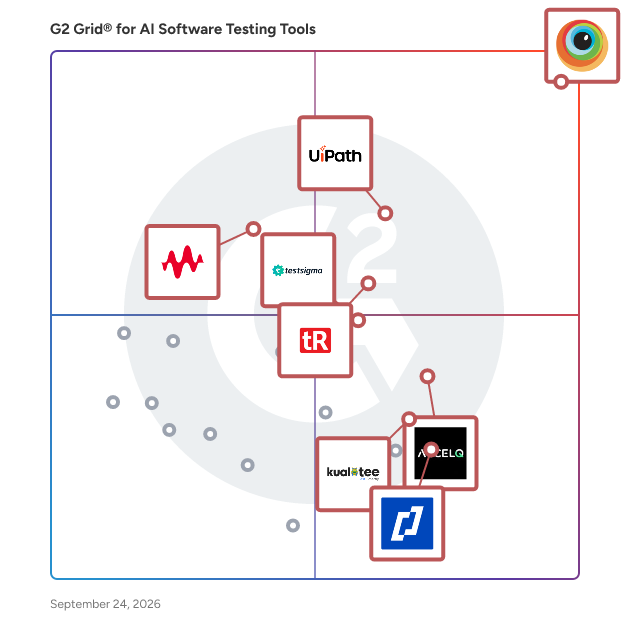
Highlighted products: BrowserStack, UiPath Agentic Automation, testRigor, ACCELQ, Testsigma, Keysight Eggplant, Kualitee, and Thunders.
Underlying data: [Grid® JSON](https://www.g2.com/categories/ai-software-testing-tools/grids.json?focus%5B%5D=browserstack&focus%5B%5D=uipath-agentic-automation&focus%5B%5D=testrigor&focus%5B%5D=accelq&focus%5B%5D=testsigma&focus%5B%5D=keysight-eggplant&focus%5B%5D=kualitee&focus%5B%5D=thunders)
Spur is an AI-powered, no-code test automation platform designed to streamline web application quality assurance. By deploying intelligent browser agents that emulate real user interactions, Spur ensures reliable and scalable testing without the need for coding expertise. This approach allows teams to create and maintain tests using natural language, making the process accessible to QA professionals, product managers, and engineers alike. Spur's vision-first, multi-modal agents interact directly with page elements, providing resilience to UI changes and adaptability to complex workflows. Key Features: - Vision-First AI Browser Agents: Navigate websites like real users, interacting with actual page elements rather than relying on brittle CSS selectors, ensuring more reliable and maintainable tests. - No-Code Natural Language Testing: Users write test cases in plain English, making test creation accessible to all team members without programming skills. - Dynamic and Complex Workflow Testing: Supports testing of dynamic forms, multi-step, multi-tab user flows, and payment/checkout processes with high customization. - Automated Scheduling and Regression Testing: Easily schedule thousands of tests to run automatically aligned with release cycles, providing continuous coverage and early bug detection. - Comprehensive Bug Reporting and Debugging Tools: One-click bug reports with video replays and detailed step analysis simplify debugging and accelerate issue resolution. - Multi-Language and AI Feature Testing: Tests can be executed across 36 languages and can be extended to test AI-driven features or agents within your application. Primary Value and Problem Solved: Spur addresses the challenges of traditional test automation by eliminating the need for coding and reducing maintenance overhead. Its AI-driven approach ensures tests are resilient to UI changes and adaptable to complex workflows, enabling teams to catch critical bugs before they impact users. By allowing tests to be written in natural language, Spur democratizes the testing process, making it accessible to a broader range of team members and accelerating the development cycle.
STEVE is an AI assistant that helps functional and QA Analysts to produce better requirements, construct and improve test cases and create actionable bug reports.
Structured AI is an innovative platform designed to automate quality assurance and quality control (QA/QC) processes in design engineering. By leveraging artificial intelligence, it enables engineering firms to detect and resolve errors in mechanical, electrical, plumbing (MEP), civil, and structural drawings before they reach the construction phase. This proactive approach minimizes costly rework, reduces requests for information (RFIs), and decreases change orders, allowing engineers to focus on high-value design tasks. Key Features and Functionality: - Cross-Discipline Consistency: The AI agents analyze and compare MEP, civil, and structural drawings to identify inconsistencies that might be overlooked during manual reviews. - Code-Aware Drawing Review: The system automatically scans drawings and models for missing information, clashes, and potential code violations, linking each finding to relevant criteria to expedite resolution. - Seamless Integration: Structured AI integrates with existing CAD, BIM, and project management tools, ensuring a smooth workflow without disrupting current processes. - Enterprise Security: The platform employs bank-grade encryption and is SOC 2 compliant, safeguarding project data and intellectual property. - Private Cloud Deployment: For maximum control, Structured AI offers on-premise deployment options, ensuring that data remains within the client's environment. Primary Value and User Benefits: Structured AI addresses the critical need for efficient and accurate QA/QC in design engineering. By automating the detection of errors and inconsistencies across various engineering disciplines, it significantly reduces the time and resources spent on manual reviews. This leads to fewer construction delays, cost savings from minimized rework, and enhanced overall project quality. Engineering firms can thus allocate more time to innovative design work, improving productivity and client satisfaction.
Supertest AI is an innovative AI-powered tool designed to streamline the software testing process by automating the generation of unit tests. Seamlessly integrating with Visual Studio Code (VS Code), it enables developers to create unit tests for React applications in seconds, significantly reducing the time and effort traditionally required for manual test writing. By leveraging advanced AI technology, Supertest AI enhances code reliability and accelerates the development lifecycle, making it an invaluable asset for developers and QA engineers alike. Key Features and Functionality: - AI-Generated Unit Tests: Automatically produces comprehensive unit tests for React components, ensuring thorough test coverage without manual intervention. - VS Code Integration: Offers a dedicated extension for Visual Studio Code, allowing developers to generate and manage tests directly within their preferred development environment. - Auto-Add Test IDs: Simplifies the process of adding test identifiers by automatically inserting them into the code, facilitating more efficient and accurate testing. - Support for React Testing Library: Currently compatible with the React Testing Library, with plans to expand support to additional testing frameworks in the future. - User-Friendly Interface: Provides intuitive commands and shortcuts, such as right-click options and keybindings, to streamline the test generation process. Primary Value and Problem Solved: Supertest AI addresses the common challenges associated with manual unit test creation, such as time consumption, potential for human error, and the repetitive nature of writing tests. By automating this process, it allows developers to focus more on feature development and less on testing logistics. This not only accelerates the development cycle but also enhances code quality and reliability, ultimately leading to more robust software products.
Susatest is an autonomous QA platform for testing Android, iOS, web, and Windows applications. As a black-box solution, it requires no source code or manual test scripts. Ten synthetic personas simulate real user behavior while performing functional verification, accessibility auditing, security scanning, API validation, performance monitoring, visual regression detection, usability assessment, and AI observability. The platform provides complete test results in 30 minutes, with initial insights in five. It generates reusable regression scripts in Appium and Playwright formats and integrates with tools like GitHub Actions, Jira, and Slack. Deployment options include cloud, local setups, and device labs like BrowserStack. Features include credential injection, one-time password support, cross-session learning, and real-time test streaming. Susatest identifies crashes, navigation issues, security vulnerabilities, and accessibility violations while monitoring login and checkout flows.
Swarmcheck is an AI-powered quality assurance platform designed to test and validate AI features within web applications. It enables development teams to ensure the reliability and performance of their AI components by automating end-to-end testing processes. By integrating Swarmcheck into their workflow, teams can identify and address issues such as hallucinations, prompt injections, and response quality regressions before they reach production. Key Features and Functionality: - Autonomous Testing: Swarmcheck automates end-to-end testing for every release, ensuring comprehensive coverage of both AI and non-AI components. - AI Assertions: The platform conducts semantic assertions to validate AI outputs, detecting issues like hallucinations and prompt injections that traditional QA tools might miss. - Swarm Exploration: Utilizing parallel AI agents, Swarmcheck uncovers edge cases at scale, enhancing the robustness of AI features. - Integration with Existing Tools: Swarmcheck seamlessly integrates with popular development tools such as GitHub, Slack, Jira, and more, fitting into existing workflows without disruption. - Enterprise Security: The platform offers self-hosted runners on AWS, GCP, or Azure, ensuring that prompts and AI outputs remain within the user's security perimeter. Primary Value and Problem Solved: Swarmcheck addresses the critical challenge of testing AI features within web applications—a task that traditional QA tools often fail to perform effectively. By providing automated, AI-specific testing capabilities, Swarmcheck empowers development teams to detect and resolve AI-related issues early in the development cycle. This proactive approach reduces the risk of deploying faulty AI features, enhances user trust, and accelerates the overall development process. Ultimately, Swarmcheck ensures that AI components function as intended, delivering a reliable and high-quality user experience.
Synthetic Society is an AI-driven platform that revolutionizes software development by integrating simulated user interactions into the development process. By deploying synthetic users that mimic real user behaviors, it proactively identifies bugs, design flaws, and user experience (UX) issues before actual users encounter them. This approach accelerates development cycles, reduces manual testing efforts, and enhances product quality, enabling teams to ship refined products with confidence. Key Features and Functionality: - Smart Simulations: AI agents behave like real users to uncover bugs and design flaws. - Auto Generation: Key user flows are auto-generated and maintained without the need for manual upkeep. - Friction Finder: Pinpoints where users get stuck, confused, or drop off, facilitating targeted UX improvements. - Full Visibility: Provides comprehensive insights into every step, click, and hesitation in the user journey. - Real-Time Analytics: Offers immediate feedback on UX issues during development, allowing for prompt resolution. Primary Value and Problem Solved: Synthetic Society addresses the inefficiencies of traditional manual testing methods, which are often slow, resource-intensive, and prone to errors. By automating the testing process with AI-driven simulations, it enables development teams to: - Accelerate Development: Integrate AI-driven user simulations into the development loop to ship a product that’s already tested and refined. - Continuous Optimization: Facilitate ongoing product refinement through continuous feedback and testing. - Actionable Analytics: Provide data-driven insights to inform product decisions and improvements. - Direct UX Insights: Gain precise feedback on user experience to enhance usability and satisfaction. - Data-Driven Decisions: Empower teams to make informed choices based on comprehensive analytics. By integrating Synthetic Society into their workflows, teams can eliminate manual testing, accelerate release cycles, and deliver high-quality products that meet user expectations.
Talotrace is an autonomous, AI-driven quality assurance platform that replaces manual and script-based testing with intelligent agents that understand your product, explore it like real users, and continuously validate critical flows across web, iOS, and Android. Instead of just reporting pass/fail results, Talotrace delivers “Traces”: detailed, evidence-backed findings that include screen recordings, step-by-step reproduction, device/OS context, logs, network activity, severity, as well as, diagnosis and engineering guidance to accelerate fixes. Key capabilities: Product-aware testing: Upload builds (APK/IPA), code, PRDs, release notes, design files, and user stories so AI agents learn your features, workflows, business logic, and expected behaviors. Autonomous mission execution: AI agents run user-flow “missions” across the devices, platforms, OS versions, and configurations that matter to your users, without requiring test scripts or heavy maintenance. Evidence-backed findings: Every issue comes with a Trace containing video, reproduction steps, application state, logs, network activity, and affected environments, plus an independent review layer to reduce false positives. From diagnosis to fix: When source code is available, Talotrace analyzes failures, surfaces likely causes, and provides engineering guidance (and eventually code patches) to speed up resolution. Always-on, scalable QA: Run one mission or thousands on demand, 24/7, with consistent coverage and no fatigue, helping teams reduce QA spend and shrink regression cycles from days to hours. Integrations & workflow fit: Issues can be linked directly into tools like Jira and Linear, fitting into existing engineering workflows. Talotrace also offers an optional Revenue Intelligence layer: the same agents that test your product can analyze conversion journeys, detect revenue leaks, benchmark experiences against competitors, and highlight growth opportunities to improve activation, retention, and monetization.
Testavi is an AI-powered QA agent that runs natural-language browser tests on real user flows, with video replays, smart assertions and end-to-end workflow coverage—no code access needed.
Testbook.ai is an AI-powered Chrome extension designed to revolutionize web application testing by automating regression tests and UI comparisons. It simplifies the testing process through intuitive record and playback functionalities, enabling users to capture interactions with their web applications and replay them without any coding knowledge. This approach significantly reduces the time and effort traditionally required for manual testing, making it accessible to users of all technical backgrounds. Key Features and Functionality: - Record and Playback: Easily record user interactions with web applications and replay them to create reusable test scenarios without writing code. - AI-Powered UI Testing: Utilize artificial intelligence to intelligently detect visual discrepancies and UI inconsistencies, ensuring a seamless user experience. - Cross-Browser Compatibility: Ensure consistent functionality across various browsers and platforms by conducting comprehensive cross-browser tests. - Cloud Integration: Seamlessly integrate with popular testing cloud services like Saucelabs and BrowserStack to enhance testing capabilities. - Detailed Reporting: Generate comprehensive reports and maintain a history of test results to track progress and facilitate continuous improvement. - Self-Healing Automation: Maintain script stability even when element properties change, reducing maintenance efforts and enhancing reliability. - Multi-Window Support: Test complex scenarios involving multiple browser windows and tabs to ensure robust application performance. - Jira Integration: Directly report bugs and issues to Jira projects, streamlining the bug-tracking and resolution process. Primary Value and Problem Solved: Testbook.ai addresses the challenges associated with manual web application testing by automating repetitive tasks and providing intelligent UI comparisons. By eliminating the need for coding in test creation, it democratizes the testing process, allowing team members without programming expertise to contribute effectively. The tool's AI capabilities ensure that even subtle visual discrepancies are identified, maintaining a consistent and high-quality user experience across different browsers and platforms. Ultimately, Testbook.ai accelerates the development cycle, enhances productivity, and leads to the delivery of superior web applications.
