Shiboleth
Who Is the Company Behind Shiboleth?
- Seller: Shiboleth
- Year Founded: 2023
- HQ Location: San Francisco, US
-
LinkedIn® Page: www.linkedin.com
2 employees on LinkedIn®
Total Products under this Category: 304
Last updated: September 05, 2026
Why You Can Trust G2's Software Rankings:
G2's software rankings are built on verified user reviews, rigorous moderation, and a consistent research methodology maintained by a team of analysts and data experts. Each product is measured using the same transparent criteria, with no paid placement or vendor influence. While reviews reflect real user experiences, which can be subjective, they offer valuable insight into how software performs in the hands of professionals. Together, these inputs power the G2 Score, a standardized way to compare tools within every category.
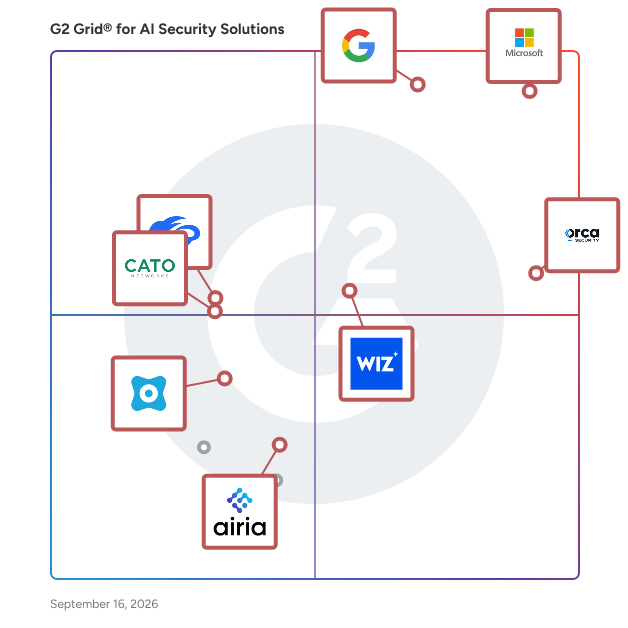
Highlighted products: Microsoft Defender for Cloud, Google Cloud Model Armor, Orca Security, Wiz, Zscaler Internet Access, Cato SASE Cloud, Securiti, and Airia.
Underlying data: [Grid® JSON](https://www.g2.com/categories/ai-security-solutions/grids.json?focus%5B%5D=microsoft-defender-for-cloud&focus%5B%5D=google-cloud-model-armor&focus%5B%5D=orca-security&focus%5B%5D=wiz-wiz&focus%5B%5D=zscaler-internet-access&focus%5B%5D=cato-networks-cato-sase-cloud&focus%5B%5D=securiti&focus%5B%5D=airia)
Pre-spend firewall for AI agents. One API call approves, blocks, or flags every transaction before a dollar moves.
SISA PRISM is a comprehensive AI security and governance platform designed to protect AI systems across various frameworks. It offers six interconnected modules—Discover, Strike, MLScanner, Secure, Observe, and Govern—that collectively address the entire AI security lifecycle, from asset discovery to regulatory compliance. Key Features and Functionality: - PrismDiscover: Identifies and catalogs AI assets, including models, agents, MCP servers, and API endpoints, ensuring a governance-ready inventory aligned with standards like ISO 42001 and the EU AI Act. - PrismStrike: Conducts adversarial testing across the OWASP LLM Top 10 vulnerabilities in multiple languages, providing replayable exploit evidence to assess and enhance AI system resilience. - PrismMLScanner: Performs pre-deployment scans of machine learning artifacts to detect hidden backdoor payloads, malicious code injections, and supply chain tampering, ensuring the integrity of AI deployments. - PrismSecure: Utilizes layer-specific fine-tuning to address vulnerabilities within AI models, significantly reducing attack success rates while preserving model utility. - PrismObserve: Offers real-time monitoring of AI systems, detecting runtime shadow AI, MCP activities, and agentic drift, with features like kill switches and rollback capabilities for immediate response. - PrismGovern: Automates compliance mapping to over 40 AI governance frameworks worldwide, facilitating continuous compliance posture management and streamlined audit processes. Primary Value and User Solutions: SISA PRISM provides organizations with a unified platform to secure their AI systems comprehensively. By integrating discovery, testing, scanning, hardening, monitoring, and governance, it ensures that AI deployments are resilient against threats, compliant with global regulations, and maintain operational integrity. This holistic approach addresses the complexities of AI security, offering users peace of mind and confidence in their AI initiatives.
Skarn is a security scanner for the AI coding-assistant session logs on a developer's machine. It covers Claude Code, Cursor, Codex CLI, Gemini CLI, GitHub Copilot, Kimi Code CLI, Grok Build, Grok Bot, Antigravity, and OpenCode from a single static binary, and detects leaked credentials across 200+ types using 248 built-in rules, plus multi-stage attack chains - prompt injection to secret read to exfiltration - correlated across MITRE ATLAS tactic-aligned stages. Every finding is crosswalked against MITRE ATLAS, the OWASP Top 10 for LLM Applications 2025, and CWE, emitted as SARIF 2.1.0 for GitHub code scanning, and every session and team gets a 0-100 risk score. Secrets are always shown redacted, never in full. A real-time pre-execution guard hook for eight of those assistants (Claude Code, Cursor, Codex CLI, GitHub Copilot, Gemini CLI, Grok Build, Antigravity, and Kimi Code CLI) can refuse a leaked credential before the tool call runs. Skarn makes zero network calls by default and is built for regulated, audit-heavy, EU data-residency environments where nothing may leave the machine.
APERION SmartFlow is an on-premises runtime governance control plane for enterprise AI. It sits inline on the call path between AI agents and any model and inspects every prompt, response, and Model Context Protocol (MCP) tool call before it completes. Security and risk teams use SmartFlow as an AI gateway, AI firewall, and policy engine in one runtime layer, so that AI agents and large language model applications can run inside regulated environments under continuous, enforceable control. SmartFlow is Kubernetes-native, runs inside the customer environment including air-gapped and sovereign deployments, and exposes no model traffic to a third party. SmartFlow is the runtime governance layer of the APERION Enterprise AI Trust Fabric. It is built for the chief information security officer and chief risk officer in financial services, banking, insurance, healthcare, life sciences, pharmaceuticals, defense, and the public sector. The problem SmartFlow solves Enterprise AI is moving from chat to agents. Agents act on behalf of people, at scale, with delegated authority. They send prompts to models, receive responses, and call tools that read and write to real systems. The controls built for humans using applications do not govern agents acting on behalf of humans. The result is a runtime gap: sensitive data reaching public models, prompt injection steering an agent off task, shadow AI outside any policy, and destructive tool calls that existing API gateways and data loss prevention tools never inspect. Detection and response tools report these failures after they happen. By then a regulated record has already left the environment. SmartFlow closes the gap with prevention on the call path. It reads the prompt before it leaves, evaluates the response before it returns, and inspects the tool call before it runs. What SmartFlow does AI gateway: routes across model providers so teams keep model optionality without rewriting applications. Supports commercial and self-hosted models behind one governed endpoint. AI firewall and policy enforcement: inline inspection of every prompt and response, with detection and redaction of personally identifiable information (PII), regulated payloads, secrets, and proprietary content before anything leaves the perimeter. MCP tool-call governance: inspects each Model Context Protocol tool call, scores intent and parameters, and stops destructive or unauthorized actions before execution. Pairs with APERION Shield, the open-source MCP middleware. AI agent identity: cryptographic identity for agents, so every action is attributable and every agent operates under a known principal rather than an anonymous service account. Verified-human step-up: for high-consequence actions, SmartFlow can hold the call and require a verified human before it proceeds. Semantic caching: reduces token cost and latency by serving semantically equivalent responses from cache. Identity-bound audit and evidence: every prompt, response, and tool call lands in a tamper-evident record bound to a verified human, built for regulatory examination rather than reconstructed after an incident. How it works SmartFlow terminates the connection between an AI agent and the model or tool it is trying to reach. On every call it runs a multi-pass policy evaluation: classification, sensitive-data detection, prompt-injection checks, and intent scoring on tool calls. Based on policy it can allow, block, redact, route to a different model, or require a verified-human step-up. Decisions are enforced inline, at low added latency and recorded in full. The same rules apply whether the traffic comes from an API-connected agent, an internal application, or an MCP tool call. Runtime governance versus detect-and-respond SmartFlow is inline runtime governance, not AI detection and response (AIDR). Detection observes activity and alerts after the fact. Runtime governance enforces policy before the action leaves the environment. For regulated workloads where a single prompt can move a customer record to a public model, prevention on the call path is the control a regulator expects. Mature programs run both: SmartFlow for the actions that cannot be allowed to happen, and detection for broad visibility. Deployment On-premises, private cloud, and air-gapped. SmartFlow runs inside the customer environment with no cloud dependency and no third-party exposure of model traffic. Kubernetes-native, containerized, and built to operate inside the network perimeter of a bank, a hospital system, or a defense environment. Sovereign deployment for data-residency and national-security requirements. Compliance and regulatory evidence SmartFlow produces identity-bound, tamper-evident audit evidence mapped to the frameworks regulated enterprises answer to, including the EU AI Act, the NIST AI Risk Management Framework, ISO 42001, FINRA, FFIEC, SR 11-7 model risk guidance, NYDFS Part 500, DORA, HIPAA, and 21 CFR Part 11. Evidence is queryable, so examination questions are answered from a record rather than a forensic reconstruction. The record names the verified human accountable for each AI action, which is what an examination asks for and what a log alone cannot provide. Integrations Identity and access: composes with Okta, Microsoft Entra, Active Directory, Veza, and SGNL rather than replacing them. SmartFlow adds the runtime and evidence layers above existing access governance. Workflow agents: composes with workflow-plane platforms such as ServiceNow and Microsoft agent orchestration. SmartFlow governs what those agents send to the model. Open source: APERION Shield, Apache 2.0 licensed, is the open-source MCP middleware front door to the platform and integrates directly with SmartFlow. Who SmartFlow is for SmartFlow is built for security and risk leaders deploying agentic AI in regulated industries: financial services, banking, insurance, capital markets, healthcare, life sciences, pharmaceuticals, defense, and the public sector. Typical buyers are the CISO, the CRO, heads of AI governance, and model-risk and compliance teams who need to deploy AI agents and prove to a regulator what every agent did, on whose behalf, and under which policy. The APERION Trust Fabric SmartFlow is one layer of the APERION Enterprise AI Trust Fabric, a four-layer architecture for governing enterprise AI agents: verified identity (NIST IAL2/AAL2 identity proofing), access governance (integrating existing identity platforms), runtime governance (SmartFlow), and audit and evidence (the APERION Regulatory Examination Suite). SmartFlow owns the runtime and evidence layers and binds identity through every action. Frequently asked questions Is SmartFlow an AI gateway or an AI firewall? Both, in one runtime layer. It routes across model providers like a gateway and inspects and enforces policy on prompts, responses, and tool calls like a firewall, with identity-bound audit underneath. Does SmartFlow run on-premises? Yes. SmartFlow is Kubernetes-native and runs inside the customer environment, including air-gapped and sovereign deployments, with no third-party exposure of model traffic. How is SmartFlow different from AI detection and response? Detection alerts after an action occurs. SmartFlow enforces policy inline before the action leaves the environment, and produces identity-bound evidence for examination. Does SmartFlow replace our identity platform? No. It composes with Okta, Entra, Active Directory, Veza, and SGNL, and adds runtime governance and evidence above them. What does SmartFlow do for regulatory examinations? It produces tamper-evident, identity-bound records mapped to frameworks including the EU AI Act, NIST AI RMF, FINRA, and HIPAA, answerable from a query.
Spellguard is a security platform for AI agents that routes all messages and tool calls through a Trusted Execution Environment for real-time policy enforcement, encrypted messaging, and tamper-proof audit logging.
Bulwark Enhanced sits between your users and any LLM, blocking prompt injection, scrubbing PII, enforcing role-based access, and writing every interaction to an immutable audit log. Ships with 40+ regulation-aligned policy templates out of the box. Prompt injection attacks rose 340% year-on-year per the OWASP LLM Top 10.
SuperTrust is an advanced AI-driven platform designed to enhance trust and security in digital interactions. By leveraging cutting-edge artificial intelligence technologies, SuperTrust provides robust solutions that ensure data integrity, authenticate user identities, and prevent fraudulent activities. Its comprehensive suite of tools is tailored to meet the needs of businesses seeking to fortify their digital ecosystems against emerging threats. Key Features and Functionality: - AI-Powered Authentication: Utilizes machine learning algorithms to verify user identities with high accuracy, reducing the risk of unauthorized access. - Real-Time Fraud Detection: Monitors transactions and user behavior in real-time to identify and mitigate potential fraudulent activities promptly. - Data Integrity Assurance: Ensures the consistency and accuracy of data across platforms, safeguarding against tampering and corruption. - Compliance Management: Helps organizations adhere to regulatory standards by providing tools for monitoring and reporting compliance-related activities. - User Behavior Analytics: Analyzes patterns in user behavior to detect anomalies that may indicate security breaches or policy violations. Primary Value and Solutions Provided: SuperTrust addresses the critical need for trust and security in digital environments by offering a comprehensive platform that combines AI-driven authentication, fraud detection, and data integrity solutions. By implementing SuperTrust, organizations can significantly reduce the risk of data breaches, ensure compliance with regulatory standards, and build confidence among their users. This leads to enhanced operational efficiency, protection of sensitive information, and a stronger reputation in the marketplace.
Security platform that monitors and closes exposure across all connected systems. Helps teams connect systems, set goals, understand impact, and automate workflows with continuous security and reduced manual work. Suggested category: Cloud security posture automation.
Surface Security is an enterprise browser security and AI visibility platform that helps organizations detect, investigate, and control risk directly inside the browsers their employees already use. The product is delivered through a managed browser extension, not a browser replacement, which allows security teams to add protection and visibility without forcing users to switch to a new enterprise browser or route all browsing activity through a vendor-controlled cloud service. Surface Security is designed for organizations that need to understand what happens after a user clicks a link, opens a web application, enters credentials, uploads files, uses SaaS tools, or interacts with AI platforms. It focuses on browser-layer activity that may not be fully visible to email security tools, EDR, firewalls, proxies, or traditional SaaS security products. The platform helps security teams identify phishing pages, adversary-in-the-middle attacks, credential theft, risky browser extensions, shadow SaaS usage, sensitive data movement, and unmanaged AI tool usage. A major part of Surface Security’s architecture is data sovereignty. The platform can be deployed on-premises or in the customer’s own cloud environment, so telemetry, policies, logs, investigation data, and sensitive browsing context remain under the customer’s control. This makes Surface Security especially relevant for regulated industries, government environments, financial services, healthcare, defense contractors, and other organizations that cannot rely on sending detailed browser activity to a third-party cloud. Surface Security provides real-time browser-layer detection and response, including phishing analysis, credential risk monitoring, session theft indicators, data loss prevention, shadow AI visibility, shadow SaaS discovery, and investigation timelines. Security teams can use the platform to warn users, block risky actions, enforce policies, review browser events, and send enriched alerts into existing SIEM and SOAR workflows. By operating as an extension on top of existing browsers, Surface Security gives enterprises a practical way to improve browser security while preserving user experience, deployment flexibility, and control over sensitive data.
TENET is a risk intelligence platform purpose-built for the Microsoft ecosystem to deliver unified visibility and proactive risk assessment across Azure and M365. It serves as a single source of truth for identifying, prioritizing, and mitigating cloud risk at scale—enabling organizations to shift from reactive firefighting to continuous, intelligence-driven security operations. Key Features: - Attack surface management: Identify risky entry points, misconfigurations, and third-party exposures. Visualize attack paths, map findings to MITRE ATT&CK, prioritize remediation, and manage incidents from a unified cloud risk view. - Anomaly detection: Detect issues early with real-time analysis of cloud workloads, identities, and applications, helping teams identify abnormal behaviour and mitigate risks before they become incidents. - Compliance readiness: Simplify audits with continuous compliance monitoring, guided remediation, and risk-prioritized insights. Reduce costs and manual effort while shrinking audit preparation from weeks to hours. - Microsoft 365: Gain visibility into external sharing, device risk, license utilization, and Copilot agents. Understand how identities, configurations, and data exposures combine to create risk across your cloud environment. - Access governance: Monitor human and non-human identities, analyze effective permissions across Entra ID and RBAC, and maintain clear visibility into who can access resources across your cloud estate. - AI monitoring: Discover and inventory AI models, agents, and cognitive services. Continuously monitor performance, reliability, and security posture while identifying AI-specific risks and prioritizing remediation. - Intelligent insights: Investigate and resolve issues faster with BriteAI. Transform live data into actionable insights, identify root causes through natural language queries, and receive precise remediation guidance. Core Value: TENET eliminates blind spots and reduces mean time to remediation (MTTR) through end-to-end Microsoft cloud visibility and guided remediation. It lowers compliance and audit overhead, enables teams to proactively identify and mitigate risks before they escalate, and scales security operations efficiently with AI-powered insights and autonomous remediation with full context via the TENET MCP server. For more information, visit www.aesonsolutions.com.
End-to-End Quality Assurance and Security of AI Applications: Automated and Regression Testing of AI applications for QA, Adversarial AI Red Teaming for Security, Low Latency Runtime Guardrails to Enforce Threat Detection and Mitigation policies. TestSavant.AI is a QA and assurance platform built specifically for AI applications. It helps teams test, secure, and monitor AI systems before and after deployment. Traditional software testing tools are not designed to test probabilistic models, prompt-driven behavior, or adversarial inputs. TestSavant fills that gap by combining automated quality evaluation, AI red teaming, and runtime guardrails in a single platform. Organizations building AI products face two major risks. First, models can fail silently through hallucinations, prompt injection, data leakage, or unpredictable behavior under edge cases. Second, even when issues are discovered during testing, teams often lack a reliable way to enforce protections in production. TestSavant addresses both problems with a unified testing and runtime protection workflow. How TestSavant Works TestSavant continuously evaluates AI applications against both quality and security criteria. The platform simulates real user behavior and adversarial attacks to uncover vulnerabilities before customers encounter them. When weaknesses are discovered, TestSavant provides guardrails that can be deployed in front of any AI system. Key Capabilities AI Quality Evaluation for AI Outputs Evaluate hallucinations, reasoning accuracy, instruction following, and other model quality attributes across prompts, agents, applications, and workflows. Automated AI Test Suites Create repeatable test scenarios that simulate real user behavior and edge cases. Run them continuously as models, applications, or prompts change. AI Red Team Testing Automatically probe AI systems with adversarial prompts and attack strategies to uncover vulnerabilities such as prompt injection, jailbreaks, sensitive data exposure, and policy violations. Runtime Guardrails Deploy our proprietary low latency self-adaptive guardrails directly into production to block unsafe inputs, prevent harmful outputs, and enforce AI policies based on findings from the testing phase. Telemetry and Observability Track threat attempts, latency, token usage, and guardrail performance to monitor how AI systems behave in the real world. Versioned AI Safety Configurations Manage and version guardrail policies so teams can adapt protection levels as models, prompts, and risk tolerance change. Who It’s For * QA teams responsible for validating AI reliability * Engineering teams deploying AI applications, agents, copilots, and chat interfaces * Security teams protecting AI systems from adversarial attacks TestSavant helps organizations ship AI faster while maintaining confidence in quality, security, and safety.
