Best AI Governance Tools - Page 29

How Many AI Governance Tools Products Does G2 Track?

Total Products under this Category: 624

Category Stats (Sep 2026)

  • Average Rating: 4.66/5 The average rating of products in this category, based on all submitted ratings
  • Top Trending Product: Harmonic Security (+0.97%) - Among all products in this category, Harmonic Security recorded the largest rating increase compared to last month

Last updated: September 26, 2026

How Does G2 Rank AI Governance Tools Products?

Why You Can Trust G2's Software Rankings:

  • 30 Analysts and Data Experts
  • 10,600+ Authentic Reviews
  • 624+ Products
  • Unbiased Rankings

G2's software rankings are built on verified user reviews, rigorous moderation, and a consistent research methodology maintained by a team of analysts and data experts. Each product is measured using the same transparent criteria, with no paid placement or vendor influence. While reviews reflect real user experiences, which can be subjective, they offer valuable insight into how software performs in the hands of professionals. Together, these inputs power the G2 Score, a standardized way to compare tools within every category.

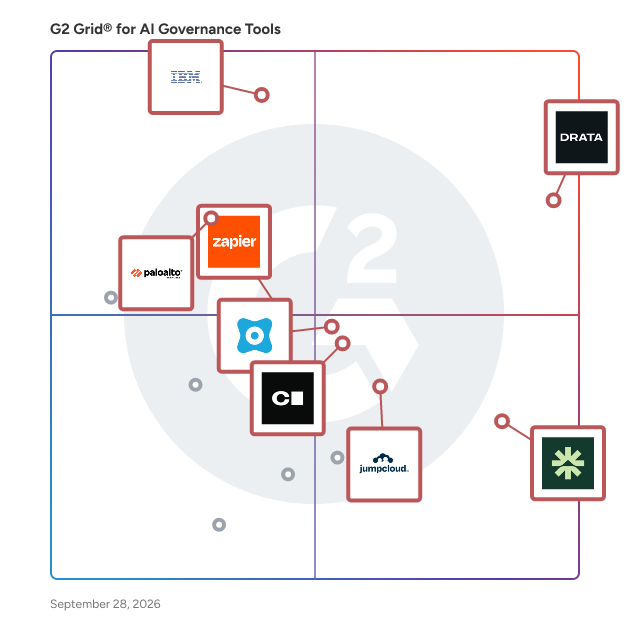
G2 Grid® for AI Governance Tools

G2 Grid® for  AI Governance Tools plotting products by satisfaction and market presence

Highlighted products: Drata, IBM watsonx.governance, Willow AI Governance Control Plane, Securiti, Cortex Cloud, JumpCloud, Coder, and Zapier.

Underlying data: [Grid® JSON](https://www.g2.com/categories/ai-governance-tools/grids.json?focus%5B%5D=drata&focus%5B%5D=ibm-watsonx-governance&focus%5B%5D=willow-ai&focus%5B%5D=securiti&focus%5B%5D=cortex-cloud&focus%5B%5D=jumpcloud&focus%5B%5D=coder&focus%5B%5D=zapier)

Oximy

Oximy gives enterprises one neutral, cross-tool view of how their people actually use AI, so IT, Finance and Security can finally answer questions that today go unanswered: which AI tools are in use, on whose account, at what cost, and with what outcome. Employees now use ChatGPT, Claude, Gemini, Copilot, Cursor and dozens of specialized AI tools, some on company licenses and some on personal accounts. Each individual choice is reasonable. Collectively, no one inside the company has the full picture. Finance sees invoices. IT sees approved logins. Security sees network activity. Nobody sees all three together. THE OXIMY PLATFORM The Oximy Platform brings together two things enterprises currently have to piece together manually: Identification: a complete, evidence-based map of which AI tools are in use, by whom, through which accounts (company or personal), and where sensitive data may be exposed. Measurement: integrations that connect this activity to the systems of record finance and IT already run on, so usage can be tied to spend, licenses and business outcomes rather than sitting in a separate dashboard. The result is a live inventory of AI activity across the organization, the underused or duplicate licenses it's paying for, and the actions available to fix both. THE AI VALUE CHAIN AI work inside a modern enterprise moves through several layers: Frontier models: OpenAI, Anthropic, Google and other model builders. Model routing and inference infrastructure: the layer managing model access, cost, reliability and fallbacks. Horizontal AI work interfaces: ChatGPT, Claude, Microsoft Copilot, Gemini, Cursor and similar tools employees use directly. Company specific harnesses, agents and skills: internal applications teams build combining company data, permissions and workflows on top of those interfaces. Adoption, governance and value intelligence: the layer that answers what's being used, by whom, at what cost, with what risk, and with what outcome. AI transformation and deployment: workflow redesign, custom agents and implementation work. Most vendors sell into one layer. Model providers see only their own product. Security tools see only network activity. Nobody sits across all of it. WHERE OXIMY FITS Oximy operates at the adoption, governance and value intelligence layer, independent of which models, tools or vendors a company uses. That neutrality is the point: Oximy isn't trying to replace ChatGPT, Claude, Copilot or any internal tool. It gives the company a single, vendor-neutral evidence layer across all of them, so decisions about spend, access and value can be made with real data instead of self-reported usage or invoices alone. USE CASES BY FUNCTION Finance: Identify underused, duplicate or unallocated AI licenses and consolidate or reclaim the spend. Get one consolidated view of AI cost across every tool and provider instead of stitching together invoices. IT: See every AI tool in use across the company, sanctioned and unsanctioned, and move usage from personal accounts to approved, secured paths without blocking people from working. Security: Understand where AI tools may be creating data exposure — which tools, which accounts, which data — so policy can be based on actual behavior rather than assumption. Operations and AI/Transformation leadership: Get a defensible answer to "is our AI investment working" — which teams have adopted AI, which workflows changed, and what should be expanded, consolidated or retired next.

Who Is the Company Behind Oximy?

  • Seller: Oximy
  • HQ Location: N/A
  • LinkedIn® Page: linkedin.com
    1 employees on LinkedIn®

Oxus

Oxus is an AI-powered platform designed to automate and streamline internal audit workflows, enabling audit teams to deliver more audits faster and with greater efficiency. By leveraging advanced artificial intelligence, Oxus transforms hours of manual tasks—such as flowcharting and control testing—into review-ready outputs within minutes. Key Features and Functionality: - Automated Control Testing: Utilizes AI to pull evidence, analyze content, and generate comprehensive workpapers ready for auditor review. - Flowchart and Process Narrative Generation: Converts walkthrough transcripts, notes, and videos into detailed flowcharts and narratives, highlighting risks and ensuring thorough documentation. - Evidence-Grounded Outputs: Ensures all outputs are directly tied to specific documents and excerpts, maintaining audit-grade accountability. - Auditor-in-the-Loop: Incorporates a review process where auditors approve outputs before finalization, ensuring accuracy and compliance. - Consistent Documentation Formats: Standardizes workpapers and documentation, reducing variability and enhancing clarity across audit reports. - Enterprise-Grade Security: Offers flexible deployment options, including both Oxus-hosted and customer-hosted solutions, to meet internal security, privacy, and regulatory requirements. Primary Value and User Solutions: Oxus addresses several critical challenges faced by internal audit teams: - Reduction in Manual Work: Automates repetitive and time-consuming tasks, allowing auditors to focus on higher-value activities such as risk assessment and strategic decision-making. - Cost Efficiency: Minimizes the need for expensive outsourcing by enabling in-house teams to handle increased workloads effectively. - Enhanced Documentation Consistency: Provides standardized formats for flowcharts and workpapers, ensuring uniformity and reducing errors across audit documentation. - Improved Evidence Management: Streamlines the process of locating and interpreting information across various files and systems, saving time and enhancing the accuracy of audits. By integrating Oxus into their workflows, internal audit teams can achieve significant time savings, reduce costs, and enhance the overall quality and reliability of their audit processes.

Who Is the Company Behind Oxus?

  • Seller: Oxus
  • HQ Location: San Francisco, US
  • LinkedIn® Page: www.linkedin.com
    875 employees on LinkedIn®

Packmind

Packmind is an innovative platform designed to enhance software development by capturing and enforcing engineering best practices across teams. It transforms scattered technical decisions and coding standards into structured, versioned playbooks that integrate seamlessly with AI coding assistants and development environments. By providing real-time guidance and governance, Packmind ensures that both human and AI-generated code adhere to organizational standards, reducing rework and accelerating delivery times. Key Features and Functionality: - Engineering Playbook Capture: Automatically aggregates coding standards, architectural decisions, and best practices from various sources, creating a centralized, versioned repository. - AI Integration: Aligns AI coding assistants, such as GitHub Copilot, with team-specific standards, ensuring generated code complies with established guidelines. - Real-Time Enforcement: Provides immediate feedback within IDEs and CI/CD pipelines, identifying and correcting deviations from best practices before code is committed. - Governance and Scalability: Offers tools to monitor and manage the adoption of standards across repositories, enabling safe scaling of AI coding practices within organizations. Primary Value and Problem Solved: Packmind addresses the challenge of maintaining code quality and consistency in the era of AI-assisted development. By embedding a team's collective knowledge into the development workflow, it reduces the reliance on tribal knowledge, minimizes code review bottlenecks, and prevents architectural drift. This leads to improved engineering performance, faster onboarding of new developers, and a significant reduction in lead times. Organizations can confidently scale their AI coding initiatives, knowing that their standards are consistently applied and enforced.

Who Is the Company Behind Packmind?

  • Seller: Packmind
  • Year Founded: 2016
  • HQ Location: Bordeaux, FR
  • LinkedIn® Page: www.linkedin.com
    13 employees on LinkedIn®

Palma.ai

Who Is the Company Behind Palma.ai?

  • Seller: Palma.ai
  • Year Founded: 2025
  • HQ Location: San Francisco, US
  • LinkedIn® Page: www.linkedin.com
    8 employees on LinkedIn®

PANADATA

Panadata is a comprehensive public data research platform that centralizes access to key information sources across Panama, Colombia, and Ecuador. It enables users to efficiently verify identities, assess risks, and ensure regulatory compliance by consolidating data from over 15 public entities. Trusted by leading financial institutions, law firms, and government agencies, Panadata streamlines due diligence, commercial intelligence, and compliance processes. Key Features and Functionality: - Consolidated Public Data: Access public records from multiple entities, providing a comprehensive view for identity verification and risk assessment. - Multi-Source Search: Quickly search across various public entities using keywords, names, or company details to find relevant information and potential matches with sanction lists. - Real-time Alerts: Receive timely updates on data changes, allowing for proactive monitoring and efficient follow-up management. - One-Click Document Download: Download multiple documents with a single click, saving time and streamlining the information-gathering process. - Customizable Reporting: Generate reports to document research findings, providing evidence for investigations and compliance purposes. - API Integration: Integrate Panadata into existing applications using a REST API to access information directly from your platform. Primary Value and User Solutions: Panadata addresses the critical need for efficient access to reliable public data in today's complex regulatory landscape. By consolidating multiple data sources into a single platform, it saves users valuable time and resources, enhances decision-making, and ensures compliance. Its comprehensive features provide a competitive edge by facilitating thorough due diligence, effective risk management, and streamlined compliance processes.

Who Is the Company Behind PANADATA?

Parcha

Parcha is an AI-driven compliance platform designed to streamline and accelerate the customer onboarding process for financial institutions and fintech companies. By automating Know Your Business (KYB) and Know Your Customer (KYC) procedures, Parcha enables organizations to approve more customers swiftly while maintaining robust compliance standards. Its suite of tools leverages advanced artificial intelligence to reduce manual workflows, minimize false positives, and enhance operational efficiency, allowing businesses to scale confidently without compromising on risk management. Key Features and Functionality: - AI-Accelerated Document Verification: Parcha verifies incorporation documents, ownership details, and addresses in over 60 languages with high accuracy, ensuring the authenticity of business entities. - Global Compliance Screening: The platform automatically screens businesses against sanctions lists, adverse media, and high-risk countries, ensuring adherence to international regulations. - In-Depth Business Due Diligence: Parcha conducts comprehensive online research to uncover a business’s customers, industry, and operational countries, facilitating thorough due diligence. - Configurable Compliance Workflows: Users can customize compliance checks and workflows to align with specific risk policies and thresholds without the need for coding. - Real-Time Analytics & Reporting: The platform provides real-time analytics to monitor compliance outcomes across the portfolio, enabling informed decision-making and operational efficiency. Primary Value and Problem Solved: Parcha addresses the challenges of time-consuming and labor-intensive compliance processes that can hinder customer onboarding and business growth. By automating these processes with AI, Parcha significantly reduces review times—by up to 90%—and minimizes false positives, allowing compliance teams to focus on genuine risks. This acceleration not only enhances operational efficiency but also improves the customer experience by reducing onboarding delays. Furthermore, Parcha's customizable workflows and real-time analytics empower organizations to maintain compliance with evolving regulations, ensuring a scalable and adaptable compliance framework.

Who Is the Company Behind Parcha?

Parsias

Parsias is an AI governance platform designed to provide organizations with comprehensive oversight of their artificial intelligence systems. By automatically scanning technology infrastructures, Parsias identifies all deployed AI algorithms, assesses their associated risks, and aligns them with relevant regulations. This continuous, agentless scanning ensures a live, unified view of an organization's AI landscape, highlighting areas that require attention and facilitating proactive management. Key Features and Functionality: - Automated Discovery: Parsias autonomously scans cloud, on-site, and hybrid environments to detect every AI system in operation, eliminating the need for manual inventories. - Risk Assessment: Each identified AI system is evaluated and classified based on risk levels—low, medium, high, or unacceptable—providing clear insights into potential vulnerabilities. - Regulatory Mapping: The platform maps over 2,000 global regulations to the specific AI systems within an organization, ensuring continuous compliance monitoring and generating actionable plans to address any gaps. - Role-Specific Dashboards: Parsias offers tailored views for various stakeholders, including CTOs, CIOs, GRC teams, data leaders, and executives, delivering relevant information from detailed algorithm data to high-level risk summaries. - AI-Powered Guidance: Users can pose regulatory questions in plain language, and the built-in AI provides specific, applicable guidance derived from pertinent regulations and internal policies. Primary Value and Problem Solved: Parsias addresses the critical challenge many organizations face: the lack of visibility and control over their AI deployments. With AI systems being implemented across various teams and platforms without centralized oversight, organizations are exposed to risks such as customer harm, regulatory breaches, and reputational damage. By offering an automated, continuous, and comprehensive view of all AI systems, Parsias empowers organizations to manage their AI portfolios effectively, ensure compliance with evolving regulations, and mitigate potential risks, thereby enhancing operational efficiency and safeguarding their reputation.

Who Is the Company Behind Parsias?

  • Seller: Parsias
  • Year Founded: 2024
  • HQ Location: London, GB
  • LinkedIn® Page: www.linkedin.com
    5 employees on LinkedIn®

PhaseLaw

The streamlined DSAR platform purpose built for enterprise teams

Who Is the Company Behind PhaseLaw?

  • Seller: Phaselaw
  • Year Founded: 2023
  • HQ Location: New York, US
  • LinkedIn® Page: www.linkedin.com
    3 employees on LinkedIn®

Phrony

Who Is the Company Behind Phrony?

Platform

Pillar Security's platform offers a comprehensive solution designed to secure the entire AI lifecycle, from development through deployment. It provides organizations with unparalleled visibility, robust control, and resilient defense mechanisms to protect against a wide array of emerging AI-specific threats. Pillar Security addresses the critical need for securing AI applications and infrastructure throughout their entire lifecycle. As organizations increasingly adopt AI-driven solutions, traditional cybersecurity tools often fall short in mitigating AI-specific risks such as data leakage, model theft, and adversarial attacks. Pillar's platform fills this gap by providing adaptive security measures tailored for AI-integrated systems, enabling businesses to innovate confidently while ensuring the integrity, confidentiality, and availability of their AI assets.

Who Is the Company Behind Platform?

Plutto

Plutto is an advanced platform designed to streamline the evaluation and management of third-party risks, including suppliers and clients. By integrating artificial intelligence (AI) and customizable workflows, Plutto enhances due diligence processes, ensuring compliance and mitigating potential risks. Key Features and Functionality: - Customizable Request Management: Facilitates the collection and management of supplier, client, and contract requests through adaptable forms, initiating seamless due diligence processes. - Document Portal: Provides a branded online portal to centralize, collect, and manage third-party documentation, featuring real-time alerts and clear guidance to simplify the entire process. - Risk and Due Diligence Assessment: Centralizes and optimizes the evaluation of suppliers and clients across financial, legal, and compliance domains. Utilizes AI-assisted reviews, integrated data sources, and traceable workflows to simplify decision-making and reduce risks. - Compliance and Conflict of Interest Monitoring: Automatically detects and monitors reputational and regulatory risks by analyzing sanction lists, Politically Exposed Persons (PEPs), and adverse media, ensuring regulatory compliance and effective risk management. Identifies potential conflicts of interest among employees, suppliers, and clients, promoting integrity and transparency in third-party relationships. - Questionnaires and RFIs: Manages and sends regulatory questionnaires (RFIs) to third parties to assess compliance in key areas such as cybersecurity, sustainability, and corporate ethics. Analyzes results based on internal policies or external regulations to efficiently identify risks and compliance gaps. Primary Value and Solutions Provided: Plutto offers a comprehensive solution for organizations to manage third-party risks effectively throughout the entire lifecycle. By centralizing information and automating processes, it provides a 360° view of suppliers and clients, integrating financial, compliance, and risk data with AI and key integrations. The platform ensures transparent and traceable approval workflows, facilitates document analysis and classification with AI to detect fraudulent documents, and provides automatic alerts for potential issues related to money laundering, economic crimes, or conflicts of interest. By maintaining clear records of changes, Plutto guarantees transparency in processes, ensuring accountability, compliance, and facilitating straightforward audits. Trusted by leading companies, Plutto has demonstrated significant improvements in efficiency, cost reduction, and regulatory compliance. For instance, organizations have reported a 76% reduction in the time required to manage suppliers and clients, a 22% decrease in operational costs, and a 74% faster response to risk alerts. In summary, Plutto empowers businesses to make informed decisions, reduce operational risks, and maintain compliance by providing a centralized, AI-driven platform for third-party risk management.

Who Is the Company Behind Plutto?

  • Seller: Plutto
  • Year Founded: 2021
  • HQ Location: Santiago, CL
  • LinkedIn® Page: www.linkedin.com
    4,716 employees on LinkedIn®

PointGuard AI Platform

PointGuard AI Platform is a comprehensive security solution designed to protect AI applications and agent-driven systems throughout their entire lifecycle. It addresses the unique challenges posed by autonomous AI agents, ensuring organizations can deploy and manage AI technologies securely and efficiently. Key Features and Functionality: - AI Discovery & Inventory: Identifies and catalogs AI models, agents, and integrations within the enterprise ecosystem. - AI Security Posture Management: Assesses and manages the security status of AI assets, ensuring compliance with best practices. - AI Security Testing and Red Teaming: Conducts adversarial simulations to uncover vulnerabilities such as prompt injections and data exposure risks. - AI Anomaly Detection and Guardrails: Monitors AI behavior in real-time, enforcing safe operational parameters and preventing unauthorized actions. - Data Loss Prevention (DLP) and Access Control: Safeguards sensitive information by controlling data access and usage within AI systems. - Agentic Gateway: Provides a centralized control point for managing Model Context Protocol (MCP), API, and agent-to-agent (A2A) communications. - Vulnerability Management: Integrates with existing systems to prioritize and remediate risks across both AI and traditional applications. Primary Value and Problem Solved: PointGuard AI Platform empowers organizations to confidently adopt and scale AI technologies by mitigating associated security risks. It offers a unified approach to AI security, combining discovery, testing, monitoring, and governance to protect against threats unique to AI systems. By implementing PointGuard, enterprises can ensure the integrity, confidentiality, and availability of their AI applications, thereby fostering innovation while maintaining robust security and compliance standards.

Who Is the Company Behind PointGuard AI Platform?

Shalaka Joshi
SJ
Researched and written by Shalaka Joshi
Updated April 9, 2026