Best AI Gateways Software - Page 4

How Many AI Gateways Software Products Does G2 Track?

Total Products under this Category: 74

Category Stats (Sep 2026)

  • Average Rating: 4.51/5 The average rating of products in this category, based on all submitted ratings
  • Top Trending Product: Portkey (+0.09%) - Among all products in this category, Portkey recorded the largest rating increase compared to last month

Last updated: September 26, 2026

How Does G2 Rank AI Gateways Software Products?

Why You Can Trust G2's Software Rankings:

  • 30 Analysts and Data Experts
  • 5,100+ Authentic Reviews
  • 74+ Products
  • Unbiased Rankings

G2's software rankings are built on verified user reviews, rigorous moderation, and a consistent research methodology maintained by a team of analysts and data experts. Each product is measured using the same transparent criteria, with no paid placement or vendor influence. While reviews reflect real user experiences, which can be subjective, they offer valuable insight into how software performs in the hands of professionals. Together, these inputs power the G2 Score, a standardized way to compare tools within every category.

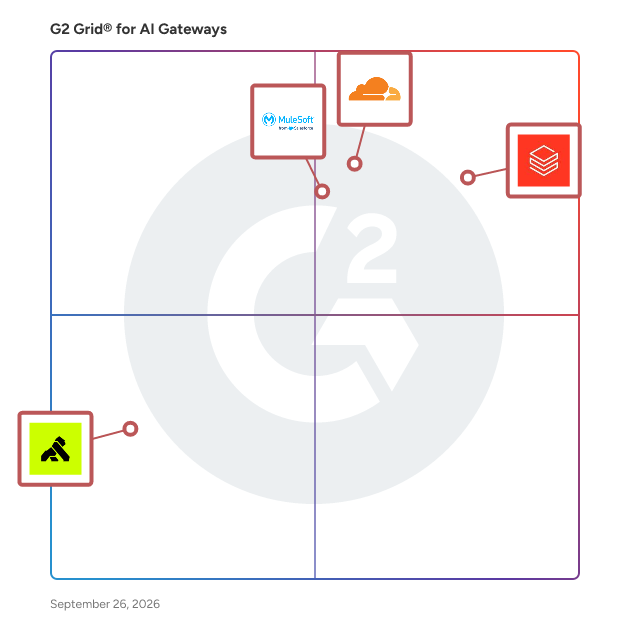
G2 Grid® for AI Gateways Software

G2 Grid® for AI Gateways Software plotting products by satisfaction and market presence

Highlighted products: Databricks, Cloudflare Application Security and Performance, MuleSoft Anypoint Platform, and Kong Konnect.

Underlying data: [Grid® JSON](https://www.g2.com/categories/ai-gateways/grids.json?focus%5B%5D=databricks&focus%5B%5D=cloudflare-application-security-and-performance&focus%5B%5D=mulesoft-anypoint-platform&focus%5B%5D=kong-inc-kong-konnect)

liteLLM

LiteLLM is an open-source Large Language Model (LLM) gateway designed to streamline access, management, and monitoring of over 100 LLM providers through a unified, OpenAI-compatible API. By offering a consistent interface, LiteLLM simplifies the integration of diverse LLMs, enabling developers to focus on building applications without the complexities of handling multiple APIs. Key Features: - Unified API Integration: Access and manage over 100 LLM providers, including OpenAI, Azure, Anthropic, Hugging Face, and more, through a single, standardized API. - Cost Tracking and Budget Management: Monitor and control spending across different LLM providers with automatic cost tracking, budget setting, and rate limiting capabilities. - Load Balancing and Fallbacks: Ensure high availability and reliability by implementing load balancing and automatic fallback mechanisms across multiple LLM deployments. - Monitoring and Logging: Integrate with tools like Langfuse, Langsmith, and OpenTelemetry for comprehensive monitoring, logging, and observability of LLM usage. - Authentication and Security: Manage access with features like Single Sign-On (SSO), JWT authentication, and audit logs to maintain secure and compliant operations. Primary Value and Problem Solved: LiteLLM addresses the challenges of managing multiple LLM providers by offering a unified gateway that simplifies API interactions, ensures consistent input/output formats, and provides robust monitoring and cost management tools. This consolidation reduces development complexity, enhances operational efficiency, and allows organizations to seamlessly integrate and scale their AI applications across various LLM platforms.

Who Is the Company Behind liteLLM?

LLM Gateway

Kubernetes-native inference gateway with unified routing, automatic failover, policy guardrails, and complete observability — no SDK changes required.

Who Is the Company Behind LLM Gateway?

Lunar.dev

Lunar.dev is an open-source platform designed to manage, govern, and optimize third-party API consumption across applications and AI agent workloads at scale. It serves as a unified API Gateway, providing real-time visibility, policy enforcement, and security controls over all agentic traffic, including Large Language Models (LLMs), Model Control Protocol (MCP) tools, and APIs. By integrating Lunar.dev, organizations can ensure safe and compliant AI adoption without hindering innovation. Key Features and Functionality: - Live API Traffic Visibility: Monitor every model, tool, and agent interaction in real-time, tracking metrics such as latency, errors, costs, and token usage. - AI-Aware Policy Enforcement: Implement fine-grained rules to control agent access, enforce rate limits, manage costs, and apply budgets, ensuring compliance and security across the AI stack. - Advanced Traffic Shaping: Optimize performance and cost by dynamically routing requests across LLM providers, applying rate limits, retries, priority queues, and circuit breakers to manage load and ensure reliability. - MCP Registry and Customization: Build an approved catalog of tools and connectors for enterprise use, assign scoped environments for agents, and configure tools according to company policies and compliance standards. - AI Agent Sandbox: Test agent and MCP behavior in a secure environment before production, conduct lineage analysis to understand relationships between agents, LLMs, MCP tools, and APIs, and evaluate risks to detect security exposures and performance regressions prior to deployment. Primary Value and Problem Solved: Lunar.dev addresses the critical need for enterprises to safely adopt AI at scale by providing a centralized control point for all agentic traffic. It ensures that AI agents, models, and tools operate within defined policies and compliance boundaries, offering real-time monitoring, policy enforcement, and security measures. This governance framework protects sensitive data, prevents unauthorized access, and maintains operational resilience, enabling organizations to innovate with AI technologies confidently and securely.

Who Is the Company Behind Lunar.dev?

  • Seller: Lunar.dev
  • Year Founded: 2022
  • HQ Location: Tel Aviv, IL
  • LinkedIn® Page: linkedin.com
    15 employees on LinkedIn®

luoluoAI

luoluoAI is a hosted multi-provider AI API gateway for developers building products, automations, and coding agents. It provides one endpoint for models from OpenAI, Anthropic, xAI, DeepSeek, Google, and GLM, so teams can switch providers without rewriting integrations or maintaining separate billing dashboards. The gateway supports OpenAI-compatible and Claude Messages-compatible APIs, with normalized streaming responses, tool-calling payloads, and provider error formats. The console provides API key management, model availability and pricing, usage, balance, and request tracking. luoluoAI uses pay-as-you-go billing. Standard API usage does not require a monthly subscription, and trial credit may be available for evaluation. Documentation and model pricing are publicly available before integration.

Who Is the Company Behind luoluoAI?

MCP Bridge

MCP Bridge is a self-hosted middleware solution that enables seamless integration between any API—be it REST, GraphQL, SOAP, or gRPC—and AI agents such as OpenAI's GPT, Claude, Mistral, and Gemini. By automatically generating Model Context Protocol (MCP) tool definitions from existing API schemas, MCP Bridge eliminates the need for manual coding or extensive rewrites, allowing developers to deploy MCP servers in minutes. Key Features and Functionality: - Automatic Tool Generation: Transforms API operations into fully described MCP tools with typed input/output schemas, parameter mappings, behavioral annotations, and documentation. - Schema Support: Supports various schema formats, including OpenAPI (JSON/YAML), GraphQL introspection, WSDL, and gRPC (.proto files or server reflection). - Self-Hosted Deployment: Deployable via Docker containers on platforms like AWS ECS, Azure Container Apps, or any orchestrator, ensuring data remains within the user's network. - Built-in Rust: Developed in Rust for memory safety and high throughput, providing a production-ready solution without external SaaS dependencies at runtime. - Code Mode for Large APIs: Utilizes meta-tools to represent extensive APIs, reducing context window usage by approximately 98% and optimizing token consumption. Primary Value and User Solutions: MCP Bridge addresses the challenge of integrating legacy and existing APIs with AI agents that were not originally designed for such interactions. By providing a unified point of control, it exposes, governs, and optimizes LLM, MCP, and API resources, eliminating integration complexity. This solution empowers developers to ship MCP servers rapidly, transforming API schemas into AI-ready tools without the need for manual tool definition creation. Ultimately, MCP Bridge streamlines the process of connecting diverse APIs to AI agents, enhancing efficiency and reducing development time.

Who Is the Company Behind MCP Bridge?

Modular

Modular is an AI integration platform designed to simplify the incorporation of AI features into applications without the need for extensive infrastructure development. By handling complex tasks such as context management, embeddings, chat history, and data retrieval, Modular enables developers to focus on delivering functional AI capabilities swiftly. Key Features and Functionality: - Context Management: Automatically integrates relevant data into the AI's context window, eliminating manual token calculations and reducing truncation errors. - Chat History: Maintains and replays conversation sessions across requests without requiring an additional database, ensuring seamless user interactions. - Smart Retrieval: Efficiently fetches pertinent data by invoking user-defined functions at appropriate times, enhancing the relevance of AI responses. - Model Routing: Facilitates easy switching between AI models like Claude, GPT-4o, and Gemini through simple configuration changes, avoiding the need for code rewrites. - Retries and Fallbacks: Manages rate limits, timeouts, and errors gracefully to maintain application uptime and reliability. - MCP Native Integration: Seamlessly connects with existing Model Control Protocol (MCP) tools, serving as the first MCP-native AI middleware. Primary Value and User Solutions: Modular addresses the common challenge of AI feature implementation becoming an extensive infrastructure project. By providing a streamlined API with methods like `ai.run` and `ai.chat`, developers can register data sources and deploy AI functionalities without delving into the complexities of model selection, prompt engineering, or data synchronization. This approach significantly reduces development time and resources, allowing teams to deliver AI-enhanced applications efficiently.

Who Is the Company Behind Modular?

OfoxAI

OfoxAI is a unified API gateway that gives developers access to 100+ large language models through a single endpoint. Connect to GPT-5.4, Claude Opus 4.6, Gemini 3.1 Pro, DeepSeek V4, MiniMax M2.5, and more — all with one API key. Key features: - Native support for OpenAI, Anthropic, and Gemini SDK protocols - Direct connection from China via Hong Kong express routes (100-300ms latency) - Pay with WeChat, Alipay, or credit card - Team collaboration with shared billing - 99.9% uptime SLA Get started in 3 minutes at https://ofox.ai

Who Is the Company Behind OfoxAI?

OrionGate

OrionGate is an AI API gateway designed to streamline the integration of various AI models into applications. It offers a unified interface that forwards requests to a diverse range of models across multiple providers, eliminating the need for developers to modify prompts, tools, or flags. With access to over 500 models from 10 providers across 8 modalities—including chat, reasoning, embedding, reranking, image, audio, and video—OrionGate simplifies the development and scaling of AI applications. Key Features and Functionality: - Intelligent Auto-Routing: Analyzes each request to select the optimal model based on user-defined preferences for quality, cost, and latency. - Dry-Run Route Simulation: Allows users to preview model selection outcomes before execution, aiding in cost management and workflow planning. - Multi-Provider Model Catalog: Provides a comprehensive and up-to-date catalog of models and pricing, accessible through a single API. - OpenAI-Compatible API: Ensures compatibility with OpenAI's chat workflow, enabling seamless integration without altering existing codebases. - Operational Controls: Offers features like hashed API keys, budget tracking, optional webhooks, usage logs, and routing defaults for enhanced management. - Usage Visibility: Provides detailed insights into usage patterns, auto-routing savings, request logs, and operational signals through a user-friendly console. - Fallback-Aware Execution: Incorporates retry and failover mechanisms to handle transient upstream failures, ensuring robust and reliable operations. Primary Value and User Solutions: OrionGate addresses the complexities associated with integrating multiple AI models from various providers by offering a centralized gateway. This approach reduces development overhead, accelerates deployment, and provides flexibility in model selection. By intelligently routing requests and offering comprehensive operational controls, OrionGate empowers developers to build, test, and scale AI applications with confidence, optimizing for performance, cost, and reliability.

Who Is the Company Behind OrionGate?

RouterBase

RouterBase is a unified API gateway that provides access to 200+ AI models including GPT, Claude, Gemini, Llama, Mistral and DeepSeek through a single OpenAI-compatible endpoint. It works as a drop-in replacement for the OpenAI SDK, with smart routing by cost or latency, automatic failover during outages, unified billing and usage analytics. SDKs are available for Python, Node.js, Go and Ruby. A free tier is available to get started.

Who Is the Company Behind RouterBase?

Sansa AI Gateway

Sansa AI Gateway is a comprehensive production stack designed to streamline and govern AI deployments. It offers a unified, OpenAI-compatible API that integrates over 200 models from more than 30 providers, including OpenAI, Anthropic, Google, Meta, and Mistral. This single integration enables features such as smart routing, persistent memory, web search, context compression, and input security, all activated per request by adding a single parameter. No new SDKs or infrastructure changes are required, facilitating seamless adoption. Key Features and Functionality: - Unified API Access: Provides a single API, key, and base URL compatible with OpenAI, allowing access to a vast array of models without the need for multiple integrations. - Smart Model Routing: Utilizes a routing model trained on over 20 billion tokens to automatically select the most suitable model for each prompt, delivering superior quality at approximately half the cost of frontier models. - Persistent Memory: Incorporates a memory parameter that enables models to retain user interactions across sessions, eliminating the need for external vector databases or retrieval pipelines. - AI Web Search: Enhances model responses by grounding them with live web results and inline citations when the ":search" suffix is appended to the model name. - Context Compression: Employs a compression parameter to remove low-value tokens from lengthy inputs, resulting in approximately 40% faster latency and 30% fewer input tokens. - Input Security (Input Guard): Detects personally identifiable information (PII) and potential prompt injections before they reach the model, ensuring secure and compliant AI interactions. - Governance: Allows the definition of model, data, safety, and spend rules as versioned policies. These policies can be attached to any request, ensuring inline enforcement with routing and inference, and providing a full audit trail for compliance. - Evaluations (Evals): Offers human-aligned evaluation tools built for production AI, enabling calibration of scoring against real reviewed cases and the ability to run evaluations across models, prompts, and live traffic to detect regressions before they impact users. - Observability: Traces every call, providing insights into cost, latency, model behavior, and policy outcomes through a unified dashboard, eliminating the need for separate logging pipelines. Primary Value and User Solutions: Sansa AI Gateway addresses several critical challenges in AI deployment: - Simplified Integration: By offering a single, OpenAI-compatible API, it reduces the complexity associated with managing multiple model providers and integrations. - Enhanced Reliability: Automatic routing and failover mechanisms ensure high uptime and consistent performance across various AI models and providers. - Cost Efficiency: Smart routing and context compression features optimize resource utilization, delivering high-quality outputs at reduced costs. - Data Security and Compliance: Built-in governance and input security features safeguard sensitive information and ensure adherence to regulatory standards. - Improved User Experience: Persistent memory and AI web search capabilities enhance the relevance and continuity of user interactions, leading to more engaging and effective AI applications. By consolidating these functionalities into a single platform, Sansa AI Gateway empowers organizations to deploy, manage, and scale AI solutions efficiently and securely.

Who Is the Company Behind Sansa AI Gateway?

Sensedia API Management Suite

Sensedia's API Platform enables exposure, consumption and management of resources and data for app creation, integration with partners and customers, and strategies of open innovation. See more information at https://sensedia.com

Who Is the Company Behind Sensedia API Management Suite?

  • Seller: Sensedia
  • Year Founded: 2007
  • HQ Location: Campinas, BR
  • LinkedIn® Page: www.linkedin.com
    654 employees on LinkedIn®
Adam Crivello
AC
Researched and written by Adam Crivello
Updated March 24, 2026