Hyaline
Who Is the Company Behind Hyaline?
- Seller: App Garden Studios
- HQ Location: N/A
-
LinkedIn® Page: www.linkedin.com
1 employees on LinkedIn®
Last updated: October 6, 2026
Total Products under this Category: 39
Last updated: November 20, 2026
Why You Can Trust G2's Software Rankings:
G2's software rankings are built on verified user reviews, rigorous moderation, and a consistent research methodology maintained by a team of analysts and data experts. Each product is measured using the same transparent criteria, with no paid placement or vendor influence. While reviews reflect real user experiences, which can be subjective, they offer valuable insight into how software performs in the hands of professionals. Together, these inputs power the G2 Score, a standardized way to compare tools within every category.
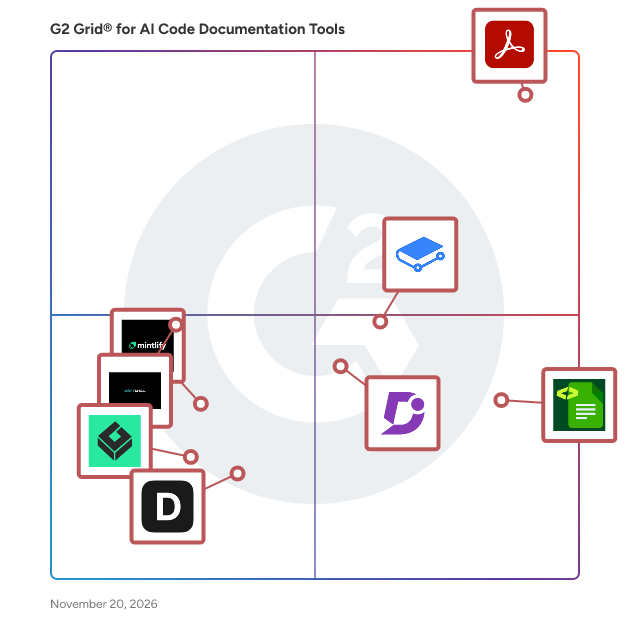
Highlighted products: Adobe Acrobat, DocuWriter.ai, GitBook, Document360, SoftSpell, Mintlify, Documentation AI, and Greptile.
Underlying data: [Grid® JSON](https://www.g2.com/categories/ai-code-documentation-tools/grids.json?focus%5B%5D=adobe-acrobat&focus%5B%5D=docuwriter-ai&focus%5B%5D=gitbook&focus%5B%5D=document360&focus%5B%5D=softspell&focus%5B%5D=mintlify&focus%5B%5D=documentation-ai&focus%5B%5D=greptile)
What is Moxie Docs? Moxie Docs is an AI-powered living documentation and repository context platform designed to solve the two biggest headaches in modern software development: documentation rot and skyrocketing AI token costs. By indexing your GitHub repositories, Moxie automatically extracts codebase conventions, architecture paths, and verified commands—serving them to both your human engineering team and your AI coding tools from a centralized, searchable workspace. Unlike traditional static wikis that are obsolete the moment code is merged, Moxie integrates directly into your CI/CD pipeline to keep your documentation and codebase perfectly in sync. Cross-Functional Alignment Moxie Docs breaks down technical silos by making codebase knowledge accessible to everyone. You can onboard users from any background with a flat-rate pricing model that doesn’t penalize seat growth: - Engineering Triage: Keeps developers focused on building features rather than digging through legacy files or writing repetitive updates. - Product and QA Management: Gives product managers and QA engineers a transparent, high-level view of application architecture, system behaviors, and feature footprints without forcing them into the source code. - Marketing and Onboarding: Allows non-technical stakeholders to use the AI-powered Q&A feature to instantly understand product capabilities, streamline feature tracking, and accelerate team onboarding. Proactive Repository Governance Moxie doesn't just host your documentation; it actively protects it. The platform surfaces actionable, 1-click insights to instantly generate, repair, or deprecate documentation based on real-time code changes. When code drifts from established team conventions, Moxie goes to work in your pull requests—automatically rewriting descriptions to match your custom structural templates, leaving precise code review comments, and flagging implementation gaps before they hit production. Key Capabilities - Automated Drift Detection and Friday Cleanups: Moxie constantly monitors your main branches and incoming merges against your existing knowledge base. When a feature evolves, Moxie flags the documentation drift instantly and aggregates required updates into clean, source-cited, docs-only Pull Requests for your team to review and merge every Friday. - Native MCP Server Context Layer: Moxie provides a native Model Context Protocol (MCP) hook-in designed for the modern AI engineering stack (including Claude Code, Cursor, Windsurf, and Codex). By serving as an external brain, Moxie gives your AI agents deep, verified codebase awareness without requiring them to constantly re-crawl your repository. - Token and Cost Optimization: Traditional AI coding workflows waste massive amounts of money on LLM token overhead by feeding entire directories into the context window for simple tasks. Moxie replaces sloppy file dumps with scoped, mathematically precise context lookups, slashing your AI agent token consumption and keeping your context windows clean. - Automated PR Workflows and Guardrails: Transform your code review process. Moxie automatically reformats incoming pull request descriptions to enforce team compliance, reviews code changes against your stated conventions, and leaves inline suggestions if a PR breaks established architectural patterns or impacts user-facing documentation.
Connect G2 to Claude or ChatGPT for answers grounded in G2's trusted reviews, comparisons, and pricing from real user insights.
Skerpa is a digital product companion that captures and sharpens your insights, guides you forward, and speeds up discovery so teams can focus on building the right products.
Create self branded, step-by-step video and user guides in a few clicks. Simply by using your SaaS. Free plan > No credit card need > No account need - Try it Now ⭐ 🚀 Create interactive how-to guides that automatically update when your product changes! With StoryToDoc, you'll create stunning interactive guides that stay current with zero effort. Just turn on the StoryToDoc extension and capture your product workflows as usual. Our AI-powered technology will: ✨ Capture only essential actions - no dead time or mistakes ✨ Create beautiful interactive guides that users can follow step-by-step ✨ Automatically update ALL your guides when your product changes
SummonAI Kit is a CLI tool that transforms any codebase into a fully-configured Claude Code environment. Instead of manually writing CLAUDE.md files, configuring skills, and setting up agents — run one command. SummonAI Kit analyzes your repo, detects your frameworks, and generates everything Claude needs to understand your stack from day one. Works with any language, any framework. React, Next.js, Python, Go, Rust — all detected automatically. Built for developers who want first-try accuracy without the setup overhead
Syntha AI is an advanced AI-powered platform designed to enhance developers' coding efficiency by automating various programming tasks. It offers a suite of intelligent agents that assist in generating, explaining, converting, debugging, and optimizing code across multiple programming languages. By integrating state-of-the-art language models like GPT-4.1 and Claude Sonnet 3.7, Syntha AI streamlines the development process, allowing developers to focus on innovation and complex problem-solving. Key Features and Functionality: - Code Generation: Automatically produce code snippets tailored to specific tasks, reducing manual coding efforts. - Code Explanation: Provide clear, plain-language explanations of complex code segments, facilitating better understanding and documentation. - Code Conversion: Effortlessly translate code between over 60 programming languages and frameworks, ensuring compatibility and flexibility. - Code Optimization: Analyze and enhance code performance and quality by identifying and rectifying inefficiencies. - Diagram Generation: Create visual representations of code structures and data flows using Mermaid syntax, aiding in visualization and communication. - Test Generation: Develop automated tests to ensure code reliability and robustness. Primary Value and User Solutions: Syntha AI addresses common challenges faced by developers, such as time-consuming manual coding, language barriers, and code optimization complexities. By automating these tasks, it significantly reduces development time, enhances code quality, and promotes seamless collaboration across diverse programming environments. This leads to increased productivity, faster project completion, and a more efficient development workflow.
Your AI assistant writes code against outdated APIs, and your dependencies age quietly until an upgrade becomes a quarter-long project. Vibgrate measures both problems before they bite. Vibgrate CLI scans your manifests — never your source — and keeps two scores deliberately separate: DriftScore (0–100, how far behind your stack is) and RiskScore (whether any of it is exposed right now). A current stack with one actively exploited CVE and a three-majors-behind stack with no known exploit need different responses; one number can't tell you which you have. It covers 19 ecosystems including legacy estates, runs offline, and needs no signup. The scoring method is published — every factor, source, and formula — with a citable DOI. Also in the box: Vibgrate AI Context (vg serve), a local-first MCP server that gives your AI assistant version-correct library docs plus a code map plus offline drift, matched to your lockfile. And DriftScore badges for your README. Free to try: npx @vibgrate/cli scan — results in about a minute. Team features on Vibgrate Cloud.
