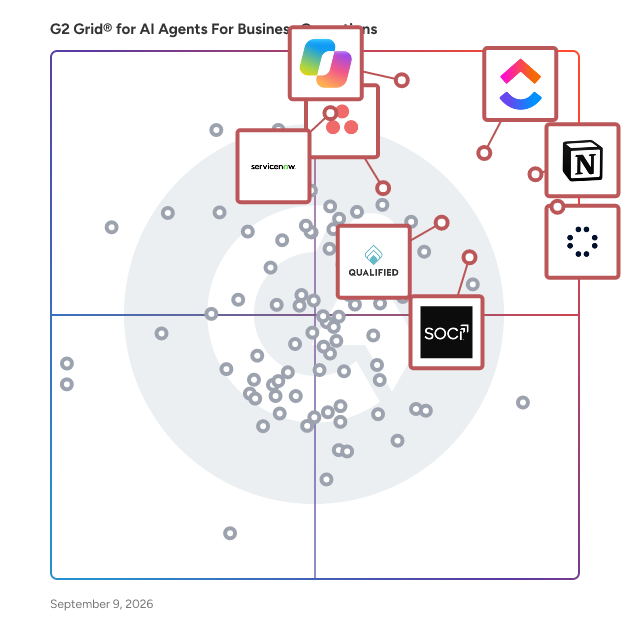
AI agents for business operations are software entities that autonomously execute internal business processes, using AI to reason across context, complete multi-step tasks, and take actions within enterprise systems with minimal human intervention. Unlike earlier generations of intelligent virtual assistants focused on conversational interaction, modern AI agents for business operations are defined by their ability to pursue goals, chain actions together, and operate across systems to complete operational work on behalf of internal teams across functions such as IT, HR, finance, legal, and back-office administration.
Core capabilities of AI agents for business operations
To qualify for inclusion in the AI Agents for Business Operations category, a product must:
- Provide a dedicated environment for building and configuring AI agents that operate within internal business systems, including defining operational goals, process logic, and the tools or enterprise data sources agents can access
- Enable agents to run multi-step, goal-directed internal workflows autonomously, not just respond to individual queries
- Support integration with enterprise systems such as HRIS, ERP, ticketing platforms, knowledge bases, and internal APIs that agents can read from or write to as part of task execution
- Give users the ability to customize agent behavior, instructions, and scope for specific internal functions and roles
- Provide tools to monitor and analyze agent activity via dashboards, logs, or reports
- Allow for human-in-the-loop controls, including escalation paths, approval steps, and override mechanisms appropriate for internal process governance
Common use cases for AI agents for business operations
AI agents for business operations are deployed across internal functions to automate processes, reduce manual workload, and improve operational efficiency. Common use cases include:
- Automating IT service requests, troubleshooting workflows, and incident resolution
- Supporting HR and people operations tasks such as onboarding, policy Q&A, and employee request handling
- Streamlining finance and procurement processes, including approvals, document handling, and data reconciliation
- Managing back-office workflows that require coordination across multiple enterprise systems
How AI agents for business operations differ from other tools
Unlike chatbots, which are typically scripted and rely on menu-driven interactions with limited intent understanding, AI agents for business operations use machine learning (ML) to interpret complex inputs, chain actions across systems, and grow more capable over time. They are also distinct from conversational interface agents, which are primarily focused on the human-to-system interaction layer, and from agentic GTM platforms, which are oriented around externally facing, revenue-generating activities such as sales prospecting, pipeline management, lead nurturing, and customer acquisition. AI agents for business operations focus specifically on automating the internal processes that keep a business running. They come in focused subtypes, including AI customer support agents and AI IT agents, each tailored to specific internal business functions.
Insights from G2 on AI agents for business operations
Based on category trends on G2, natural language understanding (NLU) and autonomous task execution stand out as the most impactful capabilities. Teams frequently note reductions in manual workload and improved response accuracy as primary outcomes of deployment.