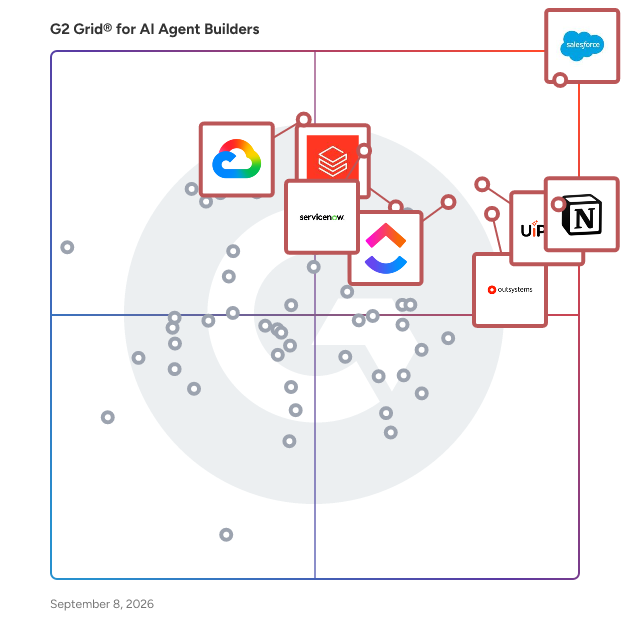
AI agent builders are platforms purpose-built to create, configure, deploy, and manage AI agent software entities that autonomously pursue goals, execute multi-step tasks, and take actions across connected systems with minimal human intervention.
Unlike tools that have added AI assistance or copilot features as a layer on top of existing functionality, AI agent builders are primarily oriented around the agent development lifecycle: defining agent goals and behaviors, connecting agents to tools and data sources, orchestrating multi-step or multi-agent workflows, and monitoring agent performance over time.
These platforms enable agents to reason across context, chain actions together, call external APIs and services, and operate asynchronously, going beyond responding to individual user queries to proactively completing work on a user's behalf. This distinguishes them from conversational interface agents, which are primarily focused on the human-to-system interaction layer, and from chatbot software, which handles reactive, turn-by-turn dialogue.
AI agent builders are used across functions, including customer support, sales development, IT operations, HR, and back-office automation. They are deployed by technical and non-technical builders seeking to automate complex, multi-step business processes that previously required human judgment or coordination across multiple systems.
These platforms typically offer a dedicated environment for designing agent logic and workflows, integration with enterprise systems such as CRM software, knowledge bases, ticketing systems, and external APIs, and tools for testing, observing, and iterating on agent behavior in production.
To qualify for inclusion in the AI Agent Builders category, a product must:
- Provide a dedicated environment for building and configuring AI agents, including defining goals, instructions, behaviors, and the tools or data sources agents can access
- Enable agents to run multi-step, goal-directed workflows autonomously, not just respond to individual queries
- Support integration with external systems, APIs, or enterprise data sources that agents can read from or write to as part of task execution
- Integrate deeply with business systems, such as CRM or knowledge bases, ensuring data-driven and role-specific interactions
- Offer tools to monitor, evaluate, and iterate on agent performance, such as logs, analytics dashboards, or testing environments
- Allow for human-in-the-loop controls, including escalation paths, approval steps, or override mechanisms
- Maintain security, compliance, and data privacy protocols appropriate for enterprise deployment