
Alyssa Towns
Alyssa Towns works in communications and change management and is a freelance writer for G2. She mainly writes SaaS, productivity, and career-adjacent content. In her spare time, Alyssa is either enjoying a new restaurant with her husband, playing with her Bengal cats Yeti and Yowie, adventuring outdoors, or reading a book from her TBR list.
What is a web user interface?
A web user interface (Web UI) is the browser-based visual and interactive layer of a web application that allows users to view information, enter data, and perform actions without installing software locally. It connects user interactions to underlying application logic through standard web technologies such as HTML, CSS, and JavaScript.
Businesses use website builders to create clean, easy-to-use interface experiences. These tools often provide domain name offerings, search engine optimization (SEO), analytics, e-commerce plugins, and mobile web functionality.
TL;DR: Web user interface definition, basic elements, and best practices
A web user interface is the visual layer of a web application that enables browser-based interaction. It includes elements like buttons, menus, forms, navigation components, and content blocks that connect users to underlying systems. Common types include graphical, touch-based, menu-driven, and command-line interfaces. Strong Web UI design improves usability, accessibility, and engagement through consistency, responsiveness, and user-centered research.


What are the different types of web user interfaces?
The main types of web user interfaces are graphical, touch-based, menu-driven, and command-line interfaces. Each type differs in how users provide input and navigate the system.
- Graphical user interface: A graphical user interface (GUI) lets individuals interact with information through graphics, icons, and other visual elements. They’re suitable for non-technical users and offer immediate visual feedback as objects change in color, size, or visibility upon interaction.
- Touch user interface: Designed so users can interact with the information using their fingers. Touch user interfaces are a standard option for small, portable devices such as phones or tablets. They’re ideal for individuals across a wide range of age groups.
- Menu-driven interface: Interfaces that employ a series of menus for users to select from are known as menu-driven interfaces. Individuals choose from multiple menus until they reach a desired location or outcome. They’re best for technology novices due to their simplistic nature and limited menu selections.
- Command-line interface: Text-based interfaces for above-average technical operating system users are known as command-line interfaces. They typically require experience or programming skills to navigate.
What are the basic elements of a web user interface?
The basic elements of a web user interface include input controls, navigation components, information displays, and content containers. These components structure interactions and guide user behavior.
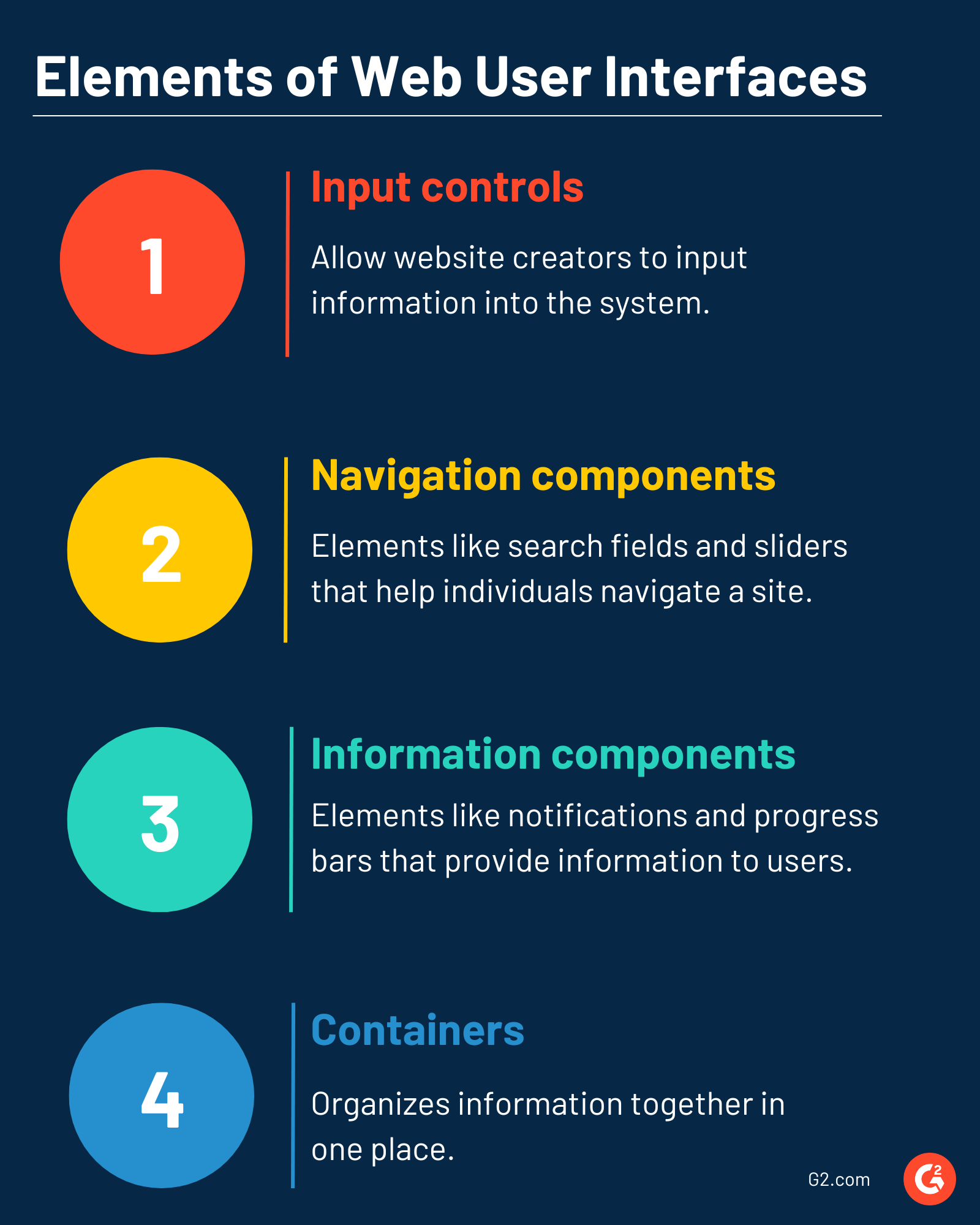
- Input controls: They allow website creators to input information into the system. Examples of input controls are checkboxes, dropdown lists, radio buttons, toggles, and date pickers.
- Navigational components: As the name suggests, navigational components help individuals navigate a site. Types of navigational components include search fields, pagination, breadcrumb locators, sliders, and carousels.
- Information components: These components provide specific information to individuals. Examples include notifications, progress bars, and message boxes.
- Containers: This method organizes information together in one place. Accordions, which allow users to expand and collapse content sections, are a popular example of a container.
What are the benefits of a well-designed web user interface?
A well-designed web user interface improves usability, reduces friction, and supports task completion. Clear structure and intuitive interaction increase engagement and retention.
- Repeat visitors: Those who interact with a good design will likely return and engage with it again. This can be part of a larger brand loyalty strategy for businesses.
- Increased traffic: A well-designed interface that quickly provides users with what they’re looking for seamlessly supports growth. Users may tell others to visit the site, and the overall positive experience can lead to organic growth over time.
- Better user interactions: Appealing, unique, and easy-to-use designs create better user interactions. In turn, users may spend more time on a page or visit more pages on a site. More time spent has the potential to lead to increased revenue.
What are the best practices for designing a web user interface?
An effective web user interface design depends on the website, the intended audience, and the goals of each page. Businesses should generally follow best practices to design web user interfaces that users will love.
- Research the intended audience. Understanding user behavior requires in-depth user and design research. During the planning process, examine who will use the website, what they’re looking for, and the intended use cases.
- Keep it consistent. Use branding, typography, components, and templates to keep the interface consistent across pages and actions. Similarly, make actions consistent to eliminate confusion and help users quickly learn their way around.
- Make the site accessible and inclusive. Think about all user types when planning web user interface designs. For example, consider how colors might impact colorblind individuals.
- Design with responsiveness in mind. Users access websites across many devices, including computers, smartphones, and tablets. Keep mobile optimization in mind, so the website is responsive and adaptable to various screen sizes to avoid frustrating users.
What is the difference between Web UI and GUI?
A GUI refers to any visual interface that allows users to interact with software through graphical elements. A Web UI is a specific type of GUI designed to operate within a web browser. While both rely on visual interaction, they differ in scope, environment, and deployment.
| Basis | Web UI | GUI |
| Scope | Specific to web applications | Applies to all visual software interfaces |
| Where it runs | Inside a web browser | Desktop, mobile, embedded systems, or web |
| Installation | No local installation required | Often installed on a device |
| Platform dependency | Cross-platform through browsers | May be OS-specific |
| Examples | SaaS dashboards, web portals | Desktop apps, system settings, design tools |
Frequently asked questions about the web user interface
Here are answers to common questions about the web user interface.
Q1. How do you access a web user interface?
You access a web user interface by opening a browser and entering the application’s URL. The interface loads in the browser and does not require local installation.
Q2. Can a Web UI be used on mobile devices?
Yes. A Web UI can be accessed through mobile browsers on smartphones and tablets. When built responsively, it adapts to smaller screens and touch interactions.
Q3. What is the difference between a web UI and a website?
A website mainly presents information, while a web UI enables structured interaction within a web-based application. Web UIs are designed for task execution rather than passive content viewing.
Q4. What makes a web UI secure?
A web UI is secure when it uses encrypted connections, authentication mechanisms, and controlled access to protect user data and system integrity.
Strong interfaces don’t happen by accident. Discover how user-centered design shapes more intuitive and effective digital products.


