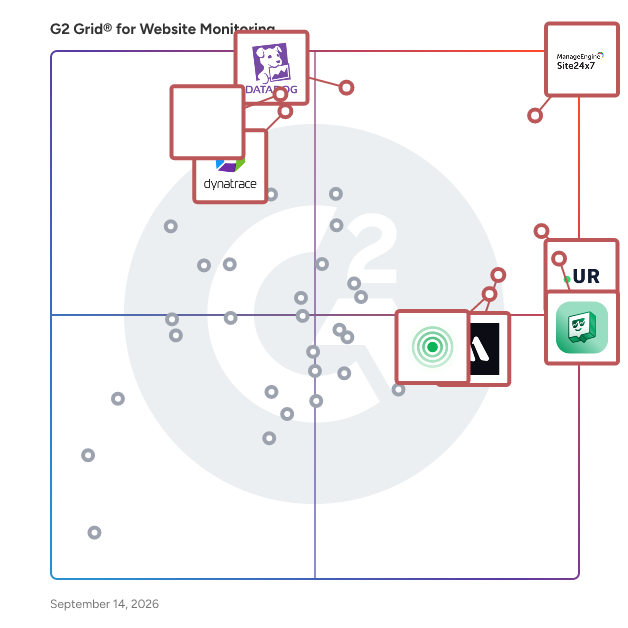
Website monitoring software facilitates the monitoring, testing, alerting, and reporting of website downtime, speed, health, and reliability, enabling website and IT administrators to quickly uncover and diagnose performance issues from a site's external or internal network, servers, email, forms, and flows.
Core Capabilities of Website Monitoring Software
To qualify for inclusion in the Website Monitoring category, a product must:
- Monitor and track web availability metrics such as HTTP, DNS, SMTP, SSH, and PING
- Monitor and track page loading speed metrics such as page load time and time to interactive
- Establish downtime, speed, and performance-related baseline metrics and alert administrators when performance degrades
- Provide visual data and reporting for users to better understand their website downtime and performance metrics
Common Use Cases for Website Monitoring Software
Website and IT administrators use monitoring tools to maintain reliable uptime and strong performance for business-critical sites. Common use cases include:
- Setting up continuous availability monitoring and instant alerts for site downtime or response time degradation
- Tracking page load speed metrics to identify and fix performance bottlenecks
- Generating performance reports to inform infrastructure decisions and demonstrate reliability to stakeholders
How Website Monitoring Software Differs from Other Tools
Website monitoring solutions complement digital experience monitoring (DEM) software, which focuses on optimizing the broader end-user experience. They are also closely related to application performance monitoring (APM) software, which tracks the performance of software or web applications in more technical depth, including code-level diagnostics and distributed tracing that website monitoring tools typically do not provide.
Insights from G2 on Website Monitoring Software
Based on category trends on G2, real-time downtime alerts and visual performance dashboards stand out as the most valued features. Faster incident response and improved uptime stand out as primary outcomes of adoption.