Eclipse Capella
Who Is the Company Behind Eclipse Capella?
- Seller: Obeo
- Year Founded: 2005
- HQ Location: Carquefou, FR
-
LinkedIn® Page: www.linkedin.com
65 employees on LinkedIn®
Total Products under this Category: 58
Last updated: September 22, 2026
Why You Can Trust G2's Software Rankings:
G2's software rankings are built on verified user reviews, rigorous moderation, and a consistent research methodology maintained by a team of analysts and data experts. Each product is measured using the same transparent criteria, with no paid placement or vendor influence. While reviews reflect real user experiences, which can be subjective, they offer valuable insight into how software performs in the hands of professionals. Together, these inputs power the G2 Score, a standardized way to compare tools within every category.
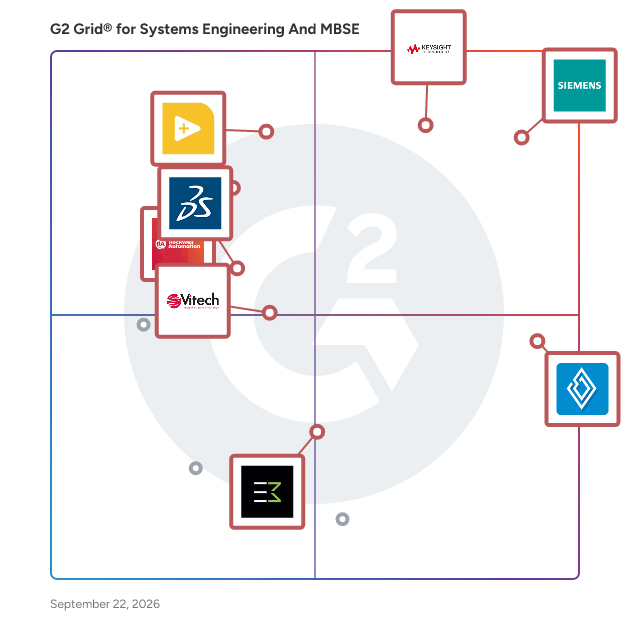
Highlighted products: Simcenter Amesim, PathWave System Design, Innoslate, LabVIEW, Studio 5000, Cameo Systems Modeler, Genesys, and Epsilon3.
Underlying data: [Grid® JSON](https://www.g2.com/categories/systems-engineering-and-mbse/grids.json?focus%5B%5D=simcenter-amesim&focus%5B%5D=pathwave-system-design&focus%5B%5D=innoslate&focus%5B%5D=labview&focus%5B%5D=studio-5000&focus%5B%5D=cameo-systems-modeler&focus%5B%5D=vitech-corporation-genesys&focus%5B%5D=epsilon3)
HBM Prenscia offers a range of solutions for engineers to efficiently transform data into decisions.
IBM Engineering Systems Design Rhapsody is a comprehensive Model-Based Systems Engineering (MBSE tool that enables engineers to design, analyze, and validate complex systems and software. By utilizing industry-standard languages such as UML, SysML, and AUTOSAR, Rhapsody facilitates the creation of visual models that enhance understanding and communication across multidisciplinary teams. Its capabilities include real-time simulation, automatic code generation, and seamless integration with other engineering lifecycle tools, streamlining the development process and ensuring consistency between design and implementation. Rhapsody supports compliance with industry standards like DO-178B/C and ISO 26262, making it suitable for safety-critical applications. By providing a collaborative environment with version control and configuration management, Rhapsody helps teams manage the complexities of modern system development, reducing errors and accelerating time-to-market. Key Features and Functionality: - Model-Based Design: Enables the creation of visual representations of system architectures, behavioral models, and state machines using UML, SysML, and AUTOSAR. - Simulation and Analysis: Allows real-time simulation and analysis of system behavior to validate designs and identify potential issues early in the development process. - Automatic Code Generation: Generates production-quality code in languages such as C, C++, Java, and Ada directly from models, ensuring consistency between design and implementation. - Integration with Engineering Lifecycle Tools: Seamlessly integrates with other IBM Engineering Lifecycle Management tools, including requirements management and workflow management, to provide end-to-end traceability. - Compliance Support: Facilitates adherence to industry standards like DO-178B/C and ISO 26262, essential for safety-critical systems. - Collaborative Development Environment: Supports concurrent work by multiple team members with version control and configuration management, enhancing collaboration and reducing errors. Primary Value and Problem Solved: IBM Engineering Systems Design Rhapsody addresses the challenges of developing complex systems by providing a unified platform for model-based design, simulation, and code generation. It enhances collaboration among multidisciplinary teams, ensures early validation of designs through simulation, and maintains consistency between models and code. By supporting compliance with industry standards, Rhapsody reduces the risk of errors and rework, ultimately accelerating development cycles and improving product quality.
It is an integrated platform offering scalable analysis, saving you time and resources.
MapleMBSE is an Excel-based tool that allows stakeholders across your entire organization to collaborate in the systems engineering process.
With the help of the "Auto Layout" functions, MES Model & Refactor (MoRe) facilitates your daily modeling tasks in Simulink. MoRe simplifies and accelerates model creation and model refactoring. Your MoRe benefits: - Auto Layout: MoRe automates the layout of Simulink models, allowing for a guideline-compliant layout at the touch of a button, and ensuring uniform models for the entire company. - Quality: Create high-quality, readable, and comprehensible models that are easily expandable and maintainable. - Efficiency: Edit and expand models quickly and effectively and welcome changing requirements, even late in development. Fast and easy model changes enable agile development.
The Cadence Palladium Emulation Platform is a high-performance solution for verifying and debugging complex System-on-Chips (SoCs) and systems. Providing unmatched scalability, it handles multi-billion-gate designs with ease, offering superior performance that’s 1.5X faster than its predecessor. With advanced debugging capabilities, including at-speed triggers and modular compilers for rapid turnaround, it ensures efficient analysis without the need for recompilation. The platform supports diverse applications, from in-circuit emulation to dynamic power analysis, making it ideal for early hardware/software co-verification and system-level testing. Accelerate your design cycles and achieve first-pass silicon success with Palladium.
By guiding engineers with appropriate industry standards (including UML, SysML 1, SysML 2, and UAF) and automating repetitive tasks, PTC Modeler reduces development time, effort, and cost. It also simplifies the development process and improves product quality by helping to find potential design problems much earlier.
Altium 365’s Requirements & System Portal (RSP), formerly Valispace, is a collaborative, AI-powered, and cloud-based requirements management and systems engineering solution for agile electronic hardware teams. Requirements & System Portal enables engineers to manage requirements in a centralized, scalable, and flexible tool with an intuitive interface, live collaboration, and full traceability and change history capabilities. Key benefits of Requirements & System Portal: - Minimize rework with up-to-date specifications - Create clearer requirements with AI-assisted automation - Manage complex projects with full requirements traceability Requirements & Systems Portal is organized into six modules: Project, System Design, Requirements, Analyses, Scripting, and Verification & Validations. Additionally, requirements are accessible within supported Altium 365 applications and Altium Designer. The capabilities of Requirements & Systems Portal related to requirements management include: Core features - Centralized Cloud Solution: Move away from spreadsheets and organize requirements in a secure cloud solution with an intuitive interface, live commenting, and full change history. - AI Assistant: Create clearer, smarter requirements in less time. Quickly break down incoming system requirements into clear electrical specifications with an AI assistant. - Live Comments & Alerts: Engage your team's experts in requirement review processes to arrive at the best possible specifications. - Link Requirements to PCB Designs & Schematics: Give engineers constant access to clear system requirements and specifications in the right context. Verify requirements directly on your designs. Changes to requirements automatically sync across your project. - Live Dashboards & Analytics: Monitor project progress and requirement verification status on live dashboards to quickly identify and resolve non-compliant design issues. - Templated Document Export & Shareable Reports: Automatically generate project documentation for compliance. Keep stakeholders informed with self-updating, shareable reports. - Versioning & Change History: Automatically track requirement changes with full version history. Review past edits, keep teams aligned, and ensure traceability and compliance. Advanced features - Parametric Requirements & Continuous Verifications: Turn numerical requirements into parameters. Create verification rules that automatically compare system performance to functional targets. - Complex System & Process Modeling: Model and analyze electrical, mechanical, and software systems-of-systems in a single visual environment. Iterate faster while adhering to best-practice methodologies. - Scripting & Automations: Create smart automations or write scripts to streamline any requirements or systems design-related tasks or customize the tool to your specific needs. - Integrations & Open API: Link systems design, requirements, and verification activities to external tools with our pre-built integrations and open API. - Reusable Requirements & System Data: Kickstart new projects or configure modular product offerings by reusing requirements and system data from existing projects.
Syndeia® is the digital thread platform for integrated digital engineering. It enables engineering teams to collaboratively and concurrently develop and manage a digital thread for any complex system/product by federating models and data from diverse ecosystems of modeling and simulation tools, enterprise applications, and data repositories. This diverse set of tools and repositories includes, for example, SysML modeling tools (e.g., SysML v2, Cameo, Rhapsody, GENESYS), PLM systems (e.g., Teamcenter, Windchill, Aras Innovator), CAD systems (e.g., Solidworks PDM, NX, Creo), ALM systems (e.g., Azure DevOps, GitHub, JIRA, GitLab), Project Management Systems (e.g., JIRA), Requirements Management Systems (e.g.,Polarion, Codebeamer, Jama Connect, DOORS-NG), Simulation tools (e.g., MATLAB/Simulink), Databases (e.g., MySQL, Neo4j), and in general any enterprise data available via a standard REST API.
