# Best Repository Management Software - Page 3

*By [Adam Crivello](https://research.g2.com/insights/author/adam-crivello)*


Repository management software helps development teams create, maintain, and track their software packages. These repository software solutions also provide an administrative component, allowing development teams to curate who gets access to certain packages, as well as tracking how those packages are accessed. More robust repository management software might provide teams with the ability to run static code analysis, vulnerability testing, or other code examinations to ensure all packaged code is stable, resistant to errors, and aligned with a company’s security policies. A repository management solution must integrate with [version control systems](https://www.g2.com/categories/version-control-systems) to be effective.

To qualify for inclusion in the Repository Management category, a product must:

- Manage software packages and components
- Curate package access to different individuals or teams
- Track package deployments
- Integrate with other software development tools


## G2 Grid® for Repository Management Software
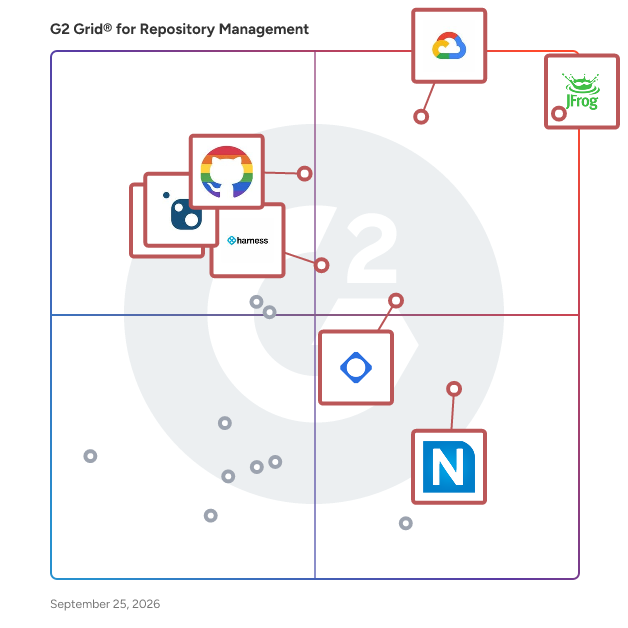
![G2 Grid® for Repository Management Software plotting products by satisfaction and market presence](https://www.g2.com/categories/repository-management/grids.png?focus%5B%5D=143017&focus%5B%5D=1318185&focus%5B%5D=108686&focus%5B%5D=73922&focus%5B%5D=108055&focus%5B%5D=3937&focus%5B%5D=108053&focus%5B%5D=108054)
Highlighted products: JFrog, Google Artifact Registry, Github Package Registry, Cloudsmith, NuGet, Ninite, Azure Artifacts, and Chocolatey.
Underlying data: [Grid® JSON](https://www.g2.com/categories/repository-management/grids.json?focus%5B%5D=jfrog-2024-03-28&amp;focus%5B%5D=google-artifact-registry&amp;focus%5B%5D=github-package-registry&amp;focus%5B%5D=cloudsmith&amp;focus%5B%5D=nuget&amp;focus%5B%5D=ninite&amp;focus%5B%5D=azure-artifacts&amp;focus%5B%5D=chocolatey)


## How Many Repository Management Software Products Does G2 Track?
**Total Products under this Category:** 34

### Category Stats (Jul 2026)
- **Average Rating**: 4.45/5 The average rating of products in this category, based on all submitted ratings
- **Top Trending Product**: Harness Platform (+0.22%) - Among all products in this category, Harness Platform recorded the largest rating increase compared to last month
*Last updated: July 14, 2026*


## How Does G2 Rank Repository Management Software Products?

**Why You Can Trust G2's Software Rankings:**

- 30 Analysts and Data Experts
- 1,300+ Authentic Reviews
- 34+ Products
- Unbiased Rankings

G2's software rankings are built on verified user reviews, rigorous moderation, and a consistent research methodology maintained by a team of analysts and data experts. Each product is measured using the same transparent criteria, with no paid placement or vendor influence. While reviews reflect real user experiences, which can be subjective, they offer valuable insight into how software performs in the hands of professionals. Together, these inputs power the G2 Score, a standardized way to compare tools within every category.


## Which Repository Management Software Is Best for Your Use Case?

- **Leader:** [JFrog](https://www.g2.com/products/jfrog-2024-03-28/reviews)
- **Highest Performer:** [Ninite](https://www.g2.com/products/ninite/reviews)
- **Easiest to Use:** [Ninite](https://www.g2.com/products/ninite/reviews)
- **Top Trending:** [Cloudsmith](https://www.g2.com/products/cloudsmith/reviews)
- **Best Free Software:** [JFrog](https://www.g2.com/products/jfrog-2024-03-28/reviews)


---

**Sponsored**

### LoadView

LoadView is a fully managed, cloud-based load and performance testing platform that helps DevOps teams, QA professionals, and performance engineers ensure their websites, web applications, APIs, and streaming media can handle real-world traffic without slowing down or crashing. By simulating from a handful to hundreds of thousands of concurrent users, it reveals exactly how your systems behave under pressure—so you can fix bottlenecks before customers notice. What sets LoadView apart is that it runs tests in real browsers, not just simple HTTP requests. While many tools only measure raw server response times, LoadView reproduces the complete user experience—loading pages, executing JavaScript, rendering dynamic content, and interacting with your application exactly as a genuine visitor would. This produces performance data reflecting what users actually feel—accurate, actionable results. Building realistic test scenarios is fast and code-free thanks to the EveryStep Web Recorder. Simply click through your site or application—log in, search, add to cart, check out—and EveryStep captures every action into a reusable script you can replay across more than 40 desktop and mobile browser and device combinations, without writing a single line of code. For teams with existing assets, LoadView natively supports Postman Collections, JMeter scripts, and Selenium scripts, so you can reuse prior work and scale it into full load tests instantly. LoadView gives you precise control over how load is applied through flexible load curve options. The Load Step Curve ramps users up and down in defined increments to observe behavior at each level. The Goal-Based Curve targets a specific number of concurrent sessions—ideal for validating against a known traffic goal. The Dynamic Adjustable Curve lets you change load on the fly during a live test. With unlimited parallel testing, you can model everything from a gradual build to a sudden spike from a launch, flash sale, or viral moment. Running on a global cloud network, LoadView generates load from numerous geographic locations worldwide via leading providers like AWS and Azure, measuring performance the way real users in each region experience it. The infrastructure is fully managed—no servers to provision, no load generators to configure, and no hardware to maintain. For applications that aren&#39;t publicly accessible, the on-premise agent and behind-the-firewall testing options let you safely load test internal sites and pre-production environments without exposing them to the open internet. After each test, LoadView delivers detailed, easy-to-read performance reports with metrics like average response time, sessions per second, error rates, and waterfall charts that break down every element on a page. Performance data is correlated against your user load, so you can pinpoint the exact moment and component where problems begin—key insight for capacity planning, SLA validation, and continuous improvement. LoadView also integrates with CI/CD pipelines, letting you automate performance testing as part of your release process. LoadView serves organizations of every size, from startups to large enterprises across ecommerce, financial services, healthcare, government, education, and media. Common use cases include preparing for high-traffic events, validating launches, stress-testing APIs and chat apps, and ensuring platforms like Salesforce hold up under load. Pricing is flexible and transparent. A zero-commitment, pay-as-you-go on-demand plan is perfect for occasional tests, while monthly and annual subscriptions suit teams with ongoing needs and include rollover of unused resources. Custom enterprise plans add dedicated performance engineering, SSO, and advanced account management. Every new account starts with free tests and no contract.


[Visit website](https://www.g2.com/external_clickthroughs/record?secure%5Bad_program%5D=ppc&amp;secure%5Bad_slot%5D=category_product_list&amp;secure%5Bcategory_id%5D=1992&amp;secure%5Bchosen_at%5D=2026-07-14T08%3A41%3A34Z&amp;secure%5Bdisplayable_resource_id%5D=1744&amp;secure%5Bdisplayable_resource_type%5D=Category&amp;secure%5Bmedium%5D=sponsored&amp;secure%5Bplacement_reason%5D=retargeted_product&amp;secure%5Bplacement_resource_ids%5D%5B%5D=118758&amp;secure%5Bprioritized%5D=false&amp;secure%5Bproduct_id%5D=118758&amp;secure%5Bresource_id%5D=1992&amp;secure%5Bresource_type%5D=Category&amp;secure%5Bsource_type%5D=category_page&amp;secure%5Bsource_url%5D=https%3A%2F%2Fwww.g2.com%2Fcategories%2Frepository-management%3Fpage%3D3&amp;secure%5Btoken%5D=15560dcc399802563a74038f36b4954b37eeeff563adbdc611c51546fec9bb7d&amp;secure%5Burl%5D=https%3A%2F%2Fwww2.loadview-testing.com%2Flanding.aspx%3Fse%3Db49d88786f8e45f583d5dbe617632ae2&amp;secure%5Burl_type%5D=custom_url)

---


## What Is Repository Management Software?

[Development Software](https://www.g2.com/categories/development)

## What Software Categories Are Similar to Repository Management Software?

- [Container Registry Software](https://www.g2.com/categories/container-registry)


---

## How Do You Choose the Right Repository Management Software?

### What You Should Know About Repository Management Software?

### What is Repository Management Software?

Repository management software, or package management solutions, grant developers insight and control over their software packages. With repository management software, developers have a centralized hub to create, manage, and track their software packages. Team leads can optimize the development workflow by assigning out tasks within repository management software to curate an organized pipeline. Effective repository management software integrates with [version control systems](https://www.g2.com/categories/version-control-systems) that track changes to software projects and make team collaboration possible.

Repository software is vital for the smooth development and deployment of software packages. Without it, development teams can find themselves facing deployment issues and messy pipelines. Repository management software grants tracking capabilities that give developers access to actionable post-deployment data. This insight puts developers at the front line of deployment issues and facilitates efficient responses to deployment issues. Repository management software ensures package management doesn’t become a headache for developers.

Key Benefits of Repository Management Software

- Efficient workflows
- Team accountability
- Clear task assignments
- Pipeline transparency
- Post-deployment insight

### Why Use Repository Management Software?

**Organized collaboration —** Repository management software compartmentalizes tasks surrounding package creation, deployment and management. Teams can divide and conquer to maximize productivity.

**Full visibility —** Repository management software gives development teams a comprehensive view of their package development and monitoring pipeline; developers benefit from enhanced transparency.

**Deployment management —** Development teams benefit from the post-deployment package tracking functionality granted by repository management software. With repository management software, developers can track actionable data about their deployed packages to efficiently address issues.

**Complete control —** Developers using repository management software have a standardized tool kit that centralizes every aspect of their software packages. This framework grants teams total control over their packages, helping eliminate barriers like duplicates and conflicting builds.

### Who Uses Repository Management Software?

**Software developers —** Developers use repository management software to manage their software package development pipelines. Solo developers benefit from keeping all of their package development and deployment in one centralized hub, while developers working on teams have a transparent view of their package-oriented tasks.

**Development team leads —** Development team leads use repository management software to keep their teams organized and efficient. Using repository management software, team leads can assign out package-oriented tasks, track progress, and comprehensively manage the package development and deployment pipeline.

### Repository Management Software Features

**Package creation —** Developers use repository management software as a centralized hub to create software packages.

**Package management —** Repository management software gives developers a complete framework for maintaining, tweaking, and removing software packages. Development team leads can manage packages by curating package access and task assignments in the team.

**Package access control —** Repository management software allows leaders to dictate which team members have access to each package. This structure enables efficient planning and task management.

**Package tracking —** With repository management software, development teams can track package downloads to keep tabs on engagement. Developers can view stats like total download count, downloads by user, high traffic locations, and more.

### Trends Related to Repository Management Software

**DevOps —** DevOps refers to the marriage of development and IT operations management to facilitate unified software development pipelines. Teams have implemented DevOps best practices to build, test, and release software more reliably and efficiently. Repository management software enhances team collaboration and organization functionality that DevOps succeeds on.

**Continuous integration and deployment (CI/CD) —** Continuous integration and deployment (CI/CD) is the current standard in DevOps best practices. Developers use the principles of CI/CD to curate a smooth development pipeline. A proper CI/CD pipeline involves constantly planning, building, testing, and deploying software while ensuring compliance with project goals and requirements. Repository management software aids the CI/CD pipeline by managing package lifecycles from planning, to deployment, to updating software packages.

### Software and Services Related to Repository Management Software

[**Software composition analysis solutions**](https://www.g2.com/categories/software-composition-analysis) **—** Software composition analysis solutions enable developers to track and analyze open source components of their applications. Developers use software composition analysis and repository management software to ensure third-party elements of their packages are updated and secured.

[**Vulnerability scanner software**](https://www.g2.com/categories/vulnerability-scanner) **—** Vulnerability scanner software, similar to software composition analysis solutions, constantly monitors applications to identify security vulnerabilities.

[**Version control systems**](https://www.g2.com/categories/version-control-systems) **—** Version control systems track changes to software development projects, enabling smooth collaboration in development teams. Version control systems are an essential component for using repository management software. They facilitate functional teamwork on package development and deployment.

[**Continuous integration software**](https://www.g2.com/categories/continuous-integration) **—** Continuous integration software facilitates the process of frequently building and testing each change made to a codebase. With continuous integration software, developers ensure sound code and functional features via automatic software testing. Repository management software ensures that software package development is well-managed throughout the continuous integration process.

[**Continuous delivery software**](https://www.g2.com/categories/continuous-delivery) **—** Continuous delivery software helps developers create deployment-ready code as efficiently as possible. These systems extend beyond the principles of continuous integration by fully staging new software and updates, though they do not automatically deploy software. Continuous deployment software facilitates short development cycles, making repository management software vital to ensuring developers can manage all aspects of their packages efficiently.


---
## What Are the Most Common Questions About Repository Management Software?
*AI-generated · Last updated: June  3, 2026*
### Which Repository Management platforms avoid common adoption failures after initial deployment in regulated industries where
According to verified users, adoption success in repository management depends less on industry labels and more on day-two usability. Recent reviews repeatedly highlight easier onboarding, intuitive interfaces, straightforward setup, clear permissions, and tight CI/CD integrations as factors that reduce rollout friction. Reviewers also point to common failure risks such as steep learning curves, complex configuration, confusing access controls, pricing friction, and heavy administration in larger environments. For teams with stricter governance needs, users consistently value centralized artifact control, traceability, policy enforcement, and reliable package distribution. In the recent review set, products with stronger adoption signals are those described as easier to implement, simpler to manage, or better aligned with automated workflows.


### Which Repository Management platforms integrate seamlessly with existing enterprise systems for organizations comparing vendors
According to verified users, integration fit usually shows up in CI/CD, cloud, package, and access-control workflows rather than in generic vendor claims. Recent reviews most often mention smooth connections with tools such as GitHub Actions, Jenkins, Cloud Build, Cloud Run, Kubernetes, Helm, Terraform, and broader enterprise delivery environments. Buyers comparing options should look for consistent themes like centralized artifact storage, support for multiple package formats, security and policy controls, and reduced manual steps across build and release pipelines. Users also flag integration drawbacks when setup is confusing, permissions are difficult to manage, or advanced workflows require significant tuning, so implementation effort remains an important comparison point.


### Repository Management solutions that code repository without requiring extensive training or setup
G2 reviewers mention that lower-effort repository management tools are usually described with phrases like easy to set up, intuitive UI, straightforward workflow integration, and minimal maintenance. In the recent reviews, buyers praise solutions that centralize packages and artifacts without forcing teams to manage too many moving parts early on. The strongest ease-of-adoption themes include simple onboarding, clean interfaces, direct CI/CD connections, and support for common package formats in one place. At the same time, reviewers warn that some platforms become harder to learn when configuration, permissions, repository structure, or advanced enterprise features grow more complex. For teams prioritizing fast rollout, usability and setup consistency are recurring decision factors.


### What are the most important features in repository management software
According to verified users, the most important features in repository management software are centralized artifact storage, version control, dependency management, support for multiple package formats, and integration with CI/CD pipelines. Recent reviews also emphasize access controls, security scanning, caching, traceability, and virtual or unified repositories that simplify how teams pull and publish packages. Buyers often value reliable handling of container images, libraries, binaries, and internal packages from a single location. Ease of setup and administration also matter because reviewers frequently mention that powerful feature depth can come with a steeper learning curve. In practice, users favor tools that balance broad repository support, governance, and automation without adding unnecessary operational friction.


### How do teams use Repository Management for CI/CD pipelines
According to verified users, teams use repository management in CI/CD pipelines to store build artifacts, cache dependencies, publish packages, and keep releases consistent across environments. Recent reviews describe teams linking repositories to build and deployment workflows so they can pull approved components faster, reduce version mismatches, and troubleshoot with clearer traceability. Reviewers also mention using these tools to manage container images, private packages, and centralized binary storage while improving governance over what moves into production. In day-to-day use, repository management supports automation by reducing manual handling of dependencies and by giving development teams a reliable source for packages, images, and release assets throughout the software delivery lifecycle.


