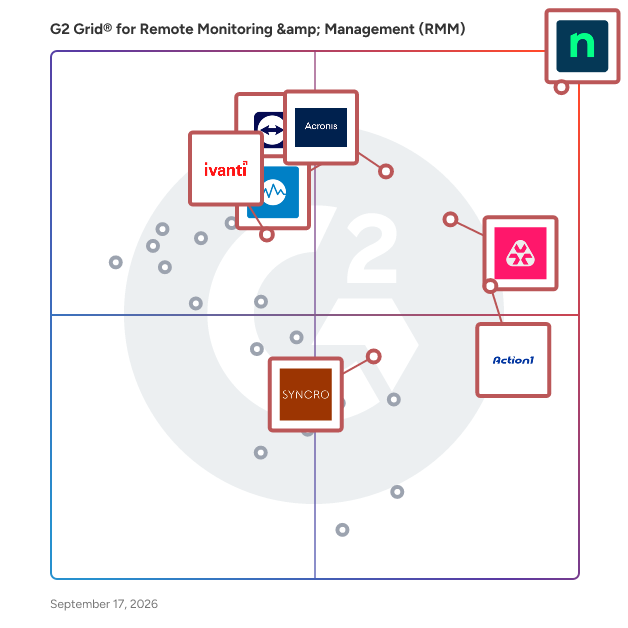
Remote monitoring and management (RMM) software allows IT teams and managed service providers (MSPs) to remotely oversee, control, and maintain systems, networks, and devices from a centralized dashboard, enabling proactive issue detection, automated remediation, and efficient management of distributed IT infrastructures without requiring on-site access.
Core Capabilities of RMM Software
To qualify for inclusion in the Remote Monitoring and Management (RMM) category, a product must:
- Monitor IT assets such as endpoints, servers, mobile devices, and applications
- Provide basic network visibility such as endpoint connectivity and uptime checks
- Discover and track IT-related issues through automated alerting and thresholds
- Provide secure remote access and control of endpoints for diagnostics, maintenance, and user support without physical presence
- Support the automation of recurring IT maintenance tasks such as deploying scripts, managing services, or executing batch operations across multiple endpoints
- Support patch management for OS and application updates
- Provide asset inventory and configuration management
- Generate real-time alerts and notifications
- Offer centralized dashboards and reporting tools
Common Use Cases for RMM Software
Internal IT departments and MSPs use RMM software to maintain continuous system performance and address issues before they impact users. Common use cases include:
- Monitoring distributed endpoints and servers from a single dashboard to ensure uptime and performance
- Automating patch deployment and routine maintenance tasks across multiple devices without manual intervention
- Proactively detecting and remediating issues before they escalate into outages or service disruptions
How RMM Software Differs from Other Tools
RMM tools work in the background monitoring systems and handling routine maintenance, while help desk software and service desk software manage user-facing communication and issue tracking. RMM platforms often integrate directly with these tools so that performance data, alerts, and asset details automatically feed into ticketing systems, creating a proactive, data-driven approach to IT service management when the two are paired together.
Insights from G2 on RMM Software
Based on category trends on G2, remote endpoint access and automated patch management stand out as the most valued capabilities. These platforms deliver reductions in on-site support visits and improved mean time to resolution as primary outcomes of adoption.