Mavvrik
Who Is the Company Behind Mavvrik?
- Seller: Mavvrik
- HQ Location: Texas, Arkansas, United States
-
LinkedIn® Page: www.linkedin.com
39 employees on LinkedIn®
Last updated: April 9, 2026
Total Products under this Category: 377
Last updated: November 01, 2026
Why You Can Trust G2's Software Rankings:
G2's software rankings are built on verified user reviews, rigorous moderation, and a consistent research methodology maintained by a team of analysts and data experts. Each product is measured using the same transparent criteria, with no paid placement or vendor influence. While reviews reflect real user experiences, which can be subjective, they offer valuable insight into how software performs in the hands of professionals. Together, these inputs power the G2 Score, a standardized way to compare tools within every category.
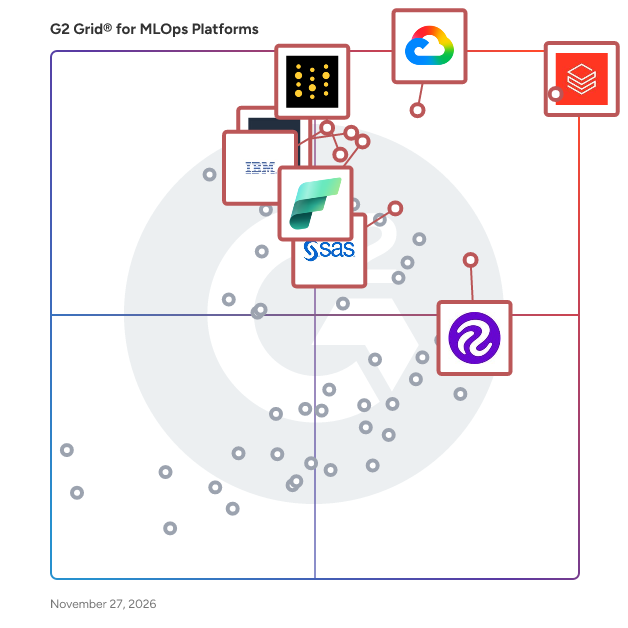
Highlighted products: Databricks, Gemini platform, Microsoft Fabric, Amazon SageMaker, Roboflow, IBM watsonx.ai, Weights & Biases, and SAS Viya.
Underlying data: [Grid® JSON](https://www.g2.com/categories/mlops-platforms/grids.json?focus%5B%5D=databricks&focus%5B%5D=gemini-platform&focus%5B%5D=microsoft-fabric&focus%5B%5D=amazon-sagemaker&focus%5B%5D=roboflow&focus%5B%5D=ibm-watsonx-ai&focus%5B%5D=weights-biases&focus%5B%5D=sas-sas-viya)
MCP Analytics answers business and statistical questions about your data, at the depth each question needs. Answer: a quick question about your data, read from all of it, shown with how we got it. Analytics: a question that needs more than an answer. A tested statistical method runs on your data, and you get charts and a written report. Custom Analytics: a question only your business asks. An analysis built for your data that you can re-run on next month's file. Every report names its method and the code that ran, so the numbers can be cited and checked. Free tools let you try a method on your own file without an account. You can also use MCP Analytics from inside an AI chat that supports MCP, with an API key.
Mindpool AI is an innovative platform that enables users to interact with multiple leading AI language models through a single prompt, providing diverse and comprehensive responses to their queries. By integrating models such as GPT-4, Claude, and Gemini, Mindpool AI offers a unified interface that simplifies access to advanced AI capabilities, catering to various needs ranging from research and creative writing to marketing idea generation. Key Features and Functionality: - Multi-Model Access: Users can simultaneously query multiple AI models, allowing for comparison and selection of the most suitable responses for their specific use cases. - Data Privacy and Security: Mindpool AI employs "pass-through" APIs, ensuring that user data is not stored or used for training purposes. Outputs are private, and users have full control over their data, with the ability to delete it by clearing browser cookies. - Enhanced Output Quality: By leveraging various AI models, Mindpool AI helps mitigate issues like biases and inaccuracies ("hallucinations") that can occur in individual models, leading to more reliable and accurate responses. - User-Friendly Interface: The platform offers a simple and intuitive interface, making it accessible to users with varying levels of technical expertise. Primary Value and User Solutions: Mindpool AI addresses the challenge of selecting the most appropriate AI model for specific tasks by providing a platform where users can compare outputs from multiple models. This approach ensures that users receive the most accurate and relevant information, enhancing productivity and creativity. Additionally, the platform's commitment to data privacy and security alleviates concerns about data misuse, allowing users to interact with AI confidently. By simplifying access to advanced AI technologies, Mindpool AI empowers users to harness the full potential of generative AI for their personal and professional endeavors.
Connect G2 to Claude or ChatGPT for answers grounded in G2's trusted reviews, comparisons, and pricing from real user insights.
Minitab Model Ops is a machine learning operations (MLOps) platform that helps teams deploy predictive models, make their predictions available to applications, and monitor performance in production. It is intended for business analysts, engineers, data science teams, and organizations that need to use models beyond the development stage. Users can import supported models into a central repository and create deployments that expose predictions through API endpoints. Models developed in Minitab Statistical Software can be published to Model Ops, and predictions can be incorporated into other business applications. Teams can use Minitab Connect to send new data for scoring and return the predictions to a data table. This supports use cases such as process decisions, forecasting, and other workflows that rely on current model outputs. Key capabilities include: - A model repository for importing, organizing, deploying, and removing supported models. - API endpoints for serving predictions to connected applications and workflows. - Drift and stability reports for evaluating changes in model inputs and performance over time. - Alerts and deployment metrics, including model status, uptime, and response time. - API keys, user roles, and audit logs for controlling access and tracking changes. Model Ops supports champion and challenger models, allowing teams to compare alternatives within a deployment. Users can set thresholds and receive notifications when a model needs attention. The platform helps teams decide when to investigate, retrain, or replace a model as conditions change. It runs online and provides browser-based access to deployment and monitoring information. Minitab offers product documentation and tutorials for setting up integrations, managing deployments, and interpreting monitoring reports.
MLflow is an open-source platform designed to streamline the end-to-end machine learning (ML) lifecycle, addressing challenges in model development, deployment, and management. It offers a suite of tools that enhance collaboration among ML practitioners, ensuring that projects are robust, transparent, and ready for real-world applications. Key Features and Functionality: - Experiment Tracking: Provides APIs and a user interface to log parameters, code versions, metrics, and artifacts during the ML process, facilitating easy comparison of multiple runs across different users. - Model Registry: Offers a centralized model store with APIs and a UI to manage the full lifecycle of MLflow Models, including versioning, aliasing, tagging, and annotations. - MLflow Deployments for LLMs: Equipped with standardized APIs, this server streamlines access to both SaaS and open-source large language models (LLMs), enhancing security through authenticated access. - Evaluate: Provides tools for in-depth model analysis, enabling objective comparison of models, whether they are traditional ML algorithms or cutting-edge LLMs. - Prompt Engineering UI: A dedicated environment for prompt engineering, allowing for experimentation, refinement, evaluation, testing, and deployment of prompts. - Recipes: Guides for structuring ML projects, focusing on delivering functional end results optimized for real-world deployment scenarios. - Projects: Standardizes the packaging of ML code, workflows, and artifacts, employing descriptors or conventions to define dependencies and execution methods. Primary Value and Problem Solved: MLflow addresses the complexities inherent in the ML lifecycle by providing a unified platform that ensures efficiency, consistency, and traceability. By integrating core components like experiment tracking, model registry, and deployment tools, MLflow enables teams to navigate the intricate processes of model development and management seamlessly. This comprehensive approach fosters innovation, enhances collaboration, and accelerates the deployment of high-quality ML solutions.
mlop is an open-source platform designed to streamline the tracking, optimization, and collaboration of machine learning experiments. Tailored for modern teams, it offers a comprehensive suite of tools that enhance the efficiency and effectiveness of ML operations. By providing real-time insights and actionable recommendations, mlop empowers users to improve model performance and reduce computational costs. Key Features and Functionality: - Experiment Tracking: Monitor and compare experiments with detailed metrics, parameters, and artifacts, ensuring a complete history of model development. - Advanced Visualization: Utilize interactive dashboards for real-time monitoring of training progress and model performance analysis. - Real-Time Alerts: Receive immediate notifications about model performance issues, enabling prompt interventions to prevent resource wastage. - Seamless Integration: Easily connect with existing codebases and development workflows, including compatibility with tools like PyTorch Lightning and Hugging Face Transformers. - Open Source and High Performance: Built for speed and scalability, mlop handles large datasets and complex models efficiently, with a community-driven development approach. Primary Value and Solutions: mlop addresses the challenges of managing machine learning experiments by offering a centralized platform that not only logs metrics but also provides actionable insights to enhance model performance. Its real-time alerting system helps users identify and resolve issues promptly, saving valuable computational resources. The platform's seamless integration capabilities ensure that teams can incorporate mlop into their existing workflows without disruption. By focusing on performance and user-friendly design, mlop enables machine learning teams to build, track, and deploy models with confidence and efficiency.
MLRun is an open-source MLOps orchestration framework designed to streamline the development, deployment, and management of machine learning models. It provides a unified platform that integrates with various tools and frameworks, enabling data scientists and engineers to build, train, and deploy models efficiently. MLRun simplifies the complexities of the machine learning lifecycle by offering a cohesive environment for collaboration and automation. Key features and functionality of MLRun include: - Automated Pipeline Orchestration: Facilitates the creation and management of end-to-end machine learning pipelines, automating tasks from data ingestion to model deployment. - Scalability: Supports scalable execution of workloads, allowing users to handle large datasets and complex computations seamlessly. - Version Control: Provides robust versioning for code, data, and models, ensuring reproducibility and traceability throughout the development process. - Integration with Popular Tools: Seamlessly integrates with widely-used machine learning frameworks and tools, enhancing flexibility and compatibility. - Real-time Monitoring and Logging: Offers comprehensive monitoring and logging capabilities, enabling users to track performance metrics and debug issues effectively. The primary value of MLRun lies in its ability to accelerate the machine learning development cycle by automating routine tasks and providing a collaborative environment. It addresses common challenges such as managing dependencies, ensuring reproducibility, and scaling operations, thereby allowing teams to focus on innovation and delivering high-quality models to production efficiently.
MLtraq is an open-source Python library designed for machine learning (ML) and artificial intelligence (AI) developers to efficiently design, execute, and share experiments. It offers a streamlined approach to tracking, streaming, reproducing, collaborating, and resuming computational states across various environments. Key Features and Functionality: - Immediate Execution: Allows for the design and execution of experiments with minimal code, facilitating real-time metric streaming. - Collaborative Environment: Enables seamless backup, merging, sharing, and reloading of experiments, ensuring computational states can be resumed anywhere. - Interoperability: Provides access to experiments using Python, Pandas, and SQL, supporting native database types and open formats to prevent vendor lock-in. - Flexibility: Supports tracking of native Python data types and structures, including NumPy, Pandas, and PyArrow objects. - Lightweight Design: Features a minimal dependency layer that can operate in various environments and complement other components or services. Primary Value and User Solutions: MLtraq addresses the need for a fast and flexible experiment tracking solution in the ML and AI domains. By offering extreme tracking capabilities and promoting collaboration through its interoperable and open design, it empowers developers to efficiently manage and share their experiments without the constraints of vendor-specific platforms. This enhances productivity and facilitates a more streamlined workflow in ML and AI development projects.
ModelFormatConvert is a versatile software tool designed to streamline the conversion of 3D model files across various formats, facilitating seamless interoperability between different 3D modeling applications. It supports a wide range of file formats, including OBJ, STL, FBX, and more, ensuring compatibility with numerous industry-standard software. The intuitive interface allows users to effortlessly upload and convert files, preserving the integrity and quality of the original models. Additionally, ModelFormatConvert offers batch processing capabilities, enabling the conversion of multiple files simultaneously, thereby enhancing productivity. By simplifying the often complex process of format conversion, ModelFormatConvert addresses the common challenge of file incompatibility, allowing designers, engineers, and 3D artists to focus on their creative work without technical hindrances.
Modzy accelerates the deployment, integration, and governance of production-ready AI. With integrations for the leading data science and DevOps tools, teams count on Modzy to quickly and easily build AI-enabled applications in a standard, repeatable, and secure way. By leveraging Modzy as a central location for monitoring all AI across the enterprise or at the edge, leaders can establish governance and security while generating higher returns from AI: 🚀 Get your AI initiatives to market faster by launching new models in minutes, not months 💰 Cut your AI cloud costs by right-sizing your AI hardware footprint 🛡️ Protect your AI models from cyber threats and sophisticated adversarial attacks ☁️ Stop slow, expensive data transfers by running your AI workloads anywhere: In the cloud, at the data center, or at the edge Modzy was founded in 2019 with a clear purpose: Build a world where people and machines working together—outperform either working alone. Our company, based in Vienna, VA, serves fortune 500 customers in energy and utilities, telecom, manufacturing, life sciences, and the public sector.
Model governance software for AI, statistical models, and everything in between. Your business needs a consistent approach to model governance for informed decisions, risk management, and performance visibility. With Monitaur, you can implement responsible and ethical governance from policy to proof for internal and external stakeholders, including technical teams, business owners, regulators, and auditors.
Non finito is a comprehensive platform designed to facilitate the comparison and evaluation of multimodal models, enabling users to assess various AI models' performance across diverse tasks. It offers a suite of tools and features that allow for in-depth analysis and benchmarking, catering to both researchers and practitioners in the field of artificial intelligence. Key Features and Functionality: - Model Comparison: Users can compare multiple multimodal models side by side, evaluating their outputs on identical inputs to discern performance differences. - Public Evaluations: Access to a repository of public evaluations allows users to review existing assessments and gain insights into model capabilities. - Custom Evaluations: Registered users have the ability to create and manage their own evaluations, tailoring assessments to specific needs and criteria. - Diverse Evaluation Examples: The platform provides a range of example evaluations, including tasks like entity tracking, logical reasoning, real-world question answering, visual deductive reasoning, and more, showcasing the versatility of the models. Primary Value and User Solutions: Non finito addresses the need for a centralized, user-friendly platform where AI models can be systematically evaluated and compared. By offering tools for both public and custom evaluations, it empowers users to make informed decisions about model selection and application. The platform's emphasis on multimodal evaluations ensures that users can assess models' performance across various data types and tasks, enhancing the development and deployment of AI solutions.
NannyML is an open-source Python library designed to monitor and maintain the performance of machine learning models in production environments, even when ground truth labels are delayed or unavailable. By estimating model performance without access to target data, NannyML enables data scientists and ML engineers to detect and address issues such as data drift and concept drift, ensuring that models continue to deliver accurate and reliable predictions over time. Key Features and Functionality: - Performance Estimation Without Labels: Utilizes advanced statistical techniques like Confidence-Based Performance Estimation (CBPE) and Direct Loss Estimation (DLE) to estimate classification and regression metrics in real-time, without requiring actual outcomes. - Data Drift Detection: Monitors changes in input data distributions at both feature and dataset levels, employing metrics such as Jensen-Shannon divergence and Wasserstein distance to identify shifts that may impact model performance. - Concept Drift Detection: Measures the impact of concept drift on model performance, providing insights into when retraining may be necessary. - Root Cause Analysis: Links data drift alerts to specific features, enabling rapid identification of the factors contributing to performance degradation. - Business Impact Assessment: Allows users to define cost-benefit matrices to quantify the monetary or business-oriented outcomes of model performance, ensuring alignment with organizational objectives. - Automated Monitoring and Alerting: Provides intelligent alerting systems that focus on performance-impacting issues, reducing false alarms and alert fatigue. - Integration and Deployment: Offers seamless integration with existing MLOps pipelines and can be deployed within an organization's cloud infrastructure for enhanced security and control. Primary Value and Problem Solved: NannyML addresses the critical challenge of maintaining machine learning model performance in production settings where ground truth labels are often delayed or absent. By enabling real-time performance estimation and drift detection without the need for actual outcomes, NannyML empowers data science teams to proactively identify and resolve issues that could lead to model degradation. This proactive monitoring ensures that models continue to provide accurate predictions, thereby preserving their business value and supporting informed decision-making processes. Additionally, by reducing false alarms and focusing on performance-impacting changes, NannyML helps teams avoid alert fatigue and allocate resources more effectively.
