# Best Generative AI Infrastructure Software - Page 9

*By [Bijou Barry](https://research.g2.com/insights/author/bijou-barry)*


Generative AI infrastructure software provides the scalable, secure, and high-performance environment needed to train, deploy, and manage generative models such as large language models (LLMs). These tools address challenges related to model scalability, inference speed, availability, and resource optimization to support production-grade generative AI workloads.

### Core Capabilities of Generative AI Infrastructure Software

To qualify for inclusion in the Generative AI Infrastructure category, a product must:

- Provide scalable options for model training and inference
- Offer a transparent and flexible pricing model for computational resources and API calls
- Enable secure data handling through features like data encryption and GDPR compliance
- Support easy integration into existing data pipelines and workflows, preferably through APIs or pre-built connectors

### Common Use Cases for Generative AI Infrastructure Software

- Training large language models (LLMs) or fine-tuning existing models using scalable compute resources.
- Running high-performance inference for chatbots, virtual assistants, content generation tools, and other AI-powered applications.
- Deploying generative AI models into production with reliable autoscaling, load balancing, and monitoring capabilities.
- Supporting hybrid or on-premises deployments for organizations with strict data residency or security requirements.
- Integrating generative AI capabilities into existing data pipelines using APIs, connectors, or SDKs.
- Managing compute costs through transparent pricing, resource optimization, and usage-based billing models.
- Ensuring secure handling of sensitive data with encryption, access controls, private environments, and compliance features.
- Running continuous experimentation, evaluation, and A/B testing for generative model improvements.
- Building custom applications, such as summarization engines, code assistants, or generative design tools, on top of pre-trained foundation models.

### How Generative AI Infrastructure Software Differs from Other Tools

Generative AI infrastructure software differs from broader cloud computing or machine learning platforms by focusing on the specialized needs of generative models, including optimized training environments, fine-tuning support, and robust security for sensitive data. Unlike other generative AI tools that provide pre-built applications, these solutions deliver the underlying infrastructure developers and engineers require to build custom generative AI systems.

### Insights from G2 on Generative AI Infrastructure Software

Based on category trends on G2, strong performance, reliability, and flexible deployment models, noting that access to pre-trained models, fine-tuning capabilities, and real-time monitoring help accelerate development while maintaining operational control.


## Top Generative AI Infrastructure Software at a Glance
| # | Product | Rating | Best For | What Users Say |
|---|---------|--------|----------|----------------|
| 1 | [Gemini Enterprise Agent Platform](https://www.g2.com/products/gemini-enterprise-agent-platform/reviews) | 4.3/5.0 (652 reviews) | Google-native end-to-end agentic AI deployment | "[Vertex AI Streamlines ML Training and Deployment with a Unified, Feature-Rich Platform](https://www.g2.com/survey_responses/gemini-enterprise-agent-platform-review-12437893)" |
| 2 | [Databricks](https://www.g2.com/products/databricks/reviews) | 4.6/5.0 (1,284 reviews) | Unified Lakehouse for end-to-end GenAI pipelines | "[Great Spark Scaling, But Slow Cluster Boot Times](https://www.g2.com/survey_responses/databricks-review-12905667)" |
| 3 | [AWS Bedrock](https://www.g2.com/products/aws-bedrock/reviews) | 4.3/5.0 (71 reviews) | Multi-model GenAI deployment inside AWS ecosystem | "[Amazon Bedrock Simplifies Enterprise GenAI with Secure, Scalable Access to Multiple Models](https://www.g2.com/survey_responses/aws-bedrock-review-12869177)" |
| 4 | [Google Cloud AI Infrastructure](https://www.g2.com/products/google-cloud-ai-infrastructure/reviews) | 4.5/5.0 (45 reviews) | TPU/GPU-accelerated generative AI model lifecycle | "[Excellent toolbox for AI implementation in the cloud](https://www.g2.com/survey_responses/google-cloud-ai-infrastructure-review-11775940)" |
| 5 | [IBM watsonx.ai](https://www.g2.com/products/ibm-watsonx-ai/reviews) | 4.4/5.0 (133 reviews) | Governed end-to-end generative AI lifecycle | "[Enterprise-Ready AI with Strong Governance and Flexible Model Support](https://www.g2.com/survey_responses/ibm-watsonx-ai-review-12773148)" |
| 6 | [Wirestock](https://www.g2.com/products/wirestock/reviews) | 4.9/5.0 (29 reviews) | Ethically-sourced visual AI training data distribution | "[Streamlined Workflow, Quality Content and a Truly Supportive Wirestock Team](https://www.g2.com/survey_responses/wirestock-review-12634326)" |
| 7 | [Langchain](https://www.g2.com/products/langchain/reviews) | 4.7/5.0 (40 reviews) | Modular LLM orchestration for RAG and agentic workflows | "[Effortless AI App Building with Powerful Integrations](https://www.g2.com/survey_responses/langchain-review-12206273)" |
| 8 | [Metaprise Agent Operating System](https://www.g2.com/products/metaprise-agent-operating-system/reviews) | 4.9/5.0 (57 reviews) | Multi-agent orchestration with air-gapped observability | "[Strong security controls without giving up operational flexibility](https://www.g2.com/survey_responses/metaprise-agent-operating-system-review-12894949)" |
| 9 | [Elasticsearch](https://www.g2.com/products/elastic-elasticsearch/reviews) | 4.5/5.0 (288 reviews) | Hybrid vector and semantic AI retrieval | "[Simple UI, Seamless Integrations, and Strong Elasticsearch Performance](https://www.g2.com/survey_responses/elasticsearch-review-12835645)" |
| 10 | [Dataiku](https://www.g2.com/products/dataiku/reviews) | 4.4/5.0 (204 reviews) | End-to-end GenAI orchestration with governed MLOps | "[VisualML Potente con Limitaciones en Procesamiento Masivo](https://www.g2.com/survey_responses/dataiku-review-12982887)" |


## How Many Generative AI Infrastructure Software Products Does G2 Track?
**Total Products under this Category:** 401

### Category Stats (Jun 2026)
- **Average Rating**: 4.53/5 (↑0.01 vs May 2026) The average rating of products in this category, based on all submitted ratings
- **Top Trending Product**: Databricks (+0.65%) - Among all products in this category, Databricks recorded the largest rating increase compared to last month
*Last updated: June 26, 2026*


## How Does G2 Rank Generative AI Infrastructure Software Products?

**Why You Can Trust G2's Software Rankings:**

- 30 Analysts and Data Experts
- 7,600+ Authentic Reviews
- 401+ Products
- Unbiased Rankings

G2's software rankings are built on verified user reviews, rigorous moderation, and a consistent research methodology maintained by a team of analysts and data experts. Each product is measured using the same transparent criteria, with no paid placement or vendor influence. While reviews reflect real user experiences, which can be subjective, they offer valuable insight into how software performs in the hands of professionals. Together, these inputs power the G2 Score, a standardized way to compare tools within every category.
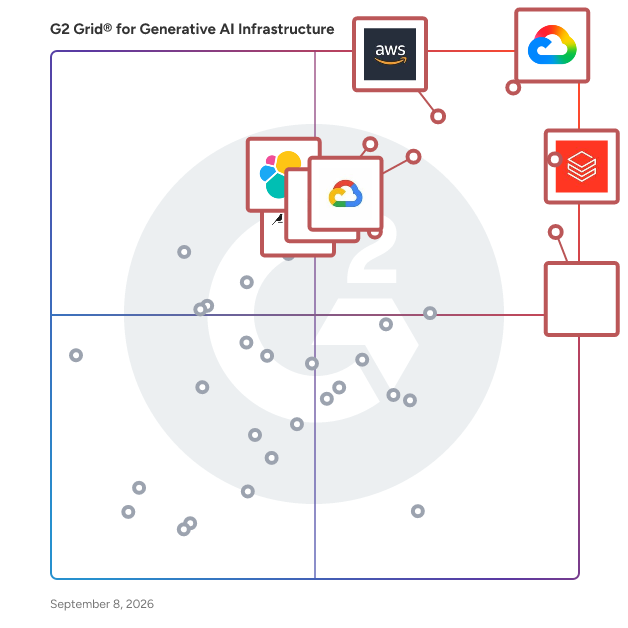

## Which Generative AI Infrastructure Software Is Best for Your Use Case?

- **Leader:** [Gemini Enterprise Agent Platform](https://www.g2.com/products/gemini-enterprise-agent-platform/reviews)
- **Highest Performer:** [Metaprise Agent Operating System](https://www.g2.com/products/metaprise-agent-operating-system/reviews)
- **Easiest to Use:** [Databricks](https://www.g2.com/products/databricks/reviews)
- **Top Trending:** [Langchain](https://www.g2.com/products/langchain/reviews)
- **Best Free Software:** [Databricks](https://www.g2.com/products/databricks/reviews)


---

**Sponsored**

### Cloudera

Cloudera is the only hybrid data and AI platform company that large organizations trust to bring AI to their data anywhere it lives. Unlike other providers, Cloudera delivers a consistent cloud experience that converges public clouds, on-prem data centers, and the edge, leveraging a proven open-source foundation. As the pioneer in big data, Cloudera empowers businesses to apply AI and assert control over 100% of their data, in all forms, improving security, governance, and real-time and predictive insights. The world’s largest brands across all industries rely on Cloudera to transform decision-making and ultimately boost bottom lines, safeguard against threats, and save lives. The Cloudera data and AI platform includes: Cloudera AI: Deploy and scale any AI model, anywhere. Cloudera brings compute to governed data where it lives for Private AI anywhere by design. Complete control, security, and governance of mission-critical data, models, agents, and inference ensure faster sovereign AI deployments. Cloudera Data-in-Motion: Make fast decisions from real-time data anywhere. Move data with any structure from any source to any destination seamlessly across hybrid environments, enabling in-the-moment business-critical decisions by processing and analyzing real-time data anywhere, from the edge to AI, as business happens. Cloudera Open Data Lakehouse: Process any data, anywhere, for actionable insights. Make smart decisions with an open data lakehouse powered by Apache Iceberg that delivers trusted, reliable, and unified data to fuel agents, AI applications, and analytics, improving collaboration, breaking silos, and simplifying sharing. Cloudera Unified Data Fabric: Unify security and governance across the entire data estate. Move beyond fragmented data management: Break down silos and connect disparate data sources intelligently and securely to provide a unified view of all organizational data and centralized end-to-end control across complex hybrid data environments.


[Visit website](https://www.g2.com/external_clickthroughs/record?secure%5Bad_program%5D=ppc&amp;secure%5Bad_slot%5D=category_product_list&amp;secure%5Bcategory_id%5D=1006880&amp;secure%5Bdisplayable_resource_id%5D=1006880&amp;secure%5Bdisplayable_resource_type%5D=Category&amp;secure%5Bmedium%5D=sponsored&amp;secure%5Bplacement_reason%5D=page_category&amp;secure%5Bplacement_resource_ids%5D%5B%5D=1006880&amp;secure%5Bprioritized%5D=false&amp;secure%5Bproduct_id%5D=1886&amp;secure%5Bresource_id%5D=1006880&amp;secure%5Bresource_type%5D=Category&amp;secure%5Bsource_type%5D=category_page&amp;secure%5Bsource_url%5D=https%3A%2F%2Fwww.g2.com%2Fcategories%2Fgenerative-ai-infrastructure%3Fpage%3D9&amp;secure%5Btoken%5D=0e26b6931bf95bb6aded4468104a46600c3e768dbb2c121826e34d8fdeada586&amp;secure%5Burl%5D=https%3A%2F%2Fwww.cloudera.com%2Fproducts%2Fcloudera-data-platform%2Fcdp-demos.html%3Finternal_link%3Dp18%23get-started&amp;secure%5Burl_type%5D=custom_url)

---

## What Are the Top-Rated Generative AI Infrastructure Software Products in 2026?
### 1. [GigaIO Accelerator Pooling Appliance – MI300X](https://www.g2.com/products/gigaio-accelerator-pooling-appliance-mi300x/reviews)
The GigaIO™ Accelerator Pooling Appliance – MI300X is a high-performance PCIe accelerator appliance designed to enhance AI/ML training, high-performance computing (HPC), and data analytics applications. It fully supports PCIe Gen5, offering up to 2.048Tb/s total bandwidth for host server connections. Equipped with eight AMD Instinct MI300X 192GB 750W OAM GPUs, it provides a total of 1.54TB of high-bandwidth memory (HBM), enabling efficient processing of complex workloads. Key Features and Functionality: - High Capacity: Accommodates 8x AMD Instinct MI300X 750W accelerators, delivering substantial computational power. - Exceptional Performance: Offers ultra-low latency with 512Gb/s uplinks, ensuring rapid data transfer and processing. - Ample Memory: Provides a total of 1.54TB HBM (8x 192GB per MI300X), facilitating efficient handling of large datasets. - Simplified Deployment: Features RESTful APIs and a WebGUI for straightforward integration and management. Primary Value and User Solutions: The GigaIO Accelerator Pooling Appliance – MI300X addresses the need for scalable and efficient computational resources in demanding environments. By enabling dynamic provisioning and scaling of PCIe devices, it allows users to allocate GPU resources as needed, optimizing utilization and reducing idle hardware. Its centralized management and continuous monitoring capabilities enhance reliability and facilitate rapid problem resolution, making it an ideal solution for AI/ML training, HPC, and data analytics acceleration.


**Who Is the Company Behind GigaIO Accelerator Pooling Appliance – MI300X?**

- **Seller:** [GigaIO](https://www.g2.com/sellers/gigaio)
- **HQ Location:** N/A
- **LinkedIn® Page:** https://www.linkedin.com/company/gigaionet.com/ (1 employees on LinkedIn®)


### 2. [GigaIO Accelerator Pooling Appliance – PCIe](https://www.g2.com/products/gigaio-accelerator-pooling-appliance-pcie/reviews)
The GigaIO Accelerator Pooling Appliance is a high-performance, fully managed PCIe Gen5 expansion chassis designed to disaggregate and pool accelerator devices such as GPUs, FPGAs, IPUs, DPUs, and specialty AI chips. By enabling dynamic provisioning and scaling of these resources, it transforms static resource silos into elastic, shareable pools, enhancing data center agility and performance while reducing total cost of ownership. Key Features and Functionality: - Capacity: Supports up to 8 double-wide PCIe Gen5 full-height, full-length accelerator cards, each delivering up to 675W, accommodating even the most power-intensive devices. - High Performance: Offers ultra-low latency with 512Gb/s uplinks and a total bandwidth of up to 2.048Tb/s dedicated to host server connections, ensuring rapid data transfer and processing. - Simplified Deployment: Features RESTful APIs and a WebGUI for intuitive management, allowing administrators to provision, monitor, and reconfigure resources seamlessly. - Enterprise-Grade Design: Equipped with redundant power supplies and fans, independent card power control, and continuous monitoring for faults, ensuring high availability and reliability in data center environments. Primary Value and Problem Solved: The GigaIO Accelerator Pooling Appliance addresses the inefficiencies of static, server-bound accelerator resources by enabling a composable, disaggregated infrastructure. This approach allows data centers to dynamically allocate and scale accelerator resources based on workload demands, leading to improved resource utilization, enhanced performance, and significant cost savings. By breaking the constraints of traditional server architectures, it provides cloud-like flexibility and agility within on-premises environments.


**Who Is the Company Behind GigaIO Accelerator Pooling Appliance – PCIe?**

- **Seller:** [GigaIO](https://www.g2.com/sellers/gigaio)
- **HQ Location:** N/A
- **LinkedIn® Page:** https://www.linkedin.com/company/gigaionet.com/ (1 employees on LinkedIn®)


### 3. [GigaIO Enterprise-Class Software](https://www.g2.com/products/gigaio-enterprise-class-software/reviews)
GigaIO&#39;s Enterprise-Class Software suite empowers organizations to fully leverage composable disaggregated infrastructure, enabling dynamic reconfiguration of data center resources to meet specific workload demands. This suite integrates seamlessly with existing enterprise tools, providing robust security features, user and resource access controls, and streamlined provisioning processes. Key Features and Functionality: - NVIDIA Bright Cluster Manager Integration: Natively integrates with NVIDIA Bright Cluster Manager, allowing users to disaggregate and reconfigure resources like GPUs directly within the management interface. - DevOps Tool Compatibility: Supports integration with existing DevOps tools, facilitating resource management and automation within familiar environments. - SuperCloud Composer Integration: Integrates with SuperCloud Composer, providing a unified dashboard for administering software-defined data centers and enabling seamless assignment of GPUs and high-performance storage. - KVM Virtualization Support: Enables composable infrastructure in virtualized environments with KVM hosts and Linux virtual machines, enhancing flexibility and resource utilization. - Slurm Job Scheduling Integration: Incorporates with Slurm, the leading open-source job scheduler for Linux, allowing dynamic allocation of composable storage and GPUs to servers based on workflow demands. - CloudShell Integration: Accelerates infrastructure provisioning by enabling teams to create self-service, on-demand replicas of full-stack environments for on-premises and hybrid cloud configurations. Primary Value and Problem Solved: GigaIO&#39;s Enterprise-Class Software addresses the challenge of underutilized and inflexible data center resources by enabling organizations to dynamically compose and reconfigure their infrastructure. This flexibility leads to optimized resource utilization, reduced operational costs, and the agility to adapt to evolving workload requirements. By integrating with existing enterprise tools and providing robust security and management features, GigaIO ensures a seamless transition to a composable infrastructure model, empowering organizations to maximize the efficiency and performance of their data centers.


**Who Is the Company Behind GigaIO Enterprise-Class Software?**

- **Seller:** [GigaIO](https://www.g2.com/sellers/gigaio)
- **HQ Location:** N/A
- **LinkedIn® Page:** https://www.linkedin.com/company/gigaionet.com/ (1 employees on LinkedIn®)


### 4. [GigaIO FabreX CLI](https://www.g2.com/products/gigaio-fabrex-cli/reviews)
FabreX CLI is a robust command-line interface developed by GigaIO, designed to provide comprehensive control over the FabreX composable infrastructure. This tool enables users to manage and configure their network and attached resources efficiently, facilitating dynamic composition and reconfiguration of hardware components to meet evolving workload demands. Key Features and Functionality: - Comprehensive Network Management: Offers full control over the entire FabreX network, allowing users to manage and configure resources seamlessly. - Integration with Automation Tools: Compatible with popular DevOps tools such as Chef, Puppet, Ansible, and Robotic Framework, enabling streamlined automation and scripting capabilities. - Redfish API Support: Provides support for industry-standard Redfish APIs, facilitating integration with existing management frameworks and enhancing interoperability. - Dynamic Resource Composition: Allows for the dynamic composition and reconfiguration of hardware resources, optimizing performance and resource utilization based on workload requirements. Primary Value and User Benefits: FabreX CLI empowers IT administrators and DevOps teams to achieve greater flexibility and efficiency in managing their composable infrastructure. By enabling precise control over hardware resources and seamless integration with automation tools, it reduces operational complexity and accelerates deployment times. This leads to optimized resource utilization, cost savings, and the ability to rapidly adapt to changing workload demands, ultimately enhancing overall data center performance.


**Who Is the Company Behind GigaIO FabreX CLI?**

- **Seller:** [GigaIO](https://www.g2.com/sellers/gigaio)
- **HQ Location:** N/A
- **LinkedIn® Page:** https://www.linkedin.com/company/gigaionet.com/ (1 employees on LinkedIn®)


### 5. [GigaIO FabreX Software](https://www.g2.com/products/gigaio-fabrex-software/reviews)
FabreX™ Software by GigaIO is a Linux-based, resource-efficient solution designed to enhance dynamic composability in enterprise data centers and high-performance computing environments. Serving as the software engine for GigaIO&#39;s Software-Defined Hardware™ (SDH), FabreX enables seamless memory and device composition, allowing for flexible and efficient resource management. Key Features and Functionality: - Hybrid and Multi-Cloud Compatibility: FabreX operates effectively across hybrid and multi-cloud environments, providing consistent performance and integration. - Software-Defined Hardware Flexibility: It brings the agility of software-defined hardware to on-premises infrastructure, enabling rapid adaptation to changing workload demands. - Resource Optimization: By facilitating dynamic scaling of server resources, FabreX optimizes on-premises resource utilization, reducing underused hardware and associated costs. - Seamless Scaling: The software supports both on-premises scaling and cloud bursting, ensuring smooth expansion and contraction of resources as needed. - Accelerator Integration: FabreX allows for the creation of unique server configurations by composing bare metal devices such as GPUs, FPGAs, NVMe storage, and DRAM, even enabling combinations not typically available in cloud environments. - Enhanced Communication: Utilizing GigaIO’s PCIe switching infrastructure, FabreX enables native protocol communications between servers and devices, including server-to-server, server-to-device, and device-to-device interactions. - Open Ecosystem Integration: The software integrates with existing management tools through DMTF open-source Redfish® APIs, facilitating fabric automation and orchestration without the need for additional management interfaces. Primary Value and User Solutions: FabreX Software addresses the limitations of traditional server architectures by enabling dynamic composition of computing resources, thereby eliminating the constraints imposed by physical server configurations. This flexibility allows organizations to tailor their infrastructure to specific workload requirements, enhancing performance and efficiency. By democratizing access to specialized compute resources, FabreX reduces time-to-insight for data-intensive applications, making it an invaluable tool for enterprises seeking to optimize their data center operations and adapt swiftly to evolving computational demands.


**Who Is the Company Behind GigaIO FabreX Software?**

- **Seller:** [GigaIO](https://www.g2.com/sellers/gigaio)
- **HQ Location:** N/A
- **LinkedIn® Page:** https://www.linkedin.com/company/gigaionet.com/ (1 employees on LinkedIn®)


### 6. [GigaIO FabreXT AI Memory Fabric Platform](https://www.g2.com/products/gigaio-fabrext-ai-memory-fabric-platform/reviews)
The FabreX™ AI Memory Fabric Platform by GigaIO is a next-generation, memory-centric fabric designed to revolutionize data center architectures in response to the exponential growth of data and the rapid adoption of advanced analytics and Artificial Intelligence (AI). By disaggregating traditional server components and enabling dynamic composition of resources, FabreX addresses the challenges posed by modern compute and storage clusters, offering unparalleled flexibility, performance, and efficiency. Key Features and Functionality: - Memory-Centric Fabric: FabreX connects memory, storage, and a wide array of accelerators—including GPUs, FPGAs, and custom ASICs—either directly or via configurations like NVMe-oF, delivering industry-leading low latency and high bandwidth. - High Performance: With latency from system memory of one server to another being less than 200 nanoseconds and bandwidth scaling up to 512 Gbits/sec in its Gen4 implementation, FabreX ensures true PCIe performance across entire clusters. - Unmatched Flexibility: The platform enables the composition of diverse resources, such as GPUs, DPUs, TPUs, FPGAs, SoCs, NVMe storage, and other I/O devices, across multiple servers and racks. It supports device-to-node, node-to-node, and device-to-device communication within the same high-performance PCIe memory fabric. - Open Standards Compliance: FabreX is 100% PCI-SIG compliant, ensuring seamless integration with heterogeneous computing, storage, and accelerator components into a unified system-area cluster fabric. Primary Value and User Solutions: FabreX addresses the critical need for scalable, flexible, and efficient data center architectures capable of handling the demands of AI, Machine Learning (ML), and Deep Learning (DL) applications. By disaggregating server components and enabling dynamic resource composition, it eliminates bottlenecks and configuration challenges inherent in traditional interconnect systems. This approach not only enhances performance but also optimizes resource utilization, reducing the total cost of ownership and allowing data centers to scale both up and out seamlessly.


**Who Is the Company Behind GigaIO FabreXT AI Memory Fabric Platform?**

- **Seller:** [GigaIO](https://www.g2.com/sellers/gigaio)
- **HQ Location:** N/A
- **LinkedIn® Page:** https://www.linkedin.com/company/gigaionet.com/ (1 employees on LinkedIn®)


### 7. [GigaIO Fabric Card](https://www.g2.com/products/gigaio-fabric-card/reviews)
The GigaIO™ Fabric Card is a high-performance network adapter designed to facilitate non-blocking, low-latency composable fabric computing at rack scale. It enables users in AI/ML, HPC, and data analytics to construct tailored systems that optimize performance while reducing total cost of ownership. By supporting a high-speed, cabled interface to cluster subsystems across GigaIO&#39;s AI fabric network, the Fabric Card allows for the creation of shared pools of vendor-agnostic PCIe devices, including GPUs, FPGAs, storage, and memory. This flexibility ensures seamless integration and management of disaggregated resource pools. Key Features and Functionality: - High Performance: Delivers up to 512Gb/s speed and 128GB/s bandwidth, ensuring rapid data transfer and processing capabilities. - Low Latency: Achieves latency of less than 10 nanoseconds, facilitating real-time data access and communication. - Versatile Connectivity: Equipped with dual QSFP-DD connections, supporting both copper and optical cabling options for flexible deployment. - Compact Design: Features a low-profile form factor compatible with both full-height and half-height PCIe slots, allowing for easy integration into various server configurations. - Dual Operational Modes: Offers Host Mode for installation into host or head-node servers and Target Mode for integration into Accelerator Pooling Appliances or resource boxes, enhancing adaptability across different system architectures. Primary Value and User Solutions: The GigaIO Fabric Card addresses the growing need for scalable and flexible computing infrastructures by enabling the dynamic composition of hardware resources. It allows organizations to disaggregate and recompose their computing resources on demand, leading to improved resource utilization, enhanced system performance, and reduced operational costs. By supporting a wide range of PCIe-compliant devices, the Fabric Card empowers users to build customized, high-performance computing environments tailored to their specific workload requirements.


**Who Is the Company Behind GigaIO Fabric Card?**

- **Seller:** [GigaIO](https://www.g2.com/sellers/gigaio)
- **HQ Location:** N/A
- **LinkedIn® Page:** https://www.linkedin.com/company/gigaionet.com/ (1 employees on LinkedIn®)


### 8. [GigaIO Fabric Switch](https://www.g2.com/products/gigaio-fabric-switch/reviews)
The GigaIO Fabric Switch is a high-performance networking solution designed to enable unified, software-driven composable infrastructure. It serves as the foundational component of GigaIO&#39;s AI fabric, facilitating true Software Defined Infrastructure (SDI) by dynamically assigning resources to meet the demands of data-intensive applications and varying workloads. Key Features and Functionality: - Ultra-High Performance: Delivers a switch capacity of 6.1Tb/s with industry-leading sub-130ns latency, ensuring rapid data transmission and minimal delay. - Ultimate Flexibility: Supports seamless integration and on-demand composition of various accelerators, including GPUs, TPUs, FPGAs, and SoCs, allowing for adaptable and scalable system configurations. - Unprecedented Scalability: Enables scaling up to dozens of accelerators, accommodating the growth of computing resources without compromising performance. - Simplified Deployment: Utilizes DMTF open-source Redfish® RESTful APIs and a Command Line Interface (CLI) for straightforward configuration and management of computing clusters. Primary Value and User Solutions: The GigaIO Fabric Switch addresses the challenges of modern data centers by providing a unified, low-latency network fabric that connects compute, storage, and accelerator resources using industry-standard PCI-Express protocols. This architecture eliminates the need for traditional interconnects like InfiniBand or Ethernet within the rack, reducing complexity and latency. By enabling direct memory access across servers, it supports the industry&#39;s first in-memory network, facilitating efficient resource utilization and dynamic workload management. This solution is particularly beneficial for AI/ML training and inferencing clusters, high-performance computing environments, data analytics acceleration, composable infrastructure deployments, and scale-up computing architectures.


**Who Is the Company Behind GigaIO Fabric Switch?**

- **Seller:** [GigaIO](https://www.g2.com/sellers/gigaio)
- **HQ Location:** N/A
- **LinkedIn® Page:** https://www.linkedin.com/company/gigaionet.com/ (1 employees on LinkedIn®)


### 9. [GigaIO GigaIO SuperNODE](https://www.g2.com/products/gigaio-gigaio-supernode/reviews)
The GigaIO SuperNODE™ is a groundbreaking single-node supercomputer designed to meet the demands of next-generation AI and accelerated computing workloads. By integrating up to 32 AMD or NVIDIA GPUs into a single server, SuperNODE eliminates the complexities associated with multi-server configurations, offering a streamlined and efficient solution for intensive computational tasks. Key Features and Functionality: - High-Density GPU Integration: Supports up to 32 AMD Instinct™ MI210 GPUs or 24 NVIDIA A100 GPUs within a single node, providing exceptional computational power. - FabreX™ Memory Fabric: Utilizes GigaIO’s FabreX, a high-performance PCIe memory fabric, to seamlessly connect all accelerators, ensuring low-latency and high-bandwidth communication. - Energy Efficiency: Operates at approximately 7 kilowatts per 32-GPU deployment, reducing power consumption compared to traditional multi-server setups. - Space Optimization: Achieves a 30% reduction in rack space requirements, allowing for higher computational density within existing data center infrastructures. - Software Compatibility: Compatible with popular AI frameworks like PyTorch and TensorFlow, enabling users to run existing applications without modification. Primary Value and Problem Solved: SuperNODE addresses the challenges of deploying and managing large-scale AI and high-performance computing infrastructures by consolidating extensive GPU resources into a single, efficient node. This consolidation reduces network overhead, minimizes latency, and simplifies system administration. By eliminating the need for complex multi-server configurations and associated networking equipment, SuperNODE offers a cost-effective, energy-efficient, and high-performance solution for organizations aiming to accelerate their AI and computational workloads.


**Who Is the Company Behind GigaIO GigaIO SuperNODE?**

- **Seller:** [GigaIO](https://www.g2.com/sellers/gigaio)
- **HQ Location:** N/A
- **LinkedIn® Page:** https://www.linkedin.com/company/gigaionet.com/ (1 employees on LinkedIn®)


### 10. [GigaIO GigaPod Solutions](https://www.g2.com/products/gigaio-gigapod-solutions/reviews)
GigaPod is an engineered solution designed to simplify and enhance rack-scale computing by disaggregating traditional server components into dynamic, composable resource pools. Leveraging GigaIO&#39;s FabreX™ dynamic memory fabric, GigaPod integrates compute and GPU acceleration I/O into a unified system using standard PCI Express (PCIe) technology. This architecture allows for on-the-fly composition of resources tailored to specific workload requirements, optimizing performance and resource utilization. By transforming the entire rack into a single unit of compute, GigaPod delivers the agility of cloud computing with the cost efficiency and control of on-premises infrastructure. Key Features and Functionality: - Dynamic Resource Composition: Enables real-time allocation and reallocation of compute, storage, and accelerator resources to meet the demands of diverse workloads. - Vendor-Agnostic Integration: Supports a wide range of processors, memory configurations, storage options, and accelerators, allowing users to select and mix components based on specific needs. - High-Performance Interconnect: Utilizes native PCIe (and future CXL) connections to ensure low latency and high bandwidth communication across all components within the rack. - Scalability: Offers the flexibility to scale from individual GigaPods to larger GigaClusters, accommodating growth and evolving computational requirements. - Simplified Management: Provides turnkey deployment with easy-to-use management tools, reducing complexity and operational overhead. Primary Value and Problem Solved: GigaPod addresses the inefficiencies and limitations of traditional server architectures by enabling true rack-scale computing. It eliminates resource silos and underutilization by allowing components to be shared and composed dynamically, based on workload demands. This approach not only accelerates high-performance computing (HPC) and artificial intelligence (AI) workloads but also reduces total cost of ownership (TCO) through higher resource utilization, decreased complexity, and lower power and cooling requirements. By providing a flexible, scalable, and efficient infrastructure, GigaPod empowers organizations to adapt swiftly to changing computational needs and achieve faster time-to-results.


**Who Is the Company Behind GigaIO GigaPod Solutions?**

- **Seller:** [GigaIO](https://www.g2.com/sellers/gigaio)
- **HQ Location:** N/A
- **LinkedIn® Page:** https://www.linkedin.com/company/gigaionet.com/ (1 employees on LinkedIn®)


### 11. [GigaIO Gryf](https://www.g2.com/products/gigaio-gryf/reviews)
Gryf is a portable AI supercomputer, co-designed by GigaIO and SourceCode, that delivers datacenter-class computing power directly to edge operations. Housed in a TSA-friendly, suitcase-sized form factor, Gryf enables real-time data processing and analytics in field environments, eliminating the need to transfer data to centralized datacenters. This innovation allows organizations to transform vast amounts of sensor data collected at the edge into actionable insights on-site. Key Features and Functionality: - Modular and Composable Design: Gryf offers a fully configurable solution through software or by interchanging compute, accelerator, storage, or network sleds, allowing dynamic reconfiguration to meet diverse mission requirements. - Scalability: Up to five Gryf units can be seamlessly interconnected using GigaIO’s FabreX™ AI memory fabric, enabling processing of petabyte-sized datasets and sharing of resources across connected units. - High Compute Density: Each Gryf chassis can accommodate a mix of six compute, accelerator, storage, or network sleds, supporting high-performance GPUs and substantial storage capacity (up to a petabyte) to execute complex AI tasks directly at the operational site. - Portability: Designed for true mobility, Gryf features a rugged, roll-on TSA-friendly form factor that fits into an overhead bin, facilitating deployment at any location. Primary Value and Problem Solved: Gryf addresses the challenge of processing and analyzing large volumes of data collected in field environments by providing a portable, high-performance computing solution. By enabling real-time analytics at the edge, Gryf eliminates delays associated with data transfer to centralized datacenters, enhances operational responsiveness, and supports critical applications in defense, sports analytics, media production, and energy sectors. Its modular design and scalability ensure adaptability to diverse and evolving mission requirements, offering a cost-effective and efficient solution for on-site data processing needs.


**Who Is the Company Behind GigaIO Gryf?**

- **Seller:** [GigaIO](https://www.g2.com/sellers/gigaio)
- **HQ Location:** N/A
- **LinkedIn® Page:** https://www.linkedin.com/company/gigaionet.com/ (1 employees on LinkedIn®)


### 12. [GigaIO RB3032 — Storage Pooling Appliance](https://www.g2.com/products/gigaio-rb3032-storage-pooling-appliance/reviews)
The GigaIO RB3032 Storage Pooling Appliance is a high-density, 1U rack-mounted NVMe storage enclosure designed to meet the demanding needs of deep learning, high-performance computing (HPC), and data analytics applications. It accommodates up to 32 hot-swappable 2.5-inch NVMe SSDs, delivering exceptional throughput and low-latency resource sharing. With four PCIe Gen 3.0 x16 ports providing 128 Gbit/sec bandwidth, the RB3032 ensures seamless connectivity to multiple host computers. Its compact design, combined with features like secure intelligent enclosure management, self-discovery, self-configuration, and hot-swap capabilities, facilitates easy maintenance and high availability. Integrated with the GigaIO FabreX Switch, this appliance offers enhanced storage capacity, performance, and flexibility, making it an ideal solution for high-workload environments. Key Features: - High Capacity: Supports up to 32 hot-swappable 2.5-inch NVMe SSDs. - Compact Design: 1U rack-mounted enclosure for efficient space utilization. - High Bandwidth Connectivity: Four PCIe Gen 3.0 x16 ports delivering 128 Gbit/sec bandwidth. - Redundant Power Supplies: Equipped with two hot-swappable 1000W power supplies for reliability. - Intelligent Management: Features secure enclosure management with self-discovery and self-configuration capabilities. - Hot-Swap Design: Facilitates easy maintenance and high availability. Primary Value and Solutions: The RB3032 addresses the challenges of managing large-scale, high-performance storage needs in AI, data analytics, and HPC environments. By disaggregating storage resources through integration with the GigaIO FabreX Switch, it provides scalable and flexible storage solutions. This approach enhances performance, reduces latency, and ensures high availability, enabling organizations to efficiently handle intensive workloads and adapt to evolving data demands.


**Who Is the Company Behind GigaIO RB3032 — Storage Pooling Appliance?**

- **Seller:** [GigaIO](https://www.g2.com/sellers/gigaio)
- **HQ Location:** N/A
- **LinkedIn® Page:** https://www.linkedin.com/company/gigaionet.com/ (1 employees on LinkedIn®)


### 13. [Gigantor Technologies](https://www.g2.com/products/gigantor-technologies/reviews)
Gigantor Technologies is a pioneering company specializing in Edge AI acceleration through innovative circuit designs and advanced AI processing technologies. Their flagship product, GigaMAACS™, transforms trained neural network models into optimized, parallel pipeline circuits, enabling real-time, high-resolution AI inference with minimal latency and reduced power consumption. This technology is particularly beneficial for applications requiring immediate, accurate responses in resource-constrained environments, such as autonomous vehicles, defense systems, and industrial automation. Key Features and Functionality: - High-Performance AI Inference: GigaMAACS™ delivers over 240 frames per second at 4K resolution, ensuring smooth and rapid processing of high-definition data. - Low Latency: The system maintains consistent, near-zero latency, providing microsecond-level response times crucial for real-time applications. - Power Efficiency: By converting neural networks into streamlined circuits, GigaMAACS™ significantly reduces power consumption compared to traditional GPU-based solutions. - Versatile Deployment: The technology supports implementation on Field-Programmable Gate Arrays (FPGAs) and Application-Specific Integrated Circuits (ASICs), offering flexibility across various hardware platforms. Primary Value and Problem Solved: GigaMAACS™ addresses the critical challenges of deploying AI at the edge, where traditional hardware often struggles with processing speed, latency, and power constraints. By providing a solution that enhances performance without compromising accuracy or efficiency, Gigantor Technologies empowers industries to implement advanced AI capabilities in real-time scenarios, thereby accelerating innovation and operational effectiveness.


**Who Is the Company Behind Gigantor Technologies?**

- **Seller:** [Gigantor Technologies](https://www.g2.com/sellers/gigantor-technologies)
- **Year Founded:** 2020
- **HQ Location:** Melbourne Beach, US
- **LinkedIn® Page:** https://www.linkedin.com/company/gigantor-technologies-inc (11 employees on LinkedIn®)


### 14. [Github KoboldCPP](https://www.g2.com/products/github-koboldcpp/reviews)
KoboldCpp is a user-friendly AI text-generation software designed to run GGML and GGUF models. Inspired by the original KoboldAI, it offers a single, self-contained executable that simplifies deployment without the need for extensive configuration. Built upon llama.cpp, KoboldCpp extends functionality to include a versatile KoboldAI API endpoint, support for various model formats, Stable Diffusion image generation, speech-to-text capabilities, and a comprehensive user interface featuring persistent stories, editing tools, memory management, world information, author&#39;s notes, character creation, and scenario development. Key Features and Functionality: - Single Executable Deployment: No installation required; runs directly as a standalone file. - Model Compatibility: Supports a wide range of GGML and GGUF models, including LLAMA, LLAMA2, GPT-2, GPT-J, RWKV, and more. - Versatile API Endpoints: Provides multiple compatible API endpoints for popular web services, enhancing integration capabilities. - Image and Speech Processing: Includes native support for Stable Diffusion image generation and speech-to-text functionality via Whisper. - Comprehensive User Interface: Features tools for story editing, memory management, world-building, character creation, and scenario planning. - Cross-Platform Support: Available for Windows, Linux, macOS, and Android (via Termux), with ready-to-use binaries and support for platforms like Colab and Docker. Primary Value and User Solutions: KoboldCpp addresses the need for an accessible and efficient platform for AI-driven text and image generation. By offering a no-installation-required, single-file solution, it simplifies the deployment process for users across various platforms. Its extensive model support and versatile API endpoints enable developers and AI enthusiasts to integrate and manage multiple AI models seamlessly. The inclusion of image generation and speech processing capabilities broadens its applicability, making it a comprehensive tool for creative writing, interactive storytelling, and AI research. Furthermore, its cross-platform availability ensures that users can operate the software on their preferred systems without compatibility concerns.


**Who Is the Company Behind Github KoboldCPP?**

- **Seller:** [GitHub](https://www.g2.com/sellers/github)
- **Year Founded:** 2008
- **HQ Location:** San Francisco, CA
- **Twitter:** @github (2,673,925 Twitter followers)
- **LinkedIn® Page:** https://www.linkedin.com/company/1418841/ (6,106 employees on LinkedIn®)


### 15. [GLBNXT knowledge workers AI platform](https://www.g2.com/products/glbnxt-knowledge-workers-ai-platform/reviews)
GLBNXT, a Netherlands-based SaaS startup. The company introduces its AI-powered platform designed to empower knowledge workers. Rather than a one-size-fits-all solution, GLBNXT adapts to each company’s data landscape, unlocking hidden insights and enabling efficient, AI-powered decision-making. The platform has already secured strategic sponsorships from prestigious IT vendors, including Dell Technologies, NVIDIA, Zeta-Alpha and ITQ. Additionally, the company has demonstrated initial traction through successful pilots with Dutch municipalities, as well as early use cases in the healthcare and education sectors—proving the platform’s adaptability across complex, knowledge-driven environments. Enterprises today face a pressing challenge: keeping pace with the rapid evolution of AI technology while maintaining the high levels of security and compliance required in their industries. Most enterprises lack the internal expertise or resources to do both effectively. GLBNXT was built to directly address this gap. A unique aspect of the platform is its full operational sovereignty—entirely hosted and managed by GLBNXT on European soil. This approach eliminates reliance on third-party infrastructure, protects data from cross-border exposure, and ensures full regulatory alignment. By offering uncompromised, sovereign AI capabilities, GLBNXT enables organizations to confidently adopt and scale AI without sacrificing control, security, or compliance.


**Who Is the Company Behind GLBNXT knowledge workers AI platform?**

- **Seller:** [GLBNXT](https://www.g2.com/sellers/glbnxt)
- **Year Founded:** 2024
- **HQ Location:** Amsterdam, NL
- **LinkedIn® Page:** https://www.linkedin.com/company/glbnxt (3 employees on LinkedIn®)


### 16. [gNucleus AI](https://www.g2.com/products/gnucleus-ai/reviews)
gNucleus AI is an innovative platform that leverages Generative AI to transform text descriptions and images into fully editable 3D CAD models. Designed for engineers and designers, it streamlines the CAD creation process, enabling rapid prototyping and efficient design iterations. By converting textual inputs and visual data into precise 3D models, gNucleus AI significantly reduces the time and effort traditionally required in CAD modeling. Key Features and Functionality: - GenAI Aided 3D Design: Utilizes advanced Generative AI algorithms to assist in creating detailed 3D CAD designs efficiently. - Text to CAD: Enables conversational CAD model creation, allowing users to generate models up to 10 times faster than manual methods. - Image to CAD: Transforms images and PDFs into fully editable parametric CAD models, not just meshes or dumb solids. - Text to Assembly: Generates assemblies from text, spreadsheets, PDFs, and BOMs, facilitating complex design processes. - Multi-Format Support: Produces models in various CAD formats, including FreeCAD, Catia, SolidWorks, STEP, IGES, STL, and GLTF, ensuring compatibility across different platforms. Primary Value and User Solutions: gNucleus AI addresses the challenges of time-consuming and labor-intensive CAD modeling by automating the creation process through AI-driven text and image inputs. This automation leads to a tenfold increase in design speed, allowing for rapid prototyping and faster product development cycles. The platform&#39;s support for multiple CAD formats and its ability to produce fully editable parametric models ensure seamless integration into existing workflows, enhancing productivity and reducing the learning curve for new users. By simplifying complex design tasks, gNucleus AI empowers engineers and designers to focus more on innovation and less on manual modeling efforts.


**Who Is the Company Behind gNucleus AI?**

- **Seller:** [gNucleus AI](https://www.g2.com/sellers/gnucleus-ai)
- **Year Founded:** 2024
- **HQ Location:** San Francisco, US
- **LinkedIn® Page:** https://www.linkedin.com/company/gnucleus-ai (3 employees on LinkedIn®)


### 17. [Gonka](https://www.g2.com/products/gonka/reviews)
Gonka is a decentralized network that maximizes the usage of global GPU capacity for significant AI workloads


**Who Is the Company Behind Gonka?**

- **Seller:** [Gonka](https://www.g2.com/sellers/gonka)
- **HQ Location:** N/A
- **LinkedIn® Page:** https://www.linkedin.com/company/No-Linkedin-Presence-Added-Intentionally-By-DataOps (1 employees on LinkedIn®)


### 18. [GoVISIBLE](https://www.g2.com/products/govisible/reviews)
GoVISIBLE is an AI Visibility Intelligence Platform for brands, marketers, SEO teams, agencies, and growth teams that want to monitor, diagnose, and improve how they appear across AI powered search and generative engines. The platform helps teams understand where their brand is visible, where it is missing, how competitors are being recommended, which sources are influencing AI answers, and what actions are needed to improve AI discoverability. GoVISIBLE is built for the complete GEO workflow. It helps users track visibility across engines, analyze prompt level performance, monitor citations and source signals, benchmark competitors, identify visibility gaps, and turn insights into execution through Action Center and Content Studio. Core GoVISIBLE capabilities include AI visibility tracking, prompt analysis, citation intelligence, competitor benchmarking, sentiment and intent analysis, source intelligence, Action Center, Content Studio, entity-level visibility insights, and AI search performance monitoring. Action Center helps teams move from dashboard insights to prioritized optimization actions. It identifies where visibility is weak, where competitors are gaining advantage, which content or external trust signals need improvement, and what actions can improve AI search presence. Content Studio supports the content execution layer by helping teams create and optimize content based on AI visibility gaps, prompt intelligence, citation opportunities, and AI search behavior.


**Who Is the Company Behind GoVISIBLE?**

- **Seller:** [SocialChamps Media Pvt. Ltd.](https://www.g2.com/sellers/socialchamps-media-pvt-ltd)
- **HQ Location:** India
- **LinkedIn® Page:** https://www.linkedin.com/company/socialchamps/


### 19. [GPUniq](https://www.g2.com/products/gpuniq/reviews)
GPUniq is a unified cloud platform that lets developers, ML engineers, and AI startups rent GPUs and access top LLM APIs from a single account and a single balance.


**Who Is the Company Behind GPUniq?**

- **Seller:** [GPUniq](https://www.g2.com/sellers/gpuniq)
- **HQ Location:** N/A
- **LinkedIn® Page:** https://www.linkedin.com/company/No-Linkedin-Presence-Added-Intentionally-By-DataOps (1 employees on LinkedIn®)


### 20. [GPUX AI](https://www.g2.com/products/gpux-ai/reviews)
GPUX.AI is a platform designed to streamline the deployment and management of GPU-intensive applications, catering to developers and organizations seeking efficient solutions for machine learning, rendering, and other computational tasks. By offering serverless inference capabilities, GPUX.AI enables users to run AI models with minimal setup, reducing the time and complexity traditionally associated with such processes. Key Features and Functionality: - Serverless Inference: Deploy AI models without the need to manage underlying infrastructure, allowing for rapid scaling and reduced operational overhead. - Support for Popular AI Models: GPUX.AI supports a range of AI models, including StableDiffusionXL, ESRGAN, and WHISPER, facilitating diverse applications from image generation to audio processing. - Rapid Deployment: Achieve cold start times as low as one second, ensuring that applications are responsive and efficient. - Persistent Storage: Utilize native storage options within containers, enabling seamless data management and accessibility. - Port Forwarding: Access applications through subdomain forwarding, simplifying the process of connecting to services running on specific ports. Primary Value and Problem Solving: GPUX.AI addresses the challenges associated with deploying and managing GPU-intensive workloads by providing a serverless platform that abstracts the complexities of infrastructure management. This approach allows developers to focus on building and optimizing their applications without the burden of configuring and maintaining hardware resources. By supporting a variety of AI models and offering rapid deployment capabilities, GPUX.AI enhances productivity and accelerates the development cycle for AI-driven solutions.


**Who Is the Company Behind GPUX AI?**

- **Seller:** [GPUX AI](https://www.g2.com/sellers/gpux-ai)
- **HQ Location:** Toronto, ca
- **LinkedIn® Page:** https://www.linkedin.com/company/gpux-ai (2 employees on LinkedIn®)


### 21. [Granica](https://www.g2.com/products/granica/reviews)
Granica is an AI data platform designed to make enterprise data AI-ready by enhancing its safety, efficiency, and effectiveness. Operating within your cloud environment, Granica enables AI and machine learning teams to build and manage high-quality datasets that are compact, secure, and powerful, facilitating scalable AI applications. Key Features and Functionality: - Granica Screen: This data privacy service identifies and protects sensitive information, including personally identifiable information (PII) and harmful content, in cloud data lakes and large language model (LLM) prompts. It ensures data safety throughout the AI lifecycle, from training to inference. - Granica Crunch: A cloud cost optimization service that employs advanced compression and deduplication algorithms to reduce the physical size of data, such as Apache Parquet files, by up to 60%. This reduction lowers storage and transfer costs while enhancing query performance. - Granica Signal: This training data selection service analyzes large-scale datasets to prioritize and select the most impactful samples for model training, improving performance by up to 30% and reducing training cycles by 20-30%. - Granica Chronicle AI: A data visibility service that provides insights into data environments, enabling optimization of access for improved compliance and cost control. Primary Value and Problem Solved: Granica addresses the challenges of managing and utilizing vast amounts of data in AI applications by providing tools that enhance data safety, reduce costs, and improve model performance. By integrating privacy protection, data compression, and intelligent data selection, Granica enables organizations to unlock the full potential of their data, ensuring AI initiatives are both effective and efficient.


**Who Is the Company Behind Granica?**

- **Seller:** [Granica](https://www.g2.com/sellers/granica)
- **Year Founded:** 2019
- **HQ Location:** Mountain View, US
- **LinkedIn® Page:** https://www.linkedin.com/company/granica-ai (31 employees on LinkedIn®)


### 22. [Great Wave AI Platform](https://www.g2.com/products/great-wave-ai-platform/reviews)
Great Wave AI is an enterprise agent orchestration platform designed to accelerate the safe and scalable adoption of Generative AI. Rather than focusing on individual chatbots or standalone tools, Great Wave AI enables organisations to build, deploy and manage networks of specialised GenAI agents, each designed to perform a defined task within clear parameters. These agents can summarise documents, search unstructured data, extract key insights or support human workflows, all while operating under strict controls for input, output and context. The platform’s orchestration layer allows multiple agents to work together, route tasks intelligently and integrate with enterprise systems via APIs or private data connectors. Evaluation is central to the platform’s design. Great Wave AI supports both human-in-the-loop and AI-on-AI evaluation. Human reviewers can assess outputs and provide feedback to fine-tune agent behaviour over time, helping to improve accuracy, tone and task alignment. In parallel, pre-defined AI evaluators automatically critique outputs against specific criteria such as factuality, relevance or adherence. This dual evaluation framework ensures agents remain accurate, auditable and aligned with business requirements. Built for non-technical teams, Great Wave AI provides a no-code environment where users can assemble agent workflows using configurable components. Governance features such as audit logs, performance monitoring, access controls and model selection ensure agents behave reliably and remain compliant with enterprise policies. Model-agnostic, infrastructure-agnostic, and data-secure, Great Wave AI abstracts away infrastructure complexity while supporting interoperability across leading LLMs including OpenAI and Anthropic. In doing so, it enables organisations to operationalise GenAI quickly, turning AI from isolated experiments into coordinated, accountable systems that deliver real business outcomes.


**Who Is the Company Behind Great Wave AI Platform?**

- **Seller:** [Great Wave AI](https://www.g2.com/sellers/great-wave-ai)
- **Year Founded:** 2021
- **HQ Location:** LONDON, GB
- **LinkedIn® Page:** https://www.linkedin.com/company/great-wave-ai/ (13 employees on LinkedIn®)


### 23. [GreenNode](https://www.g2.com/products/greennode/reviews)
GreenNode delivers high-performance NVIDIA® GPU infrastructure and ready-to-deploy AI solutions in one unified platform. Scale flexibly, optimize costs, and bring your AI models into production faster—supported by a team that’s with you every step of the way.


**Who Is the Company Behind GreenNode?**

- **Seller:** [GreenNode](https://www.g2.com/sellers/greennode)
- **HQ Location:** Singapore, SG
- **LinkedIn® Page:** https://www.linkedin.com/company/green-node/ (28 employees on LinkedIn®)


### 24. [Griptape](https://www.g2.com/products/griptape/reviews)
Build, deploy, and scale end-to-end AI applications in the cloud. Griptape gives developers everything they need to build, deploy, and scale retrieval-driven AI-powered applications, from the development framework to the execution runtime. 🎢 Griptape is a modular Python framework for building AI-powered applications that securely connect to your enterprise data and APIs. It offers developers the ability to maintain control and flexibility at every step. ☁️ Griptape Cloud is a one-stop shop to hosting your AI structures, whether they are built with Griptape, another framework, or call directly to the LLMs themselves. Simply point to your GitHub repository to get started. 🔥 Run your hosted code by hitting a basic API layer from wherever you need, offloading the expensive tasks of AI development to the cloud. 📈 Automatically scale workloads to fit your needs.


**Average Rating:** 4.0/5.0
**Total Reviews:** 1

**Who Is the Company Behind Griptape?**

- **Seller:** [Foundry](https://www.g2.com/sellers/foundry)
- **Year Founded:** 1996
- **HQ Location:** London, United Kingdom
- **Twitter:** @TheFoundryTeam (58,803 Twitter followers)
- **LinkedIn® Page:** https://www.linkedin.com/company/33583/ (387 employees on LinkedIn®)

**Who Uses This Product?**
- **Company Size:** 100% Mid-Market


#### What Are Griptape's Pros and Cons?

**Pros:**

- Ease of Creation (1 reviews)
- Ease of Use (1 reviews)
- Workflow Efficiency (1 reviews)


### What Do G2 Reviewers Say About Griptape?
*AI-generated summary from verified user reviews*

**Pros:**

- Users value the **ease of creation** with Griptape, facilitating effective workflows and AI agent development effortlessly.
- Users appreciate the **ease of use** of Griptape, finding it simple to build and manage AI workflows.
- Users value the **workflow efficiency** of Griptape, enabling them to create effective and modular AI agents seamlessly.


#### What Are Recent G2 Reviews of Griptape?

**"[Effective, Modular Python Framework for Building AI Agents and Workflows](https://www.g2.com/survey_responses/griptape-review-12279155)"**

**Rating:** 4.0/5.0 stars
*— Verified User in Oil &amp; Energy*

[Read full review](https://www.g2.com/survey_responses/griptape-review-12279155)

---


### 25. [Grsai](https://www.g2.com/products/grsai/reviews)
Grsai is an AI model API aggregation platform that provides developers with stable and cost-effective access to a wide range of advanced AI models. By integrating models such as GPT-4o, Gemini, Flux, Nano Banana, and Veo3, Grsai enables seamless incorporation of text, image, and video generation capabilities into applications. With a commitment to high performance, Grsai ensures 99.99% service availability through multi-node global deployment, automatic load balancing, and real-time monitoring. The platform offers ultra-low latency, with average response times under 200 milliseconds, and supports high concurrency to meet the demands of various applications. As a direct source provider, Grsai delivers these services at market-leading low prices, starting as low as $0.003 per request for image generation. Dedicated 24/7 technical support is available to assist users, ensuring prompt issue resolution and efficient service stability. Grsai&#39;s comprehensive suite of AI models and robust infrastructure empowers developers to build intelligent applications efficiently and affordably.


**Who Is the Company Behind Grsai?**

- **Seller:** [Grsai](https://www.g2.com/sellers/grsai)
- **HQ Location:** N/A
- **LinkedIn® Page:** https://www.linkedin.com/company/No-Linkedin-Presence-Added-Intentionally-By-DataOps (1 employees on LinkedIn®)


## What Is Generative AI Infrastructure Software?

[Generative AI Software](https://www.g2.com/categories/generative-ai)

## What Software Categories Are Similar to Generative AI Infrastructure Software?

- [Data Science and Machine Learning Platforms](https://www.g2.com/categories/data-science-and-machine-learning-platforms)
- [Large Language Model Operationalization (LLMOps) Software](https://www.g2.com/categories/large-language-model-operationalization-llmops)
- [ AI Agent Builders Software](https://www.g2.com/categories/ai-agent-builders)


---

## How Do You Choose the Right Generative AI Infrastructure Software?

### What You Should Know About Generative AI Infrastructure Software

### Generative AI Infrastructure software buying insights at a glance

[Generative AI Infrastructure](https://www.g2.com/categories/generative-ai-infrastructure) software provides the technical foundation teams need to build, deploy, and scale generative AI models, especially [large language models (LLMs)](https://www.g2.com/categories/large-language-models-llms). In real production environments. Instead of stitching together separate tools for compute, orchestration, model serving, monitoring, and governance, these platforms centralize the core “infrastructure layer” that makes generative AI reliable at scale

As more companies move from experimentation to customer-facing AI features, and as performance and cost pressures increase, Generative AI Infrastructure has become essential for engineering, ML, and platform teams that need predictable inference, controlled spend, and operational guardrails without slowing innovation.

Based on G2 reviews, buyers most often adopt generative AI infrastructure to shorten time-to-production and address scaling challenges, including GPU resource management, deployment reliability, latency control, and performance monitoring. The strongest review patterns consistently point to a few recurring wins: faster deployment and iteration cycles, smoother scaling under real traffic, and improved visibility into model health and usage. Many teams also emphasize that the infrastructure tools they keep long-term are the ones that make it easier to enforce controls (cost, governance, reliability) without introducing friction for developers and ML teams.

Pricing typically follows a usage-driven model tied to infrastructure intensity, often based on compute consumption (GPU hours), inference volume, model hosting, storage, observability features, and enterprise governance controls. Some vendors bundle platform access into tiered subscriptions and layer usage costs on top, while others shift to contracted enterprise pricing once the workload grows and requirements such as SLAs, compliance, private networking, or dedicated support become mandatory.

**Top 5 FAQs from software buyers:**

- How do generative AI infrastructure platforms manage inference speed and latency?
- What’s the best infrastructure stack for deploying LLMs in production?
- How do these tools control and forecast GPU costs at scale?
- What monitoring and governance features exist for production model operations?
- How do teams choose between managed infrastructure vs. self-hosted frameworks?

**G2’s top-rated Generative AI Infrastructure software, based on verified reviews, includes** [**Vertex AI**](https://www.g2.com/products/google-vertex-ai/reviews) **,** [**Google Cloud AI Infrastructure**](https://www.g2.com/products/google-cloud-ai-infrastructure/reviews) **,** [**AWS Bedrock**](https://www.g2.com/products/aws-bedrock/reviews) **,** [**IBM watsonx.ai**](https://www.g2.com/products/ibm-watsonx-ai/reviews) **, and** [**Langchain**](https://www.g2.com/products/langchain/reviews) **.** [**(Source 2)**](https://company.g2.com/news/g2-winter-2026-reports)

### What are the top-reviewed Generative AI Infrastructure software on G2?

[**Vertex AI**](https://www.g2.com/products/google-vertex-ai/reviews)

- Reviews: 184
- Satisfaction: 100
- Market Presence: 99
- G2 Score: 99

[Google Cloud AI Infrastructure](https://www.g2.com/products/google-cloud-ai-infrastructure/reviews)&amp;nbsp;

- Reviews: 36
- Satisfaction: 71
- Market Presence: 75
- G2 Score: 73

[AWS Bedrock](https://www.g2.com/products/aws-bedrock/reviews)

- Reviews: 37
- Satisfaction: 63
- Market Presence: 82
- G2 Score: 72

[IBM watsonx.ai](https://www.g2.com/products/ibm-watsonx-ai/reviews)

- Reviews: 19
- Satisfaction: 57
- Market Presence: 73
- G2 Score: 65

[Langchain](https://www.g2.com/products/langchain/reviews)

- Reviews: 31
- Satisfaction: 75
- Market Presence: 49
- G2 Score: 62

**Satisfaction** reflects user-reported ratings, including ease of use, support, and feature fit. ([Source 2](https://www.g2.com/reports))

**Market Presence** scores combine review and external signals that indicate market momentum and footprint. ([Source 2](https://www.g2.com/reports))

**G2 Score** is a weighted composite of Satisfaction and Market Presence. ([Source 2](https://www.g2.com/reports))

Learn how G2 scores products. ([Source 1](https://documentation.g2.com/docs/research-scoring-methodologies?_gl=1*5vlk6s*_gcl_au*MTAwMzU5MzUxLjE3NjM0MTg0NzYuNjY0NTIxMTY0LjE3NjQ2MTc0NzcuMTc2NDYxNzQ3Nw..*_ga*NzY1MDU0NjE3LjE3NjM0NzQ3ODM.*_ga_MFZ5NDXZ5F*czE3NjYwODk1MTMkbzY3JGcxJHQxNzY2MDkyMjQyJGo1NyRsMCRoMA..))

### What I Often See in Generative AI Infrastructure Software

#### Feedback Pros: What Users Consistently Appreciate

- **Unified ml workflow with seamless bigquery and gcs Integration**
- “What I like most about Vertex AI is how it unifies the entire machine learning workflow, from data preparation and training to deployment and monitoring. We’ve used it to streamline our ML pipeline, and the integration with BigQuery and Google Cloud Storage makes data handling incredibly efficient. The UI is intuitive, and it’s easy to move between no-code experimentation and full-scale custom model development.”- [Andre P.](https://www.g2.com/products/google-vertex-ai/reviews/vertex-ai-review-11796689) Vertex AI Review
- **All-in-one model training, deployment, and monitoring with automation**
- “What I like the most is how easy it is to manage the full machine learning workflow in one place. From training to deployment, everything is well integrated with other Google Cloud tools. The interface is simple, and automation features save a lot of time when handling multiple models.”- [Joao S](https://www.g2.com/products/google-vertex-ai/reviews/vertex-ai-review-11799016). Vertex AI Review
- **Scales easily for GPU/TPU workloads with enterprise reliability**
- “Google Cloud gives powerful tools and machines (like TPUs) to build and run AI faster. It is easy to scale up or down and works well with Google’s other products. It keeps data safe and offers good performance worldwide. Good for mission critical &amp; enterprise workloads. Users generally find Google’s docs, guides, forums, etc., to be thorough, which helps especially for smaller or less urgent issues.”- [Neha J.](https://www.g2.com/products/google-cloud-ai-infrastructure/reviews/google-cloud-ai-infrastructure-review-11803619) Google Cloud AI Infrastructure Review

#### Cons: Where Many Platforms Fall Short&amp;nbsp;

- **Advanced setup and MLOps concepts can feel overwhelming at first**
- “The learning curve can be steep at the beginning, especially for those new to Google Cloud’s way of organizing resources. Pricing transparency could also improve; costs can ramp up quickly if you don’t set up quotas or monitoring. Some features, like advanced pipeline orchestration or custom training jobs, feel a bit overwhelming without strong documentation or prior ML Ops experience.”- [Rodrigo M.](https://www.g2.com/products/google-vertex-ai/reviews/vertex-ai-review-11702614) Vertex AI Review
- **Costs rise quickly without quotas, monitoring, and pricing clarity**
- “Bedrock pricing model needs improvement. Few of the models are projected under AWS marketplace pricing. Bedrock is not available in all regions and has to rely on the US region for the same.”- [Saransundar N.](https://www.g2.com/products/aws-bedrock/reviews/aws-bedrock-review-10720033) AWS Bedrock Review
- **Requires GenAI knowledge; not ideal for absolute beginners**
- &amp;nbsp;“I&#39;m not sure about it. I think it &#39;might&#39; be that it is not for absolute beginners. You need to know what Generative AI models are and how they function to be able to get any benefit out of this.”- [Divya K.](https://www.g2.com/products/ibm-watsonx-ai/reviews/ibm-watsonx-ai-review-10303761) IBM watsonx.ai Review

### My expert takeaway on Generative AI Infrastructure tools

G2 review patterns point to a category that’s already delivering clear day-to-day value, but maturity in implementation still separates the winners. Across to G2 reviews, the average star rating is 4.54/5, with strong operational sentiment in ease of use (6.35/7) and ease of setup (6.24/7), as well as a high likelihood to recommend (9.08/10) and solid quality of support (6.18/7). Taken together, these metrics suggest most teams can get productive quickly, and many would recommend their infrastructure once it’s embedded into real workflows, strong signals for adoption readiness and trust.

High-performing teams treat generative AI infrastructure as a platform layer, not a collection of tools. They define which parts of the AI lifecycle must be standardized (model serving, monitoring, governance, cost controls) and where flexibility must remain (experimentation, fine-tuning pipelines, prompt iteration). Strong implementations operationalize reliability: they monitor latency, throughput, error rates, and drift continuously, and they implement guardrails for cost and access early, before usage explodes. This is where the best generative AI infrastructure truly stands out: it enables teams to scale experiments into production without compromising control over spend, performance, or governance.

Where teams struggle most is cost discipline and operational governance. Common failure points include unclear ownership across ML + platform teams, inconsistent deployment patterns, weak usage monitoring, and over-reliance on manual tuning. Teams that win focus on measurable operational signals, including inference latency, GPU utilization efficiency, cost per request, deployment rollback time, monitoring coverage, and incident response speed when models behave unexpectedly.

### Generative AI Infrastructure software FAQs

#### What is Generative AI Infrastructure software?

Generative AI infrastructure software provides the systems required to build and run generative models in production, covering compute management (often GPUs), model deployment and serving, orchestration, monitoring, and governance. The goal is to make generative AI reliable, scalable, and cost-controlled, so teams can ship AI features without operational instability.

#### What is the best Generative AI Infrastructure software?

- [Vertex AI](https://www.g2.com/products/google-vertex-ai/reviews)– Industry-leading AI platform for building, deploying, and scaling generative models, with top user satisfaction and advanced integration across Google Cloud. 
- [Google Cloud AI Infrastructure](https://www.g2.com/products/google-cloud-ai-infrastructure/reviews) – Robust cloud-based AI infrastructure offering scalable resources and flexible tools for diverse machine learning and generative AI workloads. 
- [AWS Bedrock](https://www.g2.com/products/aws-bedrock/reviews) – Amazon’s generative AI service with modular deployment across AWS, supporting multiple foundation models and seamless integration with AWS tools.
- [IBM watsonx.ai](https://www.g2.com/products/ibm-watsonx-ai/reviews) – Enterprise AI platform delivering machine learning and generative AI capabilities, with strong governance and support for regulated environments. 
- [Langchain](https://www.g2.com/products/langchain/reviews) – Developer framework for building AI-powered applications with language models, enabling rapid prototyping, orchestration, and customization of generative workflows.

#### How do teams control GPU costs with generative AI infrastructure?

Teams control GPU costs by tracking utilization, limiting inefficient workloads, scheduling batch jobs intelligently, and enforcing usage governance across projects. Strong infrastructure platforms provide visibility into consumption drivers (GPU hours, inference volume, peak usage) and include tools for quotas, rate limits, and cost forecasting to prevent runaway spend.

#### What monitoring features matter most for Generative AI Infrastructure?

The most valuable monitoring features include latency tracking, throughput, error rates, cost per request, and system-level GPU utilization. Many teams also look for AI-specific monitoring such as drift detection, prompt/response evaluation, version tracking, and the ability to correlate model changes with performance shifts in production.

#### How should buyers choose Generative AI Infrastructure tools?

Buyers should start with production requirements: which models will be served, expected traffic volume, latency goals, and governance needs. From there, evaluate deployment simplicity, observability depth, scaling reliability, security controls, and cost transparency. The best choice is usually the platform that supports both experimentation and production operations without forcing teams to rebuild workflows later.

### Sources

1. [G2 Scoring Methodologies](https://documentation.g2.com/docs/research-scoring-methodologies?_gl=1*5ky9es*_gcl_au*MTY2NDg2MDY3Ny4xNzU1MDQxMDU4*_ga*MTMwMTMzNzE1MS4xNzQ5MjMyMzg1*_ga_MFZ5NDXZ5F*czE3NTUwOTkzMjgkbzQkZzEkdDE3NTUwOTk3NzYkajU3JGwwJGgw)
2. [G2 Winter 2026 Reports](https://company.g2.com/news/g2-winter-2026-reports)

Researched By: [Blue Bowen](https://research.g2.com/insights/author/blue-bowen?_gl=1*18mgp2a*_gcl_au*MTIzNzc1MTQ1My4xNzYxODI2NjQzLjU0Mjk4NTYxMC4xNzY3NzY1MDQ5LjE3Njc3NjUwNDk.*_ga*MTQyMjE4MDg5Ni4xNzYxODI2NjQz*_ga_MFZ5NDXZ5F*czE3Njc5MDA1OTgkbzE5MCRnMSR0MTc2NzkwMjIxOSRqNjAkbDAkaDA.)

Last Updated On January 12, 2026


---
## What Are the Most Common Questions About Generative AI Infrastructure Software?
*AI-generated · Last updated: April 27, 2026*
### What what&#39;s the best generative AI platform for app development?
Based on G2 reviews, these products are frequently highlighted for building and deploying AI applications.

- [Vertex AI](https://www.g2.com/products/google-vertex-ai/reviews) -- Reviewers use it to build, test, deploy, and monitor AI applications in one place, with strong support for model experimentation and app integration.
- [Databricks](https://www.g2.com/products/databricks/reviews) -- Users describe it as a unified environment for data engineering, analytics, and AI workflows, helping teams move from pipelines to production use cases faster.
- [IBM watsonx.ai](https://www.g2.com/products/ibm-watsonx-ai/reviews) -- Reviewers mention using it to build enterprise AI solutions with prompt testing, model tuning, deployment workflows, and governance in one platform.


### What leading generative AI tools for enterprise applications?
Based on G2 reviews, these products are commonly used for enterprise AI deployment, governance, and cross-team collaboration.

- [Vertex AI](https://www.g2.com/products/google-vertex-ai/reviews) -- Users highlight its managed infrastructure, model deployment, monitoring, and integrations with other Google Cloud services for production AI applications.
- [IBM watsonx.ai](https://www.g2.com/products/ibm-watsonx-ai/reviews) -- Reviewers often point to governance, prompt labs, tuning workflows, and enterprise-ready deployment support for production AI systems.
- [Databricks](https://www.g2.com/products/databricks/reviews) -- Teams use it to unify data, analytics, and machine learning work in one governed environment for large-scale enterprise initiatives.


### What top generative AI software providers for small businesses?
Based on G2 reviews, these products stand out for approachable setup, flexibility, and support for smaller teams.

- [Botpress](https://www.g2.com/products/botpress/reviews) -- Reviewers describe it as accessible for building chatbots and AI agents with flexible integrations, low-code workflows, and budget-friendly entry points.
- [Lyzr.ai](https://www.g2.com/products/lyzr-lyzr-ai/reviews) -- Users say it is easy to deploy, fast for prototyping AI automations, and helpful for teams that want quick implementation without heavy engineering overhead.
- [Wiro](https://www.g2.com/products/wiro/reviews) -- Reviewers emphasize easy setup, one API for multiple models, and support for smaller teams building content, media, and application workflows.


### What is the best generative ai infrastructure software?
Based on G2 reviews, these products are most often associated with scalable infrastructure, deployment workflows, and production readiness.

- [Google Cloud AI Infrastructure](https://www.g2.com/products/google-cloud-ai-infrastructure/reviews) -- Reviewers consistently mention scalable GPU and TPU resources, strong performance for training and inference, and integration with broader Google Cloud services.
- [Vertex AI](https://www.g2.com/products/google-vertex-ai/reviews) -- Users describe it as a managed platform that reduces infrastructure overhead by combining experimentation, deployment, monitoring, and model access.
- [Databricks](https://www.g2.com/products/databricks/reviews) -- Reviewers highlight its unified workspace for pipelines, analytics, and AI workloads, helping teams reduce tool sprawl and manage production data workflows.


### How do buyers compare ease of setup and cost visibility in generative AI infrastructure?
Across recent G2 reviews, buyers often weigh two themes together: how quickly teams can get started and how easy ongoing costs are to understand. Reviewers praise platforms that centralize training, deployment, and integrations because they reduce setup friction and make experimentation faster. At the same time, many users call out pricing complexity, especially when multiple services, compute choices, or usage-based billing are involved. Cost predictability, documentation quality, and onboarding guidance repeatedly appear as decision factors. In this category, buyers seem to favor products that balance strong scalability and flexibility with clearer administration, easier navigation, and better visibility into resource usage during day-to-day operations.


