Best Generative AI Infrastructure Software - Page 11

How Many Generative AI Infrastructure Software Products Does G2 Track?

Total Products under this Category: 488

Category Stats (Sep 2026)

  • Average Rating: 4.51/5 (↑0.01 vs Aug 2026) The average rating of products in this category, based on all submitted ratings
  • Top Trending Product: Metaprise Agent Operating System (+62.24%) - Among all products in this category, Metaprise Agent Operating System recorded the largest rating increase compared to last month

Last updated: September 01, 2026

How Does G2 Rank Generative AI Infrastructure Software Products?

Why You Can Trust G2's Software Rankings:

  • 30 Analysts and Data Experts
  • 7,900+ Authentic Reviews
  • 488+ Products
  • Unbiased Rankings

G2's software rankings are built on verified user reviews, rigorous moderation, and a consistent research methodology maintained by a team of analysts and data experts. Each product is measured using the same transparent criteria, with no paid placement or vendor influence. While reviews reflect real user experiences, which can be subjective, they offer valuable insight into how software performs in the hands of professionals. Together, these inputs power the G2 Score, a standardized way to compare tools within every category.

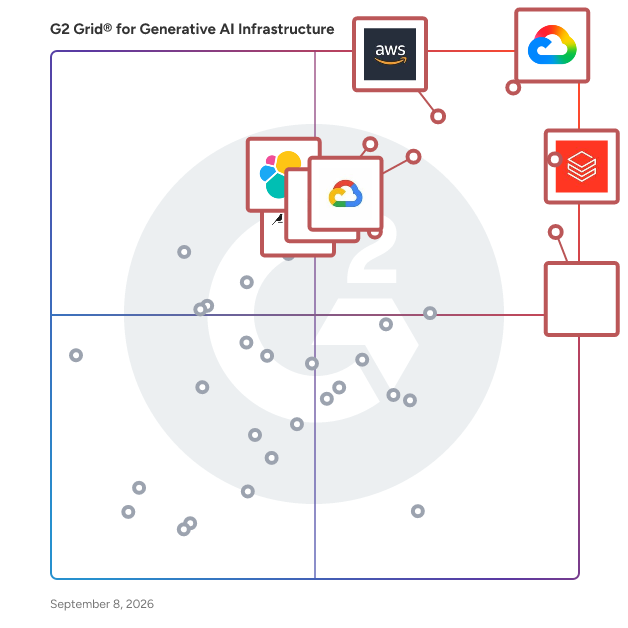
G2 Grid® for Generative AI Infrastructure Software

G2 Grid® for Generative AI Infrastructure Software plotting products by satisfaction and market presence

Highlighted products: Gemini Enterprise Agent Platform, Databricks, AWS Bedrock, Langchain, Google Cloud AI Infrastructure, IBM watsonx.ai, Dataiku, and Elasticsearch.

Underlying data: [Grid® JSON](https://www.g2.com/categories/generative-ai-infrastructure/grids.json?focus%5B%5D=gemini-enterprise-agent-platform&focus%5B%5D=databricks&focus%5B%5D=aws-bedrock&focus%5B%5D=langchain&focus%5B%5D=google-cloud-ai-infrastructure&focus%5B%5D=ibm-watsonx-ai&focus%5B%5D=dataiku&focus%5B%5D=elastic-elasticsearch)

Atlas Cloud

Atlas Cloud is a full-modal AI inference platform that gives developers and enterprises unified access to the world’s leading AI models through a single API. The platform combines AI infrastructure, multimodal model access, GPU-powered inference, and developer tooling into one scalable environment for building AI applications faster. Atlas Cloud supports chat, reasoning, image generation, video generation, audio synthesis, and multimodal AI workflows through a unified OpenAI-compatible API and consolidated billing system. Developers can integrate hundreds of production-ready AI models — including models from OpenAI, Anthropic, Google, ByteDance, DeepSeek, Qwen, Flux, Kling, Wan, and more — without managing multiple vendors or infrastructure providers. Designed for AI-native startups, creators, and enterprise engineering teams, Atlas Cloud provides high-performance inference infrastructure, intelligent model routing, serverless GPU environments, and built-in scalability to simplify AI deployment and reduce operational overhead.

Who Is the Company Behind Atlas Cloud?

Atlas Design

Atlas Design is an innovative 3D generative AI platform that revolutionizes the creation of virtual worlds and experiences. By harnessing advanced artificial intelligence, it enables game developers, architects, and virtual reality creators to produce high-quality 3D assets rapidly and efficiently. Users can generate detailed models from simple images, text descriptions, or style references, significantly reducing the time and effort traditionally required in 3D modeling. Key Features and Functionality: - Rapid Asset Generation: Produces 3D models in seconds, allowing creators to focus more on design and innovation. - High-Quality Outputs: Delivers clean geometric models with semantic segmentations, UV mappings, and optimized textures, ensuring assets are ready for immediate use. - Customizable AI: Tailors outputs to match specific artistic styles based on provided references, such as mood boards, ensuring each asset aligns with the project's aesthetic vision. - Seamless Integration: Interfaces smoothly with major gaming engines like Unity and Unreal Engine, offering API access for custom integrations. - Scalable Workflow: Supports an end-to-end workflow from 3D concepting to runtime generation, accommodating large-scale projects with consistent and continuous content production. Primary Value and User Solutions: Atlas Design addresses the challenges of time-consuming and resource-intensive 3D content creation by automating and accelerating the modeling process. Users report up to 200x efficiency gains, enabling faster project turnaround and reduced costs. Its user-friendly interface and customizable AI empower creators to produce unique, high-quality assets that align with specific artistic styles, enhancing creative freedom and project outcomes. By integrating seamlessly with existing workflows and major platforms, Atlas Design ensures flexibility and compatibility, making it an invaluable tool for professionals in gaming, architecture, virtual reality, and beyond.

Who Is the Company Behind Atlas Design?

Avahi AI Platform

Build, deploy, and scale AI solutions faster on AWS Avahi AI Platform is a cloud-native AI and data solutions platform designed to help businesses modernize applications, automate workflows, and unlock actionable insights using AWS and generative AI. Built and managed by an AWS-certified team, Avahi enables organizations to move from experimentation to production-ready AI without the complexity of managing infrastructure, security, or scalability. From intelligent customer engagement to advanced analytics, Avahi helps teams focus on innovation while the platform handles provisioning, performance, and compliance.

Who Is the Company Behind Avahi AI Platform?

Avian ChatGPT Plugin

Avian ChatGPT Plugin integrates all your business data in ChatGPT, providing comprehensive insights for decision-making.

Who Is the Company Behind Avian ChatGPT Plugin?

Axera

Axera Semiconductor Co., Ltd. is a global leader in AI inference System-on-Chip (SoC) solutions, specializing in high-performance perception and computing platforms for on-device computing, edge AI inference, and smart vehicles. Founded in 2019, Axera is dedicated to building advanced AI infrastructure to make artificial intelligence accessible and ubiquitous for everyone. The company has successfully developed and mass-produced multiple generations of chips, with cumulative shipments surpassing 200 million units by the end of 2025. Key Features and Functionality: - AXNeutron NPU: A proprietary mixed-precision Neural Processing Unit (NPU) that delivers exceptional AI inference performance. It supports mainstream large language and vision models, including DeepSeek, Qwen, and Llama, enabling efficient deployment of quantized models on edge and terminal devices. - AXProton AI-ISP: The world's first commercially scaled AI Image Signal Processor (ISP) that optimizes visual data at the pixel level in real-time, ensuring high-quality imaging even in challenging environmental conditions. - Comprehensive Developer Support: Axera provides the Pulsar2 compiler and a robust Software Development Kit (SDK) to facilitate seamless development and mass production for partners. Primary Value and Solutions: Axera's solutions address the growing demand for efficient and high-performance AI processing at the edge and terminal levels. By integrating advanced NPUs and AI-ISPs into their SoCs, Axera enables real-time data processing and decision-making in applications such as smart cities, intelligent driving, robotics, and augmented/virtual reality. This empowers industries to implement AI-driven solutions that are both cost-effective and environmentally sustainable, ultimately contributing to a more intelligent and connected world.

Who Is the Company Behind Axera?

Azerion

Azerion Intelligence is a comprehensive Multi-Cloud and AI platform designed to empower businesses with affordable, independent cloud hosting and access to open-source AI tools. It enables AI-driven business solutions to operate seamlessly across multiple global cloud providers, reducing dependencies and optimizing operational agility, cost efficiency, and latency. The platform offers instant access to leading open-source large language models such as Deepseek, Llama, Mistral, and Anthropic, along with a marketplace of AI-powered applications and agents tailored for digital marketing and publishing tasks. These include dynamic ad creation, channel mix modeling, campaign execution, content creation, social media management, translations, and financial workflows. By combining powerful AI models with a competitive and scalable pay-per-use pricing structure, Azerion delivers a versatile and future-ready AI-as-a-service platform for the European media industry. Key Features and Functionality: - Rapid API Creation: Transform models into production-ready APIs within minutes, allowing developers to focus on building applications rather than managing infrastructure. - Accelerated Performance: Utilize a finely-tuned stack for high-speed training and inference, optimized for cost-efficiency. - Simple API Integration: Integrate easily with a REST API and client libraries available for popular programming languages. - Serverless Endpoints: Deploy models instantly without pre-booking capacity, with automatic scaling from zero to peak demand, ensuring cost-effective AI with zero idle costs. - Dedicated Endpoints: Secure reserved instances for consistent, low-latency performance, ideal for production workloads requiring high throughput and predictable response times. - Comprehensive SDKs: Access multiple language SDKs, including Python, JavaScript, Go, and Java, with support for streaming responses and comprehensive examples for popular frameworks. Primary Value and Solutions Provided: Azerion Intelligence addresses the need for scalable, cost-effective AI solutions by offering a platform that reduces vendor lock-in and enhances operational agility. By providing access to leading open-source AI models and a suite of AI-powered applications, it enables businesses to automate and optimize various marketing and publishing tasks. This includes dynamic ad creation, campaign execution, and content management, thereby improving efficiency and driving better engagement and revenue. The platform's pay-per-use pricing model ensures that businesses only pay for the resources they use, making advanced AI capabilities accessible without significant upfront investment.

Who Is the Company Behind Azerion?

Bagel model

BAGEL is an open-source, unified multimodal model developed by ByteDance's Seed team, designed to seamlessly integrate text, image, and video processing capabilities. Leveraging a Mixture-of-Transformer-Experts (MoT) architecture, BAGEL excels in tasks such as text-to-image generation, image editing, style transfer, and complex visual reasoning. Pretrained on extensive interleaved multimodal data, it demonstrates emergent abilities in understanding and generating high-fidelity, contextually rich outputs across various modalities. Key Features: - Unified Multimodal Processing: Combines text, image, and video understanding and generation within a single model. - Advanced Image Generation and Editing: Produces photorealistic images from text prompts and performs intelligent image editing. - Style Transfer: Transforms images across different artistic styles with minimal alignment data. - World Navigation and Future Prediction: Exhibits capabilities in 3D manipulation, future frame prediction, and environment navigation. - Open-Source Accessibility: Available under the Apache 2.0 license, allowing for fine-tuning, distillation, and deployment across platforms. Primary Value and Problem Solved: BAGEL addresses the need for a versatile, open-source model capable of performing complex multimodal tasks that were previously restricted to proprietary systems. By unifying understanding and generation across text, images, and videos, it empowers developers and researchers to create innovative applications in content creation, virtual environment simulation, and beyond, without the constraints of vendor lock-in.

Who Is the Company Behind Bagel model?

  • Seller: Bagel AI
  • Year Founded: 2022
  • HQ Location: San Francisco, US
  • LinkedIn® Page: www.linkedin.com
    29 employees on LinkedIn®

Batteries Included

Batteries Included is a comprehensive, self-hosted AI and DevOps platform designed to simplify the deployment and management of modern software infrastructure. By integrating essential tools such as large language models, vector databases, Jupyter notebooks, and serverless web services, it enables organizations to build, train, and deploy AI applications efficiently. The platform emphasizes ease of use, eliminating the need for complex configurations and allowing users to focus on innovation rather than infrastructure management. Key Features and Functionality: - Rapid Deployment of AI Models and Tools: Quickly launch production-ready large language models, vector databases, and Jupyter notebooks without intricate setup processes. - Automated Infrastructure Management: Utilize pre-configured components, referred to as "batteries," to deploy databases, monitoring tools, and AI/ML resources seamlessly. - Enterprise-Grade Security: Implement robust security measures, including Single Sign-On (SSO), mesh networking, automated SSL, and dynamic permission configurations, all managed from a unified command center. - Efficient Scaling and Monitoring: Benefit from dynamic scaling capabilities for web services and databases, coupled with integrated monitoring tools like Grafana and VictoriaMetrics for real-time performance insights. Primary Value and Problem Solved: Batteries Included addresses the complexities associated with deploying and managing AI and DevOps infrastructure. By offering an integrated, self-hosted platform that automates configuration and scaling, it reduces operational overhead and accelerates development cycles. This empowers organizations to focus on delivering innovative products and services without being encumbered by the intricacies of infrastructure management.

Who Is the Company Behind Batteries Included?

BioLM

BioLM is an AI-driven platform specializing in enzyme and therapeutics design, discovery, and optimization. It offers custom AI workflows, in-silico variant analysis, and seamless integration of AI into wet-lab projects, catering to the biotech and life science industries. Founded in 2022 and based in Shingle Springs, California, BioLM provides scalable solutions for protein and DNA modeling, including secure tokenization, regression, classification, de novo generation, and folding. Users can access state-of-the-art models via REST API, such as ESM or BERT tokenization for sequences, and fine-tune pretrained models to develop powerful classifiers, explainers, and generators with experimental sequences. Key Features and Functionality: - Custom AI Workflows: Tailored solutions for specific tasks, including model fine-tuning, even without pre-existing data. - In-Silico Variant Analysis: Screen millions of variants computationally to identify optimal candidates from vast possibilities. - Integration with Wet-Lab Projects: Seamless incorporation of AI insights into laboratory experiments to enhance research outcomes. - Scalable Protein and DNA Modeling: Support for secure tokenization, regression, classification, de novo generation, and folding of amino acids and DNA sequences. - REST API Access: Easy access to advanced algorithms like ESM or BERT tokenization for sequences, enabling efficient model utilization. - Model Fine-Tuning: Leverage extensive pretrained information to customize models for specific applications, enhancing performance and relevance. Primary Value and Solutions Provided: BioLM accelerates the development and optimization of enzymes and therapeutics by integrating advanced AI capabilities into the biotech and life science sectors. By offering scalable and customizable AI solutions, BioLM addresses challenges in protein and DNA modeling, enabling researchers and developers to efficiently design, analyze, and optimize biological molecules. This integration leads to faster discovery processes, improved candidate selection, and enhanced overall research productivity.

Who Is the Company Behind BioLM?

  • Seller: BioLM
  • Year Founded: 2023
  • HQ Location: Oakland, US
  • LinkedIn® Page: www.linkedin.com
    4 employees on LinkedIn®

Bizgraph

Agencies that are using bizgraph.app, you can turn one-time AI projects into monthly retainers. Manage multiple clients, apply custom markups, track profits, and automate invoicing through a single API.

Who Is the Company Behind Bizgraph?

Blaxel

Agentic AI infrastructure

Who Is the Company Behind Blaxel?

  • Seller: Blaxel
  • Year Founded: 2024
  • HQ Location: San Francisco, US
  • LinkedIn® Page: www.linkedin.com
    6 employees on LinkedIn®
Bijou Barry
BB
Researched and written by Bijou Barry
Updated April 9, 2026