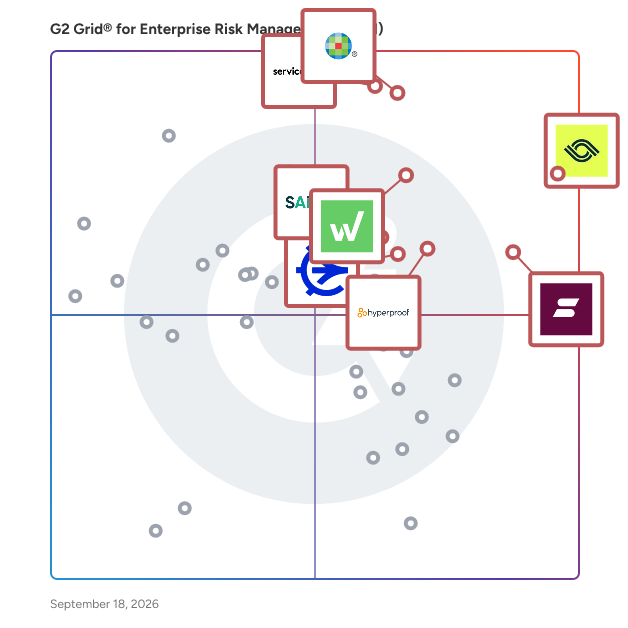
Enterprise risk management (ERM) software helps businesses identify, assess, and manage organization-wide risks across financial, legal, strategic, and operational domains. These tools centralize risk information, support repeatable risk assessment and prioritization, and deliver executive-level reporting aligned with board oversight and strategic objectives.
Core Capabilities of Enterprise Risk Management (ERM) Software
To qualify for inclusion in the Enterprise Risk Management (ERM) category, a product must:
- Centralize and manage enterprise-wide risks across multiple domains — financial, legal, strategic, and operational — in a unified risk register
- Enable enterprise risk assessments and prioritization, including scoring and visualization such as heat maps
- Align risks to business objectives and support configurable risk thresholds, customizable risk frameworks, or tolerance levels
- Provide executive-level reporting or dashboards on enterprise risk posture
- Support ongoing governance workflows, including risk ownership, mitigation tracking, and periodic review
Common Use Cases for Enterprise Risk Management (ERM) Software
ERM software supports a range of risk management activities across the organization. Common use cases include monitoring risk appetite and tolerance levels, assigning risk ownership to business unit leaders, tracking mitigation actions over time, ensuring compliance with frameworks such as COSO ERM and ISO 31000, and providing continuous oversight of risks that affect strategic, financial, operational, and compliance objectives.
How Enterprise Risk Management (ERM) Software Differs from Other Tools
ERM software is distinct from narrower risk and compliance tools. Unlike cybersecurity tools, which focus on digital security and privacy risks, ERM governs risk across the entire organization. It also differs from security compliance tools, which help organizations document adherence to security frameworks and pass audits. Similarly, while operational risk management focuses on risks stemming from human behavior, processes, or external events, ERM takes a broader organizational view. ERM software often integrates with environmental, quality, and safety management solutions to align governance, risk, and compliance functions.
Insights from G2 on Enterprise Risk Management (ERM) Software
Based on category trends on G2, centralized risk tracking, strong audit and compliance workflows, and the ability to communicate risk across business units stand out as primary strengths. Integrated GRC capabilities help maintain organizational integrity and prevent costly operational or legal incidents.