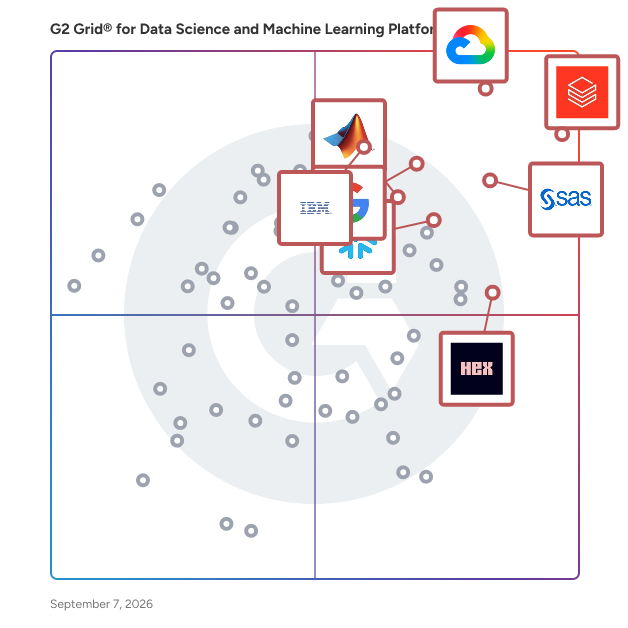
# Best Data Science and Machine Learning Platforms - Page 32

*By [Bijou Barry](https://research.g2.com/insights/author/bijou-barry)*


Data science and machine learning (DSML) platforms provide tools to build, deploy, and monitor machine learning (ML) algorithms by combining data with intelligent, decision-making models to support business solutions. These platforms may offer prebuilt algorithms and visual workflows for nontechnical users or require more advanced development skills for complex model creation.

Core capabilities of data science and machine learning (DSML) software

To qualify for inclusion in the Data Science and Machine Learning (DSML) Platforms category, a product must:

- Present a way for developers to connect data to algorithms so they can learn and adapt
- Allow users to create ML algorithms and offer prebuilt algorithms for novice users
- Provide a platform for deploying AI at scale

How DSML software differs from other tools

DSML platforms differ from traditional platform-as-a-service (PaaS) offerings by providing ML–specific functionality, such as prebuilt algorithms, model training workflows, and automated features that reduce the need for extensive data science expertise.

Insights from G2 Reviews on DSML software

According to G2 review data, users highlight the value of streamlined model development, ease of deployment, and options that support both nontechnical and advanced practitioners through visual interfaces or coding-based workflows.


## Top Data Science and Machine Learning Platforms at a Glance
| # | Product | Rating | Best For | What Users Say |
|---|---------|--------|----------|----------------|
| 1 | [Databricks](https://www.g2.com/products/databricks/reviews) | 4.6/5.0 (1,284 reviews) | Unified lakehouse ML and analytics workflows | "[Great Spark Scaling, But Slow Cluster Boot Times](https://www.g2.com/survey_responses/databricks-review-12905667)" |
| 2 | [Gemini Enterprise Agent Platform](https://www.g2.com/products/gemini-enterprise-agent-platform/reviews) | 4.3/5.0 (652 reviews) | End-to-end ML lifecycle with GCP-native MLOps | "[Vertex AI Streamlines ML Training and Deployment with a Unified, Feature-Rich Platform](https://www.g2.com/survey_responses/gemini-enterprise-agent-platform-review-12437893)" |
| 3 | [SAS Viya](https://www.g2.com/products/sas-sas-viya/reviews) | 4.3/5.0 (758 reviews) | End-to-end ML lifecycle with governed model deployment | "[Powerful &amp; Transforming Data into Decisions—Effortlessly and Intelligently.](https://www.g2.com/survey_responses/sas-viya-review-12682824)" |
| 4 | [Snowflake](https://www.g2.com/products/snowflake/reviews) | 4.5/5.0 (707 reviews) | SQL-native ML pipelines with unified data warehousing | "[Easy, Efficient Data Extraction with Clear Database Insights](https://www.g2.com/survey_responses/snowflake-review-12884116)" |
| 5 | [Deepnote](https://www.g2.com/products/deepnote/reviews) | 4.5/5.0 (377 reviews) | Collaborative notebook analytics with multi-source integration | "[Clarity for complex nutrition work](https://www.g2.com/survey_responses/deepnote-review-12699174)" |
| 6 | [Dataiku](https://www.g2.com/products/dataiku/reviews) | 4.4/5.0 (205 reviews) | End-to-end ML workflows with no-code/code flexibility | "[VisualML Potente con Limitaciones en Procesamiento Masivo](https://www.g2.com/survey_responses/dataiku-review-12982887)" |
| 7 | [IBM watsonx.data](https://www.g2.com/products/ibm-watsonx-data/reviews) | 4.4/5.0 (159 reviews) | Unified lakehouse analytics for hybrid AI workloads | "[Powerful Query Performance and Governance, But a Steep Onboarding Learning Curve](https://www.g2.com/survey_responses/ibm-watsonx-data-review-12836202)" |
| 8 | [Hex](https://www.g2.com/products/hex-tech-hex/reviews) | 4.5/5.0 (399 reviews) | Polyglot SQL-Python notebooks with AI-assisted analysis | "[Effortless Data Analysis with Powerful AI](https://www.g2.com/survey_responses/hex-review-12262172)" |
| 9 | [Anaconda Core](https://www.g2.com/products/anaconda-core/reviews) | 4.5/5.0 (235 reviews) | Dependency-free Python environment setup for data science | "[All-in-One Toolkit for Data Science Workflows](https://www.g2.com/survey_responses/anaconda-core-review-12706297)" |
| 10 | [MATLAB](https://www.g2.com/products/matlab/reviews) | 4.5/5.0 (749 reviews) | Numerical simulation and ML algorithm prototyping | "[A Robust Powerhouse for Advanced Engineering Simulations and Modeling](https://www.g2.com/survey_responses/matlab-review-12689149)" |


## How Many Data Science and Machine Learning Platforms Products Does G2 Track?
**Total Products under this Category:** 891

### Category Stats (Jun 2026)
- **Average Rating**: 4.45/5 The average rating of products in this category, based on all submitted ratings
- **Top Trending Product**: KNIME (+1.04%) - Among all products in this category, KNIME recorded the largest rating increase compared to last month
*Last updated: June 24, 2026*


## How Does G2 Rank Data Science and Machine Learning Platforms Products?

**Why You Can Trust G2's Software Rankings:**

- 30 Analysts and Data Experts
- 13,800+ Authentic Reviews
- 891+ Products
- Unbiased Rankings

G2's software rankings are built on verified user reviews, rigorous moderation, and a consistent research methodology maintained by a team of analysts and data experts. Each product is measured using the same transparent criteria, with no paid placement or vendor influence. While reviews reflect real user experiences, which can be subjective, they offer valuable insight into how software performs in the hands of professionals. Together, these inputs power the G2 Score, a standardized way to compare tools within every category.


## Which Data Science and Machine Learning Platforms Is Best for Your Use Case?

- **Leader:** [Databricks](https://www.g2.com/products/databricks/reviews)
- **Highest Performer:** [Saturn Cloud](https://www.g2.com/products/saturn-cloud-saturn-cloud/reviews)
- **Easiest to Use:** [Databricks](https://www.g2.com/products/databricks/reviews)
- **Top Trending:** [Hex](https://www.g2.com/products/hex-tech-hex/reviews)
- **Best Free Software:** [Databricks](https://www.g2.com/products/databricks/reviews)


---

**Sponsored**

### SAS Viya

SAS Viya is a cloud-native data and AI platform that enables teams to build, deploy and scale explainable AI that drives trusted, confident decisions. It unites the entire data and AI life cycle and empowers teams to innovate quickly while balancing speed, automation and governance by design. Viya unifies data management, advanced analytics and decisioning in a single platform, so organizations can move from experimentation to production with confidence, delivering measurable business impact that is secure, explainable and scalable across any environment. Key capabilities required to deliver trusted decisions include: • End-to-end clarity across the data and AI life cycle, with built-in lineage, auditability and continuous monitoring to support defensible decisions. • Governance by design, enabling consistent oversight across data, models and decisions to reduce risk and accelerate adoption. • Explainable AI at scale, so insights and outcomes can be understood, validated and trusted by business and regulators alike. • Operationalized analytics, ensuring value continues beyond deployment through monitoring, retraining and life cycle management. • Flexible, cloud-native deployment, allowing organizations to start anywhere and scale everywhere while maintaining control.


[Visit website](https://www.g2.com/external_clickthroughs/record?secure%5Bad_program%5D=ppc&amp;secure%5Bad_slot%5D=category_product_list&amp;secure%5Bcategory_id%5D=692&amp;secure%5Bdisplayable_resource_id%5D=692&amp;secure%5Bdisplayable_resource_type%5D=Category&amp;secure%5Bmedium%5D=sponsored&amp;secure%5Bplacement_reason%5D=page_category&amp;secure%5Bplacement_resource_ids%5D%5B%5D=692&amp;secure%5Bprioritized%5D=false&amp;secure%5Bproduct_id%5D=1327283&amp;secure%5Bresource_id%5D=692&amp;secure%5Bresource_type%5D=Category&amp;secure%5Bsource_type%5D=category_page&amp;secure%5Bsource_url%5D=https%3A%2F%2Fwww.g2.com%2Fcategories%2Fdata-science-and-machine-learning-platforms%3Fpage%3D18%26source%3Dsearch&amp;secure%5Btoken%5D=342c6691ceee22e8fccc6acc9a6dab2bd02aa4b153304bfbd95f40e5906161bb&amp;secure%5Burl%5D=https%3A%2F%2Fwww.sas.com%2Fgms%2Fredirect.jsp%3Fdetail%3DPLN73455_275629423&amp;secure%5Burl_type%5D=custom_url)

---

## What Are the Top-Rated Data Science and Machine Learning Platforms Products in 2026?
### 1. [Stokedge](https://www.g2.com/products/stokedge/reviews)
Stokedge is a technology consulting firm dedicated to empowering businesses through innovative digital strategies. Specializing in digital transformation and enterprise solutions, Stokedge leverages emerging technologies like cloud computing, big data, and artificial intelligence to address complex business challenges. With a team of seasoned professionals from leading tech companies and diverse industries, Stokedge combines deep industry knowledge with technological expertise to deliver impactful, data-driven solutions. Key Features and Functionality: - Digital Transformation Consulting: Stokedge assists enterprises in developing strategies that align business objectives with emerging technological capabilities, including cloud computing, big data, and AI/machine learning. - Enterprise Solution Design: The company designs and implements enterprise solutions that leverage emerging technologies to solve complex business challenges, ensuring seamless integration with existing systems. - AI Strategy Development: Stokedge helps clients identify high-value opportunities for AI application across various business domains, developing financial models and cost-benefit analyses to maximize impact. Primary Value and Solutions Provided: Stokedge empowers organizations to navigate the complexities of digital transformation by bridging the gap between business strategy and technology capabilities. By offering tailored digital transformation plans, solution architecture, and AI strategy development, Stokedge enables businesses to unlock new levels of efficiency, insight, and growth. Their client-centric approach ensures that each solution is customized to meet the unique needs and goals of the organization, driving measurable business results.


**Who Is the Company Behind Stokedge?**

- **Seller:** [Stokedge](https://www.g2.com/sellers/stokedge)
- **HQ Location:** Coimbra, PT
- **LinkedIn® Page:** https://www.linkedin.com/company/stokedge (6 employees on LinkedIn®)


### 2. [Stratosphere.io](https://www.g2.com/products/stratosphere-io/reviews)
Stratosphere.io is an AI-powered investment research platform designed to provide investors with comprehensive financial data and insights into public companies. By integrating verified information from human equity analysts, the platform offers detailed financial estimates, market intelligence, and key performance indicators (KPIs). This enables users to conduct in-depth company analyses efficiently, facilitating informed investment decisions. Key Features and Functionality: - Extensive Financial Data: Access up to 35 years of financial data and company-specific KPIs, allowing for thorough historical analysis. - AI-Powered Assistant: Utilize an AI assistant to transform complex data into actionable insights, streamlining the research process. - Customizable Dashboards: Tailor dashboards to track relevant metrics and information, enhancing user experience and productivity. - Advanced Charting Tools: Employ sophisticated charting and data visualization tools to interpret financial data effectively. - Analyst Estimates and Ratings: Access consensus analyst estimates and ratings to gauge market sentiment and projections. Primary Value and User Solutions: Stratosphere.io addresses the challenges investors face in accessing reliable and comprehensive financial data. By offering a centralized platform with verified information and AI-driven insights, it reduces the time and effort required for investment research. This empowers both individual and institutional investors to make data-driven decisions with confidence, ultimately enhancing their investment strategies and outcomes.


**Who Is the Company Behind Stratosphere.io?**

- **Seller:** [Fiscal.ai](https://www.g2.com/sellers/fiscal-ai)
- **Year Founded:** 2021
- **HQ Location:** N/A
- **LinkedIn® Page:** https://www.linkedin.com/company/finchat-io/ (33 employees on LinkedIn®)


### 3. [Streambased](https://www.g2.com/products/streambased/reviews)
Streambased is a unified event streaming data platform designed to seamlessly integrate real-time and historical data for applications, data lakes, and AI systems. By providing logical views over data in Apache Kafka and Apache Iceberg without the need for data movement or duplication, Streambased enables teams to access and analyze streaming data with confidence and speed. Key Features and Functionality: - Iceberg Service for Kafka (I.S.K.): Projects Kafka topics directly as Apache Iceberg tables, allowing immediate querying of real-time data without duplication. - Analytics Service for Kafka (A.S.K.): Offers a fully distributed SQL engine that integrates with analytics applications supporting JDBC, ODBC, or SQLAlchemy, enabling direct SQL queries on Kafka data. - Storage Service for Kafka (S.S.K.): Provides an Amazon S3-compatible proxy, allowing users to access real-time Kafka data as if it were a filesystem. - Streambased MCP Server: Implements Anthropic&#39;s Model Context Protocol standard, enabling AI agents to access real-time data. Primary Value and Solutions Provided: Streambased addresses several challenges faced by organizations dealing with streaming data: - Elimination of ETL Pipelines: By providing logical views over data, Streambased removes the need for complex ETL processes, reducing latency and operational overhead. - Real-Time Data Access: Enables immediate querying of data as it arrives in Kafka, ensuring that dashboards, reports, and AI models are always up-to-date. - Unified Governance: Applies consistent governance policies, including permissions, lineage, and schema evolution, across both operational and analytical applications, ensuring data integrity and compliance. - Performance Optimization: Utilizes indexing techniques to accelerate query performance, delivering up to 100x speed improvements over traditional SQL-on-Kafka solutions. By integrating real-time and historical data without the need for data movement, Streambased provides a single source of truth, enhances data accessibility, and simplifies the data architecture for organizations.


**Who Is the Company Behind Streambased?**

- **Seller:** [Streambased](https://www.g2.com/sellers/streambased)
- **Year Founded:** 2023
- **HQ Location:** London, GB
- **LinkedIn® Page:** https://www.linkedin.com/company/streambased (8 employees on LinkedIn®)


### 4. [Streetbeat](https://www.g2.com/products/streetbeat-streetbeat/reviews)
Streetbeat is an AI-driven financial intelligence platform designed to revolutionize investment management for both individual investors and financial institutions. By integrating advanced artificial intelligence with real-time market data, Streetbeat offers a suite of solutions that automate portfolio management, enhance market analysis, and streamline client engagement. As a registered investment adviser with the SEC and holding SOC 2 Type I and Type II certifications, Streetbeat ensures the highest standards of security and regulatory compliance. Key Features and Functionality: - AI-Powered Portfolio Management: Streetbeat&#39;s AI agents automate the processes of portfolio construction, analysis, and rebalancing, enabling financial advisors to manage client assets more efficiently. - Real-Time Market Insights: The platform provides continuous access to up-to-date financial data and market trends, empowering users to make informed investment decisions. - Seamless CRM Integration: Streetbeat integrates effortlessly with existing customer relationship management systems, facilitating improved client management and communication. - Customizable AI Agents: Users can develop tailored AI agents to automate specific financial tasks, enhancing operational efficiency and service delivery. - Comprehensive Security Measures: With SEC registration and SOC 2 certifications, Streetbeat prioritizes data protection and adheres to stringent regulatory standards. Primary Value and User Solutions: Streetbeat addresses the complexities of modern investment management by providing AI-driven tools that automate and optimize financial processes. For financial advisors and institutions, this translates to increased efficiency, scalability, and the ability to offer personalized investment strategies to a broader client base. Individual investors benefit from an intuitive platform that simplifies investment decisions, offering access to sophisticated strategies and real-time insights without requiring extensive financial expertise. By leveraging Streetbeat&#39;s technology, users can enhance their investment performance, improve client engagement, and navigate the financial markets with greater confidence and precision.


**Who Is the Company Behind Streetbeat?**

- **Seller:** [Streetbeat](https://www.g2.com/sellers/streetbeat-a68b86ae-88e5-428b-816c-0035be096043)
- **Year Founded:** 2021
- **HQ Location:** Palo Alto, US
- **LinkedIn® Page:** https://www.linkedin.com/company/streetbeat-com (3,308 employees on LinkedIn®)


### 5. [Struct](https://www.g2.com/products/structai-struct/reviews)
Struct proactively dedupes and root causes eng alerts and on-call issues - all on top of your existing observability stack and alert channels.


**Who Is the Company Behind Struct?**

- **Seller:** [Struct](https://www.g2.com/sellers/struct)
- **HQ Location:** N/A
- **LinkedIn® Page:** https://www.linkedin.com/company/No-Linkedin-Presence-Added-Intentionally-By-DataOps (1 employees on LinkedIn®)


### 6. [Sulie](https://www.g2.com/products/sulie/reviews)
Sulie is a fully managed platform designed to simplify time series forecasting for data teams. Powered by the Mimosa foundation model—a transformer-based architecture tailored for time series data—Sulie delivers accurate, out-of-the-box predictions without the need for extensive machine learning expertise or complex infrastructure management. By abstracting away MLOps complexities, Sulie enables users to focus on deriving actionable insights from their forecasts. Key Features and Functionality: - Zero-Shot Forecasting: Generate precise forecasts instantly without requiring prior training or preprocessing of historical data. - Auto Fine-Tuning: Enhance model performance with a single API call; Sulie manages the entire training pipeline, providing transparency into model selection and metrics. - Covariates Support (Enterprise): Conduct multivariate forecasting by incorporating dynamic and static covariates without the need for feature engineering. - Managed Infrastructure: Sulie handles all aspects of deployment, scaling, and maintenance, allowing users to concentrate on forecasting tasks. - Centralized Datasets: Continuously push time series data through Sulie&#39;s Python SDK, creating a centralized, versioned repository accessible across the organization. Primary Value and User Solutions: Sulie addresses the challenges of traditional time series forecasting by eliminating the need for extensive model training and infrastructure management. Its zero-shot forecasting capability allows users to obtain accurate predictions rapidly, reducing the time from data collection to actionable insights. By supporting multivariate forecasting and managing the complexities of MLOps, Sulie empowers data teams to focus on strategic decision-making rather than technical implementation, thereby enhancing productivity and operational efficiency.


**Who Is the Company Behind Sulie?**

- **Seller:** [Sulie](https://www.g2.com/sellers/sulie)
- **Year Founded:** 2023
- **HQ Location:** Zagreb, HR
- **LinkedIn® Page:** https://www.linkedin.com/company/sulie/ (1 employees on LinkedIn®)


### 7. [Summation](https://www.g2.com/products/summation-summation/reviews)
Summation delivers an AI platform that helps enterprise teams to generate insights, automate workflows, and surface strategic opportunities.


**Who Is the Company Behind Summation?**

- **Seller:** [Summation](https://www.g2.com/sellers/summation)
- **Year Founded:** 2024
- **HQ Location:** Bellevue, US
- **LinkedIn® Page:** https://www.linkedin.com/company/summation-hq (44 employees on LinkedIn®)


### 8. [SumoPPM](https://www.g2.com/products/sumoppm/reviews)
SumoPPM is an AI-powered business intelligence platform designed to streamline data analysis and enhance decision-making processes for businesses of all sizes. By integrating advanced technologies such as artificial intelligence, machine learning, and blockchain, SumoPPM offers a comprehensive suite of tools that automate and simplify complex data tasks. This enables organizations to transform raw data into actionable insights without the need for extensive technical expertise. With a focus on user-friendly interfaces and robust security measures, SumoPPM empowers businesses to optimize operations, improve customer experiences, and drive growth efficiently. Key Features and Functionality: - Data Visualization: Create interactive dashboards and visualizations effortlessly, allowing for intuitive data interpretation and reporting. - Tools Integrator: Seamlessly connect and synchronize various business tools, such as ERP, CRM, and e-commerce platforms, to centralize data and automate workflows. - AI Agents: Automate routine tasks like managing meetings, emails, and reports, enhancing productivity and operational efficiency. - Chatbots: Deploy AI-driven chatbots on websites to provide 24/7 customer support, handle inquiries, and facilitate sales processes without manual intervention. - AI Predictive Models: Utilize machine learning models to forecast trends, anticipate customer behavior, and make informed business decisions. - Audio Analytics: Analyze business calls to extract valuable insights, monitor customer satisfaction, and improve service quality. - Web Scraping: Automatically collect and analyze data from websites and social media to stay informed about market trends and competitor activities. Primary Value and Solutions Provided: SumoPPM addresses the challenge of complex data management by offering an integrated platform that simplifies data analysis and visualization. By automating routine tasks and providing real-time insights, it enables businesses to make data-driven decisions swiftly and accurately. The incorporation of blockchain technology ensures data security and integrity, fostering trust and compliance. Ultimately, SumoPPM empowers organizations to enhance operational efficiency, reduce costs, and drive sustainable growth through intelligent automation and insightful analytics.


**Who Is the Company Behind SumoPPM?**

- **Seller:** [SumoPPM](https://www.g2.com/sellers/sumoppm)
- **Year Founded:** 2024
- **HQ Location:** Madrid, ES
- **LinkedIn® Page:** https://www.linkedin.com/company/sumoppm/ (2 employees on LinkedIn®)


### 9. [SuntheticsML](https://www.g2.com/products/suntheticsml/reviews)
SuntheticsML is an AI experiment-optimization platform that helps R&amp;D teams hit their targets with far fewer experiments. Built for scientists in pharmaceuticals, chemicals, materials, and cosmetics, it uses Bayesian optimization and active machine learning to recommend the next best experiments to run — and it works from very small, real-world datasets, not big data. Most R&amp;D still runs on trial-and-error or exhaustive design-of-experiments (DOE) campaigns that burn time, budget, and materials. SuntheticsML guides every round of experimentation toward the optimal formulation, reaction, or process condition—reducing the number of experiments needed and compressing development timelines from months to weeks. What you can do with SuntheticsML: • Get next-best-experiment recommendations for formulations, reactions, and process conditions • Optimize from as few as a handful of data points—no large dataset required • Improve yield, selectivity, and performance while cutting raw-material and energy consumption • Collaborate across R&amp;D teams on a secure platform with SOC 2 Type II–attested controls and full per-customer data isolation R&amp;D and process teams use SuntheticsML to accelerate development, lower cost-to-discover, and reach better results faster—while keeping their proprietary research data fully protected.


**Who Is the Company Behind SuntheticsML?**

- **Seller:** [Sunthetics](https://www.g2.com/sellers/sunthetics)
- **Year Founded:** 2018
- **HQ Location:** San Marcos, US
- **LinkedIn® Page:** https://www.linkedin.com/company/sunthetics (14 employees on LinkedIn®)


### 10. [Superfluid](https://www.g2.com/products/superfluid/reviews)
Superfluid Labs is a data analytics and artificial intelligence company dedicated to unlocking data-driven insights for enterprises and organizations. Their platform integrates diverse data sources—including financial, transactional, and customer data—to provide comprehensive business intelligence solutions. By leveraging advanced analytics, Superfluid Labs enables businesses to make informed decisions, enhance customer engagement, and drive profitable growth. Key Features and Functionality: - Credit Risk Analysis: Develops digital credit scoring models to reduce losses and increase profitability for retail lending businesses. - Customer Insights: Offers 360-degree customer views, segmentation, and churn risk analysis to understand and retain valuable customers. - Data Analytics: Provides data aggregation, preparation, feature engineering, and automated machine learning for accurate and speedy decision-making. - Enterprise Intelligence: Delivers business intelligence, precision marketing, and customer segmentation to drive growth. - Customer Engagement: Personalizes communication through data-driven intelligence across multiple channels, including email, SMS, and voice calls. Primary Value and Solutions: Superfluid Labs addresses the challenge of harnessing vast amounts of data by providing tools that transform raw data into actionable insights. Their solutions help businesses reduce lending risks, grow customer bases, and engage clients intelligently. By automating data analytics and machine learning processes, Superfluid Labs empowers organizations to make intelligent decisions, optimize operations, and achieve sustainable growth.


**Who Is the Company Behind Superfluid?**

- **Seller:** [Superfluid](https://www.g2.com/sellers/superfluid)
- **HQ Location:** N/A
- **LinkedIn® Page:** https://www.linkedin.com/company/No-Linkedin-Presence-Added-Intentionally-By-DataOps (1 employees on LinkedIn®)


### 11. [Supranalyst](https://www.g2.com/products/supranalyst/reviews)
Supranalyst is a comprehensive data analysis platform designed to empower businesses with actionable insights through advanced analytics and intuitive visualization tools. By integrating seamlessly with existing data sources, Supranalyst enables organizations to make informed decisions, optimize operations, and drive growth. Key Features and Functionality: - Advanced Analytics: Utilizes machine learning algorithms to uncover patterns and trends within complex datasets. - Data Integration: Connects with various data sources, including databases, cloud services, and APIs, ensuring a unified data environment. - Customizable Dashboards: Offers interactive dashboards that can be tailored to specific business needs, providing real-time insights. - Collaboration Tools: Facilitates team collaboration through shared reports and annotations, enhancing collective decision-making. - Scalability: Designed to handle large volumes of data, making it suitable for businesses of all sizes. Primary Value and User Solutions: Supranalyst addresses the challenge of transforming raw data into meaningful insights by providing a user-friendly platform that simplifies complex data analysis. It empowers users to identify opportunities, mitigate risks, and make data-driven decisions efficiently. By streamlining the analytical process, Supranalyst enhances productivity and fosters a data-centric culture within organizations.


**Who Is the Company Behind Supranalyst?**

- **Seller:** [Supr Analyst](https://www.g2.com/sellers/supr-analyst)
- **Year Founded:** 2025
- **HQ Location:** N/A
- **LinkedIn® Page:** https://www.linkedin.com/company/get-eliza (3 employees on LinkedIn®)


### 12. [Surgical Safety Technologies](https://www.g2.com/products/surgical-safety-technologies/reviews)
Surgical Safety Technologies (SST) is a mission-driven organization dedicated to transforming healthcare through intelligent software solutions. Their flagship product, the Black Box Platform™, leverages advanced data analytics, audiovisual capabilities, artificial intelligence (AI), and machine learning to enhance patient safety, optimize operations, and facilitate continuous improvement across various clinical environments, including perioperative, trauma recovery, and labor and delivery settings. Key Features and Functionality: - Multimodal Data Capture: The Black Box Platform™ integrates sensors and processors to capture comprehensive data from every angle of care delivery, providing a holistic view of clinical practices. - AI-Driven Insights: Utilizing AI, the platform analyzes captured data to identify performance gaps and transform information into actionable insights, enabling organizations to detect patterns, adapt workflows, and respond to quality improvement opportunities. - Environment-Specific Solutions: SST offers tailored solutions such as the OR Black Box® for surgical quality and efficiency, Trauma Black Box for trauma resuscitations, and SIM Black Box™ for simulation-based training, each designed to optimize results in their respective settings. - Automated Documentation: The platform&#39;s AI models automatically detect and timestamp critical surgical events, integrating seamlessly with electronic health record (EHR) systems to eliminate manual documentation and reduce administrative burdens. - Mobile Accessibility: SST&#39;s mobile applications, Room State and Explorer, provide real-time case updates and access to surgical video content, enhancing workflow efficiency and educational opportunities for surgical teams. Primary Value and User Solutions: The Black Box Platform™ addresses the critical need for transparency and continuous improvement in healthcare by providing real-time, AI-driven insights into clinical practices. By capturing and analyzing comprehensive data, the platform empowers healthcare organizations to: - Enhance Patient Safety: Identify and mitigate risks through autonomous risk detection and protocol auditing, leading to improved patient outcomes. - Optimize Operations: Utilize real-time operational analytics and predictive insights to streamline workflows, reduce inefficiencies, and lower costs. - Facilitate Continuous Improvement: Leverage data-driven insights to inform training, adapt protocols, and foster a culture of continuous learning and quality enhancement. By integrating cutting-edge technologies with existing systems, SST&#39;s Black Box Platform™ future-proofs healthcare organizations, ensuring they are equipped to meet evolving challenges and deliver care at its highest potential.


**Who Is the Company Behind Surgical Safety Technologies?**

- **Seller:** [Surgical Safety Technologies](https://www.g2.com/sellers/surgical-safety-technologies)
- **Year Founded:** 2014
- **HQ Location:** New York, US
- **LinkedIn® Page:** https://www.linkedin.com/company/surgicalsafetytechnologies (58 employees on LinkedIn®)


### 13. [Symbiotai](https://www.g2.com/products/symbiotai/reviews)
SymbiotAI is an advanced artificial intelligence platform designed to seamlessly integrate with existing business systems, enhancing operational efficiency and decision-making processes. By leveraging cutting-edge machine learning algorithms, SymbiotAI provides real-time analytics and predictive insights, enabling organizations to stay ahead in a competitive landscape. Key Features and Functionality: - Seamless Integration: Easily connects with existing business infrastructures, ensuring minimal disruption during implementation. - Real-Time Analytics: Delivers up-to-the-minute data analysis, allowing for timely and informed decision-making. - Predictive Insights: Utilizes advanced machine learning to forecast trends and outcomes, aiding in strategic planning. - User-Friendly Interface: Designed with an intuitive interface, making it accessible for users with varying levels of technical expertise. - Scalability: Adapts to businesses of all sizes, from startups to large enterprises, growing alongside organizational needs. Primary Value and Solutions Provided: SymbiotAI addresses the challenge of data overload and the need for rapid, accurate decision-making in modern businesses. By automating complex data analysis and providing actionable insights, it empowers organizations to optimize operations, reduce costs, and identify new opportunities for growth. This leads to enhanced productivity, improved customer satisfaction, and a significant competitive advantage in the market.


**Who Is the Company Behind Symbiotai?**

- **Seller:** [SymbiotAI](https://www.g2.com/sellers/symbiotai)
- **HQ Location:** N/A
- **LinkedIn® Page:** https://www.linkedin.com/company/No-Linkedin-Presence-Added-Intentionally-By-DataOps (1 employees on LinkedIn®)


### 14. [Synaptik](https://www.g2.com/products/synaptik/reviews)
Run your business faster &amp; smarter with an all inclusive full stack and full serviceAutomation and AI Platform.


**Who Is the Company Behind Synaptik?**

- **Seller:** [Synaptik.co](https://www.g2.com/sellers/synaptik-co)
- **HQ Location:** N/A
- **LinkedIn® Page:** https://www.linkedin.com/company/synaptikco/about/ (2 employees on LinkedIn®)


### 15. [Synaptiq.io](https://www.g2.com/products/synaptiq-io/reviews)
Synaptiq.io is a pioneering company specializing in artificial intelligence (AI) solutions for the healthcare sector, with a primary focus on enhancing the efficiency and accuracy of radiotherapy treatment planning. Their flagship product, Mediq RT, is an AI-driven software designed to assist radiation oncologists and medical physicists by automating the contouring of organs-at-risk (OARs) and clinical target volumes (CTVs) on 3D CT images of cancer patients. This automation significantly reduces the time required for treatment planning, allowing clinicians to treat more patients effectively. Key Features and Functionality: - AI-Based Segmentation: Mediq RT employs advanced deep learning algorithms to automatically delineate regions of interest across major anatomical sites, including the head and neck, thorax, abdomen, and pelvis. - Adaptive Learning: The software continuously improves its performance post-deployment by learning from user inputs and corrections, ensuring enhanced accuracy over time. - Active Revision: Clinicians can easily adjust AI-generated contours with minimal effort, facilitating a collaborative approach between human expertise and machine intelligence. - User-Friendly Interface: Designed for ease of use, Mediq RT integrates seamlessly into existing clinical workflows, supporting both Windows and macOS platforms. Primary Value and Problem Solved: Mediq RT addresses the critical challenge of time-intensive manual contouring in radiotherapy treatment planning. By automating this process, the software reduces contouring time by an average of 92.5%, thereby decreasing the interval between diagnosis and treatment initiation. This acceleration not only enhances patient survival rates but also alleviates the workload on medical staff, enabling clinics to manage a higher patient volume without compromising quality of care. Furthermore, the AI-driven approach minimizes human error, ensuring more precise and objective treatment plans.


**Who Is the Company Behind Synaptiq.io?**

- **Seller:** [Synaptiq.io](https://www.g2.com/sellers/synaptiq-io)
- **Year Founded:** 2020
- **HQ Location:** Cluj, RO
- **LinkedIn® Page:** https://www.linkedin.com/company/synaptiq-io (21 employees on LinkedIn®)


### 16. [Synfini](https://www.g2.com/products/synfini-synfini/reviews)
Synfini is an AI-driven drug discovery platform that integrates artificial intelligence, chemistry automation, and cloud-native workflows to accelerate the development of small molecule therapeutics. By uniting physical and virtual chemistry through expert-curated AI and discovery-focused robotic automation, Synfini dramatically reduces the time and cost associated with translating targets, hits, and virtual drug concepts into validated candidates. This innovative approach enables partners to create optimized molecules efficiently, addressing the bottlenecks in traditional drug discovery processes. Key Features and Functionality: - AI Cloud Foundry: A comprehensive platform that combines AI with automated synthesis and iterative molecular design, streamlining the entire drug discovery workflow. - SynPlan: An agile dashboard for managing Design-Make-Test-Analyze (DMTA) cycles, facilitating program objectives, customizable workflows, and collaboration. - SynDesign: A neuro-symbolic AI system for molecule generation and property prediction, requiring significantly less data than traditional systems, thus reducing false designs and enhancing optimization speed. - SynRoute and SynBuild: Tools for AI-assisted synthesis pathway planning and automated compound production, respectively, ensuring efficient and reliable chemical synthesis. - SynDB: A centralized repository for reaction and molecular data, supporting seamless data management and analysis. Primary Value and Problem Solved: Synfini addresses the critical challenges in modern drug discovery by significantly accelerating the process of translating theoretical drug concepts into viable candidates. Traditional methods are often costly and time-consuming, creating bottlenecks in therapeutic development. By integrating AI with robotic automation and a vast proprietary chemistry dataset, Synfini enables rapid and cost-effective generation of robust data to validate new drug designs. This approach not only speeds up lead optimization but also improves predictive accuracy and allows exploration of a broader chemical space, making drug discovery faster, more collaborative, and more efficient.


**Who Is the Company Behind Synfini?**

- **Seller:** [Synfini](https://www.g2.com/sellers/synfini)


### 17. [SYNQ](https://www.g2.com/products/synq-2025-09-01/reviews)
SYNQ is an AI-powered data observability platform designed to ensure the reliability of critical data by proactively identifying and addressing issues before they escalate. It offers intelligent monitoring, real-time insights, and automated root cause analysis, enabling data teams to maintain high-quality data across their operations. Key Features and Functionality: - Comprehensive Monitoring and Testing: SYNQ employs a suite of monitors—including freshness, volume, schema, and growth—to detect anomalies such as missing data loads, broken schemas, and decreased ingestion rates. - Ownership and Alerting: The platform allows for the creation of ownership structures, ensuring that alerts are automatically routed to the appropriate team members, reducing the burden on data engineers and facilitating prompt issue resolution. - Root-Cause Analysis and Lineage: SYNQ provides full data lineage, helping teams trace issues back to their source, whether they stem from upstream schema changes or code modifications, thereby streamlining the debugging process. - Incident Management and Issue Resolution: The platform offers an integrated workflow for detecting, evaluating, and resolving data issues, ensuring that incidents are managed efficiently from detection to resolution. - Data Quality Analytics and Reporting: SYNQ delivers cross-platform analytics, providing insights into data quality, usage, cost, and performance, enabling teams to make informed decisions and establish service level agreements (SLAs). Primary Value and Problem Solved: SYNQ addresses the critical need for reliable data in modern organizations by offering a unified approach to data observability. By integrating monitoring, ownership alignment, root-cause analysis, and incident management into a single platform, SYNQ empowers data teams to detect and resolve issues proactively. This ensures that models and metrics perform optimally, reducing downtime and enhancing overall data quality. The platform&#39;s focus on data products and analytics engineering workflows makes it particularly valuable for teams aiming to align data quality with business-critical use cases, thereby preventing issues that could impact operations and decision-making.


**Who Is the Company Behind SYNQ?**

- **Seller:** [SYNQ](https://www.g2.com/sellers/synq)
- **Year Founded:** 2022
- **HQ Location:** London, GB
- **LinkedIn® Page:** https://www.linkedin.com/company/getsynq/ (15 employees on LinkedIn®)


### 18. [Synth](https://www.g2.com/products/synth-synth/reviews)
Synth is an advanced AI-powered platform designed to streamline the process of data analysis and interpretation for businesses and researchers. By leveraging cutting-edge machine learning algorithms, Synth automates complex data workflows, enabling users to extract meaningful insights from large datasets efficiently. This reduces the time and expertise traditionally required for data processing, allowing organizations to make informed decisions swiftly. Key Features and Functionality: - Automated Data Processing: Synth simplifies data ingestion, cleaning, and transformation, minimizing manual intervention and reducing the risk of human error. - Advanced Analytics: The platform offers a suite of analytical tools that perform predictive modeling, trend analysis, and anomaly detection, providing users with comprehensive insights. - User-Friendly Interface: Designed with a focus on usability, Synth features an intuitive interface that caters to both technical and non-technical users, facilitating seamless interaction with data. - Scalability: Synth is built to handle datasets of varying sizes, from small-scale studies to enterprise-level data, ensuring consistent performance and reliability. Primary Value and Problem Solved: Synth addresses the common challenges associated with data analysis, such as time-consuming manual processes, the need for specialized expertise, and the potential for human error. By automating and simplifying these tasks, Synth empowers organizations to harness the full potential of their data, leading to more accurate insights and better-informed strategic decisions. This efficiency not only saves time and resources but also enhances the overall effectiveness of data-driven initiatives.


**Who Is the Company Behind Synth?**

- **Seller:** [Synth](https://www.g2.com/sellers/synth)
- **HQ Location:** San Francisco, US
- **LinkedIn® Page:** https://www.linkedin.com/company/infer-so/ (30 employees on LinkedIn®)


### 19. [Synthetica](https://www.g2.com/products/synthetica/reviews)
Synthetica is an advanced artificial intelligence platform designed to empower businesses by automating complex processes and enhancing decision-making capabilities. By leveraging cutting-edge machine learning algorithms, Synthetica enables organizations to analyze vast datasets, uncover actionable insights, and drive innovation across various industries. Key features and functionalities of Synthetica include: - Data Analysis and Visualization: Synthetica processes large volumes of data, transforming them into clear, actionable visual reports that facilitate informed decision-making. - Predictive Analytics: The platform utilizes sophisticated algorithms to forecast trends and outcomes, allowing businesses to proactively address challenges and seize opportunities. - Natural Language Processing (NLP): Synthetica interprets and understands human language, enabling seamless interaction and extraction of meaningful information from unstructured text. - Automated Workflow Management: By automating routine tasks and processes, Synthetica increases operational efficiency and reduces the potential for human error. - Customizable AI Models: Users can tailor AI models to meet specific business needs, ensuring relevance and effectiveness in various applications. The primary value of Synthetica lies in its ability to transform raw data into strategic assets. By automating data analysis and providing predictive insights, it empowers businesses to make data-driven decisions, optimize operations, and maintain a competitive edge in their respective markets.


**Who Is the Company Behind Synthetica?**

- **Seller:** [Synthetica](https://www.g2.com/sellers/synthetica)
- **Year Founded:** 2019
- **HQ Location:** Marousi, GR
- **LinkedIn® Page:** https://www.linkedin.com/company/syntheticapc/ (23 employees on LinkedIn®)


### 20. [Szhao](https://www.g2.com/products/szhao/reviews)
Chroma AI is an innovative tool that enables users to create personalized gradients by inputting their current mood, favorite song lyrics, or any spontaneous thought. Leveraging advanced AI technology, Chroma AI interprets these inputs to generate unique and visually appealing gradients, offering a creative and interactive experience. Key Features and Functionality: - Mood-Based Gradient Generation: Users can input text reflecting their emotions or thoughts, and the AI translates these into corresponding color gradients. - OpenAI API Integration: The platform utilizes the OpenAI API to process user inputs and generate gradients, ensuring a seamless and intelligent user experience. - Preset Options: For quick inspiration, Chroma AI offers a selection of preset gradients that users can cycle through. - User-Friendly Interface: The platform provides a straightforward interface where users can easily enter their OpenAI API key and start generating gradients immediately. Primary Value and User Solutions: Chroma AI addresses the need for personalized and emotion-driven visual content creation. By transforming textual expressions of mood or thoughts into unique gradients, it offers users a novel way to visualize their emotions and ideas. This tool is particularly valuable for designers, artists, and individuals seeking creative inspiration or a unique method to express their feelings through color.


**Who Is the Company Behind Szhao?**

- **Seller:** [Chroma](https://www.g2.com/sellers/chroma-46567984-e1ed-4c36-84c8-be303b31fda7)
- **HQ Location:** N/A
- **LinkedIn® Page:** https://www.linkedin.com/company/No-Linkedin-Presence-Added-Intentionally-By-DataOps (1 employees on LinkedIn®)


### 21. [TableFlow](https://www.g2.com/products/tableflow/reviews)
TableFlow is an AI-powered document processing and workflow automation platform designed to transform unstructured documents into structured data with exceptional accuracy and speed. By leveraging advanced semantic AI, TableFlow understands document structures, contexts, and relationships, enabling businesses to automate data extraction, classification, and reconciliation processes. This reduces manual effort by over 90% and accelerates document processing times from hours to mere minutes. Key Features and Functionality: - Data Extraction: Accurately extracts structured data from various document formats, including PDFs, spreadsheets, and images, handling complex layouts and handwritten text. - Document Classification: Automatically identifies and categorizes documents, recognizing types such as invoices, receipts, and contracts without predefined templates. - AI Reconciliation: Compares documents across multiple sources, identifying discrepancies and ensuring data consistency, even when formats differ. - Review Experience: Provides an intuitive interface for data validation and correction, with tools for quick edits, comments, and approvals, facilitating real-time collaboration. - Analytics &amp; Reporting: Offers real-time dashboards to monitor document volumes, processing times, and success rates, aiding in identifying bottlenecks and optimizing workflows. Primary Value and Solutions Provided: TableFlow addresses the challenges of manual document processing by automating data extraction and reconciliation tasks, significantly reducing human error and operational costs. Its AI-driven approach ensures over 95% accuracy, surpassing traditional OCR methods, and processes documents in under 30 seconds. This enables businesses to scale operations confidently, improve efficiency, and enhance data accuracy across various workflows.


**Who Is the Company Behind TableFlow?**

- **Seller:** [TableFlow](https://www.g2.com/sellers/tableflow)
- **Year Founded:** 2022
- **HQ Location:** San Francisco, US
- **LinkedIn® Page:** https://www.linkedin.com/company/tableflowhq (2 employees on LinkedIn®)


### 22. [Tablepad](https://www.g2.com/products/tablepad-tablepad/reviews)
Tablepad is an AI-powered data visualization platform designed to simplify data analysis for users of all skill levels. By connecting to various data sources such as Google Sheets, Notion, CSV files, and more, Tablepad enables users to generate insightful charts and visualizations effortlessly. Its intuitive interface allows users to ask questions in plain English, with the AI interpreting these queries to produce meaningful visual representations. This eliminates the need for coding or advanced data knowledge, making data exploration accessible to everyone. Key Features and Functionality: - Data Source Integration: Seamlessly connects with multiple data sources, including Google Sheets, Notion, CSV, Excel, JSON, Parquet, Arrow, and Avro. - AI-Driven Insights: Utilizes artificial intelligence to interpret natural language queries and generate relevant charts and visualizations. - User-Friendly Interface: Designed for ease of use, allowing users to interact with their data without any coding or technical expertise. - Versatile File Format Support: Supports a wide range of file formats, ensuring flexibility in data import and analysis. - Sample Data Sets: Provides sample data sets like fake\_customer\_orders.csv, pokemons.csv, and FDIC\_bank\_failures.csv to help users get started quickly. Primary Value and Problem Solved: Tablepad democratizes data analysis by removing technical barriers, enabling users to uncover valuable insights without the need for coding or specialized knowledge. By automating the process of data visualization and interpretation, it empowers individuals and teams to make informed, data-driven decisions efficiently. This accessibility fosters a deeper understanding of data, promoting better strategic planning and execution across various domains.


**Who Is the Company Behind Tablepad?**

- **Seller:** [Tablepad](https://www.g2.com/sellers/tablepad)
- **HQ Location:** N/A
- **LinkedIn® Page:** https://www.linkedin.com/company/No-Linkedin-Presence-Added-Intentionally-By-DataOps (1 employees on LinkedIn®)


### 23. [Tablize](https://www.g2.com/products/tablize/reviews)
Tablize is an innovative online data table tool designed to simplify data cleaning, analysis, and application without the need for coding. It enables users to collaborate seamlessly with their teams, fostering efficient data workflows. By redefining data application processes, Tablize empowers individuals to accomplish tasks that traditionally required entire data teams. Key Features and Functionality: - Consolidate Metrics: Centralize all your metrics from various sources into a unified platform. - Automatic Reports: Generate live data insights through automatic reporting, keeping your team informed with up-to-date information. - Pinpoint Analysis: Dive deep into your data to identify issues and opportunities, facilitating informed decision-making. - Goal Alignment: Align goals and track progress within teams, ensuring everyone is on the same page. - Live Data Storage: Seamlessly connect disparate live data sources for integrated processing and real-time cross-sheet calculations. - Multi-Source Integration: Automatically import data from various sources, including spreadsheets, databases, ERPs, and CRMs. - Flexible Blocks: Customize dashboard blocks and utilize a diverse toolbox to tailor configurations to each user&#39;s unique analytic needs. - Everywhere Insights: Sync dashboard views fluently across terminals, empowering informed leadership anywhere. Primary Value and User Solutions: Tablize addresses the complexities of data management by providing a user-friendly platform that eliminates the need for coding expertise. It streamlines data workflows, enhances collaboration, and enables real-time data analysis. By centralizing metrics and automating reports, Tablize helps users optimize their ad spend, boost ROI, and make smarter decisions based on detailed insights. Its integration capabilities allow for seamless data consolidation from multiple sources, ensuring that users have a comprehensive view of their data landscape.


**Who Is the Company Behind Tablize?**

- **Seller:** [Tablize](https://www.g2.com/sellers/tablize)
- **HQ Location:** San Francisco, US
- **LinkedIn® Page:** https://www.linkedin.com/company/tablize-tech/ (2 employees on LinkedIn®)


### 24. [TalkingSchema](https://www.g2.com/products/talkingschema/reviews)
TalkingSchema is an AI-powered data modeling tool designed to streamline the process of database design and warehouse modeling. By transforming business requirements into production-ready schemas within minutes, it enables users to design Entity-Relationship Diagrams (ERDs) in over 80 languages, significantly accelerating the development of data models. Key Features and Functionality: - Automated Schema Generation: Users can input business logic, feature requests, KPIs, BI metrics, or user stories, and TalkingSchema will automatically generate the corresponding data model. - Rapid Creation of Star and Snowflake Schemas: The tool facilitates the swift transformation of transactional data sources into analytical models without the need for manual mapping. - Integrity and Compliance Verification: It allows for the design of new features with built-in checks to ensure data integrity, performance, and compliance, preventing disruptions in production environments. - Multilingual Support: With support for over 80 languages, TalkingSchema caters to a diverse user base, making data modeling accessible globally. Primary Value and User Solutions: TalkingSchema addresses the common challenges in data modeling by reducing the time and effort required to move from conceptual requirements to functional database schemas. It eliminates the need for extensive manual mapping and complex design processes, allowing data engineers, analysts, and developers to focus on strategic tasks and innovation. By automating and simplifying the data modeling process, TalkingSchema enhances productivity and ensures the creation of efficient, reliable, and compliant data structures.


**Who Is the Company Behind TalkingSchema?**

- **Seller:** [Talkingschema](https://www.g2.com/sellers/talkingschema)
- **Year Founded:** 2025
- **HQ Location:** N/A
- **LinkedIn® Page:** https://www.linkedin.com/company/talkingschema (2 employees on LinkedIn®)


### 25. [Tallarium](https://www.g2.com/products/tallarium/reviews)
Tallarium is an advanced pre-trade data and analytics platform designed to bring transparency and efficiency to the opaque over-the-counter (OTC) energy markets. By leveraging cutting-edge data science and machine learning, Tallarium consolidates fragmented pricing data from various sources, providing traders with a comprehensive and objective view of market prices in real time. This empowers energy traders, including majors, trading houses, banks, refiners, and funds, to make informed decisions swiftly, optimize trading performance, and effectively manage risks. Key Features and Functionality: - Quote Aggregator: Captures and structures incoming price data from multiple communication channels, such as chat and voice, analyzing it in real time to identify optimal trading opportunities. - T-Curves: Delivers accurate live and end-of-day pricing insights, offering a clear view of market trends with over 95% accuracy across key global benchmarks. - Integrations: Seamlessly integrates with existing systems through user-friendly Excel add-ins and APIs, ensuring smooth data flow and accessibility. Primary Value and Solutions Provided: Tallarium addresses the challenges of fragmented and manual data collection in OTC energy trading by offering a unified, real-time pricing platform. This solution eliminates the need for manual data entry and analysis, reducing errors and increasing efficiency. By providing a single source of truth for market pricing, Tallarium enables traders to uncover hidden liquidity, respond promptly to market risks and opportunities, and achieve best execution, ultimately enhancing trading performance and profitability.


**Who Is the Company Behind Tallarium?**

- **Seller:** [Tallarium](https://www.g2.com/sellers/tallarium)
- **Year Founded:** 2015
- **HQ Location:** London, GB
- **LinkedIn® Page:** https://www.linkedin.com/company/tallarium/ (10 employees on LinkedIn®)


## What Is Data Science and Machine Learning Platforms?

[Artificial Intelligence Software](https://www.g2.com/categories/artificial-intelligence)

## What Software Categories Are Similar to Data Science and Machine Learning Platforms?

- [Predictive Analytics Software](https://www.g2.com/categories/predictive-analytics)
- [Analytics Platforms](https://www.g2.com/categories/analytics-platforms)
- [MLOps Platforms](https://www.g2.com/categories/mlops-platforms)


---

## How Do You Choose the Right Data Science and Machine Learning Platforms?

### What You Should Know About Data Science and Machine Learning Platforms

### What are data science and machine learning (DSML) platforms?

The amount of data being produced within companies is increasing rapidly. Businesses are realizing its importance and are leveraging this accumulated data to gain a competitive advantage. Companies are turning their data into insights to drive business decisions and improve product offerings. With data science, of which [artificial intelligence (AI)](https://www.g2.com/articles/what-is-artificial-intelligence) is a part, users can mine vast amounts of data. Whether structured or unstructured, it uncovers patterns and makes data-driven predictions.

One crucial aspect of data science is the development of machine learning models. Users leverage data science and machine learning engineering platforms that facilitate the entire process, from data integration to model management. With this single platform, data scientists, engineers, developers, and other business stakeholders collaborate to ensure that the data is appropriately managed and mined for meaning.

### Types of DSML platforms

Not all data science and machine learning software platforms are designed equal. These tools allow developers and data scientists to build, train, and deploy [machine learning models](https://www.g2.com/articles/what-is-machine-learning). However, they differ in terms of the data types supported and the method and manner of deployment.&amp;nbsp;

**Cloud**  **data science and machine learning platforms**

With the ability to store data in remote servers and easily access it, businesses can focus less on building infrastructure and more on their data, both in terms of how to derive insight from it and to ensure its quality. Cloud-based DSML platforms afford them the ability to both train and deploy the models in the cloud. This also helps when these models are being built into various applications, as it provides easier access to change and tweak the models that have been deployed.

**On-premises**  **data science and machine learning platforms**

Cloud is not always the answer, as it is not always a viable solution. Not all data experts have the luxury of working in the cloud for several reasons, including data security and issues related to latency. In cases like health care, strict regulations, such as [HIPAA](https://www.g2.com/glossary/hipaa-definition), require data to be secure. Therefore, on-premises DSML solutions can be vital for some professionals, such as those in the healthcare industry and government sector, where privacy compliance is stringent and sometimes necessary.

**Edge**  **platforms**

Some DSML tools and software allow for spinning up algorithms on the edge, consisting of a mesh network of [data centers](https://www.g2.com/glossary/data-center-definition) that process and store data locally before being sent to a centralized storage center or cloud. [Edge computing](https://learn.g2.com/trends/edge-computing) optimizes cloud computing systems to avoid disruptions or slowing in the sending and receiving of data. **&amp;nbsp;**

### What are the common features of data science and machine learning solutions?

The following are some core features within data science and machine learning platforms that can help users prepare data and train, manage, and deploy models.

**Data preparation:** Data ingestion features allow users to integrate and ingest data from various internal or external sources, such as enterprise applications, databases, or Internet of Things (IoT) devices.

Dirty data (i.e., incomplete, inaccurate, or incoherent data) is a nonstarter for building machine learning models. Bad AI training begets bad models, which in turn begets bad predictions that may be useful at best and detrimental at worst. Therefore, data preparation capabilities allow for [data cleansing](https://www.g2.com/articles/data-cleaning) and data augmentation (in which related datasets are brought to bear on company data) to ensure that the data journey gets off to a good start.

**Model training:** Feature engineering transforms raw data into features that better represent the underlying problem to the predictive models. It is a key step in building a model and improves model accuracy on unseen data.

Building a model requires training it by feeding it data. Training a model is the process of determining the proper values for all the weights and the bias from the inputted data. Two key methods used for this purpose are [supervised learning and unsupervised learning](https://www.g2.com/articles/supervised-vs-unsupervised-learning). The former is a method in which the input is labeled, whereas the latter deals with unlabeled data.

**Model management:** The process does not end once the model is released. Businesses must monitor and manage their models to ensure that they remain accurate and updated. Model comparison allows users to quickly compare models to a baseline or to a previous result to determine the quality of the model built. Many of these platforms also have tools for tracking metrics, such as accuracy and loss.

**Model deployment:** The deployment of machine learning models is the process of making them available in production environments, where they provide predictions to other software systems. Methods of deployment include REST APIs, GUI for on-demand analysis, and more.

### What are the benefits of using DSML engineering platforms?

Through the use of data science and machine learning platforms, data scientists can gain visibility into the entire data journey, from ingestion to inference. This helps them better understand what is and isn’t working and provides them with the tools necessary to fix problems if and when they arise. With these tools, experts prepare and enrich their data, leverage machine learning libraries, and deploy their algorithms into production.

**Share data insights:** Users can share data, models, dashboards, or other related information with collaboration-based tools to foster and facilitate teamwork.

**Simplify and scale data science:** Many platforms are opening up these tools to a broader audience with easy-to-use features and drag-and-drop capabilities. In addition, pre-trained models and out-of-the-box pipelines tailored to specific tasks help streamline the process. These platforms easily help scale up experiments across many nodes to perform distributed training on large datasets.

**Experimentation:** Before a model is pushed to production, data scientists spend a significant amount of time working with the data and experimenting to find an optimal solution. Data science and machine learning vendors facilitate this experimentation through data visualization, data augmentation, and data preparation tools. Different types of layers and optimizers for [deep learning](https://www.g2.com/articles/deep-learning), which are algorithms or methods used to change the attributes of neural networks, such as weights and learning rate, to reduce losses, are also used in experimentation.

### Who uses data science and machine learning products?

Data scientists are in high demand, but skilled professionals are in shortage. The skillset is varied and vast (for example, there is a need to understand various algorithms, advanced mathematics, programming skills, and more). Therefore, such professionals are difficult to come by and command high compensation. To tackle this issue, platforms increasingly include features that make it easier to develop AI solutions, such as drag-and-drop capabilities and prebuilt algorithms.

In addition, for data science projects to initiate, it is key that the broader business buys into them. The more robust platforms provide resources that help nontechnical users understand the models, the data involved, and the aspects of the business that have been impacted.

**Data engineers:** With robust data integration capabilities, data engineers tasked with the design, integration, and management of data use these platforms to collaborate with data scientists and other stakeholders within the organization.

**Citizen data scientists:** With the rise of more user-friendly features, citizen data scientists, who are not professionally trained but have developed data skills, are increasingly turning to data science and machine learning platforms to bring AI into their organizations.

**Professional data scientists:** Expert data scientists use these solutions to scale data science operations across the lifecycle, simplifying the process of experimentation to deployment and speeding up data exploration and preparation, as well as model development and training.

**Business stakeholders:** Business stakeholders use these tools to gain clarity into the machine learning models and better understand how they tie in with the broader business and its operations.

### What are the alternatives to data science and machine learning platforms?

Alternatives to data science and machine learning solutions can replace this type of software, either partially or completely:

[AI &amp; machine learning operationalization software](https://www.g2.com/categories/ai-machine-learning-operationalization) **:** Depending on the use case, businesses might consider AI and machine learning operationalization software. This software does not provide a platform for the full end-to-end development of machine learning models but can provide more robust features around operationalizing these algorithms. This includes monitoring the health, performance, and accuracy of models.

[Machine learning software](https://www.g2.com/categories/machine-learning) **:** Data science and machine learning platforms are great for the full-scale development of models, whether that be for [computer vision](https://learn.g2.com/computer-vision), natural language processing (NLP), and more. However, in some cases, businesses may want a solution that is more readily available off the shelf, which they can use in a plug-and-play fashion. In such a case, they can consider machine learning software, which will involve less setup time and development costs.

There are many different types of machine learning algorithms that perform a variety of tasks and functions. These algorithms may consist of more specific ones, such as association rule learning, [Bayesian networks](https://www.g2.com/articles/artificial-intelligence-terms#:~:text=Bayesian%20network%3A%20also%20known%20as%20the%20Bayes%20network%2C%20Bayes%20model%2C%20belief%20network%2C%20and%20decision%20network%2C%20is%20a%20graph%2Dbased%20model%20representing%20a%20set%20of%20variables%20and%20their%20dependencies.%C2%A0), clustering, decision tree learning, genetic algorithms, learning classifier systems, and support vector machines, among others. This helps organizations look for point solutions.

### **Software and services related to data science and machine learning engineering platforms**

Related solutions that can be used together with DSML platforms include:

[Data preparation software](https://www.g2.com/categories/data-preparation) **:** Data preparation software helps companies with their data management. These solutions allow users to discover, combine, clean, and enrich data for simple analysis. Although data science and machine learning platforms offer data preparation features, businesses might opt for a dedicated preparation tool.

[Data warehouse software](https://www.g2.com/categories/data-warehouse) **:** Most companies have many disparate data sources, and to best integrate all their data, they implement a data warehouse. Data warehouses house data from multiple databases and business applications, which allows business intelligence and analytics tools to pull all company data from a single repository. This organization is critical to the quality of the data ingested by data science and machine learning platforms.

[Data labeling software](https://www.g2.com/categories/data-labeling) **:** To achieve supervised learning off the ground, it is key to have labeled data. Putting in place a systematic, sustained labeling effort can be aided by data labeling software, which provides a toolset for businesses to turn unlabeled data into labeled data and build corresponding AI algorithms.

[Natural language processing (NLP) software](https://www.g2.com/categories/natural-language-processing-nlp) **:** [NLP](https://www.g2.com/articles/natural-language-processing) allows applications to interact with human language using a deep learning algorithm. NLP algorithms input language and give a variety of outputs based on the learned task. NLP algorithms provide [voice recognition](https://www.g2.com/articles/voice-recognition) and [natural language generation (NLG)](https://www.g2.com/categories/natural-language-generation-nlg), which converts data into understandable human language. Some examples of NLP uses include [chatbots](https://www.g2.com/categories/chatbots), translation applications, and [social media monitoring tools](https://www.g2.com/categories/social-media-listening-tools) that scan social media networks for mentions.

### Challenges with DSML platforms

Software solutions can come with their own set of challenges.&amp;nbsp;

**Data requirements:** A great deal of data is required for most AI algorithms to learn what is needed. Users need to train machine learning algorithms using techniques such as reinforcement learning, supervised learning, and unsupervised learning to build a truly intelligent application.

**Skill shortage:** There is also a shortage of people who understand how to build these algorithms and train them to perform the necessary actions. The common user cannot simply fire up AI software and have it solve all their problems.

**Algorithmic bias:** Although the technology is efficient, it is not always effective and is marred by various types of biases in the training data, such as race or gender biases. For example, since many facial recognition algorithms are trained on datasets with primarily white male faces, others are more likely to be falsely identified by the systems.

### Which companies should buy DSML engineering platforms?

The implementation of AI can have a positive impact on businesses across a host of different industries. Here are a handful of examples:

**Financial services:** AI is widely used in financial services, with banks using it for everything from developing credit score algorithms to analyzing earnings documents to spot trends. With data science and machine learning software solutions, data science teams can build models with company data and deploy them to internal and external applications.

**Healthcare:** Within healthcare, businesses can use these platforms to better understand patient populations, such as predicting in-patient visits and developing systems that can match people with relevant clinical trials. In addition, as the process of drug discovery is particularly costly and takes a significant amount of time, healthcare organizations are using data science to speed up the process, using data from past trials, research papers, and more.

**Retail:** In retail, especially e-commerce, personalization rules supreme. The top retailers are leveraging these platforms to provide customers with highly personalized experiences based on factors such as previous behavior and location. With machine learning in place, these businesses can display highly relevant material and catch the attention of potential customers.&amp;nbsp;

### How to choose the best data science and machine learning (DSML) platform

#### Requirements gathering (RFI/RFP) for DSML platforms

If a company is just starting out and looking to purchase its first data science and machine learning platform, or wherever a business is in its buying process, g2.com can help select the best option.

The first step in the buying process must involve a careful look at one’s company data. As a fundamental part of the data science journey involves data engineering (i.e., data collection and analysis), businesses must ensure that their data quality is high and the platform in question can adequately handle their data, both in terms of format as well as volume. If the company has amassed a lot of data, it needs to look for a solution that can grow with the organization. Users should think about the pain points and jot them down; these should be used to help create a checklist of criteria. Additionally, the buyer must determine the number of employees who will need to use this software, as this drives the number of licenses they are likely to buy.

Taking a holistic overview of the business and identifying pain points can help the team springboard into creating a checklist of criteria. The checklist serves as a detailed guide that includes both necessary and nice-to-have features, including budget, features, number of users, integrations, security requirements, cloud or on-premises solutions, and more.

Depending on the deployment scope, producing an RFI, a one-page list with a few bullet points describing what is needed from a data science platform might be helpful.

#### Compare DSML products

**Create a long list**

From meeting the business functionality needs to implementation, vendor evaluations are an essential part of the software buying process. For ease of comparison, after all demos are complete, it helps to prepare a consistent list of questions regarding specific needs and concerns to ask each vendor.

**Create a short list**

From the long list of vendors, it is helpful to narrow down the list of vendors and come up with a shorter list of contenders, preferably no more than three to five. With this list in hand, businesses can produce a matrix to compare the features and pricing of the various solutions.

**Conduct demos**

To ensure a thorough comparison, the user should demo each solution on the short list using the same use case and datasets. This will allow the business to evaluate like-for-like and see how each vendor compares against the competition.

#### Selection of DSML platforms

**Choose a selection team**

Before getting started, it&#39;s crucial to create a winning team that will work together throughout the entire process, from identifying pain points to implementation. The software selection team should consist of members of the organization who have the right interests, skills, and time to participate in this process. A good starting point is to aim for three to five people who fill roles such as the main decision maker, project manager, process owner, system owner, or staffing subject matter expert, as well as a technical lead, IT administrator, or security administrator. In smaller companies, the vendor selection team may be smaller, with fewer participants, multitasking, and taking on more responsibilities.

**Negotiation**

Just because something is written on a company’s pricing page does not mean it is fixed (although some companies will not budge). It is imperative to open up a conversation regarding pricing and licensing. For example, the vendor may be willing to give a discount for multi-year contracts or to recommend the product to others.

**Final decision**

After this stage, and before going all in, it is recommended to roll out a test run or pilot program to test adoption with a small sample size of users. If the tool is well used and well received, the buyer can be confident that the selection was correct. If not, it might be time to go back to the drawing board.

### Cost of data science and machine learning platforms

As mentioned above, data science and machine learning platforms are available as both on-premises and cloud solutions. Pricing between the two might differ, with the former often requiring more upfront infrastructure costs.&amp;nbsp;

As with any software, these platforms are frequently available in different tiers, with the more entry-level solutions costing less than the enterprise-scale ones. The former will frequently not have as many features and may have usage caps. DSML vendors may have tiered pricing, in which the price is tailored to the users’ company size, the number of users, or both. This pricing strategy may come with some degree of support, which might be unlimited or capped at a certain number of hours per billing cycle.

Once set up, they do not often require significant maintenance costs, especially if deployed in the cloud. As these platforms often come with many additional features, businesses looking to maximize the value of their software can contract third-party consultants to help them derive insights from their data and get the most out of the software.

#### Return on Investment (ROI)

Businesses decide to deploy data science and machine learning platforms with the goal of deriving some degree of ROI. As they are looking to recoup the losses that they spent on the software, it is critical to understand the costs associated with it. As mentioned above, these platforms typically are billed per user, which is sometimes tiered depending on the company size. More users will typically translate into more licenses, which means more money.

Users must consider how much is spent and compare that to what is gained, both in terms of efficiency as well as revenue. Therefore, businesses can compare processes between pre- and post-deployment of the software to better understand how processes have been improved and how much time has been saved. They can even produce a case study (either for internal or external purposes) to demonstrate the gains they have seen from their use of the platform.

### Implementation of data science and machine learning platforms

**How are DSML software tools implemented?**

Implementation differs drastically depending on the complexity and scale of the data. In organizations with vast amounts of data in disparate sources (e.g., applications, databases, etc.), it is often wise to utilize an external party, whether that be an implementation specialist from the vendor or a third-party consultancy. With vast experience under their belts, they can help businesses understand how to connect and consolidate their data sources and how to use the software efficiently and effectively.

**Who is responsible for DSML platform implementation?**

It may require many people or teams to properly deploy a data science platform, including data engineers, data scientists, and software engineers. This is because, as mentioned, data can cut across teams and functions. As a result, one person or even one team rarely has a full understanding of all of a company’s data assets. With a cross-functional team in place, a business can begin to piece together its data and begin the journey of data science, starting with proper data preparation and management.

**What is the implementation process for data science and machine learning products?**

In terms of implementation, it is typical for the platform to be deployed in a limited fashion and subsequently rolled out in a broader fashion. For example, a retail brand might decide to A/B test its use of a personalization algorithm for a limited number of visitors to its site to understand better how it is performing. If the deployment is successful, the data science team can present their findings to their leadership team (which might be the CTO, depending on the structure of the business).

If the deployment is unsuccessful, the team can return to the drawing board to determine what went wrong. This will involve examining the training data and algorithms used. If they try again, yet nothing seems to be successful (i.e., the outcome is faulty or there is no improvement in predictions), the business might need to go back to basics and review their data.

**When should you implement DSML tools?**

As previously mentioned, data engineering, which involves preparing and gathering data, is a fundamental feature of data science projects. Therefore, businesses must make getting their data in order their top priority, ensuring that there are no duplicate records or misaligned fields. Although this sounds basic, it is anything but. Faulty data as an input will result in faulty data as an output.&amp;nbsp;

### Data science and machine learning platforms trends

**AutoML**

AutoML helps automate many tasks needed to develop AI and machine learning applications. Uses include automatic data preparation, automated feature engineering, providing explainability for models, and more.

**Embedded AI**

Machine and deep learning functionality is getting increasingly embedded in nearly all types of software, irrespective of whether the user is aware of it. Using embedded AI inside software like [CRM](https://www.g2.com/categories/crm), [marketing automation](https://www.g2.com/categories/marketing-automation), and [analytics solutions](https://www.g2.com/categories/analytics-tools-software) allows us to streamline processes, automate certain tasks, and gain a competitive edge with predictive capabilities. Embedded AI may gradually pick up in the coming years and may do so in the same way cloud deployment and mobile capabilities have over the past decade. Eventually, vendors may not need to highlight their product benefits from machine learning as it may just be assumed and expected.

**Machine learning as a service (MLaaS)**

The software environment has moved to a more granular microservices structure, particularly for development operations needs. Additionally, the boom of public cloud infrastructure services has allowed large companies to offer development and infrastructure services to other businesses with a pay-as-you-use model. AI software is no different, as the same companies provide [MLaaS](https://www.g2.com/articles/machine-learning-as-a-service) for other enterprises.

Developers quickly take advantage of these prebuilt algorithms and solutions by feeding them their data to gain insights. Using systems built by enterprise companies helps small businesses save time, resources, and money by eliminating the need to hire skilled machine learning developers. MLaaS will grow further as companies continue to rely on these microservices and the need for AI increases.

**Explainability**

When it comes to machine learning algorithms, especially deep learning, it may be difficult to explain how they arrived at certain conclusions. Explainable AI, also known as XAI, is the process whereby the decision-making process of algorithms is made transparent and understandable to humans. Transparency is the most prevalent principle in the current AI ethics literature, and hence explainability, a subset of transparency, becomes crucial. Data science and machine learning platforms are increasingly including tools for explainability, which helps users build explainability into their models and help them meet data explainability requirements in legislation such as the European Union&#39;s privacy law and the GDPR.


---
## What Are the Most Common Questions About Data Science and Machine Learning Platforms?
*AI-generated · Last updated: April 27, 2026*
### Leading machine learning services for enterprise
Based on G2 reviews, enterprise teams often favor platforms that unify data preparation, model training, deployment, governance, and monitoring in one environment.

- [Vertex AI](https://www.g2.com/products/google-vertex-ai/reviews) — unified ML lifecycle and deployment.
- [Databricks](https://www.g2.com/products/databricks/reviews) — lakehouse workflows with collaborative notebooks.
- [SAS Viya](https://www.g2.com/products/sas-sas-viya/reviews) — large-scale analytics with governance.
- [IBM watsonx.ai](https://www.g2.com/products/ibm-watsonx-ai/reviews) — governed AI development for enterprises.


### Top-rated software for data analysis in SaaS industry
Based on G2 reviews, buyers in software environments often prioritize platforms that shorten analysis cycles, support collaboration, and reduce tool switching.

- [Hex](https://www.g2.com/products/hex-tech-hex/reviews) — SQL, Python, and dashboarding together.
- [Vertex AI](https://www.g2.com/products/google-vertex-ai/reviews) — end-to-end ML workflows in one place.
- [Databricks](https://www.g2.com/products/databricks/reviews) — scalable analytics and ML collaboration.
- [Deepnote](https://www.g2.com/products/deepnote/reviews) — collaborative notebooks for team analysis.


### Which platform offers the best machine learning solutions
Based on G2 reviews, the strongest options depend on whether your team values unified workflows, low-code model building, notebook collaboration, or governance.

- [Vertex AI](https://www.g2.com/products/google-vertex-ai/reviews) — managed training, deployment, and monitoring.
- [Databricks](https://www.g2.com/products/databricks/reviews) — engineering, analytics, and ML together.
- [SAS Viya](https://www.g2.com/products/sas-sas-viya/reviews) — advanced analytics with strong controls.
- [Anaconda Platform](https://www.g2.com/products/anaconda-platform/reviews) — reproducible environments and package management.


### What are data science and machine learning platforms used for
According to verified users, data science and machine learning platforms are used to centralize the work of preparing data, building models, testing ideas, deploying models, and sharing results. Reviews repeatedly mention workflow simplification as a major benefit: teams can reduce tool switching, automate repetitive preparation tasks, and move from experimentation to production with less manual setup. Buyers also use these platforms for dashboards, forecasting, predictive modeling, model monitoring, collaboration across technical and non-technical teams, and connecting data from warehouses, cloud systems, spreadsheets, or operational tools. Common buyer concerns in the reviews include learning curve, documentation quality, cost visibility, and performance on very large workloads.


### How do teams use data science and machine learning platforms for collaboration
According to verified users, collaboration is one of the most practical reasons teams adopt these platforms. Reviews describe analysts, data scientists, and engineers working in shared notebooks, common environments, and governed workspaces so they can move from raw data to analysis, visualizations, and deployed models without passing files back and forth. Teams also mention easier sharing of dashboards, published apps, reusable workflows, and reproducible environments. In several reviews, this reduces friction between technical and non-technical stakeholders because results can be reviewed, discussed, and reused in one place. The strongest collaboration themes in the recent reviews are shared notebooks, consistent environments, versioned workflows, and easier handoffs into production.


