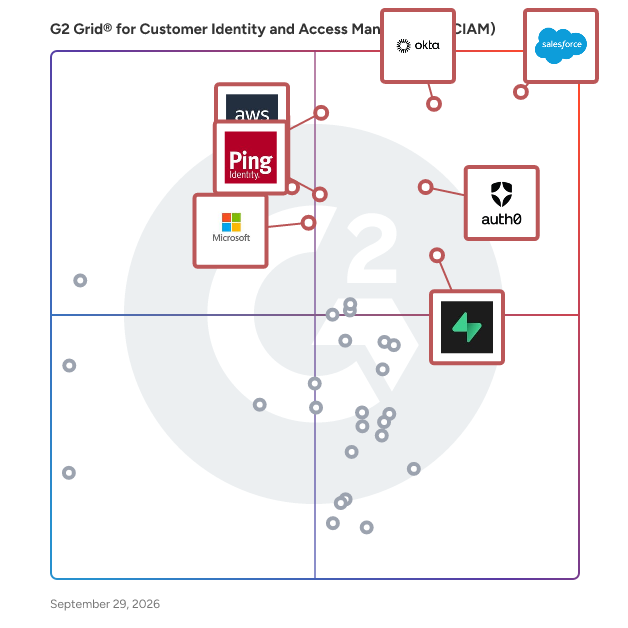
Customer identity and access management (CIAM) software enables businesses to manage customer identities, preferences, and profile information at scale, providing secure, seamless login experiences including self-registration, MFA, single sign-on (SSO), and social login, while maintaining compliance with data privacy laws such as GDPR and CCPA.
Core Capabilities of CIAM Software
To qualify for inclusion in the Customer Identity and Access Management (CIAM) category, a product must:
- Enable a seamless customer experience with self-registration and self-service functionality including account creation and preference management
- Verify user identity with authentication, which may include multi-factor authentication methods
- Enforce customer access to corporate services based on customer permissions
- Integrate with directories or other data stores that house customer data
- Scale to support a growing customer base
Common Use Cases for CIAM Software
Businesses use CIAM software to deliver user-friendly, secure digital experiences across websites and applications. Common use cases include:
- Enabling customer self-registration and profile management across web and mobile applications
- Implementing federated identity features such as SSO and social login to reduce authentication friction
- Managing customer consent and preferences to maintain compliance with GDPR, CCPA, and other data privacy regulations
How CIAM Software Differs from Other Tools
CIAM shares similarities with but differs fundamentally from identity and access management (IAM) software. IAM is designed for internal corporate use, managing identities of employees and contractors provisioned by IT staff, while CIAM is purpose-built for external, customer-focused identity management that allows customers to self-register and manage their own profiles.
Insights from G2 on CIAM Software
Based on category trends on G2, seamless SSO integration and scalable self-registration stand out as the most valued features. Improved customer login experiences and reduced identity-related support burden as primary outcomes of adoption.