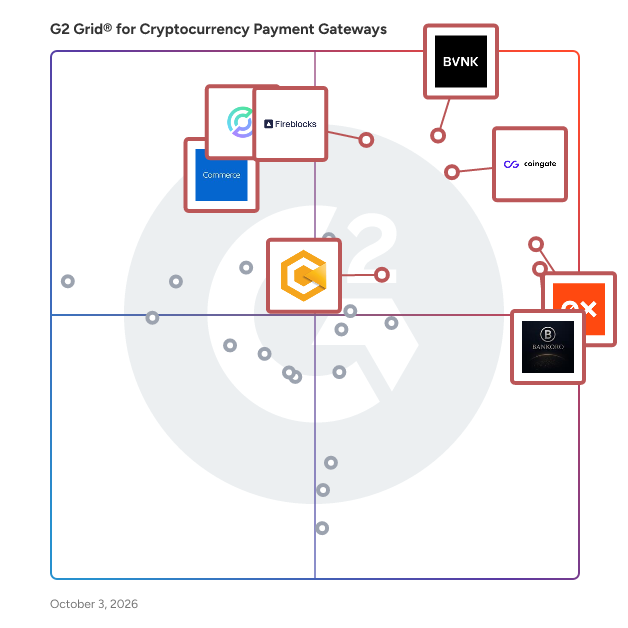
  # Best  Cryptocurrency Payment Gateways - Page 10

  *By [Brandon Summers-Miller](https://research.g2.com/insights/author/brandon-summers-miller)*

   Cryptocurrency payment gateways are software platforms that allow businesses to accept cryptocurrency payments for goods and services. They bridge traditional financial systems and decentralized digital currencies by enabling e-commerce websites, service providers, and other professionals to diversify payment options and cater to a broader audience.

Cryptocurrency payment gateways offer features like real-time transaction confirmation, automatic conversion to traditional currency, and high-grade security protocols to prevent potential fraud. These functions guarantee secure, quick, and reliable crypto payments or transfers. Some cryptocurrency payment gateways do not automatically transfer the cryptocurrency to fiat currency, so the merchant can hold the digital coins as long as they like, usually in a [cryptocurrency wallet](https://www.g2.com/categories/cryptocurrency-wallets).

Cryptocurrency payment gateways charge lower fees than traditional credit card payment systems and provide native dashboards to help track transactions. While these systems most commonly support Bitcoin payments, some gateways also support alternative cryptocurrencies, such as Ether (ETH), Litecoin (LTC), and Bitcoin Cash (BCH). Cryptocurrency payment gateways integrate with [e-commerce platforms](https://www.g2.com/categories/e-commerce-platforms), [point-of-sale systems](https://www.g2.com/categories/pos), [shopping cart software](https://www.g2.com/categories/shopping-cart), and [billing](https://www.g2.com/categories/billing).

To qualify for inclusion in the Cryptocurrency Payment Gateway category, a product must:

- Accept and process cryptocurrency payments
- Connect the transaction systems with e-commerce solutions
- Securely store the cryptocurrencies or exchange them into fiat currencies
- Encrypt the transaction information by utilizing blockchain technology


## How Many  Cryptocurrency Payment Gateways Products Does G2 Track?
**Total Products under this Category:** 180

### Category Stats (May 2026)
- **Average Rating**: 4.41/5
- **New Reviews This Quarter**: 38
- **Buyer Segments**: Mid-Market 45% │ Small-Business 42% │ Enterprise 13%
- **Top Trending Product**: zerohash (+0.417)
*Last updated: May 22, 2026*

  
## How Does G2 Rank  Cryptocurrency Payment Gateways Products?

**Why You Can Trust G2's Software Rankings:**

- 30 Analysts and Data Experts
- 700+ Authentic Reviews
- 180+ Products
- Unbiased Rankings

G2's software rankings are built on verified user reviews, rigorous moderation, and a consistent research methodology maintained by a team of analysts and data experts. Each product is measured using the same transparent criteria, with no paid placement or vendor influence. While reviews reflect real user experiences, which can be subjective, they offer valuable insight into how software performs in the hands of professionals. Together, these inputs power the G2 Score, a standardized way to compare tools within every category.

  
## Which  Cryptocurrency Payment Gateways Is Best for Your Use Case?

- **Leader:** [BVNK](https://www.g2.com/products/bvnk/reviews)
- **Highest Performer:** [Bankoro](https://www.g2.com/products/bankoro/reviews)
- **Easiest to Use:** [CoinGate](https://www.g2.com/products/coingate/reviews)
- **Top Trending:** [Cryptomus](https://www.g2.com/products/cryptomus/reviews)
- **Best Free Software:** [Confirmo](https://www.g2.com/products/confirmo/reviews)

  
---

**Sponsored**

### Bcon Global

Bcon Global is a non-custodial crypto payment gateway that allows businesses to accept cryptocurrency payments directly to their own wallets without intermediaries, account custody, or fund storage on the platform. The service supports the following blockchains: BTC, ETH, BNB, SOL, TRX, and stablecoins including USDT, USDC, USDS, and TUSD. This enables businesses to accept payments across major blockchain ecosystems and offer customers flexible payment options. Bcon Global uses a non-custodial payment model, where funds are transferred directly from the customer to the merchant’s wallet. The platform does not hold or process funds on behalf of the user. This eliminates counterparty risk and removes the need for withdrawals. Simple setup process Connection to Bcon Global does not require complex onboarding: The user specifies a wallet address This address is automatically used in generated payment invoices Customers send crypto directly to this address The merchant receives funds instantly, without intermediaries There is no KYC or KYB verification, which allows businesses to start accepting crypto payments immediately without submitting documents or waiting for approval. Integration and plugins Bcon Global provides multiple integration options: API for custom integrations (including dynamic address generation) Ready-to-use plugins for: WordPress (WooCommerce) OpenCart WHMCS These plugins allow businesses to quickly enable crypto payments without development effort. For custom use cases, the API supports automated invoice creation, payment tracking, and backend integration. Payment flow The payment process is straightforward: Customer selects crypto payment method at checkout Bcon generates an invoice with the merchant’s wallet address Customer sends payment in the selected cryptocurrency Funds are received directly by the merchant Payment status can be tracked via API or system notifications Fees and cost structure Bcon Global applies a 1% transaction fee, which is charged separately and transparently. There are: No hidden fees No withdrawal fees No custody fees Since funds go directly to the merchant’s wallet, there are no additional steps required to access or manage funds. Key advantages Non-custodial crypto payment gateway No KYC / KYB requirements Direct payments to merchant wallet Support for BTC, ETH, BNB, SOL, TRX Support for USDT, USDC, USDS, TUSD Ready plugins for WordPress, OpenCart, WHMCS API for automated crypto payment processing Transparent 1% fee Bcon Global is suitable for eCommerce websites, SaaS platforms, and online services that need a fast, simple, and non-custodial way to accept crypto payments without relying on centralized payment providers.


[Visit website](https://www.g2.com/external_clickthroughs/record?secure%5Bad_program%5D=ppc&amp;secure%5Bad_slot%5D=category_product_list&amp;secure%5Bcategory_id%5D=1228&amp;secure%5Bdisplayable_resource_id%5D=1228&amp;secure%5Bdisplayable_resource_type%5D=Category&amp;secure%5Bmedium%5D=sponsored&amp;secure%5Bplacement_reason%5D=page_category&amp;secure%5Bplacement_resource_ids%5D%5B%5D=1228&amp;secure%5Bprioritized%5D=false&amp;secure%5Bproduct_id%5D=1318285&amp;secure%5Bresource_id%5D=1228&amp;secure%5Bresource_type%5D=Category&amp;secure%5Bsource_type%5D=category_page&amp;secure%5Bsource_url%5D=https%3A%2F%2Fwww.g2.com%2Fcategories%2Fcryptocurrency-payment-gateways%3Fpage%3D6&amp;secure%5Btoken%5D=aabacade89203a9601210e7a824a838d48b02e8edfbb18c0ae0bb5d9e6376b1f&amp;secure%5Burl%5D=https%3A%2F%2Fwww.bcon.global%3Futm_source%3Dg2%26utm_medium%3Dcpc%26utm_campaign%3Dg2_ads%26utm_content%3Dprofile_link&amp;secure%5Burl_type%5D=custom_url)

---

  
    ## What Is  Cryptocurrency Payment Gateways?
  [Cryptocurrency Software](https://www.g2.com/categories/cryptocurrency)
  ## What Software Categories Are Similar to  Cryptocurrency Payment Gateways?
    - [Cryptocurrency Wallets](https://www.g2.com/categories/cryptocurrency-wallets)

  
---

## How Do You Choose the Right  Cryptocurrency Payment Gateways?

### What You Should Know About Cryptocurrency Payment Gateways

### What are cryptocurrency payment gateways?

Cryptocurrency payment gateways act as intermediaries between customers who want to make purchases in crypto and businesses accepting payments in crypto. They are widely used in industries like [e-commerce](https://www.g2.com/glossary/e-commerce-definition), freelancing, and online businesses.&amp;nbsp;

With cryptocurrency payment gateways, businesses tap into a growing market and offer customers an alternative payment method. These platforms empower businesses to think beyond the uncertainties of cryptocurrency and offer the necessary infrastructure to process transactions safely. They simplify how companies accept and manage cryptocurrency transactions while providing security and convenience for everyone involved.

### What are the common features of cryptocurrency payment gateways?

Some of the core features of cryptocurrency payment apps are given below.

- **Instant settlements:** Cryptocurrency payment platforms immediately settle transactions, converting the received cryptocurrency into fiat currency and transferring it to the business’s bank account.
- **Integration:** Cryptocurrency payment gateways offer [application programming interfaces (APIs)](https://www.g2.com/articles/what-is-an-api) and plugins to help businesses integrate crypto payment options into their websites and applications.
- **Regulatory compliance:** Cryptocurrency payment gateways typically have built-in compliance measures to adhere to [anti-money laundering (AML)](https://www.g2.com/glossary/anti-money-laundering-aml-definition) and know-your-customer (KYC) regulations. This helps businesses conform to the legal requirements.
- **Reporting and analytics:** Payment gateways often provide detailed reporting and analytics capabilities so businesses can track their transactions, sales, and other crucial data.
- **Security:** Crypto payment gateways employ comprehensive security measures to protect transactions and customer information. They use encryption, [secure sockets layer (SSL) certificates](https://www.g2.com/articles/ssl-certificate), and other security protocols to ensure the safety of funds and sensitive data. Additionally, businesses are protected from chargeback fraud.

### What types of cryptocurrency payment gateways exist?

Each type of gateway has its own advantages and functionality. The right choice for any use case will depend on individual requirements.

- **Direct payment gateways** let merchants accept cryptocurrency payments without needing an intermediary. Once the customers pay, the funds are transferred to the merchant&#39;s wallet directly.
- **Intermediary payment gateways** act as arbitrators between customers and merchants to facilitate cryptocurrency transactions. Depending on the merchant&#39;s preference, they may convert cryptocurrencies to fiat currency or vice versa.
- **Fiat and crypto gateways** support cryptocurrency and fiat currency transactions, allowing merchants to receive payments in either form.
- **Crypto-to-crypto gateways** only take care of transactions between different cryptocurrencies. They&#39;re typically used by people who operate entirely within the crypto ecosystem.
- **Centralized and decentralized payment gateways** need a trusted intermediary to process transactions, like most traditional financial systems. On the other side, decentralized gateways use blockchain&#39;s peer-to-peer design to process transactions between parties directly.
- **Single and multi-cryptocurrency gateways** only work with one type of cryptocurrency, typically Bitcoin. Multi-currency gateways support a range of cryptocurrencies, which benefits those operating in various crypto markets.
- **Custodial and non-custodial gateways** differ with regard to who has authority over funds. The service provider has control of the user&#39;s funds for custodial gateways. Non-custodial gateways allow users to have full control of their funds, adding an additional layer of security since they are not stored on the gateway.

### What are the benefits of cryptocurrency payment gateways?

Cryptocurrency payment gateways offer several benefits for businesses and customers alike.

- **Faster settlements:** Crypto payments are settled much faster than traditional banking system solutions, which often involve delays due to long processing periods and intermediaries. With cryptocurrency payment gateways, businesses receive funds quickly – sometimes within minutes – improving cash flow and liquidity.
- **Access to a wider customer base:** Businesses tap into a global customer base using cryptocurrency payment solutions. Companies can accept digital payments from customers anywhere in the world without the limitations of traditional banking systems or currency conversion issues.
- **Lower transaction fees:** Cryptocurrency transactions involve lower fees than traditional payment methods like credit cards or bank transfers. Since they can facilitate transactions at lower costs, they reduce the expenses associated with payment processing.
- **Privacy and anonymity:** Cryptocurrency payment processors offer clients increased privacy. Transactions conducted with cryptocurrencies typically don’t require customers to disclose sensitive personal information, which protects their privacy and reduces the risk of identity theft or data breaches.

### Cryptocurrency payment gateways vs. Traditional payment gateways

Both cryptocurrency and traditional [payment gateways](https://www.g2.com/categories/payment-gateways) are platforms that facilitate online transactions between merchants and customers. However, their underlying technology and the currency they operate with differ.

Traditional payment gateways use centralized financial systems, compared to cryptocurrency payment gateways that operate on a decentralized blockchain. The choice between the two depends on the target market, regulatory environment, and the level of risk tolerance.&amp;nbsp;

Cryptocurrency payment gateways come with benefits like lower processing fees and global accessibility but also bring challenges related to volatility and regulatory uncertainties. Traditional payment gateways provide a more regulated framework but may involve higher fees and longer transaction times.

### Who uses cryptocurrency payment gateways?

- **E-commerce businesses:** E-commerce businesses utilize crypto payment gateways to accept online payments. They offer a gateway with customizable payment buttons that reflect the business’s branding.
- **Freelancers:** Freelancers and consultants can use crypto payment platforms to receive client payments. Cryptocurrencies offer faster and more cost-effective cross-border payments, making them ideal for freelancers who work with international clients.
- **Brick-and-mortar stores:** Physical retail stores and businesses may use mobile applications or POS systems that integrate with the payment gateway so customers can pay with digital currencies in the store. They can also create [quick response (QR) codes](https://learn.g2.com/qr-code) with the help of these platforms.
- **Nonprofit organizations:** Crypto payment processors benefit nonprofit organizations that want to accept cryptocurrency donations. Besides making it easier for donors to contribute funds using digital currencies, it also provides increased transparency and peace of mind regarding transaction tracking.

### Cryptocurrency payment gateway pricing

The pricing and fees of cryptocurrency payment gateways vary per the service provider, but these associated costs are typical.

- **Transaction fees:** Most cryptocurrency payment gateways charge a small percentage of the transaction amount as a fee. This cost can range from 0.5% to 3% or higher. In some cases, there might be a fixed fee per transaction in addition to the percentage fee.
- **Integration cost:** Depending on the integrations needed for your existing systems, you might have to pay the associated costs to your service provider. The exact amount depends on your business&#39;s needs and setup.
- **Subscription fees:** Some payment gateway providers offer different subscription plans. Higher-tier plans usually include additional services or lower transaction fees.
- **Currency conversion/exchange fees:** If the payment gateway automatically converts cryptocurrencies to fiat, certain fees might apply to that process. The exchange rates can also affect the overall cost.
- **Setup fee:** Many service providers charge a one-time setup fee.&amp;nbsp;

### Software and services related to cryptocurrency payment gateways

Related solutions that can be used with cryptocurrency payment gateways include:

- [Retail POS systems](https://www.g2.com/categories/retail-pos) help businesses manage sales transactions and refine overall retail operations. A POS system includes a combination of hardware components like a cash register, barcode scanners, receipt printers, and software applications that handle sales, inventory management, and reporting.
- [Anti-money laundering (AML) software](https://www.g2.com/categories/anti-money-laundering), also known as AML compliance software, is designed to prevent, detect, and report potential money laundering activities and other financial crimes.
- [Cryptocurrency wallets](https://www.g2.com/categories/cryptocurrency-wallets), also known as crypto wallets, are software applications or physical devices that let users interact with, store, and manage their cryptocurrencies securely.
- [Cryptocurrency exchange platforms](https://www.g2.com/categories/cryptocurrency-exchanges) manage trading between buyers and sellers. It is the most common way for businesses to begin investing in cryptocurrencies.

### Challenges with cryptocurrency payment gateways

Software solutions come with their own set of challenges, despite their advantages.&amp;nbsp;

- **Anonymity:** The primary purpose of cryptocurrency is to preserve user anonymity by going around third parties like financial institutions and payment gateways. A cryptocurrency payment system is a third party that cryptocurrencies were designed to bypass.
- **Volatility:** Cryptocurrencies are known for frequent, often rapid, price fluctuations. Merchants who accept cryptocurrency payments may face challenges with managing volatility, as the value of the received cryptocurrencies may change quickly. This puts revenue calculations, profit margins, and financial stability at risk. However, certain products lock in the exchange rate applicable at the point of transaction.
- **User experience:** Cryptocurrency payment gateways may require users to go through more steps than traditional methods. Along with a basic comprehension of cryptocurrencies, users must understand how to create and manage wallets and perform transactions using wallet addresses. This additional complexity can impact the overall user experience and potentially deter some customers.

### How to choose the best cryptocurrency payment gateways

Some cryptocurrency payment tools offer advanced features, while some focus on security. Therefore, buyers should take their time researching their options before making a purchase decision.

The purchase process should begin with buyers defining their key requirements for the software product. After they decide which type of cryptocurrency will be supported, buyers have to consider security features, regulatory compliance, and vendor reputation.

#### Compare cryptocurrency payment gateway products

Buyers should create a long list containing every crypto payment tool they’re considering. Then they should refine the list. At this stage, buyers can eliminate products without nice-to-have features, like customizable payment buttons or QR codes.&amp;nbsp;

Buyers can compare different cryptocurrency payment solution vendors on [G2.com](https://www.g2.com/). Look for those with a good reputation in the market, essential features, and transparent pricing policies.

#### Conduct product demos

Buyers should test the cryptocurrency payment gateway products to ensure they work as advertised prior to finalizing a decision. Most software vendors offer free trials or demos. Ideally, users should try out the top five software options from the short list with the same use cases.

#### **Choose a selection team**

A selection team should assess how secure and reliable the product is and whether it will meet the company&#39;s specific needs. The team can include key stakeholders such as product managers, security professionals, and financial managers.

#### **Negotiate a deal**

Buyers shouldn’t be afraid to ask the software providers for additional discounts based on the seats they purchase. If there are certain features that the buyer may not use, they can ask the vendor if it&#39;s possible to receive additional discounts by removing them.

#### **Final decision**

After conducting demos and discussing them with the selection team, buyers should properly understand whether the crypto payment gateway software meets their requirements and performance criteria. If the selection team endorses the product, the buyer can proceed with the contracting process. If not, the buyer can return to the short list and test out more product options.

### Cryptocurrency payment gateway trends

- **Integration of non-fungible tokens (NFTs):** Several payment gateways have incorporated non-fungible tokens (NFTs) to match the increasing popularity. Merchants can accept payments for NFT purchases, expanding the range of goods and services processed using cryptocurrencies.
- **Integration with decentralized exchanges (DEXs):** Cryptocurrency payment gateway providers are exploring partnerships with decentralized exchanges (DEXs) to provide users with more ways to convert cryptocurrencies into fiat or other digital assets. Separate exchanges are unnecessary because the integration allows for real-time conversion and settlement.
- **Decentralized finance integration:** Integrating decentralized finance (DeFi) protocols and smart contract capabilities into cryptocurrency payment gateways is gaining traction. This makes it easier to handle more complex financial transactions directly within the payment gateway ecosystem.

_Researched and written by_ [_Amal Joby_](https://research.g2.com/insights/author/amal-joby)

_Reviewed and edited by_ [_Aisha West_](https://www.linkedin.com/in/westeawest?miniProfileUrn=urn%3Ali%3Afs_miniProfile%3AACoAADdYcxgBaQ5VRKS5lVVbTM6LJQQfEiASskU&amp;lipi=urn%3Ali%3Apage%3Ad_flagship3_search_srp_all%3B%2FUNVr1JDRL2lG3ASDYQJMg%3D%3D)


