Co-Bank+
Who Is the Company Behind Co-Bank+?
- Seller: TECNOSTAC SYSTEMS
- HQ Location: Cochin, IN
-
LinkedIn® Page: www.linkedin.com
44 employees on LinkedIn®
Total Products under this Category: 173
Last updated: September 29, 2026
Why You Can Trust G2's Software Rankings:
G2's software rankings are built on verified user reviews, rigorous moderation, and a consistent research methodology maintained by a team of analysts and data experts. Each product is measured using the same transparent criteria, with no paid placement or vendor influence. While reviews reflect real user experiences, which can be subjective, they offer valuable insight into how software performs in the hands of professionals. Together, these inputs power the G2 Score, a standardized way to compare tools within every category.
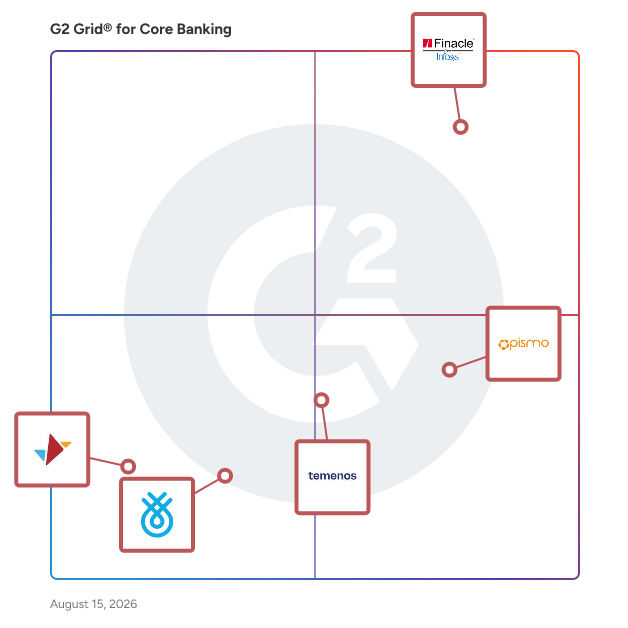
Highlighted products: Finacle, Pismo, Temenos Transact, Flinks, and Episys.
Underlying data: [Grid® JSON](https://www.g2.com/categories/core-banking/grids.json?focus%5B%5D=finacle&focus%5B%5D=pismo&focus%5B%5D=temenos-transact&focus%5B%5D=flinks&focus%5B%5D=episys)
Akkuro by Topicus is redefining banking for institutions building beyond today’s benchmark. Evolving from its composable banking foundations into Agentic Banking, Akkuro gives banks and fintechs the architecture, intelligence and control to transform financial services. Across lending, savings, investments, core banking and digital customer experience, Akkuro enables financial institutions to build, integrate and expand capabilities without disrupting what already works. Its modular, service-first and data-first architecture connects data, semantics, services, permissions and workflows, creating a bank-grade foundation for intelligent execution in regulated, real-world environments. Akkuro is more than a digital front end, a collection of modules or intelligence layered onto disconnected systems. It enables banks to assemble differentiated capabilities, automate and orchestrate complex processes, and act with context, control and auditability built in. The result is the agility to respond to evolving customer needs today while continuously expanding what the institution can deliver tomorrow. The next benchmark in banking will not be set by institutions that keep modernising at the edges. It will be set by those that rethink how the bank operates. Akkuro is built to enable exactly that. Learn more at www.akkuro.com
ConnectCore Direct Bank is a platform designed to help users manage everyday banking and retail transactions online.
Connect G2 to Claude or ChatGPT for answers grounded in G2's trusted reviews, comparisons, and pricing from real user insights.
Constantinople is an innovative software-as-a-service platform designed to transform banking operations by providing a comprehensive, cloud-native infrastructure. Established in 2022, it offers banks a fully managed service that encompasses customer experience, product infrastructure, operations, servicing, and compliance. By automating manual processes and embedding compliance obligations directly into its platform, Constantinople enables banks to focus on customer relationships and core banking activities, thereby reducing operational complexity and costs. Key Features and Functionality: - Comprehensive Banking Products: Supports a full suite of configurable banking products, including mobile apps, internet banking, transaction and savings accounts, payments, debit and credit cards, and various lending products, all branded under the client's name. - Operational Services: Provides essential operational services such as customer onboarding, Know Your Customer , Anti-Money Laundering , fraud management, payments and lending operations, loan origination and decisioning, regulatory reporting, and customer service. - Compliance Automation: Integrates compliance obligations, risk settings, and automated controls within the platform to ensure adherence to regulatory standards. - Cloud-Native Infrastructure: Hosts and manages banks' customers directly on its cloud-native infrastructure, eliminating the need for costly in-house systems. Primary Value and Problem Solved: Constantinople addresses the challenges banks face with outdated infrastructure, high operational costs, and complex regulatory compliance. By offering an all-in-one platform that automates operations and ensures compliance, it reduces the need for extensive in-house resources. This allows banks to concentrate on enhancing customer relationships and developing their core banking services, ultimately leading to improved efficiency and a more agile response to market demands.
Core Banking is a modular, cloud-native platform designed to serve as the high-performance back-bone for [Target: e.g., retail banks, neobanks, or credit unions]. Built on an API-first microservices architecture, it enables financial institutions to move away from legacy batch processing toward a Centralized
SaaS platform for payments, FX, compliance and client operations, with plug-and-play KYC, screening, monitoring and verification.
AOPAY BNexus is a Core Banking Software Solution that helps financial institutions manage key operations like account management, deposits, loans, payments, and real-time transaction processing through a unified, centralized system. It is designed for banks, neobanks, credit unions, and microfinance institutions seeking an efficient, secure platform for managing daily banking activities while ensuring compliance with regulatory standards. AOPAY BNexus streamlines core banking operations by providing a flexible, scalable system that supports both cloud-based and on-premise deployment. It integrates seamlessly with digital channels, fintech applications, and third-party services via open banking APIs to enhance functionality and automation. Key Features: - Centralized account management for deposits, loans, payments, and transactions. - Real-time transaction processing across multiple banking channels (mobile, web, ATM, etc.). - Configurable banking products for deposits, savings, loans, and credit services. - Open banking APIs for easy integration with fintech apps and external systems. - Compliance reporting tools to ensure regulatory adherence (KYC, AML, Basel, IFRS). Benefits: - Automates workflows for common banking processes such as onboarding, loan approval, and transaction handling. - Improves customer experience by enabling faster processing times and 24/7 access. - Enhances operational efficiency by reducing manual data entry and error-prone processes. - Scalable to accommodate the needs of growing financial institutions with increasing transaction volumes. - Flexible deployment options that meet different regulatory, security, and performance requirements. AOPAY BNexus serves as a comprehensive core banking solution for institutions aiming to modernize their banking systems, improve operational efficiency, and stay competitive in the evolving digital banking landscape. It provides a robust foundation for managing banking operations securely and efficiently, while empowering institutions to deliver better financial services to their customers.
Fintech Market's Loan Management System is an all-in-one loan origination and management tool for digital lenders, neobanks, and fintech companies looking to scale and optimize their lending business. Built with configurability and reliability in mind, the product serves 9 different lending verticals, from consumer and SME lending all the way to e-wallets. Its wide range of setup possibilities makes it an ideal loan servicing solution for meeting diverse requirements.
Corniche provides true multiple currency accounting with a uniform back-office interface, merchant and card services, payment interfaces and powerful Corniche on-line banking facilities.
AOPAY Credit Cooperative Society Software Solution is a type of financial management software solution that helps credit cooperative societies manage member accounts, deposits, loans, repayments, accounting, and regulatory compliance in a centralized system. The software is designed for cooperative society administrators, managers, accountants, and operational staff to support daily financial activities while maintaining transparency and accuracy. It falls under the broader category of Financial Services / Core Banking or Loan Management Software and is commonly used by urban and rural credit cooperative societies. The primary use cases of Credit Cooperative Society Software include member onboarding, savings and deposit management, loan processing, interest calculation, repayment tracking, and statutory reporting. By digitizing cooperative operations, the software reduces manual processes, improves data accuracy, and supports compliance with cooperative society regulations. Key features and capabilities include: - Member Management: Maintain detailed member profiles, share records, account balances, and transaction histories. - Deposit Management: Manage savings accounts, fixed deposits, recurring deposits, and automated interest calculations. - Loan Management: Process loan applications, generate EMI schedules, track repayments, and monitor overdue accounts. - Accounting & Finance: Automate bookkeeping, manage ledgers, and generate financial statements and balance sheets. Compliance & Reporting: Produce audit-ready reports, statutory filings, and regulatory documentation required by authorities. Credit Cooperative Society Software Solution enables cooperative institutions to streamline financial and member operations, improve operational efficiency, reduce manual errors, and maintain regulatory compliance. The centralized platform supports better financial visibility, accurate reporting, and scalable growth for cooperative societies while ensuring secure management of member funds and lending activities.
CreditLive is a digital credit management platform designed to help businesses easily manage customer credit, track outstanding payments, and maintain transaction records in one place. With CreditLive, businesses can simplify their credit management process, improve visibility into customer accounts, reduce manual record-keeping, and stay organized with a centralized digital solution.
CSI's Digital Banking Solutions offer financial institutions a comprehensive suite of integrated technologies designed to enhance customer engagement and streamline banking operations. By providing seamless access across various devices, these solutions ensure that customers can manage their finances anytime, anywhere, thereby meeting the evolving expectations of today's digital-savvy consumers. Key Features and Functionality: - Seamless Core Banking Integration: Ensures smooth operation across all banking channels, providing a unified experience for both customers and staff. - Parity Across Channels: Delivers consistent functionality and user experience, whether accessed via web, mobile, or other digital platforms. - Customer-Centric Designs and Tools: Incorporates intuitive interfaces and features tailored to enhance user satisfaction and engagement. - Industry-Leading Security and Risk Management: Implements advanced security measures, including biometric authentication and fraud detection, to protect customer data and transactions. - Digital Account Opening: Facilitates a streamlined onboarding process, allowing new customers to open and fund accounts digitally with ease. - Online and Mobile Banking: Provides a comprehensive digital banking platform that includes bill payment, fund transfers, and personal financial management tools. - Live Chat and Video Collaboration: Offers real-time customer support through chat and video features, enhancing the personalized service experience. - Digital Payments: Supports various payment methods, including P2P payments, same-day ACH, and wire transfers, catering to diverse customer needs. - Business Banking Tools: Equips business customers with services like merchant solutions and invoicing, aiding in efficient financial management. - Digital Targeted Ads: Utilizes transaction data to deliver relevant marketing messages within the digital banking platform, boosting engagement and cross-selling opportunities. Primary Value and Solutions Provided: CSI's Digital Banking Solutions empower financial institutions to stay competitive in a rapidly evolving digital landscape by offering a robust, secure, and user-friendly platform. These solutions address the critical need for banks to provide seamless digital experiences that attract and retain customers, enhance operational efficiency, and ensure compliance with industry standards. By integrating advanced technologies and customer-focused features, CSI enables banks to meet the demands of modern banking while fostering growth and customer loyalty.
CSI Meridian is a comprehensive transportation management software developed by Computer Support, Inc. (CSI) to streamline and enhance the operations of trucking companies. Established in 1990 and headquartered in south-central Pennsylvania—a pivotal region for the trucking industry—CSI has leveraged its deep understanding of transportation logistics to create a solution that addresses the multifaceted needs of the sector. Key Features and Functionality: - Dispatching: Facilitates efficient load assignment, route optimization, and real-time tracking, ensuring timely deliveries and optimal resource utilization. - Accounting: Integrates accounts receivable, accounts payable, payroll, and general ledger functionalities, providing a unified platform for financial management. - Shop Maintenance: Manages vehicle maintenance schedules, inventory processing, and repair tracking, promoting fleet reliability and longevity. - Customer & Carrier Web Portals: Offers online platforms for customers and carriers to tender, track, and manage loads, enhancing transparency and communication. - Driver Settlement: Automates driver payment processes, accommodating various compensation structures and ensuring accurate and timely settlements. - Freight Billing: Streamlines the billing process with flexible rating options and electronic transmittal capabilities, reducing administrative overhead. - IFTA Reporting: Generates fuel tax reports automatically from dispatching and billing workflows, simplifying compliance with regulatory requirements. - Safety & Accident Reporting: Tracks driver violations, manages drug testing records, and facilitates incident reporting, promoting a culture of safety. - Warehouse Management: Coordinates warehouse operations with trucking activities, optimizing storage and distribution processes. Primary Value and Solutions Provided: CSI Meridian delivers a fully integrated business management system tailored for the trucking industry. By consolidating critical functions such as dispatching, accounting, vehicle maintenance, and customer relations into a single platform, it eliminates the need for disparate systems, thereby reducing errors and improving operational efficiency. The software's flexibility allows for customization to meet the unique requirements of each trucking company, regardless of size or specialization. With user-friendly interfaces and comprehensive reporting tools, CSI Meridian empowers transportation businesses to make informed decisions, enhance customer satisfaction, and achieve sustainable growth.
DFNS is a core banking platform for digital assets. It gives banks, fintechs, and enterprises the infrastructure to run financial operations and build products onchain, provisioning wallets, securing keys, governing transactions, and servicing tokenized assets across blockchains, the way a traditional core banking system underpins accounts, payments, and ledgers in conventional finance. The platform addresses a structural gap. The core systems financial institutions run today were not built for assets that settle in seconds, on public networks, with cryptographic ownership. Rather than replacing an organization's existing core banking system, hardware security modules, or compliance stack, DFNS provides the layer that lets those systems operate onchain. It is delivered as composable modules through one REST API and SDKs, so an organization can adopt a single capability or the full platform, and it connects to more than 100 blockchains and third party services through a single integration surface. Over 500 institutional and fintech clients run on DFNS, including Standard Chartered, First Abu Dhabi Bank, IBM, Stripe, Circle, Thunes, and Broadridge. Roughly 1% of all global stablecoin payment volume settles through the platform. DFNS is used across digital asset custody, banking, embedded wallets, stablecoin payments, trading operations, tokenization, and treasury and asset management. The platform is organized into modules, including: 1. Wallet-as-a-Service — create, index, and manage wallets across 100+ blockchains and third party services, as one account layer for custody, payments, trading, treasury, and tokenization. 2. Transaction Management — format, approve, decode, simulate, sign, broadcast, and track transactions at scale, built for high volume flows and complex approval logic. 3. Treasury Management and Tokenization Engine — manage onchain treasury across entities, currencies, and networks, and issue and service tokenized assets across their full lifecycle. 4. Policy Engine and Governance Engine — enforce limits, allowlists, quorums, roles, and ABI aware approvals before every signature, and cryptographically verify every intent, policy, and signature against a state the customer controls, deployed within their own perimeter. 5. Key Management — run keys across MPC, HSM, TEE, or BYOK models, with production grade protocols built for resilience, scale, and no single point of failure. A defining characteristic is that authentication and transaction signing are handled as separate functions, and policies are evaluated before any signature is produced, giving organizations programmable control over who can move which assets, under what conditions. Keys are operated so that a complete private key is never assembled in one place. DFNS can be deployed as managed SaaS, hybrid, or fully on premises. The deployment model changes while the modules and controls stay the same, allowing key material and infrastructure to be placed according to regulatory and operational requirements. It integrates with existing systems including core banking platforms, custody and compliance tooling, and payment rails, and organizations typically adopt it to add digital asset capabilities to existing products, to meet requirements under frameworks such as GENIUS, MiCAR, and DORA, or to consolidate wallet, transaction, governance, and settlement operations onto one platform.
Average Rating: 4.7/5.0
Total Reviews: 52
AI-generated summary from verified user reviews
"Scaling with Confidence Using DFNS"
Rating: 5.0/5.0 stars
— Jordan P.
"Highly Customizable, Friendly UX with Responsive Support and Flat-Fee Pricing"
Rating: 5.0/5.0 stars
— Ganesh M.
