Artificial Intelligence Software Resources - Page 28
Articles, Glossary Terms, and Discussions to expand your knowledge on Artificial Intelligence Software
Resource pages are designed to give you a cross-section of information we have on specific categories. You'll find articles from our experts, feature definitions, and discussions from users like you.
Artificial Intelligence Software Articles
I Compared the 7 Best Machine Translation Software (2027)
What Is Machine Learning? How It Works and What It Is For
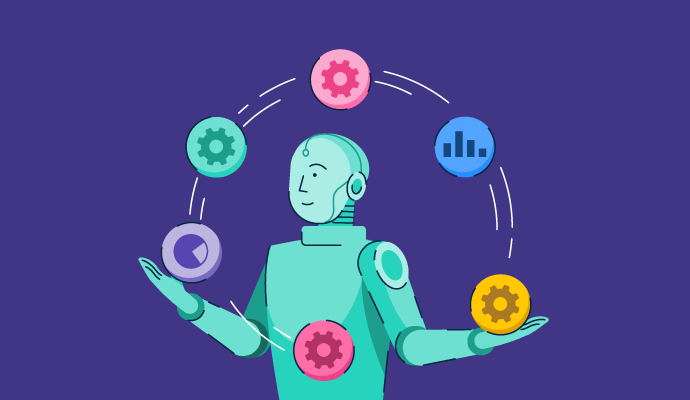
20 Revolutionary AI Applications in 2025: Real-World Examples

What Is Image Annotation? Types, Use Cases and More
10 Best Data Labeling Software With G2 User Reviews
AI In Music: Benefits, Challenges, and Tools for Musicians
Brief History of Artificial Intelligence - From 1900 till Now
What Is Artificial Intelligence (AI)? Types, Definition And Examples
What Is TinyML? A Brief Introduction And Benefits
History Of Computers: Timeline, I/O Devices and Networking
AI Image Generation: The Science Behind How It Works
The Rise of AI-Generated Art: From Algorithms to Aesthetics
What Is Artificial General Intelligence (AGI)? The Future Is Here
Mastering ChatGPT: Behrang Asadi on the Growing Effect of Generative AI
Top Digital Transformation Trends in 2021
Innovation in Artificial Intelligence [INFOGRAPHIC]
When Platforms Collide, Analytics Evolves
Tech Companies Bridging the Gap Between AI and Automation
The Industry Impact of AI Regulations in the EU
The Things Have Eyes: An Introduction to IoT
The Data Toolbox: The Expanding Domain of AI & Analytics
CX Tech: Artificial and Intelligent
G2 on Enterprise AI & Analytics: What is It Really & Why Does It Matter?
AI in Retail: How It’s Being Used (+ 4 Brand Examples)
Embedded AI: Embedded Systems Trends for 2019
Artificial Intelligence Software Glossary Terms

Artificial Intelligence Software Discussions
Thirty minutes is an aggressive bar because most platforms in this category are built for ongoing design and automation, not a fast win. But for an engineer evaluating tools, the question of how quickly they can go from zero to a working workflow matters a lot, especially before committing to a more complex and expensive enterprise rollout.
Looking across G2's AI Orchestration category, the builder interfaces most often praised by engineers specifically for fast ramp-up are Automation Anywhere Agentic Process Automation, Workato, and Zapier.
Here's a closer look at five worth comparing:
- Automation Anywhere Agentic Process Automation (4.5/5, 80+ reviews): Many of the reviewers are RPA developers and software engineers, who consistently point to the intuitive drag-and-drop interface as making bot-building genuinely fast to pick up, even before touching its more advanced layers.
- Workato (4.7/5, 20+ reviews): Its model of triggers and actions is frequently described by engineers as quick to catch-on, and the low-code interface gets automation running fast even though the platform has more depth to learn over time.
- Zapier (4.5/5, 60+ reviews): The visual editor is built for a fast first go, and while its core users are less technical, engineers evaluating it consistently cite the same near-zero ramp-up time as its main draw.
- Kore.AI (4.6/5, 50+ reviews): Reviewers describe configuration as effortless and the builder as beginner-friendly, though some note the learning curve grows once you move past basic bot flows into more advanced versions.
- UiPath Agentic Automation (4.6/5, 220+ reviews): Engineers and RPA developers make up its top users and generally praise ease of use for integrating and automating tasks.
Looking for input from G2 reviewers and content teams, product designers, and marketing professionals in the AI Avatar Generators category, specifically from those who use AI avatars as a recurring part of their production workflow rather than a one-off experiment, and can speak to which platform has earned genuine operational trust rather than just producing impressive demo outputs.
The platforms with the strongest content team and designer trust evidence:
- HeyGen: The ability to turn a written script into a finished, presenter-led video in minutes is described as the production transformation that makes HeyGen a daily content team tool rather than an occasional experiment. Product designers and content teams producing multilingual content credit the 175+ language localisation for enabling the same avatar to deliver the same script in multiple markets simultaneously without re-recording.
- Synthesia: HR teams, L&D managers, and internal communications professionals describe building and updating training videos in hours rather than weeks by replacing on-camera recording with avatar-presented scripts. The brand kit feature allows content teams to embed company logo, colours, and fonts consistently across all avatar videos.
- D-ID: The API-first architecture is the trust signal for product designers and development teams who need to embed talking avatar generation directly into their applications, products, or workflows rather than using a standalone video creation interface. Product teams building customer-facing digital assistants, interactive explainer videos, and personalised video experiences credit D-ID's API for enabling programmatic avatar generation at scale without manual video production.
- Colossyan: Corporate training and learning content with branching scenarios is the trust model for L&D content teams whose training requirements extend beyond linear video to interactive learning experiences.
- Runway: AI video generation with avatar and character consistency across frames is described as the trust model for creative teams whose output requires the highest fidelity visual storytelling, narrative content, brand films, and product demonstrations where avatar realism and cinematic quality are the primary standards. The creative control over motion, expression, and environment is credited for producing outputs that content teams can use for premium brand contexts.
For content teams that have integrated AI avatar generation into a recurring production workflow: How many avatar videos per week are you now producing compared to before, and what was the specific production step that the platform most directly eliminated from your previous process?
HeyGen turning a script into a finished presenter-led video in minutes is what makes it a daily tool instead of an occasional experiment. The 175+ language localization is genuinely useful for anyone producing the same content across markets.
I'm researching AI orchestration tools and one distinction that matters a lot in this category is the difference between platforms built for engineering teams and those built so a non-technical user can build a working automation without coding.
Looking across G2's AI Orchestration category, the tools that come up most for the no-code, non-engineer use case are Zapier, Workato, and IBM watsonx Orchestrate.
Here's a closer look at five worth comparing:
- Zapier (4.5/5, 60+ reviews): Explicitly built as a no-code platform "for businesses that want to grow faster... without relying on development teams," with a visual editor for building automations in a few clicks — reviewers most often cite it as removing the need for technical skills entirely.
- Workato (4.7/5, 20+ reviews): A low-code/no-code interface that reviewers say enables "quick automation without needing technical expertise," with 14,000+ pre-built connectors that reduce how much manual configuration a non-engineer has to do.
- IBM watsonx Orchestrate (4.4/5, 40+ reviews): Includes a low-code agent builder specifically designed for "everyday business users as well as professional developers," letting non-technical users create and deploy AI agents alongside more advanced pro-code options for IT.
- Automation Anywhere Agentic Process Automation (4.5/5, 80+ reviews): Its AI Agent Studio is a low-code workspace for building agents, and reviewers specifically mention it as "enabling non-coders to effortlessly build bots"
- UiPath Agentic Automation (4.6/5, 220+ reviews): Widely adopted with low-code capabilities designed for both technical and non-technical users.


![Innovation in Artificial Intelligence [INFOGRAPHIC] Innovation in Artificial Intelligence [INFOGRAPHIC]](https://learn.g2.com/hubfs/Marketing%20Automation-1.png)