QualityAI
Who Is the Company Behind QualityAI?
- Seller: QualityAI
- Year Founded: 1997
- HQ Location: London, GB
-
LinkedIn® Page: www.linkedin.com
5,439 employees on LinkedIn®
Total Products under this Category: 268
Last updated: September 15, 2026
Why You Can Trust G2's Software Rankings:
G2's software rankings are built on verified user reviews, rigorous moderation, and a consistent research methodology maintained by a team of analysts and data experts. Each product is measured using the same transparent criteria, with no paid placement or vendor influence. While reviews reflect real user experiences, which can be subjective, they offer valuable insight into how software performs in the hands of professionals. Together, these inputs power the G2 Score, a standardized way to compare tools within every category.
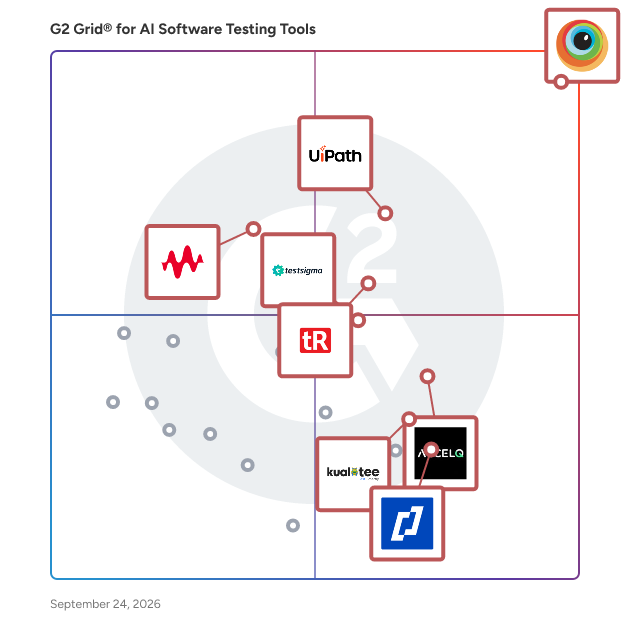
Highlighted products: BrowserStack, UiPath Agentic Automation, testRigor, ACCELQ, Testsigma, Keysight Eggplant, Kualitee, and Thunders.
Underlying data: [Grid® JSON](https://www.g2.com/categories/ai-software-testing-tools/grids.json?focus%5B%5D=browserstack&focus%5B%5D=uipath-agentic-automation&focus%5B%5D=testrigor&focus%5B%5D=accelq&focus%5B%5D=testsigma&focus%5B%5D=keysight-eggplant&focus%5B%5D=kualitee&focus%5B%5D=thunders)
QuarkIQL was a platform designed to streamline the testing of computer vision APIs by enabling users to generate custom images and API requests with ease. Leveraging advanced image diffusion models, it allowed developers to create specific test images by simply inputting descriptive prompts. The platform supported various HTTP methods, including GET and POST, facilitating comprehensive API testing. Additionally, QuarkIQL maintained a log of user queries, enabling efficient tracking and repetition of experiments without starting anew. This suite of features aimed to simplify the development and testing process for computer vision applications.
Ranger builds tools to help you move fast. We think software teams should spend more time building and less time finding bugs.
ReAPI is an AI-powered platform designed to streamline API documentation, debugging, and testing processes. By integrating user-friendly tools with advanced AI capabilities, ReAPI enhances collaboration among development teams and accelerates API development cycles. Key Features and Functionality: - Visual Editor for API Documentation: ReAPI offers an intuitive visual editor that simplifies the creation and maintenance of API documentation, eliminating the need for complex YAML editing. - AI-Enhanced Schema Generation: Utilizing AI, ReAPI can generate comprehensive JSON schemas from example data, complete with meaningful descriptions and format specifications, streamlining the documentation process. - No-Code API Testing Platform: The platform provides a no-code environment for creating and managing API tests, enabling both technical and non-technical team members to design and execute tests without writing code. - Integrated Debugging Tools: ReAPI includes sophisticated debugging features that allow developers to edit and debug test cases directly in the browser, enhancing efficiency and reducing development time. - Mocking Services: The platform offers robust mocking services, allowing developers to simulate API responses and behaviors without needing access to actual backend services, facilitating testing in various scenarios. Primary Value and Problem Solved: ReAPI addresses common challenges in API development by providing a comprehensive suite of tools that enhance efficiency, collaboration, and accuracy. By offering a user-friendly visual editor, AI-powered schema generation, and a no-code testing environment, ReAPI reduces the complexity and time required for API documentation and testing. Its integrated debugging and mocking services further streamline the development process, enabling teams to identify and resolve issues promptly. Overall, ReAPI empowers development teams to produce high-quality APIs with greater speed and consistency.
Regresco is managed regression testing for B2B SaaS teams shipping weekly without a dedicated QA hire. Point it at your staging URL and it drafts test flows from your real site, runs them in the cloud, and classifies every failure as a real regression, a flaky test, or a broken locator. Broken selectors auto-heal at runtime, so tests do not rot the way hand-written suites do.
Regression Games is an AI agent platform designed to enhance the Unity game development environment. It enables developers to create and integrate intelligent bots for various applications, including quality assurance (QA) testing, non-player characters (NPCs), multiplayer scenarios, and game balancing. By automating these processes, Regression Games aims to streamline game development workflows and improve overall game quality. Key Features and Functionality: - Bot Development for Unity: Facilitates the creation of AI-driven bots tailored for Unity-based games. - Quality Assurance Testing: Automates QA processes, allowing for efficient identification and resolution of game issues. - NPC Integration: Enables the development of intelligent NPCs that enhance gameplay dynamics. - Multiplayer Support: Provides tools to implement and test multiplayer functionalities effectively. - Game Balancing: Assists in fine-tuning game mechanics to ensure a balanced and engaging player experience. Primary Value and User Solutions: Regression Games addresses the challenges of manual testing and NPC development in game creation. By offering an AI-driven platform, it reduces the time and resources required for QA testing and NPC integration. This leads to faster development cycles, improved game performance, and a more immersive gaming experience for players. Developers benefit from streamlined workflows and the ability to focus on creative aspects of game design, knowing that the technical elements are efficiently managed.
RelicX is an AI-powered, no-code software testing platform that streamlines the creation and execution of end-to-end tests. By leveraging Generative AI, it enables users to author tests quickly without the need for coding, making it accessible to both technical and non-technical users. The platform's AI-driven features enhance test quality through automated assertions and visual validation, ensuring comprehensive coverage and reliability. One of RelicX's standout features is its self-healing capability, where tests adapt to UI and workflow changes, significantly reducing maintenance efforts. Additionally, RelicX offers session replay functionality, allowing teams to diagnose and resolve issues by observing real user interactions. Its seamless integration into existing CI/CD pipelines facilitates efficient test execution and supports automated deployment decisions, enhancing overall software quality assurance processes. Key Features: - No-Code Test Authoring: Create tests rapidly without writing code. - AI-Driven Test Case Generation: Automatically generate test cases based on application behavior. - Self-Healing Tests: Adapt to UI and workflow changes to minimize maintenance. - Visual Regression Testing: Detect UI issues automatically to ensure a consistent user experience. - Session Replay: Observe real user interactions to diagnose and resolve issues efficiently. - CI/CD Integration: Seamlessly incorporate into existing pipelines for streamlined test execution. Primary Value: RelicX addresses the challenges of traditional software testing by automating and simplifying the test creation and maintenance process. Its AI-driven, no-code approach reduces the time and effort required for test development, making it accessible to a broader range of users. The platform's self-healing and visual validation features ensure that tests remain reliable and up-to-date, even as applications evolve. By integrating seamlessly with CI/CD pipelines, RelicX enhances the efficiency of software development cycles, enabling teams to deliver high-quality software faster and more reliably.
Relling Systems is a pioneering company dedicated to transforming hardware testing and validation processes to accelerate innovation. Recognizing that traditional hardware testing methodologies are often outdated and inefficient, Relling Systems aims to modernize these processes by integrating continuous testing frameworks that align with contemporary software development practices. This approach not only streamlines validation but also enhances the overall efficiency and reliability of hardware development. Key Features and Functionality: - Standardized Testing Infrastructure: Relling Systems advocates for modular and interoperable test setups, reducing setup times and allowing engineers to focus on innovation rather than troubleshooting test configurations. - Automated and Reproducible Testing: By adopting principles from modern software development, Relling Systems ensures that test configurations are code-based, making them reproducible, shareable, and less prone to human error. - Continuous Field Testing: Their solutions enable hardware to self-evaluate performance throughout its lifecycle, transforming testing from a discrete phase into an ongoing process that extends into deployment. Primary Value and User Solutions: Relling Systems addresses the critical bottleneck in hardware innovation caused by outdated testing infrastructures. By providing modern, automated, and continuous testing solutions, they help engineers and companies: - Accelerate design cycles by reducing the time spent on manual testing and validation. - Enhance product reliability through consistent and reproducible testing methodologies. - Focus on core engineering tasks by minimizing the complexities associated with traditional test setups. In essence, Relling Systems empowers hardware developers to innovate more rapidly and efficiently by revolutionizing the testing and validation landscape.
ReportGenerator is a tool designed to convert code coverage data from various formats into readable reports, facilitating the analysis and visualization of code coverage metrics. It supports multiple input formats, including OpenCover, Cobertura, and JaCoCo, and generates reports in diverse formats such as HTML, XML, and Markdown. Key features include detailed class-level reports, branch coverage visualization, and historical coverage trend analysis. By providing clear insights into code coverage, ReportGenerator helps developers identify untested code sections, monitor testing progress over time, and enhance overall code quality.
Rock Smith is an AI-powered black box QA testing platform designed to automate web application testing by simulating real user interactions. Unlike traditional testing tools that rely on brittle selectors, Rock Smith's AI agents visually understand applications, enabling them to adapt to UI changes without manual intervention. This approach reduces maintenance efforts and eliminates flaky tests, allowing engineering teams to focus on development rather than debugging. Key Features and Functionality: - Edge Case Generation: Automatically generates 14 types of test scenarios, including boundary values, invalid inputs, and security tests like XSS and SQL injection, ensuring comprehensive coverage. - Test Personas: Simulates diverse user behaviors with configurable personas, from tech-savvy power users to first-time visitors, to uncover issues specific to different user groups. - Local Browser Execution: Executes tests locally via a desktop application, ensuring sensitive data remains on the user's machine, which is ideal for testing internal and staging environments securely. - Semantic Targeting: Identifies elements by visual description rather than fragile selectors, allowing tests to self-heal when the UI changes. - Real-time Execution: Provides live test execution with step-by-step screenshots and AI reasoning for each action, offering complete visibility into the testing process. - Visual Intelligence: AI agents perceive the application as users do, understanding buttons, forms, and modals by their appearance, enhancing the accuracy of test interactions. Primary Value and Problem Solved: Rock Smith addresses the challenges of traditional QA testing by automating the process with AI agents that adapt to UI changes, reducing the need for manual test maintenance. This leads to faster release cycles, improved test coverage, and more reliable applications, enabling teams to ship products more efficiently without compromising quality.
